What Is the TCPA? A Plain-English Guide to the Telephone Consumer Protection Act
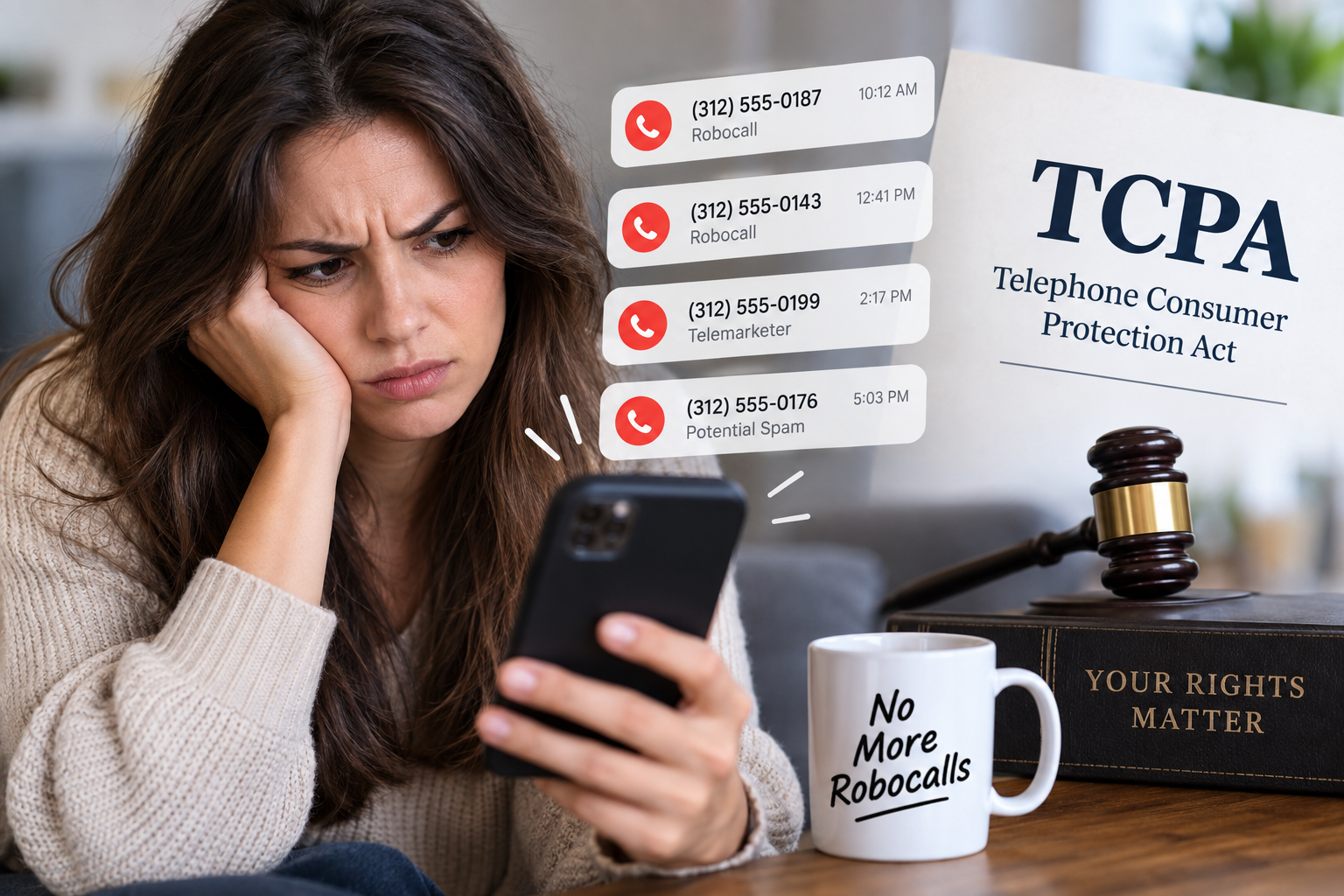
Your phone buzzes for the fourth time today. Same area code as yours. You pick up and it’s a recorded voice trying to sell you an extended car warranty on a car you don’t own. You hang up, block the number, and three hours later a different number calls with the same script.
That feeling of being hunted by your own phone has a name in federal law. It’s called a Telephone Consumer Protection Act violation, and it can be worth real money to the person on the receiving end.
The TCPA is one of the most active consumer protection laws in the country. It’s also one of the most misunderstood. This guide walks through what the law actually does, what counts as a violation, who can be sued, and what the penalties look like. By the end you’ll know more about the TCPA than most of the telemarketers calling you.
What Does TCPA Stand For?
TCPA stands for the Telephone Consumer Protection Act. Congress passed it in 1991 and it’s codified at 47 U.S.C. section 227. The Federal Communications Commission, known as the FCC, writes the rules that put the statute into practice, and those rules live at 47 C.F.R. section 64.1200. The Federal Trade Commission, or FTC, runs a related set of rules called the Telemarketing Sales Rule.
The law has been amended several times over the years, and federal courts have shaped it through thousands of decisions. The version we live with today is a mix of the original 1991 statute, FCC orders, and case law. That’s why the same phone call can be perfectly legal in one situation and a four-figure violation in another.
Why Congress Created the TCPA
In the late 1980s, computer-driven autodialers and prerecorded sales calls exploded. People came home to answering machines full of robocalls. Hospitals and emergency lines got tied up by automated systems calling random numbers in sequence. Congress held hearings, listened to angry voters, and passed the TCPA to draw some lines.
The core idea is simple. Your phone is your private property, and someone who wants to use it to sell you something or collect a debt needs your permission first. Everything else in the law builds on that one principle.
What the TCPA Covers
The statute restricts several specific things. Knowing what’s actually covered matters because the law doesn’t ban every annoying call. The TCPA generally restricts:
- Calls made using an automatic telephone dialing system, often called an autodialer
- Calls or texts using an artificial or prerecorded voice
- Calls to mobile phones without proper consent
- Unsolicited fax advertisements
- Calls placed before 8 a.m. or after 9 p.m. in the recipient’s local time zone
- Calls to numbers on the National Do Not Call Registry
- Calls that don’t honor a request to stop
Each one of those items has its own rulebook underneath it. The autodialer rules alone have been the subject of a Supreme Court case. The consent rules have been rewritten by the FCC more than once. The Do Not Call rules have their own enforcement structure.
What the TCPA Does Not Cover
This is where a lot of confusion sits. The TCPA is not a general “no spam” law. Several types of calls and texts fall outside its main protections.
Calls from a live human being to a residential landline, without an autodialer or prerecorded message, are mostly outside the TCPA’s autodialer rules. They may still violate the Do Not Call Registry rules if your number is registered. Calls for purely informational purposes from someone you have an existing business relationship with often qualify for an exemption. Calls from political campaigns to landlines, calls from nonprofit charities, and certain healthcare-related calls have their own carve-outs.
The law also doesn’t reach scammers in other countries who ignore U.S. law entirely. That’s a real limit. A consumer in Ohio can sue a telemarketer in Florida far more easily than they can collect from a call center overseas.
TCPA Consent in Plain English
Consent is the heart of the law. If a business has the right kind of consent, the call is legal. If it doesn’t, the call can be a violation. There are two main types of consent under the TCPA.
Prior express consent is the lower bar. It applies to informational calls, like an appointment reminder from a dentist or a fraud alert from a bank. Giving the company your number for that purpose usually counts.
Prior express written consent is the higher bar. It applies to telemarketing or advertising calls and texts made with an autodialer or prerecorded voice. The consumer has to sign a written agreement that clearly says they’re agreeing to receive marketing calls or texts, identifies the seller by name, and makes clear that consent is not required as a condition of buying anything.
A Hypothetical: Marcus and the Pre-Checked Box
Say a guy named Marcus signs up for a free trial of a fitness app. The signup page has a pre-checked box that says “Send me promotional texts and calls about gym partners and supplements from our affiliates.” Marcus doesn’t notice. The next week he starts getting four texts a day from companies he’s never heard of.
Whether that counts as valid written consent depends on a lot of details. Was the box pre-checked? Did it clearly identify each affiliate by name? Did it say Marcus could buy the fitness app without agreeing? Did Marcus actually sign anything, or just keep scrolling? Cases like Marcus’s are the bread and butter of TCPA litigation.
How Autodialer Rules Work After Facebook v. Duguid
For years, the biggest fight in TCPA law was over what counts as an autodialer. Plaintiffs argued the term was broad and covered almost any modern dialing system. Defendants argued it only meant equipment that generates random or sequential numbers.
In 2021, the U.S. Supreme Court sided with the defendants in a case called Facebook, Inc. v. Duguid. The Court held that to be an autodialer under the TCPA, equipment must have the capacity to use a random or sequential number generator to either store or produce telephone numbers. Most modern marketing dialers don’t do that. They call from lists of real numbers.
That ruling narrowed the autodialer claim significantly. But it didn’t end TCPA litigation. The prerecorded voice rules, the Do Not Call rules, and the consent rules all still apply on their own. A call that uses a recorded voice is still covered even if the dialer technically wouldn’t qualify as an autodialer.
What Is a TCPA Violation Worth?
This is the part that gets people’s attention. The TCPA provides statutory damages, which means a consumer can recover a set amount per violation without proving any actual harm.
$500 per violation is the standard statutory amount. If a court finds the violation was knowing or willful, that figure can be tripled to $1,500 per violation. Each call or text can count separately.
A Hypothetical: Rosa and the Solar Company
Imagine a person named Rosa who registered her cell phone on the Do Not Call list five years ago. A solar company buys a marketing list and an autodialer system starts ringing her phone. She tells them to stop on call one. They keep calling. Over six weeks she logs 28 calls and 11 prerecorded voicemails.
Under the TCPA, every one of those contacts could be a separate violation. At $500 each, that’s $19,500. If a court finds the company knew the calls violated the law and kept calling anyway, it could treble the damages to $58,500. Cases with thousands of consumers can settle for tens of millions of dollars.
Who Enforces the TCPA?
The TCPA has three enforcement tracks. They overlap and sometimes work in parallel.
Private lawsuits are the biggest engine. The TCPA includes a private right of action, meaning any consumer who gets an illegal call or text can file their own lawsuit in federal or state court. They don’t need permission from a government agency. Many of these cases are filed as class actions when one company has called or texted thousands of people the same way.
The FCC enforces the rules at the federal level and can issue fines that have reached eight figures against major robocall operations. The agency also publishes consumer guidance on unwanted robocalls and texts and issues declaratory rulings that clarify how the rules apply to new technology, like ringless voicemail or AI-generated voice calls.
State attorneys general can bring TCPA actions on behalf of residents of their state. After Congress passed the Pallone-Thune TRACED Act in 2019, states got more tools to coordinate enforcement against robocall operations.
TCPA Call Time Restrictions
The law sets specific hours for telemarketing calls. Calls and texts for marketing purposes can’t be made before 8 a.m. or after 9 p.m. in the called party’s local time zone. That’s the local time of the person being called, not the caller.
Picture a Texas telemarketer dialing a list at 7:30 a.m. their time. If the list includes numbers in New York, those calls are landing at 8:30 a.m. local time, which is fine. If it includes numbers in California, those calls hit at 5:30 a.m. local time, which is a clear violation. The burden is on the caller to get the time zone right.
Calls outside those hours to someone who’s on the Do Not Call list, or who’s previously told the caller to stop, can stack violations on top of each other. Same call, multiple legal problems.
The National Do Not Call Registry
The Do Not Call Registry is a separate but closely related system. The Federal Trade Commission runs it under authority from the Do-Not-Call Implementation Act and rules tied to the TCPA. Any consumer can register a number for free at donotcall.gov.
Once a number has been on the registry for 31 days, most telemarketers can’t call it for sales purposes. The TCPA allows a consumer to sue for $500 per violation if they get two or more telemarketing calls in a 12-month period from the same seller after the number has been registered. Knowing violations can again be trebled to $1,500.
There are exceptions for political calls, charitable calls, calls from companies the consumer has done business with in the last 18 months, and a few other categories. Those exceptions are narrower than telemarketers like to admit, and the burden of proving them falls on the caller.
Text Messages Under the TCPA
Text messages get the same treatment as calls under the TCPA. The FCC and federal courts have made that clear repeatedly. An unsolicited marketing text sent through an automated system without proper written consent can carry the same $500 to $1,500 per violation damages.
This matters because a lot of modern marketing has shifted to SMS. Companies often think a text is less intrusive than a call and assume the rules are looser. They aren’t. If anything, the volume of texts means damages can pile up faster.
Consider a homeowner named Devon who fills out an online quote form for a single home renovation contractor. The form has fine print buried five scrolls down authorizing texts from “our partners and affiliates.” Over the next month, Devon gets 47 marketing texts from 12 different companies he’s never heard of. Whether any of those companies had valid consent depends on the chain of disclosures and whether each one identified itself properly.
Common TCPA Misconceptions
A lot of people misunderstand the law in ways that hurt them. Some of the most common myths are worth clearing up.
“If I just say stop, they have to stop forever.”
A revocation of consent has to be reasonable and clear, but yes, in general, once you tell a caller to stop, continued calls become violations. The catch is that the revocation has to actually reach the caller. Telling a low-level rep on a call, saying stop by text reply, or sending a written notice all work. Just blocking the number on your end doesn’t necessarily put the company on notice.
“I gave my number to one company, so any company can call me.”
Consent under the TCPA is specific to the company you gave it to, for the purpose you gave it for. A health insurance company you signed up with does not have consent for a debt collector who bought your number from a data broker.
“Robocalls are completely illegal.”
Not quite. Prerecorded calls to landlines for informational purposes from a company you have an existing business relationship with are often legal. Calls from political campaigns to landlines are also generally permitted. The rules are stricter for cell phones and for marketing calls.
“If I can’t prove damages, I have no case.”
The TCPA was specifically designed to avoid this problem. The $500 per violation amount is statutory, meaning a consumer doesn’t have to show they lost any specific amount of money. The annoyance and intrusion are the harm Congress decided was enough.
“Only big lawsuits matter.”
Small-claims and individual TCPA cases get filed all the time. A single consumer with detailed records of calls and texts can sometimes recover meaningful damages without joining a class action. The records are everything though. Screenshots, call logs, voicemail recordings, and dates matter.
What Records Matter in a TCPA Situation
If a consumer is on the receiving end of suspected illegal calls or texts, certain records tend to matter most in figuring out whether a violation occurred. Those usually include:
- The date and time of each call or text
- The number that called and what the caller said
- Whether a recorded or artificial voice was used
- Whether the consumer asked the caller to stop, and when
- Whether the number is on the National Do Not Call Registry
- Any consent forms or signup pages the consumer may have filled out
Phone bills, voicemail recordings, screenshots of text threads, and notes taken right after a call all help. The TCPA’s statute of limitations is four years from the violation in federal court, so old records can still matter.
TCPA Exemptions That Often Come Up
The law has several built-in exemptions. Whether one applies in a given situation is often the central fight in a TCPA case.
Established business relationship exemptions allow some marketing calls to landlines from companies a consumer has done business with in the previous 18 months, or made an inquiry to in the previous three months. This exemption is narrower for cell phones and for prerecorded calls.
Tax-exempt nonprofit organizations are mostly outside the autodialer and prerecorded call restrictions when calling on their own behalf for fundraising or membership purposes.
Political calls to landlines are generally permitted, though calls to cell phones with autodialers or prerecorded voices to deliver political messages still require consent.
Healthcare-related calls from a provider you have a relationship with often qualify, particularly for appointment reminders, prescription notices, and similar communications. The HIPAA framework interacts with the TCPA here in complicated ways.
Emergency purposes calls are exempt across the board. The classic example is a school district calling parents about a closure.
How TCPA Cases Typically Play Out
Most TCPA cases settle. That’s true of most civil litigation, but it’s especially true of TCPA cases because the damages math is so harsh for defendants. When a company has placed 50,000 calls without proper consent, even a low-end settlement looks expensive.
Cases generally start with a demand letter or a complaint filed in federal court. The court considers whether the calls or texts meet the statutory definitions, whether consent was valid, whether any exemption applies, and how many violations occurred. Class actions add a layer where the court has to certify that the case can proceed on behalf of a defined group of people.
Companies that face repeated TCPA suits often respond by tightening their consent processes, scrubbing their lists against the Do Not Call Registry, training reps to honor stop requests, and auditing their dialing technology. The companies that don’t tend to end up in litigation again.
Why the TCPA Still Matters Today
Some lawyers predicted the TCPA would fade after the 2021 Supreme Court decision narrowed the autodialer definition. That didn’t happen. Filings have stayed high. The prerecorded voice rules, the Do Not Call rules, the consent rules, and the revocation rules all keep generating cases.
New technology has actually expanded the law’s footprint. In February 2024 the FCC issued a declaratory ruling confirming that AI-generated voices count as artificial voices under the statute. Ringless voicemail drops have been the subject of multiple FCC rulings. SMS marketing has grown dramatically and brought TCPA exposure with it. Each shift in how companies try to reach consumers becomes a new front in the law.
For consumers, the takeaway is that the TCPA gives them a real tool against unwanted calls and texts. For businesses, the takeaway is that documenting consent and honoring stop requests is cheap insurance against very expensive lawsuits.
Putting It All Together
The TCPA is a federal law that protects consumers from certain unwanted calls, texts, and faxes. It restricts autodialers, prerecorded voices, calls to numbers on the Do Not Call list, calls outside the 8 a.m. to 9 p.m. window in the recipient’s time zone, and calls that continue after a consumer says stop. Damages start at $500 per violation and can reach $1,500 per violation when a court finds the conduct was willful.
The law has been around since 1991 and shows no sign of slowing down. Consumer plaintiffs, the FCC, the FTC, and state attorneys general all enforce it. Federal courts have built decades of case law on top of the statute. Every new technology that gets used to reach consumers, from AI voice clones to ringless voicemail, eventually runs into the TCPA’s basic question. Did the company have permission?
Records are what turn a frustrating experience into a documented one. Dates, times, numbers, and whether a live person or a recording was on the line are the details that determine how the statute applies. The law was written to put the burden on the caller, not on the person receiving the calls.
This article is for educational purposes only and is not legal advice. Reading it does not create an attorney-client relationship. For advice on your specific situation, consult a licensed attorney in your state.