
Category: Lemon Law

If your new vehicle spends more time in the shop than on the road, your state’s lemon law may entitle you to a refund or replacement. Learn how to recognize a lemon, document repair attempts, understand the buyback process, and know exactly what the manufacturer owes you.

  • Florida Lemon Law Attorney Fees: Who Actually Pays?

    Florida Lemon Law Attorney Fees: Who Actually Pays?

    Lemon Title Meaning: What It Is and How Florida Handles It

    You’re scrolling used car listings and one of them mentions a lemon title. Maybe the price looks too good. A lemon title generally means the manufacturer bought the car back after a dispute over a defect. The car isn’t necessarily wrecked, and it isn’t junk. But its title history shows that it was once repurchased under a lemon law process.

    Florida handles this differently than many buyers expect. Florida doesn’t print the words “lemon title” on the certificate of title. The state uses its own phrase, and Florida law also provides a limited route for certain owners to request a corrected title later.

    Here’s what the brand actually means, where it comes from, and what Florida law requires a seller to disclose before the deal closes.

    What a Lemon Title Actually Means

    “Lemon title” is everyday slang, not a legal term. People use it to describe a title showing that a manufacturer previously repurchased the vehicle under a state lemon law process.

    In Florida, the relevant category covers a vehicle purchased by a manufacturer pursuant to a settlement, determination, or decision under Chapter 681, Florida’s Lemon Law. The manufacturer then owns a vehicle with a documented history of a defect serious enough to lead to a statutory repurchase.

    Florida requires that history to be reflected on the certificate of title so a later buyer can see it. That recorded history is what people mean when they say lemon title, lemon law title, or buyback lemon title.

    Key takeaway: A lemon title is a title-history designation, not a description of the car’s current mechanical condition. It tells you something important about the vehicle’s past, not necessarily whether the car runs properly today.

    Florida Calls It a “Manufacturer’s Buy Back,” Not a Lemon Title

    If you’re looking at a Florida title and hunting for the word “lemon,” you won’t find it. Under Fla. Stat. § 319.14, the Florida Department of Highway Safety and Motor Vehicles stamps the certificate of title with the words “Manufacturer’s Buy Back” when a manufacturer repurchased the vehicle pursuant to a settlement, determination, or decision under Chapter 681.

    The statute has a formal name for these cars. It calls them nonconforming vehicles.

    Nonconforming vehicle: Under section 319.14(1)(c)9, a motor vehicle purchased by a manufacturer pursuant to a settlement, determination, or decision under Chapter 681, Florida’s lemon law.

    So what consumers call a Florida “lemon title” is a Florida certificate of title bearing the “Manufacturer’s Buy Back” notation. A listing might use one phrase while the official paperwork uses the other.

    The Brand Shows Up on the Registration Too

    Section 319.14(4) says that when a title, including an out-of-state title, is branded to show a condition or prior use, the brand also has to appear on the registration certificate. As a general rule, the brand is then carried forward onto later titles and registrations for the life of the vehicle.

    That rule covers foreign titles too. A car with a qualifying brand from another state doesn’t ordinarily get a clean slate just by being titled in Florida.

    How a Car Gets a Lemon Title in the First Place

    A car doesn’t get the “Manufacturer’s Buy Back” brand just because it had a bad week at the repair shop. It has to have been repurchased under Chapter 681, after the defect survived the repair rules described in our plain-English guide to the Florida Lemon Law.

    The word “settlement” also has a specific meaning here. Under section 319.14(1)(c)10, it’s an agreement reached after the dispute was submitted to a manufacturer’s program or approved for state arbitration, the process covered in our walkthrough of how Florida lemon law arbitration works. Whether an informal goodwill buyback before any filing triggers the brand is a closer question. The payout math on the original owner’s side is covered in our Florida lemon law refund calculation guide.

    Once a manufacturer accepts a return, Fla. Stat. § 681.114 requires it to report the vehicle identification number to the state within 10 days. That reporting is part of how the vehicle’s history gets tracked.

    What a Florida Seller Has to Tell You

    Florida stacks two separate disclosure duties on top of each other, and they come from two different chapters of the statutes.

    The first is section 681.114. Nobody may knowingly lease, sell at wholesale or retail, or transfer title to a returned vehicle unless the nature of the defect is clearly and conspicuously disclosed to the buyer. The manufacturer also has to warrant a fix for that defect for one year or 12,000 miles, whichever comes first.

    That warranty matters because it applies to the disclosed defect. It isn’t necessarily a new bumper-to-bumper warranty covering everything that could go wrong with the car.

    The second duty comes from section 319.14 itself. Subsection (2) requires written disclosure of the vehicle’s nonconforming status before the sale, exchange, or transfer is completed. Subsection (3) goes further. Any advertisement knowingly offering the vehicle for sale or exchange has to clearly and precisely state that it’s a nonconforming vehicle.

    Worth knowing: Under section 319.14(6), knowingly selling, exchanging, or offering to sell or exchange a vehicle contrary to the section is a second degree misdemeanor in Florida. A violation of the advertising rule in subsection (3) is also expressly a second degree misdemeanor.

    There’s also a shield built in. Section 319.14(9) says a person isn’t liable in a civil action under that section when the vehicle’s prior-use or condition designation wasn’t noted on the title and registration they received, unless that person actively concealed the vehicle’s history from the buyer.

    Say You’re Buying a Buyback in Lakeland

    Say Wendell finds a three-year-old crossover on a small lot on South Florida Avenue in Lakeland. Comparable cars are running around $24,000. This one is priced at $17,500. The salesperson says it’s a manufacturer buyback and hands him a disclosure form describing an engine that burned through oil between changes, a problem that went back for repair again and again.

    That form isn’t just a courtesy. Section 681.114 requires clear and conspicuous disclosure of the defect when a returned vehicle is knowingly transferred, and the manufacturer has to warrant a fix for that oil problem for one year or 12,000 miles, whichever comes first.

    Wendell checks the Florida title and sees “Manufacturer’s Buy Back” stamped on it, as section 319.14 requires for a qualifying Chapter 681 repurchase.

    Now flip the story. Say a different lot on US-192 in Kissimmee advertises a similarly branded car, but the ad says nothing about its nonconforming status and no written disclosure ever appears. Florida separately regulates the title notation, the pre-sale written disclosure, and the advertising of these vehicles. Skipping those steps is where serious legal problems can start.

    Both names and both lots are invented for illustration.


    Can a Lemon Title Be Removed in Florida?

    This is one of the more unusual parts of Florida’s title law.

    Section 319.14 generally requires title brands to carry forward for the life of the vehicle. But subsection (10) creates a specific exception for certain nonconforming vehicles and lets an eligible private-use owner request a corrected certificate of title.

    The statute applies to the transfer of a nonconforming vehicle “with 36,000 or more miles on its odometer, or 34 months whichever is later” once ownership has passed to an owner for private use. The owner shown on the title may then ask the department for a corrected certificate without the nonconforming-vehicle statement.

    The wording is unusual. It compares a mileage threshold with a time threshold using “whichever is later,” so it’s safer to quote the statute than to reduce it to a simpler rule the Legislature didn’t write.

    Two other things are worth understanding. First, a corrected title isn’t automatic. The titled private-use owner has to request it from the department.

    Second, subsection (10) lifts the requirements of subsections (1), (2), and (3) of section 319.14 in the situations it describes. Section 681.114 is a separate statute that independently regulates the knowing transfer of returned vehicles, and nothing in subsection (10) expressly removes that separate disclosure duty. A corrected title also doesn’t necessarily erase history already reported to government or commercial vehicle-history databases.

    What a Lemon Title Does to a Car’s Value

    A manufacturer buyback history can make a vehicle worth less than a comparable car with a clean title.

    The reason is straightforward. Some buyers won’t consider a buyback at all. Financing can be harder depending on the lender, and reselling the car later may be harder too, since buyers often weigh its history heavily.

    The flip side in Florida is the one-year or 12,000-mile warranty on the disclosed defect. That protection is real, but it’s tied to fixing that one problem, not a blanket warranty against every future repair.

    How to Check for a Lemon Title Before Buying in Florida

    A vehicle’s buyback history can show up in several places:

    A price far below comparable listings with no explanation attached is worth a second look at the paperwork. For the other rules that apply to used car purchases, including “As Is” sales and the Buyers Guide, see our guide on whether the lemon law applies to used cars with no warranty in Florida.

    Common Questions About Lemon Titles in Florida

    Is a lemon title the same as a salvage title?

    No. They come from completely different events. A salvage or rebuilt title concerns a vehicle’s damage or total-loss history. Florida’s “Manufacturer’s Buy Back” brand concerns a vehicle repurchased by its manufacturer under Chapter 681. Section 319.14 covers several kinds of brands, and they shouldn’t be treated as interchangeable.

    Should I buy a car with a lemon title?

    That’s a personal decision that depends on the specific car. What Florida law provides is information and some added protection: disclosure of the defect and a one-year or 12,000-mile warranty to fix it. A buyer can weigh the price against the repair history, current condition, remaining warranty coverage, financing options, and resale prospects.

    Does a lemon title from another state carry over to Florida?

    Generally, yes. Section 319.14(4) expressly covers foreign titles and carries qualifying brands onto Florida title and registration documents. Section 681.114 also reaches vehicles returned under a similar statute of another state, so Florida’s disclosure rules aren’t limited to cars bought back under Florida law.

    Do lemon law rights pass to the next owner?

    Partly. Fla. Stat. § 681.115 says Chapter 681 rights extend to a later transferee and voids agreements that waive them. But buying the car doesn’t start a fresh rights period. Florida measures that period from the vehicle’s original delivery, so a buyer of a manufacturer buyback shouldn’t assume they get a new 24 months.

    What does “lemon title issued” mean on a report?

    It generally means a state motor vehicle agency recorded a lemon law or buyback designation against that VIN. The wording varies by state. A national report might say “lemon title issued,” while the Florida certificate of title uses the statutory wording “Manufacturer’s Buy Back.”

    The Short Version

    A lemon title means a manufacturer previously repurchased the vehicle through a lemon law process. Florida marks those titles “Manufacturer’s Buy Back,” requires written and advertised disclosure under section 319.14, and separately requires disclosure of the defect plus a one-year or 12,000-mile warranty under section 681.114.

    Florida is unusual because section 319.14(10) offers a limited path for certain private-use owners to request a corrected title. That doesn’t necessarily make the vehicle’s history disappear, and it doesn’t clearly remove every separate disclosure duty under Chapter 681.

    This article is for educational purposes only and is not legal advice. Reading it does not create an attorney-client relationship. For advice on your specific situation, consult a licensed attorney in your state.


  • Boat Lemon Law in Florida: Boats, RVs and Motorcycles

    Boat Lemon Law in Florida: Boats, RVs and Motorcycles

    Boat Lemon Law in Florida: Boats, RVs and Motorcycles

    Florida has more registered recreational boats than any other state, and RVs fill campgrounds from the Keys to the Panhandle. So it surprises a lot of people to learn there’s no boat lemon law in Florida at all. The state’s lemon law was written for cars and trucks, and it leaves several popular vehicles out on purpose.

    This guide covers what Florida’s lemon law excludes, why RVs are only partly covered, how the separate RV program works, and what other laws step in when a boat, motorcycle, or camper turns out to be a lemon. For how the law works on regular passenger cars, start with our plain-English guide to Florida’s lemon law.

    Is There a Boat Lemon Law in Florida?

    No. Florida’s lemon law only applies to a “motor vehicle,” and the statute defines that as a vehicle sold in the state to transport persons or property. Boats aren’t part of that definition, and no separate Florida boat lemon law exists.

    That doesn’t mean a defective boat leaves the buyer with nothing. It means the rules come from somewhere else, mainly federal warranty law and Florida’s general sales law. We’ll walk through those below.

    Key takeaway: Florida’s lemon law doesn’t cover boats, motorcycles, mopeds, e-bikes, off-road vehicles, or the living quarters of an RV. Other warranty laws may still apply to those purchases.

    Which Vehicles Does Florida’s Lemon Law Exclude?

    The definition of “motor vehicle” in Fla. Stat. § 681.102 covers new vehicles, demonstrators, and certain leased vehicles sold in Florida. It also includes recreational vehicles. Then it carves out a specific list of exceptions.

    Under the statute, these aren’t covered:

    • Vehicles that run only on tracks
    • Off-road vehicles
    • Trucks over 10,000 pounds gross vehicle weight
    • Motorcycles and mopeds
    • Electric bicycles
    • The living facilities of recreational vehicles

    Boats never make the list because they were never in the definition to begin with. The Florida Attorney General’s “Is My Vehicle Covered?” page lays out the same exclusions, along with the rule that vehicles bought for resale don’t qualify.


    The Florida RV Lemon Law: Covered, but Only Partly

    RVs sit in a strange middle ground. Florida’s lemon law does cover a motorhome, but it splits the vehicle in two. The part that drives is covered. The part you live in isn’t.

    The Driving Parts vs. the Living Facilities

    The statute defines “living facilities” as the portions designed or used mainly as living quarters. Its list of examples isn’t meant to be complete:

    • Flooring
    • Plumbing system and fixtures
    • Roof air conditioner and furnace
    • Generator
    • Electrical systems other than automotive circuits
    • The side entrance door and exterior compartments
    • Windows, except the windshield and the driver and front passenger windows

    So a chassis problem that makes the motorhome unsafe to drive is a lemon law problem. A roof AC that won’t cool the bedroom isn’t, at least not under Chapter 681.

    RVs Run on Different Numbers

    The 24-month Lemon Law rights period is the same for RVs and cars. Some of the other timelines are longer for RVs under Fla. Stat. § 681.104.

    After a final repair notice, a manufacturer generally gets 10 days to fix a car. For an RV, it gets 45 days from the time the RV is delivered to the repair facility. The out-of-service presumption is doubled too. A car is presumed to have had a reasonable number of repair attempts after 30 cumulative days in the shop, as long as the other conditions are met. An RV needs 60. The mileage offset on an RV refund is also figured over 60,000 miles instead of 120,000.

    60 days out of service for repairs is the RV threshold under Florida’s lemon law presumption. For a regular car, it’s 30.

    RVs also tend to have more than one manufacturer. The chassis might come from one company and the coach body from another, each with its own warranty. The Attorney General’s recreation vehicle page explains that written notice generally goes to each manufacturer that might be responsible, not to the dealer.

    How Florida’s RV Mediation and Arbitration Program Works

    Car disputes in Florida usually go to the state’s New Motor Vehicle Arbitration Board, the process covered in our walkthrough of how Florida lemon law arbitration works. RVs take a different road. Under Fla. Stat. § 681.1096, every manufacturer involved in an eligible RV dispute, including separate chassis and component makers, must take part in a mediation and arbitration program the state has approved. The program applies to RVs acquired on or after October 1, 1997.

    Here’s how the program generally runs under Fla. Stat. § 681.1097:

    1. Application. An eligible RV dispute has to go to the program before a lawsuit. The application is due no later than 60 days after the 24-month rights period ends, and it counts as filed on the date the program stamps it received.
    2. No certified-program detour. Unlike car buyers, RV owners don’t have to go through a manufacturer’s own certified dispute program first, even if one of the RV’s manufacturers has one.
    3. Mandatory mediation. Both sides have to mediate unless the dispute settles first. The manufacturer must send someone with settlement authority.
    4. Arbitration if mediation fails. A deadlocked case moves to a single arbitrator, who can’t be the same person who mediated. The decision comes within 10 days of the hearing.
    5. Compliance or appeal. The manufacturer has 40 days to comply. The decision is binding unless either side appeals to circuit court.

    The whole process, mediation and arbitration together, is supposed to wrap up within 70 days of the program receiving the claim. Program fees are paid by the manufacturer, not the consumer. And if a manufacturer appeals an RV award and loses, the same consumer protections that apply to state board appeals kick in, including attorney’s fees and possible double or triple damages for a bad-faith appeal.

    If the program isn’t qualified or loses its approval, RV disputes fall back to the state arbitration board instead. Our guide to the Florida lemon law statute of limitations lines up the RV deadline with the other clocks.

    Towable Campers and Van Conversions

    Florida defines an RV as a motor vehicle designed mainly for temporary living, camping, or travel. Because a “motor vehicle” under the statute is one propelled by its own power, travel trailers and fifth wheels that get towed

  • Florida Lemon Law for Leased Cars: How the Refund Works

    Florida Lemon Law for Leased Cars: How the Refund Works

    Florida Lemon Law for Leased Cars: How the Refund Works

    You didn’t buy the car. You leased it. So when it keeps going back to the shop for the same problem, it’s easy to assume the lemon law isn’t meant for you. In Florida, that assumption is wrong. A lemon law leased car claim is built right into the statute.

    The tricky part is the money. A buyer paid a purchase price, so a refund is easy to picture. A lessee made a deposit and some monthly payments, and the leasing company still owns the car. This article explains how Florida splits a lease refund, how the mileage offset works on a lease, and what happens to the lease contract itself.

    For how a Florida lemon law claim works from start to finish, our plain-English guide to the Florida Lemon Law covers the basics. This post zooms in on leases only.

    Does the Florida Lemon Law Apply to Leased Vehicles?

    Yes. Florida’s lemon law lives in Chapter 681 of the Florida Statutes. The definitions section, Fla. Stat. § 681.102, defines a “consumer” as the purchaser or the lessee of a motor vehicle used mainly for personal, family, or household purposes. So a lessee stands in the same spot as a buyer when it comes to who can bring a claim.

    The same section says a “motor vehicle” includes a leased vehicle, as long as a manufacturer’s warranty came with it or the lessee is responsible for repairs. The usual exclusions still apply. Motorcycles, mopeds, off-road vehicles, and trucks over 10,000 pounds gross vehicle weight are left out whether they’re bought or leased. Electric vehicles get no special treatment either way. A leased EV is covered the same as a leased gas car.

    Not Every Lease Qualifies

    Florida’s definition of “lessee” has limits. It covers someone who leases a vehicle for 1 year or more under a written lease that makes the lessee responsible for repairs. It also covers anyone who leases under a lease-purchase agreement.

    That leaves out short-term arrangements. Say Grant rents an SUV for a 10-week work project in Miami, and its touchscreen and backup camera keep blacking out on the Dolphin Expressway. That rental agreement isn’t a lease of 1 year or more, so it doesn’t fit the lemon law’s definition. A standard 24-month or 36-month consumer lease from a dealership, on the other hand, usually does.

    Key takeaway: Under Florida law, a lessee is a “consumer” just like a buyer. The repair rules, the 24-month Lemon Law rights period, and the arbitration process all work the same way. What changes is how the refund is calculated and who gets paid.

    How a Lease Refund Works When There’s No Purchase Price

    When a leased car qualifies, the manufacturer generally has to repurchase it. The refund rule is in Fla. Stat. § 681.104. For leases, that section splits the money two ways. The lessee gets one amount, and the leasing company, called the lessor, gets another.

    What the Lessee Gets: The “Lessee Cost”

    Under section 681.104, the lessee receives the “lessee cost.” Section 681.102 defines that as the total deposit and rental payments already paid to the lessor for the vehicle. It specifically leaves out debt from any other transaction.

    In plain terms, the starting point for the lessee’s side of the refund is the money that went toward this lease. The Florida Attorney General’s Lemon Law Remedy Calculation Guideline breaks that down into items like these:

    • The security deposit paid at signing
    • Other out-of-pocket lease costs at signing, such as fees, prorated taxes, government fees, and a prepaid first payment
    • Monthly lease payments made through the date of repurchase
    • Any trade-in allowance applied to the lease
    • Reasonable collateral charges not already paid at signing or rolled into the monthly payment

    Under the guideline, the offset for use is then subtracted. Reasonable incidental charges caused by the defect, like towing or a rental car, are added back on top.

    What the Lessor Gets: The “Lease Price” Minus the Lessee’s Share

    The leasing company still owns the car, so it gets paid too. Section 681.104 says the lessor receives the “lease price” less the lessee cost. Section 681.102 defines the lease price as the capitalized cost of the lease plus a few extra items if they aren’t already included, such as the lessor’s earned rent charges through the repurchase date, collateral charges, fees paid to obtain the lease, and sales tax the lessor paid when it first bought the car.

    “Capitalized cost” comes from Florida’s motor vehicle lease statute, Fla. Stat. § 521.003. It’s the agreed total price of the lease before any down payment, trade-in, or rebate is subtracted. Once those reductions come off, what’s left is the number the monthly payment is based on. Both figures usually appear on the front page of the lease.

    How the Mileage Offset Works on a Florida Lease

    Florida doesn’t hand back every dollar. The manufacturer gets a “reasonable offset for use,” which is a deduction for miles driven. For a purchased car, section 681.102 bases the offset on the sale price on the invoice, as our guide to the Florida lemon law refund calculation explains. For a lease, it uses the “agreed upon value” shown in the lease agreement instead.

    The lease offset formula: miles attributable to the lessee × agreed upon value ÷ 120,000. (Recreational vehicles use 60,000 instead.)

    A few details matter here. First, the miles counted run up to the date of a settlement agreement or arbitration hearing, whichever comes first. They don’t stop when the defect first showed up.

    Second, not every mile on the odometer counts. The Attorney General’s guideline excludes delivery miles and other miles that weren’t the lessee’s, including dealer test drives during repairs, manufacturer inspection drives, and test drives by an arbitration panel. Third, the agreed upon value is reduced by any manufacturer rebate the lessee received.

    Why mileage matters: Because the offset keeps growing until a settlement or hearing, every month of driving can shrink a lessee’s refund. On a lease, where the lessee’s own payments may be a small slice of the car’s value, the offset can take a big bite.

    What Happens to the Lease Contract Itself?

    This is the question most lessees ask first. If the manufacturer takes the car back, is the lessee still stuck paying for the rest of the lease? Under Florida law, the answer is generally no.

    Once the refund is paid, section 681.104 says the consumer, lienholder, or lessor turns over clear title and possession of the vehicle to the manufacturer. The lessor has been paid its share, the manufacturer gets the car, and the lease comes to an end. The same section says a lessee who gets a refund or replacement under the lemon law can’t be charged a penalty for early lease termination.

    That protection is a big deal. Early termination charges on a normal lease can run into the thousands. A lemon law repurchase is treated differently because the lease is ending because of the defect, not because the lessee chose to end it.

    What If the Lessee Wants a Replacement Instead?

    Florida gives every consumer an unconditional right to choose a refund over a replacement. If a lessee picks a replacement, the Attorney General’s guideline notes that whether the new vehicle can be swapped in under the existing lease, and at what cost, depends on the lessor. The replacement must be identical or reasonably equivalent, and the lessee pays the manufacturer the offset for use.


    A Leased Lemon in West Palm Beach: Example Refund Math

    Say Simone leases a new electric SUV from a dealership on Okeechobee Boulevard in West Palm Beach. It’s a 36-month lease. She pays $2,500 at signing to cover the deposit, fees, and her first payment, then $489 a month. Her lease lists an agreed upon value of $46,000.

    Within a few months, the SUV stops accepting a charge at home and at public chargers, and twice it won’t power on at all in her driveway. The dealer tries to fix it three times. Simone sends written notice to the manufacturer by registered mail, one of the delivery methods section 681.104 calls for before the final repair attempt. The final attempt fails too. Her claim goes through state arbitration, the process explained in our walkthrough of how Florida lemon law arbitration works. By the hearing date, she’s made 14 monthly payments on top of what she paid at signing and driven 15,000 miles of her own.

    Here’s roughly how her side of the refund would be figured using the statute’s approach:

    1. Lessee cost: $2,500 at signing plus 14 payments of $489 ($6,846) equals $9,346.
    2. Offset for use: 15,000 miles × $46,000 ÷ 120,000 equals $5,750.
    3. After the offset: $9,346 minus $5,750 equals $3,596.
    4. Incidental charges: She spent $420 on rental cars and $150 on a tow, so $570 gets added back.
    5. Simone’s estimated refund: about $4,166.

    Now the lessor’s side. Say the lease price, counting the capitalized cost, earned rent charges, and the original sales tax, comes to $47,300. The lessor would receive $47,300 minus Simone’s $9,346 lessee cost, or $37,954. Simone hands back the SUV, the lessor transfers title to the manufacturer, and she doesn’t owe an early termination penalty.

    Notice how much the offset moved the number. If Simone had settled at 9,000 miles instead of 15,000, the offset would have been $3,450 instead of $5,750. That’s $2,300 more in her refund, all from timing.

    How Florida’s Lease Rules Differ From Federal Law

    The federal Magnuson-Moss Warranty Act, 15 U.S.C. § 2301, is the national warranty law. Its definition of “consumer” starts with “a buyer” of a consumer product. Because a lessee isn’t technically a buyer, federal courts around the country have disagreed about whether and when lessees can sue under it.

    Florida skips that fight. Chapter 681 names lessees as consumers in plain words, defines the lessee cost and the lease price, and spells out exactly who gets paid. That’s why a Florida lessee’s claim usually runs through the state lemon law first, with federal law playing a backup role, if any.

    Florida Leased Car Lemon Law FAQs

    Does the 24-month Lemon Law rights period work differently for a lease?

    No. The rights period is the 24 months after the vehicle was first delivered to a consumer, and that clock runs the same for a lessee as for a buyer, even on a 36- or 39-month lease. Our guide to the Florida lemon law statute of limitations covers the deadlines that follow it.

    Will I have to pay an early termination fee if my leased car is a lemon?

    Section 681.104 says a lessee who receives a refund or replacement under the lemon law can’t be charged a penalty for ending the lease early. That protection applies to the lemon law remedy. A lease ended for some other reason, like simply returning the car early, follows the lease contract’s normal terms.

    Is a lemon law buyback the same as buying out my lease?

    No. A lease buyout is when the lessee pays to purchase the car at the end of the lease or before it. A lemon law buyback goes the other direction. The manufacturer pays the lessee and the lessor, and the manufacturer ends up with the car.

    Does the lemon law apply to a car leased through my business?

    Florida’s definition of “consumer” focuses on vehicles used mainly for personal, family, or household purposes. Say Luis leases a sedan in his landscaping company’s name and drives it mostly for client visits around Fort Lauderdale. That primary business use could put the car outside the definition. How a car is mainly used is a fact question that depends on the details.

    What if I rolled old car debt into my lease?

    The definition of lessee cost excludes “debt from any other transaction.” The Attorney General’s guideline also says that when a trade-in allowance was inflated to cover money owed on the old car, the Board may use the trade-in’s retail value minus that debt, which can be a negative number. Rolled-in debt from a prior car generally doesn’t come back as part of the refund.

    The Bottom Line on Leased Lemons in Florida

    Florida’s lemon law treats lessees as consumers, so a leased car can qualify just like a purchased one. The refund is split, with the lessee getting back deposits and payments minus a mileage offset based on the lease’s agreed upon value, and the lessor getting the rest of the lease price. Once that happens, the lease ends without an early termination penalty.

    This article is for educational purposes only and is not legal advice. Reading it does not create an attorney-client relationship. For advice on your specific situation, consult a licensed attorney in your state.
  • Florida Lemon Law Arbitration: How the Process Works

    Florida Lemon Law Arbitration: How the Process Works

    Florida Lemon Law Arbitration: How the Process Works

    Your new car has been back at the dealership three times for the same problem, and it still isn’t fixed. You’ve heard Florida has a lemon law. But when you look into it, you keep running into one word: arbitration. What is it, and why does it keep coming up?

    Florida lemon law arbitration is the step that sits between a broken car and a courtroom. In most cases, a Florida consumer can’t take a lemon law dispute straight to court. The dispute generally has to go through the state’s arbitration system first, and sometimes through a manufacturer’s own program before that.

    This guide walks through how that process works, start to finish. If you’re new to the law itself, the Florida lemon law plain-English guide covers the basics, like what counts as a lemon and how repair attempts are counted.


    Why Arbitration Is a Required Step in Florida

    Florida’s lemon law lives in Chapter 681 of the Florida Statutes. One section, Fla. Stat. § 681.1095, creates the Florida New Motor Vehicle Arbitration Board. That same section says a consumer must first submit the dispute to the state before filing a lawsuit over a lemon law claim. The board hears the dispute if it’s found eligible.

    That’s a big deal. In many legal disputes, arbitration is something people agree to in a contract. Here, it’s built into the statute. The law treats the board as the front door to Florida lemon law relief.

    Key takeaway: In Florida, state arbitration generally comes before court. A lemon law lawsuit filed without first going through the state process is likely to run into problems.

    Two Tracks: Manufacturer Programs vs. the State Board

    Florida lemon law arbitration can involve two different forums. Which one comes first depends on the brand of the car.

    Track One: A State-Certified Manufacturer Program

    Some manufacturers run their own dispute programs. Under Fla. Stat. § 681.108, if the state has certified a manufacturer’s program and the manufacturer told the buyer how to use it, the consumer generally has to go through that program first. The program must meet the federal standards in 16 C.F.R. Part 703, the FTC’s rules for informal dispute settlement.

    “State-certified” doesn’t mean the state runs the program. It means the program meets certain state and federal requirements. The Florida Attorney General keeps a list of state-certified, manufacturer-sponsored programs, which currently includes BBB AUTO LINE, the National Center for Dispute Settlement (NCDS), and CAP Motors. Each one covers specific brands, and certifications are renewed periodically, so the list can change.

    The program generally has 40 days to decide the dispute. And here’s the part people miss. A manufacturer program’s decision isn’t legally binding on the consumer. If the consumer is unhappy with it, the dispute can still move on to the state board.

    Track Two: The Florida New Motor Vehicle Arbitration Board

    The state board is run through the Florida Attorney General’s Office. Under Fla. Stat. § 681.109, a dispute can reach the state board in a few ways:

    • The manufacturer has no certified program, or the program can’t hear that type of dispute.
    • The certified program didn’t decide the case within 40 days.
    • The consumer is dissatisfied with the certified program’s decision, or with how the manufacturer complied with it.

    There’s a one-way rule worth knowing. The manufacturer can’t ask the state board to review a decision from its own program. Only the consumer gets that second look.

    How to File a Lemon Law Claim in Florida for Arbitration

    The state board process starts with a Request for Arbitration form. The Attorney General’s Office explains how to submit the Request for Arbitration form. Here’s how the process generally runs:

    1. The form is mailed. The original form and copies of the requested documents go to the Attorney General’s Lemon Law Arbitration Screening office in Tallahassee. The date the office stamps it becomes the filing date.
    2. The office screens it. The office generally makes an initial eligibility call within 20 days of filing.
    3. Gaps get flagged. An incomplete form is returned, and the consumer generally has 30 days to respond. Otherwise, the claim can be rejected.
    4. Eligible cases move forward. Disputes that look potentially entitled to relief are sent to the board. Both sides get notice of the approval.

    The office can reject claims it finds fraudulent or outside the board’s authority. A claim rejected for weak evidence can be reconsidered if new information comes in. If a claim is rejected, the law allows the consumer to file a lawsuit instead, and the rejection can be used as evidence.

    The Filing Window

    The Request for Arbitration generally has to be received, not just mailed, within 60 days after the 24-month Lemon Law rights period ends, or within 30 days after a certified program’s final action, whichever is later. Our guide to the Florida lemon law statute of limitations lines up this window with the other two deadlines that apply.

    What a Florida Lemon Law Arbitration Hearing Looks Like

    Once a case is approved, the clock starts. Under section 681.1095, the board generally must hear the dispute within 40 days and decide it within 60 days of approval. If the consumer asks for a continuance, those time limits are waived.

    According to the Attorney General’s page on hearings before the Florida New Motor Vehicle Arbitration Board, hearings are held on weekdays at locations around the state, chosen to be as convenient as possible for the consumer. They’re open to the public. A panel of three board members hears each case and decides by majority vote.

    Inside the Room

    It’s less formal than a trial, but it’s still serious. Both sides give testimony under oath. Each side can present documents and cross-examine the other side’s witnesses. The board can also inspect or test drive the car.

    Attorneys are allowed but not required, and a party who hires one pays for that attorney. The Attorney General’s Office doesn’t represent either side. It just runs the process.

    The Two Questions the Board Answers

    The hearing generally has two parts. First, the board decides whether the car is a lemon under the law. If it isn’t, the claim is dismissed. If it is, the board moves to the second question, which is the remedy. That means a refund or a replacement and the dollar amounts the manufacturer must pay.

    The panel usually announces its decision out loud at the end of the hearing. A written decision with findings follows.


    The 40-Day Compliance Window

    If the board rules for the consumer, the manufacturer generally has 40 days from receiving the decision to comply. That means paying the refund or delivering the replacement.

    Up to $1,000 per day. That’s the fine the state can ask a circuit court to impose on a manufacturer that neither complies nor appeals within 40 days. The total can climb until it reaches twice the car’s purchase price.

    There are narrow exceptions. A manufacturer can avoid the fine by showing, with clear and convincing evidence, that the delay was beyond its control or that the consumer accepted the delay in writing. Fines go into the state’s Motor Vehicle Warranty Trust Fund, not to the consumer.

    Appealing the Decision: Trial De Novo in Florida Circuit Court

    A board decision is final unless one side appeals. Either the consumer or the manufacturer can appeal by filing a petition in Florida circuit court within 30 days of receiving the written decision. The case can be filed in the county where the consumer lives, where the car was bought or leased, or where the hearing took place.

    The appeal is a “trial de novo,” which is Latin for a fresh start. The circuit court hears the case over again rather than just checking the board’s work for mistakes. The board’s decision can still be used as evidence.

    Florida also builds real risk into a manufacturer’s appeal. If the court upholds a consumer’s award, the manufacturer owes extra amounts on top of it, and a bad-faith appeal can double or triple the total. Our breakdown of Florida lemon law attorney fees walks through those penalties in detail.

    A Hypothetical: Daniela’s Tucson in Coral Springs

    Say Daniela buys a new Hyundai Tucson from a dealership on University Drive in Coral Springs. Within six months, the forward collision system starts slamming on the brakes for no reason, usually on an empty stretch of the Sawgrass Expressway. The dealer tries to fix it three times, and the phantom braking keeps coming back.

    Daniela sends the manufacturer written notice and gives it a final repair attempt, as Fla. Stat. § 681.104 requires. That fails too. Hyundai is on the state’s list of brands with a certified program through BBB AUTO LINE, so her dispute goes there first.

    Within 40 days, the program decides. It offers one more software update, not a refund. Daniela isn’t bound by that. She mails a Request for Arbitration to the Attorney General’s Office, and it’s received within 30 days of the program’s decision.

    Her request is approved, and a hearing is set in the Broward County area. Daniela brings her repair orders and dashcam clips and testifies about the braking. The manufacturer’s representative says the system is working as designed. The panel reviews the repair history and finds the Tucson is a lemon. It awards a refund of her purchase price and collateral charges, minus a mileage offset, following the formula in our Florida lemon law refund calculation guide.

    Now the manufacturer has a choice. It can pay within 40 days, or it can file for a trial de novo in Broward County circuit court within 30 days. If it appeals and loses, the cost goes up.

    How Florida Differs From Federal Law

    The federal rules on manufacturer dispute programs come from the Magnuson-Moss Warranty Act and the FTC’s Part 703 regulations. Under those rules, a program’s decision doesn’t bind the consumer. That’s where federal law mostly stops.

    Florida goes further. It adds a state-run board with its own deadlines, a fine for manufacturers that ignore awards, and penalties for bad-faith appeals. It also makes the state process a required step before court in most lemon law cases. That combination gives Florida consumers a second, state-backed forum that federal law doesn’t provide.

    RV owners: Recreational vehicles follow a separate track. Florida’s RV Mediation and Arbitration Program under Fla. Stat. § 681.1096 handles eligible RV disputes. Our guide to boats, RVs, and motorcycles under Florida lemon law explains how that program works and what it covers.

    Common Questions About Florida Lemon Law Arbitration

    Is lemon law arbitration in Florida binding?

    It depends on which forum. A certified manufacturer program’s decision isn’t binding on the consumer. A state board decision is final unless either side appeals to circuit court within 30 days.

    Can you skip arbitration and go straight to court in Florida?

    Generally, no. Section 681.1095 requires a consumer to submit a lemon law dispute to the state first. A lawsuit usually comes after the board process, or after the state rejects the claim at screening.

    How long does lemon law arbitration take in Florida?

    It varies. A certified program has about 40 days to decide. At the state level, screening generally takes up to 20 days. After approval, the board generally hears the case within 40 days and decides within 60 days.

    What if my car’s brand uses a program that isn’t certified?

    The Attorney General warns that some manufacturers without certified programs may still steer owners toward their own complaint process. Time spent in a non-certified program doesn’t change the state filing deadlines, so the Request for Arbitration window keeps running.

    What happens if the manufacturer ignores the board’s decision?

    If it doesn’t comply or appeal within 40 days, the state can seek fines of up to $1,000 per day. On the consumer’s application, a court must also affirm the award.


    Wrapping Up

    Florida lemon law arbitration usually runs in a set order. First comes a certified manufacturer program if the brand has one, then the state board, then circuit court only if someone appeals. Each stage has its own deadline, and the 40-day compliance window gives the board’s decisions real weight.

    This article is for educational purposes only and is not legal advice. Reading it does not create an attorney-client relationship. For advice on your specific situation, consult a licensed attorney in your state.
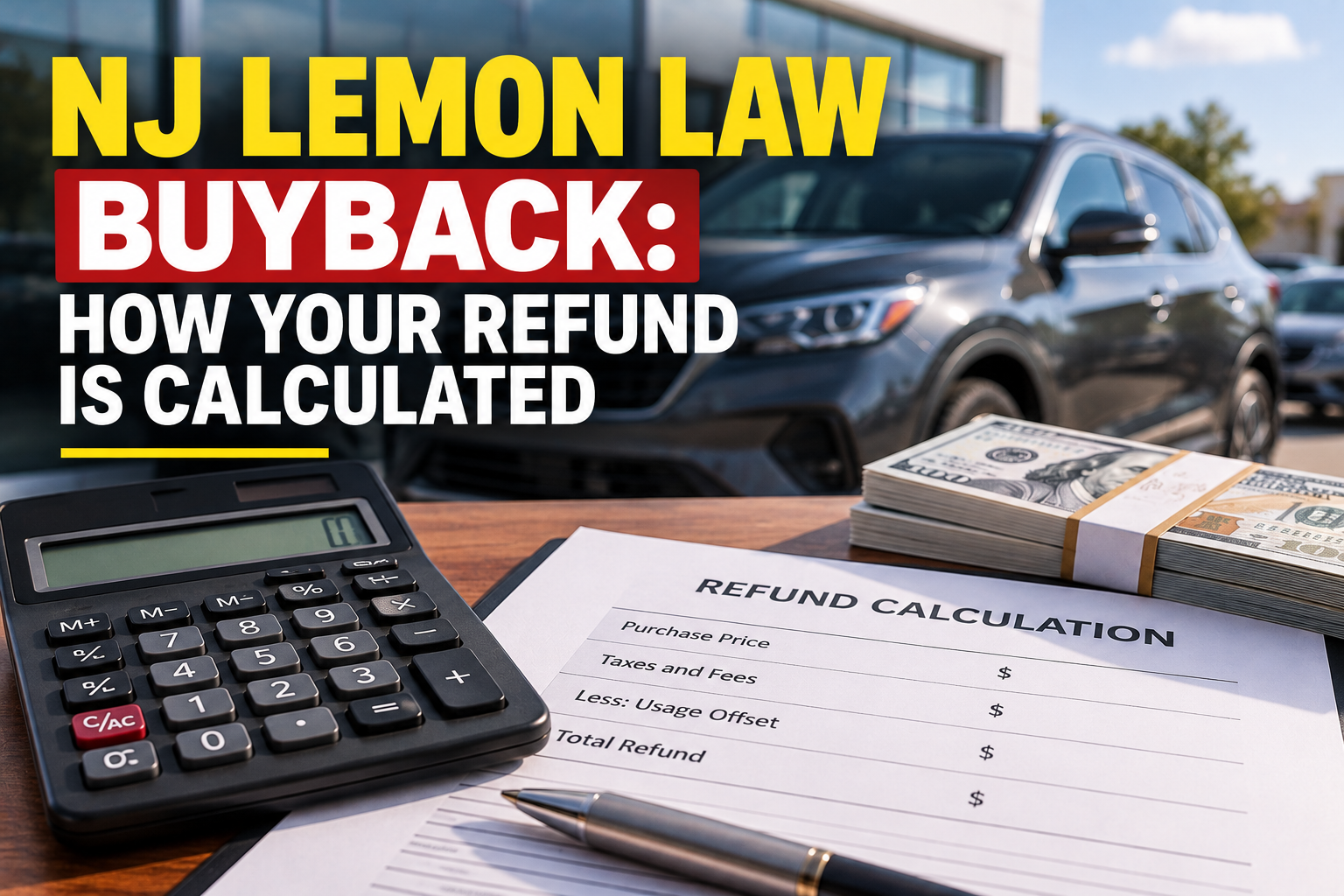
  • NJ Lemon Law Buyback: How Your Refund Is Calculated

    NJ Lemon Law Buyback: How Your Refund Is Calculated

    NJ Lemon Law Buyback: How Your Refund Is Calculated

    Winning a New Jersey lemon law case and getting your money back are two different things. Once a car qualifies as a lemon, the next question is simple. How much does the buyback actually pay?

    The answer isn’t a guess or a round number. New Jersey uses a written formula for the NJ lemon law refund, and it uses two very different formulas depending on whether the car was bought new or used. This post puts those formulas side by side and runs real numbers through them so you can see how the math works.

    If you’re new to the topic, the complete guide to the New Jersey lemon law covers the whole process, and our breakdown of what qualifies as a lemon for new cars in NJ covers the tests a car has to meet first. This article picks up where those leave off, at the money.


    Two Laws, Two Refund Formulas

    New Jersey has a New Car Lemon Law and a separate Used Car Lemon Law. They don’t share a refund formula. They don’t even make the same party pay. A new car buyback comes from the manufacturer, while a used car refund comes from the dealer that sold you the car.

    Here’s the quick version before we break each one down.

    New Car BuybackUsed Car Refund
    Who paysThe manufacturerThe selling dealer
    Starting pointFull purchase price, including trade-in creditPurchase price
    Sales tax and registration feesAdded back inLeft out
    Finance charges, towing, rentalsAdded back inNot part of the formula
    Main deductionMiles at first repair visit times price, divided by 100,000IRS business mileage rate times every mile you drove
    Extra deductionNoneExcessive wear and tear, if any
    Replacement car optionYes, but you can say noNo, the remedy is a repurchase

    How the New Car Lemon Law Buyback Is Calculated in New Jersey

    The new car refund rule lives in N.J.S.A. 56:12-32. When a defect can’t be fixed within a reasonable time, the manufacturer has to take the car back and give a full refund of the purchase price. The state’s regulation, N.J.A.C. 13:45A-26.11, spells out the same pieces line by line.

    What Gets Added In (the Collateral Charges)

    People often search for “collateral charges” and “incidental damages.” New Jersey’s statute doesn’t use those labels. It simply lists what goes into the refund.

    • The full purchase price, including any credit you got for a trade-in
    • Options or add-ons the manufacturer or dealer installed within 30 days of delivery
    • Sales tax, license fees, and registration fees
    • Finance charges
    • Towing costs
    • Actual rental car costs while the car was out of service for the defect

    The regulation also lists the Division filing fee and reasonable attorney’s fees, expert fees, and costs as items in the refund computation. One catch applies to trade-ins. If a trade-in credit grossly exceeds the real value of the old car, it can be excluded, and the manufacturer carries the burden of proving that.

    The NJ Lemon Law Mileage Offset

    Then comes the deduction. Some people call it a mileage offset or a personal use deduction. The statute calls it a “reasonable allowance for vehicle use,” and N.J.S.A. 56:12-30 defines it with a fixed formula.

    New car use allowance = miles on the car at the first repair visit for the defect × purchase price (or lease price) ÷ 100,000

    Notice what the formula counts. It’s not the miles on the car when you hand back the keys. It’s the odometer reading the first time you brought the car in for that defect. Every mile driven after that first visit doesn’t increase the deduction at all.

    How the NJ Used Car Lemon Law Refund Is Calculated

    Used cars run on a different rule. Under N.J.S.A. 56:8-71, a dealer that can’t fix a covered defect has to repurchase the car and refund the purchase price. The math is set out in N.J.A.C. 13:45A-26F.14.

    The refund starts with the total purchase price. Then four things come out of it.

    1. All sales taxes
    2. Title and registration fees, or similar government charges
    3. A reasonable allowance for excessive wear and tear, if there is any
    4. A deduction for personal use

    The personal use deduction is defined in N.J.A.C. 13:45A-26F.2. It uses the IRS business mileage rate in effect on the date the dealer repurchases the car, multiplied by every mile you drove from the day you bought it until the repurchase.

    Used car personal use deduction = IRS business mileage rate on the repurchase date × total miles you drove

    That rate moves. According to the IRS standard mileage rates page, the 2026 business rate was 72.5 cents per mile from January through June, then rose to 76 cents per mile starting July 1, 2026. So the same miles can cost a little more or less depending on when the buyback closes.

    Watch the difference: The new car formula freezes the deduction at your first repair visit. The used car formula keeps counting every mile until the repurchase. On a used car, time spent driving while a dispute drags on shows up in the math.


    Worked Example 1: A New SUV in Springfield

    Say Tamara buys a new Chevy Equinox from a dealer on Route 22 in Springfield. The price is $36,000, and that includes a $6,000 trade-in credit for her old sedan. The dealer installs remote start and floor liners for $650 at delivery. She pays $2,385 in sales tax and $300 in title and registration fees, and she finances the rest.

    At 1,800 miles, the engine starts losing coolant and overheating. She brings it in. It goes back several more times over the next few months, and she rents a car for 12 days at $45 a day. One overheat on Route 78 costs her a $150 tow. By the time the manufacturer buys the car back, she has paid $1,150 in finance charges.

    Adding It Up

    • Purchase price, including the trade-in credit: $36,000
    • Dealer-installed options: $650
    • Sales tax: $2,385
    • Title and registration: $300
    • Finance charges paid: $1,150
    • Towing: $150
    • Rental car (12 days at $45): $540

    That totals $41,175. Now the use allowance. Using the $36,000 vehicle price, the math is 1,800 × $36,000 ÷ 100,000, which comes to $648.

    Tamara’s estimated buyback: $41,175 minus $648 = $40,527. Part of that goes to her lender to pay off the loan, since New Jersey law sends refunds to the consumer and any lienholder based on their interests.

    Worked Example 2: Same Car, Later First Repair

    Now say Derek in Mount Laurel buys the exact same Equinox on the exact same terms. The difference is timing. His overheating problem doesn’t show up until 14,500 miles, still inside New Jersey’s coverage window of two years or 24,000 miles.

    His use allowance is 14,500 × $36,000 ÷ 100,000, which comes to $5,220. Assuming every other number matches Tamara’s, his estimated buyback is $41,175 minus $5,220, or $35,955.

    Same car, same price, a difference of $4,572. The only thing that changed was the odometer reading on the first repair order. That’s why the date and mileage on that first visit matter so much in a new car buyback calculation.

    Worked Example 3: A Used Sedan in Jersey City

    Say Luz buys a 2020 Nissan Altima with 47,000 miles from a used car dealer in Jersey City. She pays $17,500, plus $1,159 in sales tax and $250 in title and registration fees. Because the car had between 24,000 and 60,000 miles at sale, the dealer’s required warranty runs 60 days or 2,000 miles, whichever comes first.

    The engine starts misfiring in the first month. Three repair attempts later it’s still misfiring, and the dealer repurchases the car in October 2026. By then Luz has driven it 1,600 miles. She also cracked the front bumper cover on a parking garage pillar, and the dealer values that at $300 as excessive wear and tear.

    • Purchase price: $17,500
    • Sales tax and title fees: not included in the refund
    • Personal use deduction: 1,600 miles × $0.76 = $1,216
    • Excessive wear and tear: $300

    Luz’s estimated refund: $17,500 minus $1,216 minus $300 = $15,984.

    If the same repurchase had closed in May 2026, the rate would have been 72.5 cents, and the deduction would have been $1,160 instead. Small difference, but it shows how the date plugs into the formula.

    Compare Luz’s result to Tamara’s. Tamara got her sales tax, fees, and finance charges back. Luz’s refund formula leaves taxes and government fees out entirely. That’s one of the biggest practical gaps between the two New Jersey laws. The used car lemon law eligibility rules explain which cars fall under that second law in the first place.


    How Leased Vehicles Are Refunded in New Jersey

    Leases follow a split approach under N.J.S.A. 56:12-32. The lessee gets back what was actually paid under the lease, minus a use allowance based on the lease price instead of a purchase price. The leasing company is paid separately, and no early termination penalty can be charged. Our post on the New Jersey lemon law for leased cars runs a full worked example of that split.

    Lemon Law Replacement Vehicle vs. Refund

    Under the New Car Lemon Law, a manufacturer may offer to replace the car instead of buying it back. The consumer doesn’t have to accept. The statute lets the consumer reject the replacement offer and demand a refund instead.

    If a replacement is accepted, the manufacturer has to make sure any loan on the old car transfers to the new one. Say Tamara took a replacement Equinox instead of the $40,527 refund. The lien on her Equinox would transfer to the replacement car.

    Either way, the returned car doesn’t vanish. New Jersey brands its title before it can be resold, as our post on what a lemon title in NJ means explains.

    The Used Car Lemon Law works differently. N.J.S.A. 56:8-71 talks about the dealer repurchasing the car and refunding the price. It doesn’t set up a replacement option the way the new car law does.

    How New Jersey Compares to Federal Warranty Law

    The federal Magnuson-Moss Warranty Act also talks about refunds. Under a “full” warranty, a product that can’t be fixed after a reasonable number of tries must be refunded or replaced at the consumer’s choice. Most new car warranties are labeled “limited” rather than “full,” though, so that federal refund rule often doesn’t apply to a car warranty directly.

    What federal law doesn’t give you is New Jersey’s built-in math. The state statute names the exact items in the refund and the exact deduction formula. Neighboring states like New York and Connecticut write their own formulas too, so a buyback number from one state doesn’t carry over to another.

    Formula vs. Settlement Amount

    A lot of buybacks never reach a final decision. They settle. New car disputes can go through the New Jersey Lemon Law Unit, which sends contested cases to a hearing before an administrative law judge, and many end in an agreement before the hearing date. Our guide to the NJ lemon law hearing process walks through those steps.

    The statutory formula still matters in a settlement. It gives both sides the same reference point. A proposed settlement amount can be checked against what the formula would produce, line by line.

    Common Questions About NJ Lemon Law Refunds

    Do you get your down payment back under the NJ lemon law?

    For a new car, the refund is built on the full purchase price, so money put down is part of what’s being refunded. A trade-in credit counts too. The use allowance is then subtracted from the total.

    Does the NJ lemon law cover rental car reimbursement?

    For new cars, yes. The statute includes actual rental expenses, but only for the time the car was out of service because of the defect. Those are the same days tracked under the NJ lemon law 20 day rule. Receipts are what prove those costs, and the regulation lists rental receipts among the documents that go with a Lemon Law Unit application.

    Is the mileage offset based on current miles?

    Not for new cars. The new car allowance uses the mileage at the first repair visit for the defect. For used cars, the deduction uses every mile driven from purchase until the dealer repurchases the car.

    Can you trade in a lemon car instead?

    People do trade in problem cars, but a trade-in is a private deal with a dealer, not a lemon law remedy. The trade-in value is whatever the dealer offers. A lemon law buyback follows the statutory formula covered above.

    Who pays attorney fees in a New Jersey lemon law case?

    For new car cases decided through the state program, N.J.A.C. 13:45A-26.11 lists reasonable attorney’s fees, expert witness fees, and costs among the items in the refund computation. In other words, those costs are built into what the manufacturer pays rather than coming out of the consumer’s refund.

    The Bottom Line on NJ Lemon Law Refund Calculations

    A New Jersey new car buyback adds back taxes, fees, finance charges, towing, and rentals, then subtracts a use allowance frozen at the first repair visit. A used car refund leaves taxes and fees out and subtracts the IRS mileage rate for every mile driven, plus any excessive wear. Same state, very different numbers.

    This article is for educational purposes only and is not legal advice. Reading it does not create an attorney-client relationship. For advice on your specific situation, consult a licensed attorney in your state.
  • NJ Consumer Fraud Act and Car Dealers: How It Works

    NJ Consumer Fraud Act and Car Dealers: How It Works

    NJ Consumer Fraud Act and Car Dealers: How It Works

    You bought a used car from a New Jersey dealer. The salesperson said it had a clean history. Three months later, a body shop tells you the frame was bent in a crash, and the car is worth thousands less than you paid.

    That situation usually isn’t a lemon law problem. It’s a dealer conduct problem, and in New Jersey that falls under the New Jersey Consumer Fraud Act, often called the CFA. It’s one of the strongest consumer protection laws in the country, and it has real teeth when a car dealer misleads a buyer.

    This guide explains how the CFA works for car buyers. It covers what counts as consumer fraud, how treble damages and fee shifting work, and the dealer practices that come up most often. For the full picture on defective new and used cars, see our complete guide to the New Jersey Lemon Law.


    Lemon Law vs. Consumer Fraud Act: Which One Fits?

    People mix these two up all the time. They protect against different things.

    New Jersey’s lemon laws are about defects. A car has a problem the manufacturer or dealer can’t fix after a reasonable number of tries, and the law provides a path to a refund or replacement. The used car version has strict mileage and price limits, which we cover in our breakdown of whether used cars qualify in New Jersey.

    The Consumer Fraud Act is about honesty in the sale. It asks whether the dealer lied, hid something important, or broke a state rule during the transaction. A car can run perfectly and still be the subject of a CFA claim if the dealer misrepresented it.

    Key takeaway: Lemon law focuses on what’s wrong with the car. The Consumer Fraud Act focuses on what the seller said or didn’t say about it. Some situations involve both.

    What N.J.S.A. 56:8-2 Says Counts as Consumer Fraud

    The core of the law is N.J.S.A. 56:8-2 of the New Jersey Consumer Fraud Act. It makes it unlawful to use deception, fraud, false promises, misrepresentation, or unconscionable commercial practices in connection with selling merchandise. Cars count as merchandise.

    The statute also covers the knowing concealment or omission of a material fact, when the seller intends for the buyer to rely on that silence. A material fact is something a reasonable buyer would care about, like a prior accident or a salvage history.

    The three types of CFA violations

    New Jersey’s Supreme Court sorted CFA violations into three groups in Cox v. Sears Roebuck & Co. (1994). The difference matters because each type has a different intent requirement.

    • Affirmative misrepresentations. The dealer says something false, like “no accidents.” The buyer generally doesn’t need to prove the dealer meant to deceive.
    • Knowing omissions. The dealer stays silent about something important. Here the dealer’s knowledge and intent are part of what has to be shown.
    • Regulatory violations. The dealer breaks a specific state regulation. These work like strict liability, so a dealer’s good faith generally isn’t a defense.

    One more point. The statute says a practice can be unlawful whether or not anyone was actually misled. That language shapes how the state enforces the law, though a private buyer still needs to show a loss to collect damages.

    Treble Damages and Attorney Fees Under N.J.S.A. 56:8-19

    This is the part that makes the CFA so powerful. Under N.J.S.A. 56:8-19, a person who suffers an “ascertainable loss” because of an unlawful practice can sue. If they win, the court must triple the damages. The court must also award reasonable attorneys’ fees, filing fees, and costs.

    3x Under the CFA, proven damages from a dealer’s unlawful practice are tripled, and the dealer generally pays the buyer’s reasonable attorney fees on top of that.

    What “ascertainable loss” means

    An ascertainable loss is a real, measurable money loss. It can’t be vague or speculative. Common examples are paying more than the car was worth, paying a fee you shouldn’t have been charged, or paying for a service that was never done.

    Cox also held that fee shifting doesn’t always depend on a loss. If a buyer proves a violation but can’t show a measurable loss, the court can still award attorney fees and costs. Treble damages, though, require that ascertainable loss.

    How New Jersey compares to New York and federal law

    New Jersey stands out. Across the Hudson, New York General Business Law § 349 allows actual damages or $50, and trebling for willful violations is capped at $1,000. Attorney fees in New York are up to the judge. In New Jersey, trebling has no such cap and fees are mandatory once a buyer wins.

    Federal law is thinner here. The FTC polices deceptive practices nationally, but the FTC Act doesn’t give individual car buyers a right to sue. That’s a big reason state laws like the CFA carry so much weight for car buyers.


    Common New Jersey Car Dealer Fraud Problems

    Dealer fraud claims tend to fall into a handful of patterns. Here’s how the CFA generally applies to each one.

    Hidden accident or frame damage

    Accident history affects value, so it’s usually a material fact. If a dealer says a car has never been in a crash when it has, that’s an affirmative misrepresentation. If the dealer knew about the damage and simply said nothing, it may be a knowing omission.

    Undisclosed flood damage

    New Jersey sees its share of storm flooding, and flood cars often get cleaned up and resold. Water damage can rot wiring and electronics months later. A dealer who knows a car was flooded and hides it from a buyer is the kind of conduct the concealment language in 56:8-2 targets.

    Say Danielle buys a 2020 Jeep Grand Cherokee from a lot near Route 37 in Toms River. Six months later, the dashboard lights flicker and the mechanic finds silt packed under the carpet. If the dealer took the Jeep in at auction with a flood disclosure and didn’t pass that on, her situation fits the omission category.

    Odometer rollback

    Rolling back mileage is a misrepresentation about one of the most important facts on any used car. It can support a CFA claim in New Jersey. It’s also a federal violation. Under 49 U.S.C. § 32710, a person who violates federal odometer law with intent to defraud is liable for three times actual damages or $10,000, whichever is greater, plus attorney fees. The federal claim has a two-year filing deadline.

    Doc fees and pre-delivery charges

    New Jersey has specific dealer rules in its Automotive Sales Practices regulations at N.J.A.C. 13:45A-26B. The state doesn’t cap documentary fees. Under N.J.A.C. 13:45A-26B.3, though, a dealer can’t tell you a government agency requires the fee. The dealer also has to itemize each documentary service and its price in writing on the sale document, in at least 10-point type.

    A companion rule, N.J.A.C. 13:45A-26B.2, covers pre-delivery service fees. A dealer can’t charge you for prep work that someone else, like the manufacturer, already paid the dealer for. Each pre-delivery service also has to be listed and priced in writing.

    Watch for this phrase: “The state makes us charge this fee.” Under New Jersey’s dealer regulations, telling a buyer a government entity requires a documentary service is itself an unlawful practice.

    Add-ons you didn’t agree to

    Paint protection, VIN etching, nitrogen tires, and service contracts sometimes show up on a contract the buyer never asked for. Slipping these in, or saying they’re required to get financing when they aren’t, can be a misrepresentation under the CFA. The money paid for an unwanted add-on is often the clearest example of an ascertainable loss.

    Example: Kevin’s “Clean” Accord in Paramus

    Here’s how the math generally works. Kevin buys a 2019 Honda Accord from a used car lot on Route 17 in Paramus for $21,500. The salesperson tells him it’s never been in an accident. Kevin also pays a $699 doc fee after being told New Jersey requires it.

    Four months later, Kevin gets rear-ended at a light on Route 4. The body shop shows him old weld marks on the frame from a prior major repair. An appraiser says a car with that history was worth about $16,000 when Kevin bought it.

    In this made-up example, Kevin’s measurable loss on the car is $5,500, the gap between what he paid and what it was worth. If a court found the “no accidents” statement violated the CFA, that $5,500 would be tripled to $16,500. The dealer would also generally owe Kevin’s reasonable attorney fees and costs.

    The doc fee is a separate issue. The fee itself was legal to charge, but the claim that the state required it breaks a specific regulation. That kind of regulatory violation doesn’t require proof the dealer meant to mislead Kevin.

    Real outcomes depend on evidence, the paperwork, and how a court views the facts. This example is simplified to show how the statute’s pieces fit together.

    Where CFA Car Cases Are Heard in New Jersey

    Private CFA cases are usually filed in the Superior Court of New Jersey, Law Division. Smaller claims can go to the Special Civil Part, which has its own lower-dollar track for small claims. Many dealer contracts also include arbitration clauses, which can move a dispute out of court entirely depending on how the clause is written.

    The state can act too. The Attorney General and the New Jersey Division of Consumer Affairs enforce the CFA and can seek civil penalties against dealers. A state action is separate from a buyer’s own private case.


    FAQs About the NJ Consumer Fraud Act and Car Dealers

    Does the NJ Consumer Fraud Act apply to used car dealers?

    Yes. The CFA covers the sale of merchandise, which includes new and used cars. It applies whether or not the car qualifies under either of New Jersey’s lemon laws.

    Does an “as is” sale protect a dealer from a fraud claim?

    Not from fraud. An “as is” sale generally limits warranty claims about the car’s condition. It doesn’t give a dealer permission to lie about accident history or mileage. Used car lots also have to post a Buyers Guide on each vehicle under the federal FTC Used Car Rule, which shows whether the car is sold as is or with a warranty.

    Is there a cap on dealer doc fees in New Jersey?

    No dollar cap. New Jersey’s rules focus on disclosure instead. The fee has to be itemized in writing, and the dealer can’t say a government agency requires it.

    Can a dealer be liable if the salesperson didn’t know the car was damaged?

    It depends on the type of claim. For a false statement like “no accidents,” New Jersey courts generally don’t require proof of intent to deceive. For pure silence, the buyer usually has to show the dealer knew the fact and kept quiet on purpose.

    How long is there to bring a CFA claim in New Jersey?

    New Jersey courts have generally applied a six-year filing deadline to private CFA claims. When that clock starts can be disputed, especially when the problem wasn’t discovered right away. Related federal claims, like odometer fraud, can have much shorter deadlines.

    The Bottom Line

    The New Jersey Consumer Fraud Act reaches what a dealer says, what a dealer hides, and how a dealer follows state rules during a car sale. When a buyer proves an unlawful practice and a measurable loss, damages are tripled and attorney fees shift to the dealer. That combination makes it one of the most important consumer laws for New Jersey car buyers, and it works alongside the state’s lemon laws rather than replacing them.

    This article is for educational purposes only and is not legal advice. Reading it does not create an attorney-client relationship. For advice on your specific situation, consult a licensed attorney in your state.

  • Is There a Lemon Law for Private Car Sales in NJ?

    Is There a Lemon Law for Private Car Sales in NJ?

    Is There a Lemon Law for Private Car Sales in NJ?

    You found a clean-looking Volkswagen Jetta on an online listing, met the owner in a parking lot in Linden, and paid $7,500 in cash. Two weeks later the turbocharger fails and the repair quote is $3,800. Your first question is probably the one thousands of people type into Google: is there a lemon law for private car sales in New Jersey?

    The short answer is mostly no. New Jersey’s used car lemon law is aimed at dealers, and a true one-time private sale falls outside it. But “no lemon law” doesn’t mean “no law.” A private buyer can still have rights under fraud law, warranty law, and the title and odometer rules.

    This guide walks through what’s left for a buyer after a New Jersey private party sale. It also covers the “private seller” in the driveway who has quietly sold enough cars to count as a dealer under state law.

    Key takeaway: New Jersey’s used car lemon law generally doesn’t cover a genuine one-time private sale. Private buyers may still have claims for fraud, broken promises about the car, or odometer tampering. And a seller who has sold or offered three or more used cars in the past 12 months is treated as a dealer under N.J.S.A. 56:8-67.

    Why New Jersey’s Used Car Lemon Law Skips Most Private Sales

    New Jersey’s used car protections put the duties on a “dealer.” Under N.J.S.A. 56:8-67, a dealer is any person or business that sells or offers a used car for sale after selling or offering three or more used cars in the previous 12 months. Someone selling the family minivan once every few years never reaches that number.

    That’s why the mandatory dealer warranty and the repair duties that come with it don’t attach to a typical private sale. We cover those dealer rules, including the price, age, and mileage limits, in our guide on whether used cars qualify under New Jersey lemon law. For how New Jersey lemon law works overall, see the complete New Jersey lemon law guide.

    New Jersey’s line is actually stricter than the federal one. The FTC’s Used Car Rule, 16 C.F.R. § 455.1, only treats a seller as a dealer after five or more used vehicle sales or offers in 12 months. New Jersey pulls in sellers sooner, after three.

    One Exception Worth Knowing: A Nearly New Car

    A private sale can still land inside New Jersey’s other lemon law. The New Car Lemon Law protects anyone the car is transferred to while the original two year and 24,000 mile window is still open, and that claim runs against the manufacturer, not the seller. So a one year old car bought from a neighbor may still be covered. Our breakdown of what qualifies as a lemon under the NJ new car law explains that side.

    The Driveway “Private Seller” Who Is Really a Dealer

    Some people who look like private sellers are running a small car business out of their driveway. The industry calls this “curbstoning.” The seller buys cheap cars, fixes them up just enough, and lists them as “my personal car, selling because I got a new one.”

    How the Three-Car Count Works

    The statute counts cars sold or offered for sale. That detail matters. A seller who listed three different cars over the past year may count toward the threshold even if one of them never sold.

    Say Darnell lives on a quiet side street in Paterson. Since last fall he has sold a 2016 Nissan Altima, a 2017 Toyota Corolla, and a 2015 Ford Escape, all advertised as his “own car.” When he lists a 2018 Honda Civic this spring, he has already sold or offered three used cars in 12 months. Under the state’s definition, Darnell is a dealer for that fourth sale, even though he has no lot and no sign.

    What Changes Once a Seller Crosses the Line

    A seller who meets the dealer definition picks up the duties New Jersey places on dealers. Under N.J.S.A. 56:8-68, a dealer can’t misstate a car’s mechanical condition and must disclose known material defects before the sale. If the car is sold “as is,” the dealer has to explain that term in writing first.

    If the car also meets the used car lemon law’s price, age, and mileage limits, the required dealer warranty can come into play too. That warranty can only be waived on cars with more than 60,000 miles, through a negotiated, separately signed writing. Our post on whether there’s a 30 day lemon law on used cars in NJ covers how long that warranty lasts and the waiver rules. A buyer whose warranty isn’t honored can file a free application with the Lemon Law Unit, explained in our guide to the NJ lemon law hearing process.

    There’s a licensing angle as well. N.J.S.A. 39:10-19 bars anyone from being in the business of buying, selling, or dealing in motor vehicles in New Jersey without a license from the Motor Vehicle Commission. An unlicensed curbstoner may be breaking that rule on top of everything else.


    Does the New Jersey Consumer Fraud Act Cover a Private Sale?

    The New Jersey Consumer Fraud Act, N.J.S.A. 56:8-2, makes deception, misrepresentation, and knowing concealment of material facts in the sale of merchandise unlawful. It’s widely seen as one of the strongest consumer laws in the country. When it applies, N.J.S.A. 56:8-19 says a court must triple the buyer’s damages and award reasonable attorney fees.

    The catch is who the Act reaches. In DiBernardo v. Mosley, 206 N.J. Super. 371 (App. Div. 1986), the Appellate Division held that the Act didn’t apply to a homeowner’s sale of their own house. The court read the law as aimed at professional sellers, not people making an isolated sale of their own property.

    That case involved a house, not a car. Still, a person who sells their own car once would likely make the same argument. A curbstoner who buys and sells cars for profit looks much more like the professional seller the Act was written for.

    Watch out: Whether the Consumer Fraud Act covers a particular private car sale isn’t settled by a single bright-line rule. It usually turns on how often the seller sells cars and whether the seller is acting like a business. The answer can change the value of a claim a lot, because of the treble damages and fee-shifting provisions.

    Common Law Fraud and Equitable Fraud in New Jersey

    Even when the Consumer Fraud Act doesn’t apply, old-fashioned fraud law does. It applies to everyone, including a one-time private seller. In Gennari v. Weichert Co. Realtors (N.J. 1997), the New Jersey Supreme Court listed five elements of common law fraud:

    1. A material misrepresentation of a present or past fact
    2. The seller knew or believed the statement was false
    3. The seller intended the buyer to rely on it
    4. The buyer reasonably relied on it
    5. The buyer suffered damages as a result

    Proving that the seller knew the statement was false is often the hardest part. New Jersey also recognizes equitable fraud, which drops that requirement. In Jewish Center of Sussex County v. Whale, 86 N.J. 619 (1981), the Supreme Court held that a buyer seeking an equitable remedy like rescission, meaning undoing the deal, doesn’t have to prove the other side knew the statement was false.

    Here’s how that plays out. Say Grace buys a 2014 Jeep Grand Cherokee from a seller in Long Branch for $9,000. The seller says, “It’s never been in a flood.” Grace later finds silt under the carpets and rust on the seat rails, and a mechanic says the car sat in floodwater. If the seller knew about the flood, Grace’s facts look like common law fraud. If the seller honestly didn’t know, a court could still consider equitable fraud and unwind the sale.

    Do Private Sellers Give Warranties Under New Jersey’s UCC?

    New Jersey’s version of the Uniform Commercial Code, Title 12A, governs sales of goods, and a car is a good. Different warranties apply to different sellers, and this is where a lot of private buyers get confused.

    Implied Warranty of Merchantability: Usually Not for Private Sellers

    The implied promise that a car is fit for ordinary driving comes from N.J.S.A. 12A:2-314. It only applies when the seller is a merchant who deals in that kind of goods. A nurse selling her own SUV isn’t a car merchant, so this warranty usually doesn’t arise. A curbstoner flipping cars may be a different story.

    Express Warranties: Any Seller Can Make One

    Under N.J.S.A. 12A:2-313, a seller’s statement of fact about the car that becomes part of the deal can create an express warranty. This applies to private sellers too. “New timing belt at 90,000 miles” is a statement of fact. “She runs great” is closer to opinion or sales talk, which the statute says doesn’t create a warranty.

    Fitness for a Particular Purpose

    N.J.S.A. 12A:2-315 refers to “the seller,” not just merchants. It can apply when the seller knows the buyer needs the car for a specific job and the buyer relies on the seller to pick something suitable. Say a buyer explains she needs a truck to tow a 5,000-pound camper, and the seller points her to a pickup that can’t do it. That’s the kind of situation this section addresses.

    What “As Is” Does and Doesn’t Do

    Under N.J.S.A. 12A:2-316, “as is” language generally wipes out implied warranties. That section is about warranties only. It doesn’t erase a specific promise the seller made, and it doesn’t touch fraud, which is a separate claim with its own rules.

    Title and Odometer Rules for NJ Private Car Sales

    The paperwork rules apply to every seller, private or not. According to the New Jersey Motor Vehicle Commission, the seller signs the back of the title and gives the buyer a bill of sale showing the buyer’s name and address, the sale date, the odometer reading, and the price. The buyer then has 10 working days to transfer the title at a motor vehicle agency or face a $25 penalty.

    Federal law adds odometer protection. Under 49 U.S.C. § 32705, a person transferring ownership must give a written mileage disclosure. Federal rules exempt some older vehicles, including cars from model year 2010 and earlier. If someone violates the federal odometer law with intent to defraud, 49 U.S.C. § 32710 makes them liable for three times the actual damages or $10,000, whichever is greater, plus attorney fees.

    $10,000 minimum The floor on a federal odometer fraud judgment under 49 U.S.C. § 32710, even if the buyer’s actual loss was much smaller. The claim must generally be filed within two years.

    Say Tyrell buys a 2016 Chevy Malibu in Cherry Hill. The title and bill of sale show 62,000 miles. A dealer’s service printout later shows the car had 141,000 miles two years earlier. If the seller rolled the odometer back on purpose, the federal statute could allow at least $10,000, regardless of whether New Jersey’s lemon law ever applied.

    Title history matters too. A car that a manufacturer once bought back under a lemon law carries a permanent brand on its New Jersey title. Our post on what a lemon title in NJ means explains how to spot one and who has to disclose it.


    A Hypothetical: One Bad Sale in Edison, Four Possible Paths

    Let’s put it together. Leah answers an online ad for a 2022 Subaru Outback listed at $18,500 by a seller named Glen in Edison. Glen tells her the car has “never been in an accident” and the head gaskets were “replaced last year, I have the receipt somewhere.” The bill of sale says “sold as is.” Three weeks later, coolant is leaking and a body shop finds frame repair from a serious crash.

    First question: is Glen really a private seller? If he sold or offered three or more used cars in the prior 12 months, he’s a dealer under state law. That would bring in the dealer disclosure duties and possibly the used car warranty, since the Outback appears to fit the limits the New Jersey Division of Consumer Affairs describes: sold for $3,000 or more, seven model years old or less, and 100,000 miles or less.

    If Glen is truly a one-time seller, the analysis shifts. “Never been in an accident” is a statement of fact, so it could support a fraud claim if Glen knew about the crash, or an equitable fraud claim if he didn’t. The head gasket statement could be an express warranty, and “as is” wouldn’t cancel it. The Consumer Fraud Act’s treble damages would be harder to reach for a true one-off sale.

    Where These Disputes Are Heard in New Jersey

    Most private car sale disputes are about money, and the amount decides the court. In the Superior Court’s Special Civil Part, the Small Claims section hears claims of $5,000 or less, and the Special Civil section hears claims up to $20,000. Bigger claims go to the Law Division.

    Deadlines differ by claim. A UCC warranty claim generally has four years from delivery of the car under N.J.S.A. 12A:2-725. Fraud and Consumer Fraud Act claims get six years under N.J.S.A. 2A:14-1. In Catena v. Raytheon Co. (App. Div. 2016), the court applied that six-year period and held the clock doesn’t start until the buyer discovered, or reasonably should have discovered, the basis for the claim. The federal odometer claim has two years.

    FAQs About NJ Used Car Private Sales

    Can you return a used car in NJ after a private sale?

    Not automatically. New Jersey has no general cooling-off period that lets a buyer hand back a privately purchased car. A return usually happens only if the seller agrees or a court orders the deal undone, for example through rescission based on fraud.

    Is there a lemon law for private car sales in NJ?

    Not for a genuine one-time private sale. The used car lemon law’s warranty duties fall on dealers, and New Jersey defines a dealer by the three-car, 12-month count. Fraud, warranty, and odometer laws still apply to private sellers.

    Does “sold as is” mean the seller can’t be held responsible?

    No. “As is” generally knocks out implied warranties. It doesn’t cancel express promises, and it doesn’t protect a seller who lies about a material fact.

    Is someone selling cars online always a private seller?

    No. Where a car is listed doesn’t decide anything. What matters under N.J.S.A. 56:8-67 is how many used cars the person sold or offered in the past 12 months.

    Can a private seller owe triple damages in New Jersey?

    Only if the Consumer Fraud Act applies to the sale. For a genuine one-time sale of a personal car, that’s an uphill argument after DiBernardo. For a seller who buys and resells cars as a side business, the argument gets much stronger.

    The Bottom Line

    New Jersey’s used car lemon law generally stops at the dealer’s door, so a true private sale isn’t covered. What’s left for a private buyer is fraud law, the UCC’s express and fitness warranties, and title and odometer rules. And a “private seller” who has sold or offered three or more cars in a year may be a dealer in the eyes of the law.

    This article is for educational purposes only and is not legal advice. Reading it does not create an attorney-client relationship. For advice on your specific situation, consult a licensed attorney in your state.
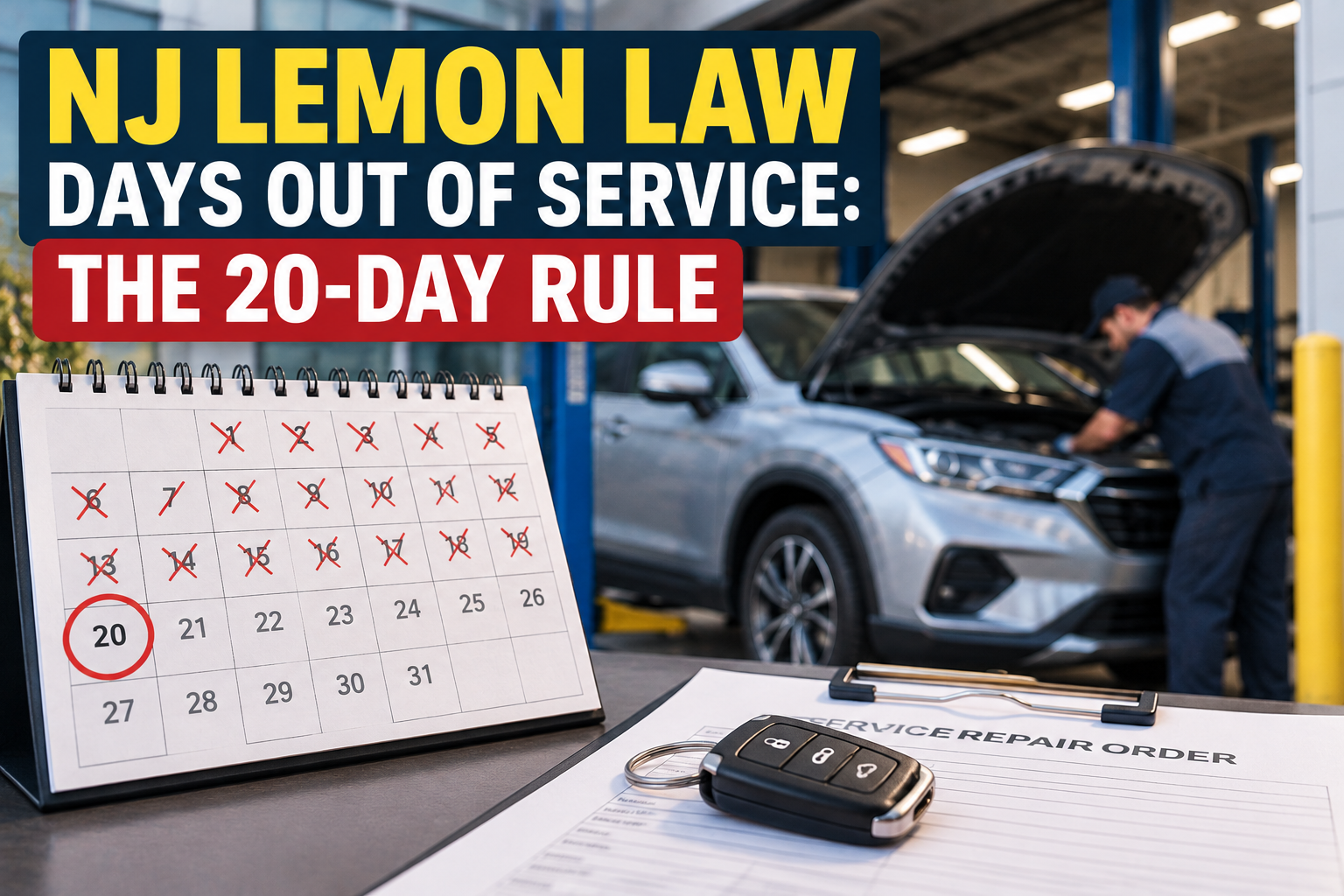
  • NJ Lemon Law Days Out of Service: The 20-Day Rule

    NJ Lemon Law Days Out of Service: The 20-Day Rule

    NJ Lemon Law Days Out of Service: The 20-Day Rule

    Your car has been sitting at the dealer for what feels like forever. First it was a week. Then another visit, and another. Now you’re wondering whether all that time in the shop counts for something under the NJ lemon law, and whether there’s a magic number of days.

    There is. New Jersey counts days out of service, and the number is 20. That’s lower than many people expect. But the way those days get counted is where most of the confusion lives.

    This post explains how the 20-day rule works for new cars, the 45-day rule for motor homes, how days from different problems add up, and how the separate used car law counts time a car spends waiting for repairs. For the bigger picture, our complete guide to New Jersey lemon law covers the whole statute.

    What Does “Days Out of Service” Mean in New Jersey?

    New Jersey’s new car lemon law gives consumers three ways to show a manufacturer had a fair shot at fixing a defect and failed. One is repeat repairs. Another is a serious safety defect that survives even one repair. Both of those are covered in our breakdown of what qualifies as a lemon for new cars in NJ. The third is time, and that’s the one this post is about.

    Under N.J.S.A. 56:12-33, the law presumes a manufacturer couldn’t fix the car in a reasonable time if the car has been out of service by reason of repair for a cumulative total of 20 or more calendar days since original delivery, and a defect still exists. Those days have to fall inside the term of protection, which is the first 24,000 miles or two years after delivery, whichever comes first.

    20 calendar days
    The cumulative days-out-of-service threshold for a new car under New Jersey’s lemon law. For a motor home, it’s 45 calendar days.

    A “presumption” is a legal shortcut. It means the law starts from the assumption that the manufacturer had enough chances. The manufacturer can still argue otherwise, but the burden shifts in the consumer’s favor.

    How the Regulations Define a Day

    The statute says “calendar days” and stops there. The state’s lemon law regulations at N.J.A.C. 13:45A-26 fill in more detail. They define “out of service” as the number of days the car is on the premises of a repair facility for the purpose of repairing one or more defects.

    Calendar days means weekends and holidays count. If your car sits at the dealer from a Friday to the following Monday, that’s four calendar days on the lot, even though only two were business days.

    How the 20 Days Add Up Under the New Car Law

    The key word in the statute is “cumulative.” The 20 days don’t have to be one long stretch. They can come from several shorter visits that add up over the term of protection.

    Days From Different Problems Can Count Together

    This is the part that surprises people. The repeat-repair path generally looks at the same defect coming back again and again. The days-out-of-service path is different. The regulations describe it as time out of service by reason of repair for one or more defects.

    So a week for an engine problem and a week for an electrical problem can both go into the same count. What the law still requires is that at least one defect continues to exist after all that time. A car that was in the shop for 25 days but is now fully fixed is a different situation.

    Days That Don’t Count

    The regulations carve out one big exception. Delays caused by the consumer, such as being slow to pick up the car after the dealer says it’s ready, are not counted as days out of service.

    Routine maintenance also sits outside the count, because the definition is tied to repairing a defect. An oil change or tire rotation isn’t a repair of a nonconformity, so that time generally wouldn’t qualify.

    Watch the pickup gap. If the dealer calls to say the car is ready and it sits there three more days, those three days are generally treated as consumer delay, not days out of service.

    Motor Homes Get 45 Days

    For a motor home, the threshold jumps to 45 or more calendar days. The statute also has a travel rule. If a motor home owner keeps traveling and gets the same problem looked at by a second authorized shop instead of waiting for the first repair to finish, the law treats that as one repair attempt, not two.

    The statute and regulations also say that, in certain motor home situations, a visit to a shop the manufacturer hasn’t authorized doesn’t count as a repair attempt. That can matter for owners who break down far from a dealer that services their rig.


    Example: How a Mercer County Driver Reaches 20 Days

    Say Mei buys a new Kia Telluride from a dealer on Route 1 in Lawrenceville. Two months in, the SUV loses power and drops into limp mode on I-295. She drops it off on a Thursday, and the dealer keeps it for 8 days waiting on a sensor.

    Five months later, the climate control and front defroster quit in January. That visit takes 6 days. Then the power loss comes back, and the SUV sits for another 9 days. On that last visit, the dealer calls on a Tuesday to say it’s ready, but Mei can’t get there until Friday.

    Here’s how the count generally works:

    1. First power loss visit: 8 days
    2. Climate control and defroster visit: 6 days
    3. Second power loss visit: 9 days, minus the 3 days the SUV waited for pickup, for 6 counted days

    That’s 20 counted days, all inside the first two years and under 24,000 miles. The defroster days add to the power loss days because the regulations count time spent repairing one or more defects. If the power loss still happens after that third visit, Mei’s situation would generally fit the 20-day presumption.

    Notice how close it was. If Mei had picked up the SUV a day later, or if the dealer’s paperwork showed a later drop-off date, the total could have landed at 19. That’s why the dates on the paperwork matter so much. Mei is made up, and every real count depends on the actual repair records.

    Why the Drop-Off Date on the Repair Order Matters

    Days out of service are proven with paper, not memory. The New Jersey regulations require the dealer to hand over an itemized, legible statement of repair every time the car comes back during the term of protection. That statement has to show the date and odometer reading when the car was dropped off, and the date and odometer reading when it was made available again.

    Those two dates are what the count is built on. A lemon law application to the state includes copies of these repair statements. If a repair order lists the wrong drop-off date, or if the car was left overnight and the order wasn’t opened until the next afternoon, the count can come up short.

    Say Victor leaves his car in the dealer’s night drop box in Union on a Sunday evening. The service writer doesn’t open the repair order until Tuesday. On paper, the car went in on Tuesday, even though it’s been sitting on the lot since Sunday. Those two days can disappear from the record unless something else shows when the car really arrived.

    Key takeaway: Under the new car regulations, the repair statement must show the drop-off date, the pickup-ready date, and the odometer at each point. Those dates are usually the main evidence of how many days a car was out of service.

    What Happens After 20 Days in the Shop in NJ

    Hitting 20 days doesn’t automatically turn a car into a lemon. The presumption only applies once the manufacturer has received written notice by certified mail, return receipt requested, inside the term of protection. The manufacturer then gets one final chance to fix the defect within 10 calendar days of receiving it. Reaching 20 days is one of the events that allows that notice to go out.

    From there, the claim moves through the application and hearing steps covered in our guide to the NJ lemon law hearing process. The days also connect to money. Rental car costs for the time the car was out of service because of a defect can be part of what a consumer recovers, as our post on how a NJ lemon law buyback is calculated explains.

    One narrow rule can stretch the count. If repairs weren’t available because of a war, strike, fire, flood, or other natural disaster, that time is added to both the 20-day period and the two year term. Our post on the NJ lemon law time frame covers that extension and the rest of the timing rules.


    How the NJ Used Car Lemon Law Counts Days

    Used cars run under a completely separate law with its own rules. It applies to qualifying used cars bought from a dealer and ties protection to a short dealer warranty. Our post on whether used cars actually qualify walks through who’s covered.

    The used car law also uses a 20-day number, but it measures something slightly different. Under N.J.S.A. 56:8-71, the dealer is presumed to have had a reasonable chance to fix the car if it was out of service for a cumulative total of 20 or more days during the warranty period while waiting for the dealer to begin or complete repair.

    That “begin or complete” language matters. Time spent waiting for the dealer to even start working on the car counts, not just time spent with a mechanic under the hood. And under the used car regulations at N.J.A.C. 13:45A-26F, that same waiting time also extends the warranty itself, which our post on the 30, 60, and 90 day used car warranty explains.

    Example: Bianca’s Used CR-V in Elizabeth

    Say Bianca buys a 2021 Honda CR-V with 45,000 miles from a dealer in Elizabeth for $19,000, which gives her a 60 day warranty. Three weeks in, the all wheel drive starts whining and shuddering. The dealer keeps the SUV 12 days before a part even arrives, then sends it home.

    A month later the same noise is back. This time the CR-V waits 9 more days for the dealer to finish the repair. That’s 21 days of waiting on the same covered drivetrain problem inside the warranty, which crosses the used car law’s 20-day line. Bianca is made up, and every real situation turns on the dealer’s dates and records.

    New car law counts days the car is at a repair facility being repaired. Used car law counts days the car is waiting for the dealer to begin or complete repairs, and that waiting time also extends the warranty itself.

    How New Jersey’s 20-Day Rule Differs From Federal Law

    The 20-day count comes from state law, not federal law. The Magnuson-Moss Warranty Act covers written warranties nationwide, but it doesn’t set a specific number of days out of service.

    Common Questions About Days Out of Service in NJ

    What if my car is out of service for 20 days in NJ?

    For a new car, 20 or more cumulative calendar days out of service for repair, inside the term of protection, with a defect that still exists, is one of the three triggers for the lemon law presumption. The certified mail notice and the manufacturer’s 10-day final repair chance still come into play before the presumption applies.

    Do the 20 days have to be in a row?

    No. Both the new car and used car laws use a cumulative total. Three visits of 7 days each add up to 21 days.

    Do weekends and holidays count toward the 20 days?

    For a new car, yes. The statute counts calendar days, so a car that sits at the dealer over a holiday weekend racks up every one of those days.

    My new car keeps going to the shop for different problems. Does that count?

    Under the new car regulations, days out of service are counted for repairing one or more defects, so time spent on different problems can add together. The repeat-repair trigger is different, since it looks at the same defect coming back.

    Do days count if the dealer is just waiting on parts?

    For a new car, the definition looks at days the car is on the premises of a repair facility for the purpose of repair, and neither the statute nor the regulations carve out parts delays. For a used car, the law expressly counts time spent waiting for the dealer to begin or complete repair.

    The Bottom Line on NJ Days Out of Service

    New Jersey counts 20 cumulative calendar days out of service for a new car, or 45 for a motor home, and days from different defects can add up. The used car law counts 20 days of waiting for the dealer to begin or finish repairs, and that waiting also stretches the warranty. In both cases, the dates on the repair paperwork are what the count is built on.

    This article is for educational purposes only and is not legal advice. Reading it does not create an attorney-client relationship. For advice on your specific situation, consult a licensed attorney in your state.

  • NJ Lemon Law for New Cars: What Qualifies as a Lemon

    NJ Lemon Law for New Cars: What Qualifies as a Lemon

    NJ Lemon Law for New Cars: What Qualifies as a Lemon

    Your new car keeps going back to the dealer for the same problem. At some point you start to wonder whether it’s a lemon. Under the NJ lemon law, new car owners don’t get to decide that based on frustration alone. The law uses a short set of tests, and a car either meets them or it doesn’t.

    This article walks through what qualifies as a lemon in NJ. It covers which vehicles the law protects, the “use, value, or safety” standard for a substantial defect, the special rule for serious safety defects, and the two repair counts that trip people up. For the full picture of how the law works from start to finish, see our complete guide to the New Jersey lemon law.

    What Qualifies for Lemon Law in NJ? The Four Tests

    New Jersey’s new car lemon law lives at N.J.S.A. 56:12-29 et seq. It doesn’t use the word “lemon” in a loose, everyday way. Instead, a vehicle generally qualifies when four things line up.

    1. The vehicle is a type the law covers.
    2. The problem showed up during the term of protection.
    3. The problem is a substantial defect, meaning it substantially impairs the car’s use, value, or safety.
    4. The manufacturer had a reasonable number of chances to fix it and couldn’t.

    Miss one of these and the claim usually falls apart, even if the car is truly frustrating to own. The sections below take each test in order.


    Which Vehicles the NJ Car Lemon Law Covers

    The law covers new passenger cars and motorcycles that are bought or leased in New Jersey, or registered with the state’s Motor Vehicle Commission. Authorized emergency vehicles, farm tractors, and the driving parts of a motor home are covered too.

    Leased cars count, because the statute defines a consumer as a buyer or a lessee. The refund works differently for a lease, though, and our post on the New Jersey lemon law for leased cars explains how the money is split.

    A few things are left out. The living quarters of a motor home aren’t covered, and neither are vehicles registered for commercial use. The law also protects more than just the first buyer. Someone who gets the car while the original coverage is still running, like a family member it’s transferred to, can generally enforce it too.

    Used cars are a different story. They fall under a separate law with dealer warranty tiers based on mileage. Our article on whether used cars qualify under New Jersey lemon law covers that track. Everything below is about new vehicles.

    The Problem Has to Show Up in Time

    New Jersey’s protection window runs for the first 24,000 miles or the first two years after the car was originally delivered, whichever comes first. A problem that first appears after that window generally falls outside the lemon law, though the manufacturer’s regular warranty may still cover it.

    The window controls more than when the defect starts. The repair attempts and the manufacturer’s receipt of the certified letter have to land inside it too. Our post on the NJ lemon law time frame covers how that clock runs and what happens near the edge.

    What Counts as a Substantial Defect: Use, Value, or Safety

    The statute calls a qualifying problem a “nonconformity.” That’s a defect or condition that substantially impairs the use, value, or safety of the vehicle. The key word is “substantially.” Not every annoyance clears the bar, and an administrative law judge or court decides close calls based on the facts.

    Use

    A use problem gets in the way of driving the car the way it’s meant to be driven. Think of a car that won’t start some mornings, a transmission that slips into neutral on the highway, or an infotainment crash that also kills the backup camera. Say Nadia in Montclair can’t trust her new crossover to start for her 7 a.m. shift at least twice a week. That’s a fair example of a use issue.

    Value

    A value problem makes the car worth meaningfully less, even if it still drives. A persistent water leak that soaks the carpet, or a defect that would scare off any buyer who learned about it, can fall here. A single loose piece of trim usually wouldn’t.

    Safety

    A safety problem puts the driver, passengers, or others at risk. Brakes that grab or fade, steering that pulls hard, airbag warnings, and sudden stalling are common examples. Some safety problems are serious enough to get their own faster rule, covered below.

    What usually doesn’t qualify: Minor rattles, cosmetic nicks, and problems caused by an accident, vandalism, abuse, or neglect are generally outside the law. The same goes for damage caused by someone other than the manufacturer, its agent, or an authorized dealer, like an aftermarket shop.


    How Many Repair Attempts Make a Lemon in New Jersey?

    This is where most people get confused, because New Jersey uses two different counts. One count tells you when the final chance letter can go out. The other tells you when the case is ready for a hearing. They’re connected, but they’re not the same number.

    Two Attempts: The Final Chance Letter

    According to the state’s New Car Lemon Law consumer brief from the Division of Consumer Affairs, the certified final chance letter can be sent to the manufacturer after two failed repair attempts on the same defect. The letter goes by certified mail, return receipt requested, and the manufacturer then gets 10 days from the date on the return receipt to make one final repair attempt.

    Three Attempts: Ready for a Hearing

    The final repair after the letter is usually the third attempt. If the defect still exists after it, the statute presumes the manufacturer couldn’t fix the car within a reasonable number of tries. That’s the point where a consumer can generally apply to the Lemon Law Unit, and our guide to the NJ lemon law hearing process walks through what happens next.

    The repair count generally looks at substantially the same defect coming back. Three visits for three unrelated problems don’t add up to three attempts.

    The Separate Path for Time in the Shop

    There’s a second route that doesn’t depend on repeat repairs. Under N.J.S.A. 56:12-33, 20 or more cumulative calendar days out of service for repairs during the term of protection also triggers the presumption, and those days can come from more than one defect. Our post on the NJ lemon law 20 day rule explains which days count and which don’t.

    Key takeaway: Two failed attempts open the door to the certified letter. The manufacturer’s final repair after that letter is usually attempt number three. If the problem survives it, the hearing route generally opens.

    Serious Safety Defects: Why One Attempt Can Be Enough

    New Jersey treats one category of problem very differently. A serious safety defect is one that’s likely to cause death or serious bodily injury if the vehicle is driven. Brake failure, a steering system that locks up, or a car that shuts off at highway speed are the kinds of problems that fit.

    For these defects, the state’s consumer brief says a single failed repair attempt is enough to send the certified final chance letter. The statute’s presumption for this kind of defect also needs only one prior repair attempt, as long as the problem still exists. The idea is simple. The law doesn’t expect someone to keep driving a dangerous car while the dealer tries again and again.

    Ordinary defect: two failed attempts, then the letter, then the final repair. Serious safety defect: one failed attempt, then the letter, then the final repair.


    Two Hypothetical New Jersey Lemons, Worked Through

    Keisha’s No Start Explorer in Freehold

    Say Keisha buys a new Ford Explorer from a dealer on Route 9 in Freehold. At 5,200 miles, the dash flickers and the SUV won’t restart after she stops for gas. The dealer replaces the battery. Three weeks later it happens again in a grocery store lot, and the dealer replaces a body control module.

    At 9,800 miles, the same no start returns. That’s two failed attempts on the same defect, well inside 24,000 miles and two years, and a car that won’t reliably start impairs its use. Under the process the state describes, Keisha’s situation would allow the certified final chance letter to go out. If the manufacturer’s final repair doesn’t solve it, her Explorer generally fits the three attempt presumption.

    Hector’s Steering in Bridgewater

    Now say Hector leases a new Ram 1500 in Bridgewater. Four months in, the steering briefly locks up while he’s changing lanes on I-287. The dealer updates the power steering software and returns the truck. Ten days later, the steering locks again on a highway ramp.

    Steering that locks at highway speed is a strong example of a serious safety defect. Because one repair has already failed, the state’s guidance allows the final chance letter to go out right away. Hector’s lease doesn’t change the analysis, since leased vehicles are covered. Both Keisha and Hector are made up, and every real case turns on its own repair records.

    How New Jersey Differs From Federal Warranty Law

    The federal Magnuson-Moss Warranty Act also protects car buyers, but it doesn’t set a specific repair count, a mileage window, or a state hearing process. New Jersey’s lemon law fills that gap with clear numbers: 24,000 miles or two years, two attempts before the letter, three attempts or 20 days for the presumption, and a faster track for serious safety defects. Those concrete triggers make a New Jersey lemon claim easier to measure than a general warranty dispute.

    Once a car does qualify, the usual outcome is a manufacturer buyback. Our post on how a NJ lemon law buyback is calculated shows what goes into that refund.

    Common Questions About What Qualifies as a Lemon in NJ

    Does one repair make my new car a lemon in NJ?

    Usually not. For an ordinary defect, the state’s process calls for two failed attempts before the certified letter and a final repair after it. The exception is a serious safety defect, where one failed attempt is enough to send the letter.

    Is an electrical problem enough to make a car a lemon?

    It can be. The test isn’t the type of part. It’s whether the problem substantially impairs the car’s use, value, or safety. An electrical fault that stops the car from starting or kills safety features can qualify, while a glitchy radio usually wouldn’t.

    Does a car bought out of state qualify?

    It can. The law covers vehicles bought or leased in New Jersey, and also vehicles registered with New Jersey’s Motor Vehicle Commission. A car bought in another state and registered here may fall within the law.

    Do business vehicles qualify?

    Vehicles registered for commercial use are excluded, according to the Division of Consumer Affairs. A car that’s simply used now and then for work but registered as a regular passenger vehicle is a different situation.

    Does it matter who did the repairs?

    Yes. Repair attempts generally need to be made by the manufacturer, its agent, or an authorized dealer. Visits to an independent shop usually don’t count toward the repair total.

    The Bottom Line

    A new car generally qualifies as a lemon in New Jersey when a covered vehicle has a defect that substantially impairs its use, value, or safety, shows up within 24,000 miles or two years, and survives a reasonable number of repair attempts. For most defects that means two attempts before the certified letter and a final repair after it, while a serious safety defect needs only one attempt to start that process.

    This article is for educational purposes only and is not legal advice. Reading it does not create an attorney-client relationship. For advice on your specific situation, consult a licensed attorney in your state.
  • NJ Lemon Law Time Frame: How Long Does the Lemon Law Last?

    NJ Lemon Law Time Frame: How Long Does the Lemon Law Last?

    NJ Lemon Law Time Frame: How Long Does the Lemon Law Last?

    Your car has been back at the dealer three times, and now a new worry has started. Did you wait too long? The NJ lemon law time frame is one of the most searched questions about the law. People want to know how long the lemon law is good for, and whether there’s a deadline to bring a claim.

    The honest answer is that New Jersey runs more than one clock. A new car has a protection period. A used car has a dealer warranty window. And the question of how long you have to actually file a claim is murkier than most websites let on.

    This post walks through each clock in plain English. For the full picture of how the law works from start to finish, see our complete guide to the New Jersey Lemon Law.

    Key takeaway: A new car in New Jersey is protected for 24,000 miles or two years from delivery, whichever comes first. Used cars get a much shorter dealer warranty based on mileage. The Lemon Law itself doesn’t spell out a separate deadline for filing a lawsuit.

    The Three Clocks in New Jersey Lemon Law

    Most confusion about lemon law time limits comes from mixing up three different questions. They sound alike, but they run on different rules.

    1. The new car protection period. When the defect has to show up and when the manufacturer has to hear about it.
    2. The used car warranty window. How long the dealer’s required warranty lasts.
    3. The filing deadline. How long after all that a claim can be brought.

    The first two are written clearly into New Jersey law. The third one isn’t. We’ll take them one at a time.

    How Long Is the NJ Lemon Law Good For on a New Car?

    New Jersey’s new car Lemon Law, found at N.J.S.A. 56:12-29 and the sections that follow it, protects a new car for the first 24,000 miles or two years after the original delivery date. Whichever limit comes first ends the protection. The state calls this window the term of protection.

    24,000 miles or 2 years
    The new car term of protection in New Jersey, measured from original delivery, whichever comes first.

    That “whichever comes first” part matters more than people expect. For drivers with long commutes, mileage usually wins. The two years only matters if the car stays under 24,000 miles the whole time.

    Say Ravi buys a new Hyundai Tucson in Woodbridge and drives about 1,800 miles a month on the Garden State Parkway for work. He’ll pass 24,000 miles a little over a year after delivery. His term of protection ends right then, even though two full years haven’t gone by.

    Leased cars run on the same window, even though most leases last 36 months. That gap catches a lot of lessees off guard, and our post on the New Jersey lemon law for leased cars explains how it plays out.

    What Has to Happen Inside the Window

    Under N.J.S.A. 56:12-33, the law’s presumption that a car is a lemon applies to defects that arise within the term of protection. The repair attempts or days out of service that build the case are also counted inside that window. Those triggers are explained in our breakdown of what qualifies as a lemon for new cars in NJ.

    The state’s regulations at N.J.A.C. 13:45A-26 add one more timing rule. The consumer’s written “final chance” notice, sent by certified mail with return receipt requested, has to be received by the manufacturer within the term of protection. Mailing it isn’t enough. It has to arrive in time.

    Once the manufacturer gets that notice, it has 10 calendar days to make a final repair attempt. That’s a short clock, and it runs on the manufacturer’s side, not the consumer’s.

    The Narrow Extension for Disasters and Strikes

    N.J.S.A. 56:12-33 does allow the two-year term to stretch in one situation. If repair services weren’t available because of a war, invasion, strike, fire, flood, or other natural disaster, that time gets added on. The same extension applies to the 20-day out-of-service count, which our post on the NJ lemon law 20 day rule covers.

    This is a narrow rule. It’s tied to those listed events. An ordinary busy service department or a parts delay doesn’t appear on the list.


    How Long Does the Used Car Lemon Law Apply in NJ?

    Used cars run on a separate law with a much shorter clock. A dealer selling a qualifying used car has to give a written warranty of 90, 60, or 30 days depending on the mileage at sale, each with a matching mileage cap. Time the car spends waiting on the dealer’s repairs is added back to that warranty. Our post on whether there’s a 30 day lemon law on used cars in NJ breaks down each tier and how the clock stretches.

    Not every used car gets the warranty at all. Our guide on whether used cars qualify under NJ lemon law covers the price, age, and mileage tests. For timing purposes, the key point is simple. The defect has to be reported and the car brought to the dealer before the warranty runs out, and the used car rules don’t set a separate deadline for filing a dispute application after that.

    Is There a Lemon Law Statute of Limitations in New Jersey?

    This is where a lot of websites get it wrong. New Jersey’s new car Lemon Law has no section that says a claim must be filed within a set number of years. The regulations at N.J.A.C. 13:45A-26 allow consumers to go to Superior Court instead of the state program, but they don’t put a time limit on that either. The used car rules don’t set one.

    That doesn’t mean there’s no deadline at all. When a statute is silent on timing, courts generally borrow a limitations period from somewhere else in state law. New Jersey has general limitations periods for contract claims and for sales of goods. Which one would apply to a particular lemon law claim isn’t settled by the Lemon Law itself.

    The state program adds another wrinkle. The Lemon Law Unit’s own page describes its eligibility conditions in terms of the car being under two years old with fewer than 24,000 miles. So the administrative route and a court case may not run on the same timeline.

    Watch out: No written filing deadline in the Lemon Law doesn’t mean unlimited time. Courts can apply other limitations rules, and the key events, like the defect, the repairs, and the manufacturer receiving notice, still have to happen inside the term of protection.

    How Federal Law Compares

    The federal Magnuson-Moss Warranty Act also covers car warranty problems. It doesn’t set its own filing deadline either, so courts generally borrow one from state law.

    The bigger difference is coverage. New Jersey’s Lemon Law is tied to the 24,000 mile or two year window. The federal law follows the written warranty itself, which can run longer. That’s why some warranty problems that fall outside the state Lemon Law can still be raised under federal law.

    Once a Claim Is Filed, the Clocks Speed Up

    After a new car application is accepted by the Lemon Law Unit, the state program runs on short statutory deadlines, from the hearing date through the final decision and the window to appeal. Our guide to the NJ lemon law hearing process lays out each of those deadlines and the choice between the state program and Superior Court.


    Example: Two Neighbors in Randolph

    Say Carmen takes delivery of a new Chevy Tahoe in Randolph on June 2, 2025. At 6,000 miles, the digital gauge cluster starts rebooting while she drives, taking the speedometer with it. The dealer tries to fix it twice by November, and it keeps happening.

    In January 2026, with 11,000 miles on the SUV, Carmen sends the manufacturer a certified letter. It arrives January 9. The manufacturer has until January 19 to make a final repair. It tries and fails.

    Every step happened well inside her term of protection, which runs until June 2, 2027 or 24,000 miles, whichever comes first.

    Now say her neighbor Jamal bought the same SUV the same week but drives for work across North Jersey. His gauge cluster problem starts at 22,500 miles. The dealer tries a repair at 23,200 and again at 23,800. He mails his certified letter at 23,900, but it doesn’t reach the manufacturer until his odometer reads 24,300.

    Jamal’s defect showed up in time, and so did both repair attempts. But the regulations require the manufacturer to receive the notice within the term of protection. Because his letter arrived after he crossed 24,000 miles, that step happened outside the window. Same SUV, same problem, very different timing. Carmen and Jamal are made up, and every real case turns on its own dates and records.

    The New Jersey Lemon Law clock measures when things happen, not just when a problem starts. The defect, the repair attempts, and the manufacturer’s receipt of the notice all need to land inside the window.

    Common Questions About NJ Lemon Law Time Limits

    How long is the lemon law good for in NJ?

    For new cars, 24,000 miles or two years from original delivery, whichever comes first. For qualifying used cars, a dealer warranty of 90, 60, or 30 days depending on the car’s mileage at sale.

    Does the lemon law time frame restart after a repair?

    No. The new car term of protection runs from the original delivery date. A repair doesn’t reset it. The only built-in extension covers time when repairs weren’t available because of events like a strike, flood, or natural disaster.

    Is it 18,000 miles or 24,000 miles in New Jersey?

    The current statute says 24,000 miles. Older guides and some court materials still reference 18,000 miles from an earlier version of the law. If a source says 18,000, it’s likely out of date.

    What is the NJ lemon law statute of limitations?

    The Lemon Law doesn’t name one. Courts generally borrow a limitations period from other parts of New Jersey law when a statute is silent. Which one applies can depend on the specific claim.

    When does the clock start on a new car?

    On the date of original delivery to the consumer, not the build date. A car that sat on a lot for months before being sold as new starts its term of protection when the first buyer or lessee takes delivery.


    The Bottom Line on New Jersey Lemon Law Deadlines

    New Jersey’s lemon law runs on more than one clock. New cars are covered for 24,000 miles or two years, and the manufacturer has to receive the certified notice inside that window. Used cars get a shorter, mileage-based dealer warranty that stretches while the car waits on repairs. The Lemon Law itself doesn’t set a separate deadline for filing a lawsuit.

    This article is for educational purposes only and is not legal advice. Reading it does not create an attorney-client relationship. For advice on your specific situation, consult a licensed attorney in your state.
  • The NJ Lemon Law Hearing Process, From Application to Appeal

    The NJ Lemon Law Hearing Process, From Application to Appeal

    The NJ Lemon Law Hearing Process, From Application to Appeal

    Your car has been back to the shop again. The dealer says it can’t find anything wrong, or it says the problem isn’t covered. At some point you start wondering what actually happens if you file an NJ lemon law application. Who hears the case? Is it a real court? How long does it take?

    New Jersey answers those questions differently than most states. Instead of sending lemon disputes to a private arbitrator, New Jersey lets consumers bring them to the state’s Lemon Law Unit inside the Division of Consumer Affairs. Accepted cases go to a hearing in front of an administrative law judge.

    This guide walks through that process in two tracks. One is for new cars. The other is for used cars bought from a dealer. It also covers the other routes, like manufacturer arbitration programs and Superior Court. For the bigger picture on who qualifies, start with our complete guide to the New Jersey lemon law.


    The Four Places a New Jersey Lemon Law Dispute Can Go

    People often talk about “filing a lemon law claim” as if there’s one door. In New Jersey there are really four, and they don’t work the same way.

    1. The Lemon Law Unit and the OAL. The state program. The Unit screens the application, and the Office of Administrative Law holds the hearing.
    2. A manufacturer’s dispute program. Many automakers sponsor informal arbitration, such as BBB AUTO LINE.
    3. A dealer’s own dispute procedure. This applies only on the used car side, and only if the dealer offers one.
    4. Superior Court. A regular lawsuit in the Superior Court of New Jersey.

    Which doors are open depends on whether the car was new or used. So the rest of this article splits into those two tracks.

    The New Car Track: How the NJ Lemon Law Application Works

    New Jersey’s New Car Lemon Law is found at N.J.S.A. 56:12-29 through 56:12-49. The Division’s procedures for it are spelled out in N.J.A.C. 13:45A-26. The hearing process has a few gates you pass through in order.

    Gate one: the certified letter and final repair attempt

    Under N.J.S.A. 56:12-33, the law presumes a manufacturer couldn’t fix the car after three failed repairs of the same problem, 20 or more days in the shop, or one failed repair of a serious safety defect. Our breakdown of what qualifies as a lemon for new cars in NJ explains each trigger, and our post on the 20 day out of service rule covers how shop days are counted. All of it has to happen inside the NJ lemon law time frame of two years or 24,000 miles.

    There’s a catch. The presumption only works against the manufacturer if the consumer sends written notice by certified mail, return receipt requested. That letter can go out after the second repair attempt. The manufacturer then gets one last chance to fix the car within 10 days of receiving it. That final attempt is often what becomes the third repair.

    Gate two: the application and the $50 fee

    Under N.J.S.A. 56:12-37, the consumer can bring the dispute to the Division only after sending that certified notice. The application asks for a written history of the problem, repair orders, purchase papers, and sworn statements about the defect and the letter.

    The Lemon Law Unit checks the application for completeness. It can accept it, reject it, or send it back for fixes. The Unit doesn’t decide who’s right at this stage. It only decides whether the paperwork qualifies for a hearing.

    After approval, the Division asks for a $50 filing fee. Under the regulations, the application counts as accepted once the fee arrives and the Unit date stamps it. The fee is recoverable as a cost if the consumer wins.

    Gate three: the OAL hearing

    Once the fee is paid, the manufacturer has to take part in the state hearing. The statute says the hearing must be held no later than 20 days after the application is accepted, unless the consumer agrees to a later date. The manufacturer must answer each statement in the application within 10 days of getting the OAL’s transmittal sheet.

    Hearings take place at OAL offices in Newark, Trenton, or Atlantic City. The Division notes that consumers can choose from the available dates. Evidence comes from documents, photos, and testimony. Bringing a lawyer or an expert witness is optional, not required.

    Gate four: the initial decision and the Director’s final decision

    The administrative law judge sends a written initial decision to the Director of the Division of Consumer Affairs within 20 days after the hearing ends. That decision lists the findings, any remedies, and a specific date to complete them. The remedy is usually a refund, and how that number is built is covered in our post on how a NJ lemon law buyback is calculated. For a lessee, it also ends the lease, as our post on the New Jersey lemon law for leased cars explains.

    The Director then has 15 days to adopt, reject, or modify it. If the Director does nothing in that window, the judge’s decision becomes final. A manufacturer that unreasonably fails to comply can face penalties of $5,000 per day.

    20 + 20 + 15 Under the statute, a new car case can move from accepted application to final decision in about 55 days: up to 20 days to the hearing, 20 days for the initial decision, and 15 days for the Director’s review. Real cases can run longer if the consumer agrees to a later hearing date or the OAL calendar is full.

    Why the Division Decision Is Binding Under N.J.S.A. 56:12-39

    This is the part people tend to miss. Under N.J.S.A. 56:12-39, a consumer doesn’t have to use a manufacturer’s program or the Division’s hearing before suing in Superior Court. Going straight to court is allowed.

    But if the consumer does choose the Division’s hearing, the decision binds both the consumer and the manufacturer. It also bars a separate Superior Court lawsuit under the lemon law act. The only way to challenge it is an appeal.

    Either side can appeal a final decision to the Appellate Division of the Superior Court. The regulations set a 45-day window. If the manufacturer appeals, it has to post a bond covering the award plus $2,500 for the consumer’s expected attorney’s fees and costs. Without the bond, the appeal isn’t heard.

    The choice of forum matters. Picking the state hearing generally means giving up a separate lemon law lawsuit over the same dispute. A manufacturer program decision works differently, as the next section explains.

    Manufacturer Programs Like BBB AUTO LINE in New Jersey

    Many automakers run or fund informal dispute programs. BBB AUTO LINE is the best known. It says it charges vehicle owners nothing, and participating manufacturers cover the cost.

    Under N.J.S.A. 56:12-36, a New Jersey consumer may use one of these programs but doesn’t have to before going to the Division’s hearing. The findings and decision from the program can be used as evidence by either side in a later legal action.

    How federal law differs from New Jersey law

    Federal law handles this differently. Under the Magnuson-Moss Warranty Act at 15 U.S.C. § 2310(a)(3), if a manufacturer sets up a qualifying program and requires it in the written warranty, the consumer generally has to try that program before filing a federal warranty lawsuit.

    The FTC’s rule for these programs, 16 C.F.R. § 703.5, says a decision should usually come within 40 days. It also says the decision isn’t legally binding on anyone. So a consumer unhappy with the result can still pursue other remedies. That’s a big contrast with the binding Division decision described above.

    New Jersey also stands apart from its neighbors. New York and Connecticut send lemon law disputes to state arbitration programs. New Jersey uses administrative law judges instead, which makes its hearing look more like a small trial.


    The Used Car Track: When a NJ Dealer Won’t Honor the Warranty

    Used cars run on a separate law with its own process. Under N.J.S.A. 56:8-69, dealers have to give a written warranty on qualifying used cars, lasting 90, 60, or 30 days depending on mileage at sale. Our post on whether there’s a 30 day lemon law on used cars in NJ breaks down those tiers.

    The warranty generally applies to cars bought from a dealer for $3,000 or more that are seven model years old or less and have 100,000 miles or less. Our article on whether used cars qualify under the NJ lemon law covers those thresholds in detail. A true private sale isn’t covered by this track at all, and our post on private car sales in NJ explains what’s left for those buyers.

    When a used car claim becomes ripe

    Under N.J.S.A. 56:8-71, a dealer that fails to fix a covered material defect after a reasonable chance must buy the car back. The law presumes the dealer had that chance if the same defect was repaired three or more times within the warranty and still exists. It also applies if the car was out of service 20 or more days waiting for the dealer’s repairs.

    The consumer has to tell the dealer about the defect and bring the car to the dealer’s regular place of business before the warranty runs out. Time spent waiting on the dealer’s repairs extends the warranty.

    The free application

    Unlike the new car side, there’s no filing fee. The Division’s Used Car Lemon Law consumer brief says filing a claim is free. The consumer sends the dispute resolution application, a complaint form, and copies of the sales papers, repair receipts, and the Buyer’s Guide window sticker.

    The application also asks the consumer to pick a forum. One option is the Division’s program with a hearing at the OAL. The other is the Division’s alternative dispute resolution, which means informal settlement talks with an independent third party.

    The dealer’s 10-day response and the OAL hearing

    The rules for this stage are in N.J.A.C. 13:45A-26F. Once the Unit accepts the application, it notifies the consumer and the dealer’s designated contact. The case then goes to the OAL as a contested case, and the OAL mails both sides the hearing date.

    The dealer has 10 days from receiving the OAL’s transmittal sheet to respond by certified mail to each statement in the application. The dealer also has to say whether it objects to a decision based only on the papers, if the consumer asked for one.

    According to the Division, the hearing is usually set within about 20 days, depending on the OAL’s schedule. The judge issues an initial decision within 20 days of the hearing, and the Director issues a final decision within 15 days after that.

    The 45-day appeal under 26F.15

    Under N.J.A.C. 13:45A-26F.15, the dealer or the consumer may appeal the final decision to the Appellate Division within 45 days. A copy of the notice of appeal also goes to the Director. If the consumer wins and nobody appeals, the dealer has to report its compliance to the Director within 10 days after the deadline for completing the remedies.

    New Car vs. Used Car: NJ Lemon Law Hearing Process Side by Side

    New Car TrackUsed Car Track
    Who answers the claimManufacturerDealer
    Filing fee$50, recoverable if the consumer winsNone
    Before applyingCertified letter and one final repair attemptNotice to dealer and repairs within the warranty
    Response deadline10 days from the OAL transmittal sheet10 days from the OAL transmittal sheet
    Who decidesALJ initial decision, Director final decisionALJ initial decision, Director final decision
    Main remedyRefund or lease terminationDealer repurchase
    AppealAppellate Division, 45 daysAppellate Division, 45 days

    Two Hypothetical New Jersey Cases, Start to Finish

    Anita’s new SUV in Middlesex County

    Say Anita buys a new Subaru Outback from a dealer on Route 9 in Old Bridge. At 6,000 miles, the adaptive cruise control and lane keeping shut off without warning, and a radar error stays on the dash. The dealer replaces a sensor. Two months later it happens again on the Turnpike, and the dealer recalibrates the system.

    After that second repair, Anita mails a letter to the manufacturer by certified mail, return receipt requested. The manufacturer gets one final shot within 10 days of receiving it. The radar error comes back a week later. Now there have been three attempts, all inside the 24,000-mile and two-year window.

    Anita files her application with the Lemon Law Unit. It’s approved, she pays the $50 fee, and the case goes to the OAL in Newark. If the judge rules for her and the Director adopts that decision, the manufacturer has 45 days to appeal, and it can’t do so without posting a bond. Because Anita chose the state hearing, she generally can’t start a separate lemon law lawsuit over the same problem.

    Kyle’s used sedan in Ocean County

    Now say Kyle buys a five-year-old Chevy Malibu with 38,000 miles from a used car lot on Route 72 in Manahawkin. He pays $14,500. At that mileage, the dealer’s warranty has to run at least 60 days or 2,000 miles.

    Three weeks in, the front axle starts clunking and the car shudders when he accelerates. The dealer works on it three times, and the car sits on the lot for 12 days in between. Those 12 days extend Kyle’s warranty. After the third visit, the dealer tells him the car is “fine” and refuses to look at it again.

    Kyle sends the free application to the Used Car Lemon Law Unit and picks the OAL hearing. The dealer has 10 days from the OAL’s transmittal sheet to respond. If the judge and the Director find the dealer failed to fix the front axle, the dealer could be ordered to buy the car back. That refund is the price minus taxes and fees, with deductions for personal use and excess wear. Either side then has 45 days to appeal. Anita and Kyle are made up, and every real case turns on its own records.

    Key takeaway: Both tracks end in front of an administrative law judge and the Director of Consumer Affairs. The big differences are the $50 fee, who has to answer the claim, and what has to happen before the application can be filed.

    Common Questions About NJ Lemon Law Hearings

    How do you file a lemon law claim in NJ?

    For a new car, the process starts with the certified letter to the manufacturer and the final repair attempt. Then comes the application to the Lemon Law Unit and the $50 fee once it’s approved. For a used car, the application goes to the Used Car Lemon Law Unit and there’s no fee. Superior Court is a separate option in both tracks.

    Is the NJ lemon law hearing the same as arbitration?

    Not exactly. People often call it “NJ lemon law arbitration,” but the state program is a hearing before an administrative law judge at the OAL. Arbitration usually refers to manufacturer programs like BBB AUTO LINE, which follow federal rules and aren’t binding on the consumer.

    Do you need a lawyer for a New Jersey lemon law hearing?

    The Division says an attorney is optional. Many consumers represent themselves. Even so, the hearing is a contested case with evidence and testimony, and the manufacturer or dealer usually knows the process well.

    What if the dealer refuses to fix a used car in NJ?

    If the defect is covered by the required dealer warranty and the repair-attempt or 20-day test is met, the Used Car Lemon Law provides a repurchase remedy. The free application, the OAL hearing, and the Superior Court are the main routes for enforcing it.

    Do you have to use the manufacturer’s program first?

    Not for a New Jersey lemon law claim. State law lets a consumer skip it. A claim under the federal Magnuson-Moss Warranty Act can be different if the warranty requires the program first.

    Wrapping Up

    New Jersey gives car owners a state-run hearing that most states don’t have. New car claims run through a certified letter, a $50 fee, and a binding decision from the Director. Used car claims are free to file and target the dealer instead, with the same OAL hearing and a 45-day appeal window.

    For official forms and contact details, the Division’s New Car Lemon Law consumer brief and the Lemon Law Unit’s pages are the primary sources.

    This article is for educational purposes only and is not legal advice. Reading it does not create an attorney-client relationship. For advice on your specific situation, consult a licensed attorney in your state.

  • New Jersey Lemon Law for Leased Cars: How It Works

    New Jersey Lemon Law for Leased Cars: How It Works

    New Jersey Lemon Law for Leased Cars: How It Works

    You don’t own a leased car. The leasing company does. So when your leased SUV keeps going back to the shop for the same problem, it’s natural to wonder if the lemon law even applies to you. In New Jersey, the answer is yes. The New Jersey lemon law for leased cars gives lessees the same core rights against the manufacturer that buyers have.

    What changes is the money. A lease has no single purchase price to hand back, so the law splits the refund between you and the leasing company. It also ends the lease without the early termination penalty that would normally apply.

    This guide walks through how that works, where lessees get tripped up, and one rule in the used car law that catches people who buy out their lease. For the full picture of the state’s lemon laws, see our New Jersey lemon law complete guide.

    Key takeaway: New Jersey’s New Car Lemon Law treats a lessee as a “consumer.” If a leased car qualifies, the manufacturer refunds what the lessee actually paid under the lease (minus a mileage deduction), pays off the leasing company separately, and the lease ends with no early termination penalty.

    Does the New Jersey Lemon Law Apply to Leased Cars?

    It does. The New Jersey New Car Lemon Law starts at N.J.S.A. 56:12-29. Its definitions section, N.J.S.A. 56:12-30, defines a “consumer” as a buyer or lessee of a motor vehicle, as long as the vehicle isn’t for resale or sublease. That one word, “lessee,” is what brings leased cars inside the law.

    The state’s lemon law regulations, N.J.A.C. 13:45A-26, say the same thing in plainer terms. They cover all purchasers and lessees of passenger cars, motorcycles, and authorized emergency vehicles that are registered, sold, or leased in New Jersey.

    The regulations also require the dealer or leasing company to hand you a written lemon law statement when you sign the lease. That statement says a qualifying consumer may be entitled to a refund of the purchase price or the lease payments. If you leased in New Jersey, that notice is likely tucked in your lease paperwork.

    Being a lessee gets you in the door. The car still has to meet the same tests as a purchased one, including a substantial defect and enough failed repair attempts. Our breakdown of what qualifies as a lemon for new cars in NJ covers those tests.

    The Lease Clock and the Lemon Law Clock Don’t Match

    Most leases run 36 months. New Jersey’s lemon law protection is shorter. It covers defects that show up in the first 24,000 miles or the first two years after original delivery, whichever comes first.

    That gap matters for lessees. A problem that first appears in month 30 of a 36-month lease falls outside the New Car Lemon Law, even though you still have the car. Mileage can close the window even faster.

    Say Wes leases a Ford Explorer and commutes from Brick to Newark every weekday. He puts about 1,300 miles a month on it. He’d hit 24,000 miles around month 18, six months before the two-year mark. For the lemon law, whichever limit hits first is the one that counts.

    The certified letter to the manufacturer also has to arrive inside that window, not just the defect. Our post on the NJ lemon law time frame covers how those clocks run.


    How a Lemon Law Refund Works on a Leased Car in New Jersey

    When a buyer wins a lemon law case, the math starts with the purchase price. A lessee never paid a purchase price. That’s why N.J.S.A. 56:12-32 has a separate rule for leases. It says a lessee has the same remedies against the manufacturer as a buyer, then spells out who gets paid what. The purchase side of that math is covered in our post on how a NJ lemon law buyback is calculated.

    What the Lessee Gets Back

    The manufacturer refunds the full amount the consumer actually paid under the lease agreement. That generally means money paid at signing and the monthly payments made so far. The statute also adds back certain charges the consumer actually paid, such as sales tax, license and registration fees, and the cost of some dealer-installed options.

    Rental car costs can be part of it too. The statute provides for reimbursement of the actual cost of renting a comparable car while the leased car was out of service for repairs.

    The Deduction for Miles Driven

    The refund is reduced by a “reasonable allowance for vehicle use.” For a leased car, New Jersey uses the total lease price in place of the purchase price. The formula looks like this.

    Mileage at first repair visit × total lease price ÷ 100,000 = deduction

    The key number is the mileage when you first brought the car in for the defect, not the mileage on the day the case ends. Every mile you drive after that first visit doesn’t count against you.

    No Early Termination Penalty

    Breaking a lease early usually triggers a big fee. The lemon law takes that off the table. When a lessee is entitled to a refund, the car goes back and the statute says no penalty for early termination can be charged. The lease simply ends.

    What the Leasing Company Gets

    The leasing company is paid separately. The manufacturer refunds the leasing company the car’s original purchase price plus any unrecovered interest expense, minus what the consumer already paid under the lease. In plain terms, the leasing company is made whole for the car it bought, and the lessee’s payments are credited so nobody gets paid twice.

    A Worked Example: Elena’s Leased Hybrid in Hoboken

    Elena lives in Hoboken and leases a new Toyota RAV4 Hybrid from a dealer in Hudson County. She pays $2,500 at signing and $425 a month for 36 months. That puts her total lease price at $17,800. The leasing company bought the SUV for $36,500.

    At 4,200 miles, a hybrid system warning lights up and the SUV drops to reduced power on Washington Street. She takes it in. Over the next year it goes back again and again for the same problem, and it ends up qualifying under the lemon law. By month 14, she has paid $8,450 under the lease ($2,500 plus 14 payments of $425).

    Here’s how the numbers could shake out under one straightforward reading of the formula.

    • Mileage deduction: 4,200 × $17,800 ÷ 100,000 = $747.60
    • Elena’s refund: $8,450 minus $747.60 = $7,702.40, plus covered charges she actually paid, like registration fees
    • Leasing company’s refund: $36,500 plus any unrecovered interest, minus the $8,450 Elena paid
    • Early termination fee: $0

    Elena hands back the keys, the lease ends, and she walks away with most of what she put in. Elena is made up, and real cases can come out differently depending on the lease terms, what counts toward the total lease price, and which charges are documented.

    What Happens to the Leasing Company’s Interest and the Title?

    A leased car often has more than one party with a stake in it. The leasing company holds title, and a bank or finance arm may hold a lien. N.J.S.A. 56:12-32 directs the refund to the lessor and any lienholder according to their interests as shown on the ownership records. That’s how the leasing company’s interest gets cleared.

    The car itself doesn’t just disappear. A returned lemon that gets resold or leased again has to come with a written notice about the defect, and its title is branded so the next person knows its history. Our post on what a lemon title in NJ means explains that process.

    Who Brings the Claim in New Jersey: You or the Leasing Company?

    The lemon law claim runs against the manufacturer, not the dealer and not the leasing company. Since the statute gives a lessee the same remedies as a buyer, the lessee is the “consumer” who can pursue it.

    A lessee has the same two routes a buyer does: an application to the Division of Consumer Affairs’ Lemon Law Unit, or a lawsuit in New Jersey Superior Court. Our guide to the NJ lemon law hearing process compares the two. Under N.J.S.A. 56:12-42, a consumer who prevails is awarded reasonable attorney’s fees, expert fees, and costs.

    For a lessee, one document matters more than any other. The application asks for a copy of the lease agreement, including any stated credit or allowance, because the lease is what proves what was paid.

    The Lease Buyout Trap in New Jersey’s Used Car Lemon Law

    Here’s a rule many lessees never hear about. New Jersey also has a separate used car lemon law, and its regulations at N.J.A.C. 13:45A-26F define which cars count as a “used motor vehicle.” That definition leaves out a car that was under a lease for more than 90 days when it’s sold to the lessee at the end of the lease. The same goes for a sale to the lessee’s family member or employee.

    Watch out: Buying out your own lease generally isn’t a “used car” sale under New Jersey’s used car lemon law. The protections that apply when you buy a used car from a dealer typically don’t attach to a lease buyout of a car you leased for more than 90 days.

    Say Paul from Princeton has leased a Honda Accord for three years. The lease ends, and he buys the car for its buyout price. Six weeks later, the engine starts making a knocking noise. If he’d bought a three-year-old Accord off a dealer’s lot, the used car law’s required dealer warranty might have covered him. Because this was a buyout of his own long-term lease, that law generally doesn’t apply.

    Paul’s New Car Lemon Law window has also closed, since the car is past two years. Any remaining factory warranty, or a warranty sold with the buyout, would be the more likely source of protection. Our post on whether used cars qualify under the NJ lemon law covers the used car rules in more detail.


    How New Jersey Compares to Federal Law

    The main federal warranty law is the Magnuson-Moss Warranty Act. Its definition of “consumer” in 15 U.S.C. § 2301 starts with a “buyer” of a product, and courts around the country have split on whether, and when, a lessee fits that definition.

    New Jersey takes that question off the table for new cars. The state statute names lessees directly and lays out a lease-specific refund formula. That clarity is one of the biggest practical differences between relying on New Jersey’s lemon law and relying on federal warranty law alone.

    New York and Connecticut also extend their lemon laws to leased cars, but each state sets its own coverage window, refund math, and claim process. A lease signed in New Jersey runs on New Jersey’s rules.

    Records That Usually Matter in a Leased Car Claim

    Lease cases turn on paperwork, because the refund is built from what was actually paid. These are the documents that typically come up.

    • The signed lease agreement, including the amount due at signing and any credits
    • A payment history showing each monthly payment made
    • Every repair order, especially the first one, since it shows the mileage used in the deduction
    • The certified mail letter to the manufacturer and its return receipt
    • Receipts for rental cars, towing, and registration fees

    FAQs About the NJ Lemon Law for Leased Vehicles

    Can you return a leased car under the lemon law in NJ?

    If the car qualifies as a lemon, yes. The lessee returns the car, the manufacturer refunds the lessee and pays off the leasing company, and the lease ends without an early termination penalty.

    Do lease payments stop during a lemon law claim?

    The lemon law doesn’t pause a lease while a claim is pending. The lease is still a contract with the leasing company until the car is returned. Payments made during that time generally count toward the “amount actually paid” in the refund.

    Does the money due at signing get refunded?

    The statute refunds the full amount actually paid under the lease agreement. Money paid at signing under the lease, like a down payment, is generally part of that total. A refundable security deposit is usually handled separately under the lease itself.

    Does the New Jersey lemon law cover a leased used car?

    Usually not. The New Car Lemon Law covers new vehicles, and the used car lemon law is written around purchases from dealers. A lease of a used car typically falls outside both, which leaves any written warranty and federal law as the main sources of protection.

    What if I leased the car out of state but now live in New Jersey?

    New Jersey’s regulations cover vehicles that are registered, sold, or leased in the state. A car leased elsewhere but registered in New Jersey can fall within that definition, as long as the defect shows up inside the two-year, 24,000-mile window.

    The Bottom Line

    New Jersey treats lessees as consumers under its New Car Lemon Law. A qualifying leased car is returned, the lessee gets back what was actually paid minus a mileage deduction, the leasing company is paid off separately, and no early termination penalty applies. The one big trap sits at the end of the lease, where a buyout of a long-term lease usually falls outside the used car lemon law.

    This article is for educational purposes only and is not legal advice. Reading it does not create an attorney-client relationship. For advice on your specific situation, consult a licensed attorney in your state.
  • Lemon Title in NJ: What It Means and Who Must Tell You

    Lemon Title in NJ: What It Means and Who Must Tell You

    Lemon Title in NJ: What It Means and Who Must Tell You

    You find a clean-looking SUV on a lot in New Jersey. The price is a few thousand dollars under every similar listing. Then you see two words on the paperwork that stop you cold: lemon title.

    A lemon title is a permanent brand on a car’s ownership record. In New Jersey, it means the manufacturer took the car back because a defect covered by the warranty was never fixed within a reasonable time. The brand follows the car through every sale that comes after.

    This guide explains how New Jersey brands a buyback title, what a dealer has to tell the next buyer, and whether the brand ever comes off. For the full picture of how lemon law claims work in this state, see our complete guide to the New Jersey Lemon Law.

    What Is a Lemon Title on a Car?

    A lemon title is a “branded” title. A brand is a label a state puts on a title to warn future owners about a car’s history. Salvage and flood are other common brands. A lemon brand tells you the car went back to its manufacturer over a defect that couldn’t be repaired. What counts as that kind of defect is covered in our breakdown of what qualifies as a lemon for new cars in NJ.

    There’s no federal law that puts a lemon brand on a title. Each state writes its own rules, so the label, the process, and the disclosure rules change from one state to the next. New Jersey’s rules come from two places. The Lemon Law sets out what the next buyer has to be told, and the motor vehicle title law makes the brand permanent.

    Key takeaway: In New Jersey, a lemon title isn’t a judgment about whether the car runs well today. It’s a permanent record that the manufacturer once took the car back over a warranty defect that wasn’t fixed in time.

    Which Cars Get a Lemon Title in New Jersey?

    The brand isn’t limited to cases that end with a judge’s order. Under N.J.S.A. 39:10-9.3, the title notice applies to a car returned to the manufacturer in any of these ways:

    • Under New Jersey’s Lemon Law
    • Under a similar lemon law in another state
    • Through a lawsuit
    • Through an informal dispute settlement program, like a manufacturer’s arbitration process

    That out-of-state piece matters in a region like ours. A car bought back under New York’s or Pennsylvania’s lemon law and later shipped to a dealer in Paramus is still covered by New Jersey’s resale rules once someone tries to sell it here.

    How the NJ MVC Brands a Buyback Title

    The branding process runs through two state offices. The Lemon Law Unit in the Division of Consumer Affairs signs off first, and then the New Jersey Motor Vehicle Commission marks the title. The MVC won’t add the brand until the Lemon Law Unit approves it.

    Step one: the title gets stamped

    The Division of Consumer Affairs rules for the Lemon Law, found at N.J.A.C. 13:45A-26.3, say what happens the moment the car goes back. The manufacturer, its agent, or the dealer that accepts the car has to stamp the original title with the letter R and the words “RETURNED TO MANUFACTURER UNDER LEMON LAW OR OTHER PROCEEDING.” Within 10 days, a copy of that stamped document goes to the MVC’s Special Title Section.

    Step two: the manufacturer asks for the brand

    According to the MVC, the request comes from the manufacturer’s side, not the consumer’s. The MVC lists what it needs:

    • The original title, assigned to the manufacturer
    • A signed, dated letter on manufacturer letterhead asking for the “Lemon” brand, listing the year, make, model, and VIN
    • A power of attorney for the agent signing for the manufacturer
    • Lien releases, if the car had a loan on it
    • The fee, which the MVC lists as $60, or $85 for a financed vehicle

    Once that’s done, the MVC permanently brands the car. On a New Jersey title, the brand shows up as status “L” for Lemon.

    What the original owner signs

    The original owner’s part is small. They sign the title over to the manufacturer and complete the odometer section. The MVC also allows the owner to give a representative a limited power of attorney, paired with a separate odometer disclosure form.


    What a New Jersey Dealer Must Tell the Next Buyer

    The brand on the title is only half of New Jersey’s protection. The other half is a written warning the next buyer has to receive before the sale. That rule lives in N.J.S.A. 56:12-35, part of the Lemon Law itself.

    Under that section, a returned car can’t be resold or re-leased in New Jersey unless three things happen:

    1. A written notice. The manufacturer gives the dealer a statement, and the dealer gives it to the buyer. It has to be on its own sheet of paper, in 10-point bold type, and say the car was returned because it didn’t conform to the warranty and the problem wasn’t fixed within a reasonable time.
    2. A signed receipt. The dealer gets the buyer to sign a receipt confirming they got the notice. The rules let the dealer print an underlined notation on the front of the buyer’s order form instead of using a separate sheet.
    3. Notice to the MVC. The dealer tells the MVC about the sale so the branded title transfers to the new owner.

    Watch for this: The disclosure duty falls on the manufacturer and the dealer or lessor. The law also says a dealer doesn’t have to double-check that the manufacturer did its part, and isn’t liable when the manufacturer fails to comply. So when a disclosure goes missing, who is responsible can depend on where the chain broke.

    What happens when the notice is skipped

    New Jersey treats a failure to follow N.J.S.A. 56:12-35 as an unlawful practice under the New Jersey Consumer Fraud Act. That law is known for giving consumers strong remedies. Claims under it are generally brought in the Law Division of the New Jersey Superior Court, or in its Special Civil Part for smaller amounts.

    The title law adds its own penalty. N.J.S.A. 39:10-9.3 allows a fine of up to $7,500 for anyone who transfers, or tries to transfer, a returned car without following the branding rules.

    $7,500
    The maximum fine under N.J.S.A. 39:10-9.3 for transferring a returned vehicle in violation of New Jersey’s title branding rules.

    Example: One Jeep, Two Owners in South Jersey

    Say Simone buys a new Jeep Grand Cherokee from a dealer in Voorhees. Within the first year, the engine cuts out on the Atlantic City Expressway four separate times. The dealer tries to fix it again and again and can’t. Simone files a Lemon Law claim, and before the hearing, the manufacturer agrees to buy the Jeep back. Our guides to the NJ lemon law hearing process and how a NJ lemon law buyback is calculated cover those earlier stages.

    Simone signs the title over to the manufacturer and fills in the odometer reading. That’s her last step. Once the Jeep is back in the manufacturer’s hands, it stamps the title, sends a copy to the MVC’s Special Title Section within 10 days, and later files its letterhead request for the brand. The MVC marks the title “L.”

    Months later, the engine wiring has been replaced and the Jeep lands on a used lot along Route 9 in Lakewood. Felix likes it. It’s listed at $6,000 below comparable Grand Cherokees. Before he signs, the dealer hands him a separate sheet in bold print explaining the Jeep was returned to the manufacturer over an uncorrected warranty defect. Felix signs a receipt saying he got it, and the dealer reports the sale to the MVC.

    Now change one fact. Say the dealer never hands Felix the notice, and he only learns about the brand a year later when he tries to trade the Jeep in. In that version, the missing disclosure is exactly the kind of failure New Jersey labels an unlawful practice under the Consumer Fraud Act. How that plays out would depend on the facts and on who in the chain dropped the ball. Simone and Felix are made up.

    Can a Lemon Title Be Removed in NJ?

    No. New Jersey designed the brand to stay. N.J.S.A. 39:10-9.3 says the notice has to keep appearing on every title issued after each later sale or transfer. Fixing the defect doesn’t erase it, and neither does selling the car a third or fourth time.

    Some people wonder about moving a car to another state to get a clean title. That practice is often called “title washing,” and it’s the exact problem branding laws are built to stop. The Division of Consumer Affairs also publishes a list of vehicles branded under the New Jersey Lemon Law. The state notes the list isn’t complete and only covers cars up to 12 model years old.

    Checking the title matters most when the seller isn’t a dealer. A private seller doesn’t hand over the dealer’s bold-print notice, so the title itself is often the only warning. Our post on private car sales in NJ covers what a private buyer can do when a seller hides a car’s history.

    How a Lemon Title Affects Value and Resale

    Branded cars usually sell for less than the same car with a clean title. That discount is the reason they draw interest. Some buyers see a buyback as a bargain, especially when the defect was repaired. Others steer clear because the brand can make the car harder to sell or trade in later.

    Some lenders and insurers also treat branded titles differently than clean ones. Policies vary from company to company, so a buyback that looks cheap on the lot can carry costs that show up later.

    The point of the brand and the notice is simple. The first owner learned about the defect the hard way. New Jersey’s rules make sure the next owner learns about it on paper, before the sale.

    Frequently Asked Questions About NJ Lemon Titles

    What does “lemon title issued” mean?

    It means a state has branded the car’s title to show it was returned to the manufacturer under a lemon law or a similar proceeding. In New Jersey, that brand appears as status “L” on the title and carries forward to every future owner.

    Should I buy a car with a lemon title?

    That’s a personal decision, and this article can’t make it for you. People who weigh it usually look at what the original defect was, whether it was actually repaired, what warranty coverage remains, and how the lower price stacks up against harder resale later. In New Jersey, a dealer selling the car is required to give you a written notice about its history before the sale.

    Does a manufacturer buyback always mean a lemon title?

    New Jersey’s branding rules cover cars returned under the Lemon Law, a similar law in another state, a lawsuit, or an informal dispute settlement program. A buyback that happens through a settlement before a hearing still falls in that group. Whether an unusual goodwill buyback outside those channels triggers the brand is a question that depends on the specific facts.

    Is a lemon title the same as a salvage title?

    No. A salvage brand usually means an insurance company declared the car a total loss after damage. A lemon brand means the manufacturer took the car back over a warranty defect. Both are permanent brands, but they warn about very different histories.

    Do used cars get lemon titles too?

    The branding rules focus on cars returned to the manufacturer. New Jersey also has a separate Used Car Lemon Law with its own rules for dealer repurchases. You can read how that law works in our article on whether used cars qualify under the NJ Lemon Law.

    The Bottom Line on Lemon Titles in New Jersey

    A New Jersey lemon title is a permanent “L” brand the MVC adds after the Lemon Law Unit approves the manufacturer’s request. Before a dealer resells that car, N.J.S.A. 56:12-35 requires a bold written notice and a signed receipt from the buyer. The brand follows the car for life, so every future owner can see where it’s been.

    This article is for educational purposes only and is not legal advice. Reading it does not create an attorney-client relationship. For advice on your specific situation, consult a licensed attorney in your state.
  • Is There a 30 Day Lemon Law on Used Cars in NJ?

    Is There a 30 Day Lemon Law on Used Cars in NJ?

    Is There a 30 Day Lemon Law on Used Cars in NJ?

    You bought a used car, and a week later something feels off. Maybe the engine sounds wrong. Maybe you just regret the payment. Then a friend says, “Don’t worry, there’s a 30 day lemon law. You can take it back.”

    Is there a 30 day lemon law on used cars in New Jersey? Sort of, but not the way most people think.

    New Jersey doesn’t give you a general right to return a used car. What it does have is a required dealer warranty that can last 30, 60, or 90 days depending on the car’s mileage. That warranty is where the “30 day” idea comes from. This post explains the myth, how each tier works, how the clock can stretch, and when a dealer can sell a car “as is.” It’s one piece of our larger New Jersey lemon law guide, which covers both new and used cars.

    The 30 Day Lemon Law Myth, Explained

    The myth goes like this. Any used car you buy comes with a 30 day window, and if you don’t like it, you can bring it back for your money. That rule doesn’t exist in New Jersey, and it doesn’t exist under federal law either.

    The Federal Trade Commission says so in its guide on buying a used car from a dealer. Federal law doesn’t require dealers to give buyers a three day right to cancel. A dealer can choose to offer a return policy, but that’s a store policy, not a legal right.

    So where does the “30 day” number come from? In New Jersey, it’s real, but it’s a warranty period, not a return period. Those are two very different things.

    Key takeaway: A return right lets you undo the sale because you changed your mind. A warranty only requires the dealer to fix certain defects. New Jersey’s used car law creates a warranty, not a return right.

    New Jersey’s 90, 60, and 30 Day Used Car Warranty Tiers

    New Jersey’s Used Car Lemon Law sits inside the state’s Consumer Fraud Act at N.J.S.A. 56:8-67 et seq. The details live in the Division of Consumer Affairs regulations at N.J.A.C. 13:45A-26F. Section 26F.3 sets the minimum warranty a dealer must give, based on the odometer reading at the time of sale.

    • 24,000 miles or less: 90 days or 3,000 miles, whichever comes first
    • More than 24,000 but under 60,000 miles: 60 days or 2,000 miles, whichever comes first
    • 60,000 miles or more (up to 100,000): 30 days or 1,000 miles, whichever comes first

    That last tier is the “30 day lemon law” people half remember. It only applies to higher mileage cars. A lower mileage car actually gets more protection, up to 90 days. These are minimums, so a dealer can always offer more.

    The tiers only apply to cars that qualify in the first place. The car has to come from a dealer, sell for $3,000 or more, be seven model years old or less, and have 100,000 miles or less. Our guide on whether used cars qualify under the NJ lemon law walks through each test and the cars left out.

    “Whichever Comes First” Matters

    Each tier has a day limit and a mileage limit. The warranty ends when you hit either one.

    Say Owen buys a 2022 Toyota Camry with 41,000 miles from a dealer in Hamilton. He gets the 60 day, 2,000 mile tier. If he commutes to Newark on the Turnpike and puts 2,000 miles on it in five weeks, his warranty ends at five weeks, not 60 days.

    Repair Time Can Extend the Clock

    Under N.J.A.C. 13:45A-26F.3(d), the warranty period is extended by the time the car sits waiting for the dealer to start or finish repairs on a material defect. That rule keeps a slow shop from running out a buyer’s clock. A defect still has to be reported to the dealer, with the car brought to the dealer’s place of business, before the warranty runs out.

    Say Imani buys a 2023 Subaru Crosstrek with 19,000 miles from a dealer in Morristown, which gives her the 90 day tier. On day 78, the engine develops a timing chain rattle. The car sits 15 days waiting on a part. Those 15 days are added to her warranty, so it now runs through day 105 instead of day 90.


    When a NJ Dealer Can Sell a Used Car “As Is”

    A qualifying car with 60,000 miles or less can’t be sold “as is” to get around the warranty. The only exception is for cars with more than 60,000 miles, and even then the rules are strict.

    Under N.J.S.A. 56:8-73, the waiver has to come out of a price negotiation, and the buyer has to get a price adjustment in return. It has to be in writing, stated separately in the sales agreement or an attachment, and signed separately by the buyer. It also has to describe the warranty being given up and say the car is being bought “as is.”

    Watch for this: A checkbox buried in a sales contract doesn’t meet that standard. And if a dealer simply fails to provide a required warranty without a valid waiver, the regulations treat the warranty as given anyway.

    What the 30, 60, or 90 Days Actually Protect

    This is the second half of the myth. Even inside the window, the warranty doesn’t cover everything. It reaches drivetrain parts like the engine, transmission, and drive components, and the buyer can be charged a $50 deductible per covered repair. A broken AC, a glitchy touchscreen, or worn brakes generally fall outside it. The used car eligibility guide linked above lists every covered part and exclusion.

    When Can a New Jersey Used Car Actually Be Returned?

    There is a path to a refund, but it runs through repairs, not regret. During the warranty, a buyer may seek a dealer repurchase if the same covered defect survives three or more repair attempts, or if the car spends 20 or more cumulative days waiting on the dealer’s repairs.

    Our post on the 20 day out of service rule explains how that waiting time is counted. The free application and hearing are covered in our guide to the NJ lemon law hearing process, and the refund formula is in our post on how a NJ lemon law buyback is calculated.

    3 attempts or 20 days. Those are the two triggers in New Jersey’s used car rules. Disliking the car, finding a cheaper one, or a repair that isn’t covered don’t count.

    Example: Andre and the “30 Day Lemon Law” in Vineland

    Say Andre buys a 2020 Nissan Rogue with 72,000 miles from a dealer in Vineland for $12,500. During negotiation, he signs a separate waiver on the state’s form and gets $600 knocked off the price. Two weeks later, his AC quits on a hot August drive to the shore, and he spots a better deal on another lot. He tries to return the car under the “30 day lemon law.”

    He runs into three problems. There’s no general return right. He waived the 30 day warranty in writing, which the law allows above 60,000 miles with a negotiated price cut. And even with the warranty, an AC failure isn’t a covered drivetrain item.

    Now change two facts. Say the Rogue had 55,000 miles and Andre signed nothing. The dealer couldn’t have waived the warranty at all, so he’d have a 60 day warranty by law. It still wouldn’t cover the AC, but a failing transmission in that window would be a different story. Andre is made up, and every real situation turns on its own paperwork.


    How New Jersey’s Used Car Rules Differ From Federal Law

    Federal law gives used car buyers disclosure, not a warranty. Dealers must post the FTC Buyers Guide on each used car, showing whether it’s sold “as is” or with a warranty. The Guide also overrides conflicting terms in the sales contract. But federal law doesn’t require a dealer to offer any warranty at all.

    New Jersey goes further. For cars that qualify, a dealer generally can’t just check the “as is” box and walk away. The state requires a written drivetrain warranty, and if the dealer leaves it out, the regulations treat it as given anyway. That’s the real protection hiding behind the “30 day lemon law” myth.

    FAQs About the 30 Day Lemon Law in NJ

    Is there a 30 day lemon law on used cars?

    Not as a return right. In New Jersey, 30 days is the minimum dealer warranty for used cars with 60,000 miles or more. Lower mileage cars get 60 or 90 days. None of these tiers let a buyer return a car just for changing their mind.

    Can you return a used car in NJ?

    Only in limited situations. A dealer may offer its own return policy, and that policy should be in writing. Under the Used Car Lemon Law, a repurchase can come into play after three failed repairs of the same covered defect or 20 days waiting on repairs during the warranty.

    What is the 90 day lemon law?

    In New Jersey, it’s the top warranty tier. A used car with 24,000 miles or less at sale gets a dealer warranty of 90 days or 3,000 miles, whichever comes first.

    Is there a 3 day right to cancel a car purchase in NJ?

    Not under federal law, and New Jersey’s used car law doesn’t create one either. Any short return window would come from the dealer’s own written policy.

    Can a dealer sell a used car “as is” in New Jersey?

    For cars that qualify for the warranty, only if the car has more than 60,000 miles, the buyer negotiated a price reduction, and the buyer separately signed a written waiver. A true private sale is a different situation, covered in our post on lemon law and private car sales in NJ.

    The Bottom Line

    New Jersey has no general 30 day right to return a used car. What it has is a dealer warranty of 90, 60, or 30 days based on mileage, ending at whichever limit comes first and stretching while the car waits on repairs. Only cars over 60,000 miles can be sold “as is,” and only with a negotiated, separately signed waiver.

    This article is for educational purposes only and is not legal advice. Reading it does not create an attorney-client relationship. For advice on your specific situation, consult a licensed attorney in your state.

  • CT Used Car Dealer Fraud: What Connecticut Law Covers

    CT Used Car Dealer Fraud: What Connecticut Law Covers

    CT Used Car Dealer Fraud: What Connecticut Law Covers

    The salesman said the car was never in an accident. The listing said one owner and clean history. A few months later, a mechanic puts it on a lift and finds frame welds, a replaced airbag, or silt packed under the carpet. That’s the moment people start searching for answers on CT used car dealer fraud.

    This is a different problem from a car that simply breaks. A warranty covers repairs. Fraud is about what the dealer said, what the dealer hid, and whether the deal you signed was the deal you thought you were getting. Connecticut handles those two problems with different laws.

    This post explains how Connecticut law treats a dealer that sold you a bad car through a lie or a cover-up, and what your rights look like when buying a used car from a dealer goes wrong. It covers the state’s unfair trade practices law, the federal rules on odometers and used car sales, and the most common fraud patterns. For the bigger picture on new cars, used cars, and buybacks, see our complete guide to Connecticut lemon law.

    The short version: Connecticut’s main tool against dishonest car dealers is CUTPA, the Connecticut Unfair Trade Practices Act. It reaches businesses like dealerships, allows actual damages, punitive damages, and attorney’s fees, and generally has a three-year deadline. Federal law adds separate rules for rolled-back odometers and for lies about a used car’s condition.

    What counts as used car dealer fraud in Connecticut?

    In everyday speech, “fraud” covers almost any bad deal. In the law, it usually means a false statement or a hidden fact that matters to the purchase. A dealer that says “no accidents” about a car with a rebuilt front end has made a false statement. A dealer that knows a car sat in floodwater and says nothing may have hidden a fact that any buyer would care about.

    That’s different from a dealer that won’t fix a covered problem. A refused repair is mainly a warranty fight, and our post on what happens when a CT dealer won’t honor a used car warranty walks through that process. Plenty of cases involve both. A dealer might lie about a car’s history and then refuse to repair it.

    Federal law draws a similar line. The FTC’s Used Car Rule makes it a deceptive practice for a dealer to misrepresent a used car’s mechanical condition, to misrepresent warranty terms, or to say a car comes with a warranty when it doesn’t, under 16 C.F.R. section 455.1. The FTC enforces that rule. Private buyers usually press these claims through state law, which in Connecticut means CUTPA.

    CUTPA: Connecticut’s main law against dealer fraud

    CUTPA bans “unfair or deceptive acts or practices in the conduct of any trade or commerce” under Conn. Gen. Stat. section 42-110b. Selling cars is trade or commerce, so a licensed dealership falls squarely inside it. A business that sells cars regularly without a license generally does too.

    One feature makes CUTPA very different from old-fashioned fraud claims. Connecticut courts have held that a buyer doesn’t have to prove the dealer meant to deceive anyone. A statement that has a tendency to mislead can be enough, even if the salesperson believed it.

    What a CUTPA claim can recover

    Under Conn. Gen. Stat. section 42-110g, a person who suffers an “ascertainable loss” of money or property can sue for actual damages. That just means a loss that can be measured. Paying $16,000 for a car that was worth $10,000 because of hidden damage is a measurable loss.

    The same section lets a court award punitive damages and order other relief it finds proper. A court can also award attorney’s fees based on the work a lawyer did, not on the size of the recovery. The person suing has to mail a copy of the complaint to the Attorney General and the Commissioner of Consumer Protection when the case starts.

    3 years from the violation: the CUTPA filing deadline under section 42-110g(f)

    Why CUTPA reaches dealers but usually not private sellers

    The “trade or commerce” language is the dividing line. Courts have generally been reluctant to apply CUTPA to a one-time sale by someone who isn’t in the business of selling cars. A neighbor selling an old minivan out of the driveway usually isn’t engaged in trade or commerce in the way the statute means.

    That’s a big reason a dealer purchase gives a buyer more options than a private one. Private buyers still have misrepresentation law and federal odometer protections, as our post on CT private car sale laws explains. A seller who flips cars for profit without a dealer license is a different story, because that person may be in trade or commerce after all.

    How Connecticut compares to New York

    Connecticut’s law is unusually strong for consumers. Across the border, New York’s version of the law, General Business Law section 349, allows actual damages or $50, whichever is greater. A New York court can increase that only for willful or knowing violations, and the increase is capped at $1,000. CUTPA itself sets no dollar cap on punitive damages, which is one reason dealer fraud claims are litigated differently in the two states.

    The most common dealer fraud patterns in Connecticut

    Most dealer fraud cases fall into a handful of patterns. Each one has its own facts that tend to matter.

    Hidden accident damage

    This is the classic case. A car with serious prior damage gets sold as “clean” or “accident free.” Say Kevin buys a 2021 Toyota Camry from a lot on the Berlin Turnpike. The salesman tells him it’s never been hit. A body shop later finds the rear quarter panel was replaced and the trunk floor was welded.

    In a case like Kevin’s, two questions usually drive the outcome. What exactly did the dealer say, in writing or out loud? And what did the dealer know or have reason to know, for example from an auction condition report or its own inspection? Texts, ads, and the window sticker often end up being the best evidence.

    Flood cars and branded titles

    Flood-damaged cars often get a branded title in the state where they flooded. Some are then moved and retitled somewhere else, a practice called “title washing,” so the brand disappears from the new paperwork. Rust in odd places, a musty smell, and fogged lights are common signs.

    The federal National Motor Vehicle Title Information System, run through the U.S. Department of Justice, exists partly to stop this. It collects title data across states so a past brand is harder to hide. A dealer that had access to that history and sold the car as clean faces exactly the kind of question CUTPA is built to answer.

    Odometer rollback

    Digital odometers didn’t end mileage fraud. Federal law still treats it seriously. Under 49 U.S.C. section 32710, a person who violates the federal odometer rules with intent to defraud is liable for three times the actual damages or $10,000, whichever is greater. The court must award attorney’s fees to a buyer who wins.

    Say Marcus buys a 2017 Ford F-150 in Bristol showing 68,000 miles. An old service record later shows 141,000 miles two years earlier. If a court found the dealer acted with intent to defraud, the floor alone would be $10,000. The federal claim has a shorter clock than CUTPA. It has to be filed within two years after the claim accrues.

    Spot delivery and yo-yo financing

    Some dealers let buyers drive off before the loan is final. The Consumer Financial Protection Bureau calls this spot delivery. Days or weeks later, the dealer calls to say the financing “fell through” and the buyer has to sign a new deal at a higher rate or bring the car back.

    Say Tasha drives a 2020 Honda Civic home from a Bridgeport dealer at 6.9 percent. Ten days later, she’s told the only approval is 14.5 percent. According to the CFPB, whether the dealer can do that depends heavily on the contract, and a buyer who walks away should get the down payment back. When a dealer won’t return the down payment or the trade-in, or never had a real loan approval in the first place, the deal can start to look like a CUTPA problem.

    Lies about warranties and “as is”

    Since October 1, 2026, a Connecticut dealer can only sell a used car “as is” if the car is ten years old or older. A dealer that tells a buyer a newer car “has no warranty” is misstating the law, and the FTC rule above specifically covers misrepresenting warranty terms. Our post on CT used car as is sales rules covers which cars still qualify.

    Where Connecticut dealer fraud complaints go

    Connecticut gives buyers more than one place to bring a dealer fraud dispute. They work very differently.

    • The DMV. The Department of Motor Vehicles licenses dealers and runs a Consumer Complaint Center. Under Conn. Gen. Stat. section 14-64, the commissioner can suspend or revoke a dealer’s license, impose civil penalties of up to $5,000 per violation, and order restitution after a hearing.
    • Small claims. The small claims session of the Connecticut Superior Court handles most money claims up to $5,000. It’s faster and simpler, but there’s no appeal, and a dealer can ask to move the case to the regular docket.
    • The regular Superior Court docket. Larger CUTPA claims, odometer claims, and cases seeking punitive damages generally go here. Federal odometer claims can also be filed in the U.S. District Court for the District of Connecticut.

    A DMV complaint and a lawsuit aren’t mutually exclusive. The DMV process is about the dealer’s license and restitution. A lawsuit is about damages.

    A hypothetical: a flood car sold in New Haven

    Say Priya buys a 2020 Nissan Rogue from a used car lot on Whalley Avenue in New Haven in mid-October 2026. She pays $17,400. The online listing says “clean title, no accidents, no flood damage,” and the salesman repeats it on the test drive.

    In January, the heater starts smelling like a basement. Her mechanic pulls up the carpet and finds silt and rusted seat rails. A title history report shows the Rogue carried a flood brand in another state before it was retitled. Two local dealers tell her the car is worth about $9,000 with that history.

    Here’s how the law lines up. The listing and the salesman’s words are specific statements about the car’s history. If they were false, CUTPA doesn’t require Priya to prove the dealer meant to lie, though what the dealer knew would matter a lot to any punitive damages request. Her ascertainable loss looks like roughly $8,400, the gap between what she paid and what the car was worth. She’d have three years from the sale to file under CUTPA.

    Notice what doesn’t help her much. The Rogue is six years old, so it came with Connecticut’s 60-day or 3,000-mile used car warranty. That window closed months before she found the problem. Her issue isn’t a repair the dealer refused. It’s a car that was never what the dealer said it was, and that’s the gap fraud law fills.

    Watch the clocks: CUTPA runs three years from the violation, which is often the sale date, not the date you found the problem. The federal odometer claim runs two years from when the claim accrues. The used car warranty runs 60 days or 3,000 miles. One car can involve all three deadlines.

    Common questions about CT used car dealer fraud

    Can you sue a car dealer for lying in Connecticut?

    Yes, Connecticut law allows it. Buyers usually bring these cases under CUTPA, sometimes alongside common law fraud or misrepresentation claims and federal odometer claims. Whether a particular statement supports a claim depends on what was said, what the dealer knew, and what the buyer lost.

    Does a Connecticut dealer have to tell you a car was in an accident?

    A dealer that says a car was never in an accident, when it was, has made a statement CUTPA can reach. Silence is harder. Staying quiet about serious damage the dealer knew about can also be treated as deceptive, depending on the facts. Separately, the FTC rule bars dealers from misrepresenting a used car’s mechanical condition.

    Does the Connecticut lemon law cover dealer fraud?

    Not directly. The new car lemon law runs against the manufacturer and is about defects that can’t be fixed. Used car warranty law is about repairs. A dealer lie about a car’s history is a fraud and CUTPA question, even when a lemon law or warranty claim exists too.

    Why do auto fraud attorneys in CT take small cases?

    Fee shifting is a big part of it. CUTPA lets a court award attorney’s fees based on the work done, not the amount won, and the federal odometer law requires fees for a winning buyer. That makes a $3,000 dealer fraud claim more practical to bring than it would be in many other areas of law.

    The takeaway

    Connecticut treats dealer fraud separately from warranty and lemon law problems. CUTPA is the main tool, and it reaches dealers in a way it usually doesn’t reach one-time private sellers. Federal law adds strong odometer remedies and bans lies about a used car’s condition and warranty.

    How those rules apply to one car depends on the listing, the paperwork, the dealer’s knowledge, and the dates. Those details are what a licensed Connecticut attorney would look at.

    This article is for educational purposes only and is not legal advice. Reading it does not create an attorney-client relationship. For advice on your specific situation, consult a licensed attorney in your state.
  • CT Dealer Won’t Honor Used Car Warranty? What Happens Next

    CT Dealer Won’t Honor Used Car Warranty? What Happens Next

    CT Dealer Won’t Honor Used Car Warranty? What Happens Next

    The engine light comes on three weeks after you buy the car. You bring it back to the lot, and the answer is no. Maybe they say it’s not covered. Maybe they say you never got a warranty. Maybe they offer to split the bill.

    Connecticut used car warranty law was written with this moment in mind. The statute doesn’t just say a dealer has to give a warranty. It also covers what happens when the paperwork is missing, when the clock runs out mid-dispute, and what the state can do to a dealer that won’t follow the rules.

    Our guide to the October 1, 2026 used car rules explains what the warranty requires. This post picks up where that one ends: what the law says when a CT dealer refuses to fix a used car.

    The short version: A Connecticut dealer that skips the written warranty is treated as if it gave one anyway. Notice given inside the warranty window keeps the claim alive after the window closes. Dealers that break the used car warranty law can face DMV penalties of up to $5,000 per violation, and buyers have a separate path through the small claims session of Superior Court.

    What a Connecticut dealer owes on a used car after October 1, 2026

    A quick refresher before getting to the refusals. Public Act 26-100 rewrote Conn. Gen. Stat. section 42-221, part of Connecticut’s Used Automobile Warranties Act in Chapter 743f. The new version took effect October 1, 2026.

    For a used vehicle less than ten years old, at any price, a licensed dealer selling to a consumer has to include an express warranty in the contract. It covers the full cost of parts and labor and promises the car is mechanically operational and sound for at least 60 days or 3,000 miles, whichever ends first. On those same vehicles, the dealer can’t exclude, modify, disclaim, or limit implied warranties.

    The sale date matters. Contracts signed before October 1, 2026 are generally measured against the older version of the law. That version had a $3,000 price floor, a seven-year age cutoff, and a shorter 30-day or 1,500-mile warranty for cars priced from $3,000 to just under $5,000.

    The refusals CT used car buyers hear most

    Dealer denials tend to fall into a handful of familiar lines. Each one runs into a specific piece of Chapter 743f.

    “We’ll split it with you” or “We only cover labor”

    The statutory warranty covers the full cost of both parts and labor. Section 42-221 specifically bars dealers from limiting it with phrases like “fifty-fifty,” “labor only,” or “drive train only.” The 2026 rewrite kept that language. A half-and-half offer on a covered repair is the exact arrangement the statute names and rules out.

    “It was sold as is”

    Since October 1, 2026, section 42-224 allows a dealer to sell a used car as is only if the vehicle is ten years of age or older. The old option of selling a cheap car as is, regardless of age, is gone. An as is stamp on a seven-year-old car sold after that date doesn’t line up with the statute.

    Even on a car old enough to qualify, the disclaimer has to follow a strict format. It has to appear in a boxed notice on the front page of the contract, in set type sizes, with the buyer’s signature inside the box. And an as is sale still doesn’t wipe out express promises the dealer made, written or spoken.

    “You signed a waiver”

    Under section 42-223, any purchase agreement that waives, limits, or disclaims the buyer’s rights under the chapter is voidable at the buyer’s option. There’s one narrow exception. A buyer can waive coverage for a single defect the dealer disclosed in advance, but only through a signed, conspicuous, plain-language writing that names that defect. A general waiver tucked into the sales packet doesn’t fit that exception.

    “That’s wear and tear” or “That’s your fault”

    This one can be a real dispute. The warranty excludes damage from an automobile accident or from the buyer’s misuse. Whether a particular failure is a covered mechanical problem or something outside the warranty is a factual question. Repair records and an independent mechanic’s findings usually end up at the center of it.

    The “deemed given” rule: no paperwork, still a warranty

    Some dealers deny a claim by pointing at the contract. There’s no warranty in here, so there’s nothing to honor. Connecticut closed that door decades ago, and the 2026 changes left it closed.

    Section 42-223 says that if a dealer fails to provide a written warranty the law requires, the dealer is deemed to have given it. The warranty attaches to the sale by operation of law. Leaving it off the paperwork doesn’t make it go away.

    Missing warranty paperwork does not mean a missing warranty.

    The rule only reaches sales where the warranty was required in the first place. For contracts signed on or after October 1, 2026, that means a used vehicle less than ten years old, counted from January 1 of its model year, sold by a licensed Connecticut dealer to a consumer. The chapter defines a consumer as someone buying for personal, family, or household use, not for resale. Sales between dealers don’t count, and neither does a lessee buying out a lease at the end of the term.

    Promised repairs have their own rule

    Section 42-225 adds a related requirement. If a dealer promises to make repairs or fix a condition as part of the sale, it has to list those repairs in writing, attach the list to the contract, and make it part of the contract. A verbal “we’ll take care of the brakes” is supposed to end up on paper.

    When the warranty clock runs out during a Connecticut dispute

    A common stalling move is to drag things out until the 60 days or 3,000 miles are gone. Two sections deal with that.

    Section 42-222 requires a dealer to honor the warranty even after the period expires, as long as the buyer notified the dealer of the claimed breach within the warranty period. Notice inside the window preserves the claim. Section 42-223 also extends the warranty term by any time the car sits with the dealer for warranty repairs.

    Notice is the hinge. The statute protects claims the dealer was told about during the warranty period. Disputes over whether and when notice happened are common, which is why dated texts, emails, and repair orders tend to matter so much later.

    How the CT DMV complaint process works for used car warranties

    Here’s a split that confuses a lot of people. New car lemon law claims run through the Department of Consumer Protection’s new vehicle lemon law program. Used car warranty complaints go somewhere else: the Department of Motor Vehicles, which licenses dealers.

    The DMV’s Consumer Complaint Center lists used car warranty disputes among the issues it investigates against Connecticut-licensed dealers. Its published process looks like this.

    1. The consumer completes a consumer complaint, Form K-35, and prints two signed copies.
    2. One copy goes to the DMV Consumer Complaint Center at 60 State Street in Wethersfield. The other goes to the dealership the complaint is about.
    3. Copies of the related paperwork are included, such as the warranty, invoice, and repair bills. The DMV asks for copies, not originals.
    4. If the dispute gets resolved after filing, the DMV asks for a short signed and dated letter saying so.

    What section 42-226a and section 14-64 add

    Section 42-226a is one sentence long. It says any dealer that violates sections 42-221 through 42-226 is subject to the penalties in Conn. Gen. Stat. section 14-64, the dealer licensing statute. Because it points to section 42-221, it reaches the new October 1 warranty and implied-warranty rules too.

    Under section 14-64, after notice and a hearing, the Commissioner of Motor Vehicles can suspend or revoke a dealer’s license, impose a civil penalty of up to $5,000 for each violation, or both. The commissioner can also order the dealer to pay restitution to an aggrieved customer. That restitution piece is what gives a DMV complaint teeth for the buyer, not just for the state.

    What the DMV says it won’t investigate

    The DMV draws a line around some disputes. It says it doesn’t investigate shoddy repairs or a mechanic’s misdiagnosis, and it points those customers to small claims court instead. It also notes that a buyer who wins a court judgment may be able to get restitution through a DMV hearing that invokes the dealer’s surety bond.

    The small claims session of Connecticut Superior Court

    Connecticut doesn’t have a separate small claims court building. Small claims is a session of the Superior Court, and it handles most money claims up to $5,000. Cases are decided by magistrates, the rules of evidence are simplified, and many people appear without a lawyer.

    Two features matter for used car disputes. First, small claims decisions can’t be appealed. Second, a defendant dealer can ask to transfer the case to the regular Superior Court docket, where full civil procedure applies. A claim worth more than $5,000 generally belongs on the regular docket from the start.

    Other Connecticut and federal laws that can apply

    The used car warranty law isn’t the only option on the table. Section 42-223 says nothing in the chapter limits rights or remedies a consumer has under any other law. Two others come up often.

    The Connecticut Unfair Trade Practices Act lets a person who suffers an ascertainable loss from an unfair or deceptive practice sue for actual damages under Conn. Gen. Stat. section 42-110g. A court can also award punitive damages and attorney’s fees. CUTPA claims carry a three-year filing deadline from the violation.

    At the federal level, the Magnuson-Moss Warranty Act lets a consumer sue a warrantor that fails to honor a written or implied warranty, under 15 U.S.C. section 2310(d). A consumer who prevails can recover attorney’s fees. Unlike Connecticut, federal law doesn’t require a dealer to offer a used car warranty at all. It governs warranties once they exist, which is why Connecticut’s mandatory warranty does so much of the work here.

    A hypothetical: a denied warranty claim in Waterbury

    Say Darnell buys a 2019 Honda CR-V on October 3, 2026, from a licensed used car lot on Wolcott Street in Waterbury. He pays $14,800 and plans to use it as the family car. The contract has no warranty page in it.

    On day 41, with about 2,200 miles on the odometer, the temperature gauge spikes and coolant starts leaking. Darnell texts the dealer that afternoon. The dealer’s reply: there’s no warranty on this car, but they’ll do the repair if he pays half of the $2,900 estimate.

    Here’s how the statute lines up. Counting from January 1, 2019, the CR-V is seven years old. Under the old law, that age alone would have made it exempt. Because Darnell bought it after October 1, 2026, the ten-year cutoff applies instead, so a warranty was required and section 42-223 treats the dealer as having given it. The 50/50 offer runs into the “fifty-fifty” language in section 42-221. And the text on day 41 is notice inside the 60-day window, which section 42-222 says keeps the claim alive after day 60.

    From there, the paths described above come into play. A DMV complaint could lead to a hearing, penalties, and a restitution order. A $2,900 claim also fits under the $5,000 small claims limit. The dealer might still argue the leak came from misuse, and that factual fight would be decided on the evidence.

    Flip one fact. If Darnell had bought a 2015 model, the car would be eleven years old. The dealer could sell it as is with a properly boxed disclaimer, and Chapter 743f wouldn’t require any warranty.

    Common questions about CT used car warranty denials

    Can a CT dealer refuse to fix a used car under warranty?

    A dealer can dispute whether a problem is covered, for example by claiming accident damage or misuse. What it can’t do under section 42-221 is limit a covered repair to labor only, drivetrain only, or a 50/50 split. Refusals that violate the chapter can lead to DMV penalties under section 14-64.

    Can a CT dealer sell a used car as is?

    For sales on or after October 1, 2026, only if the vehicle is ten years of age or older, counted from January 1 of its model year. Price no longer matters. Under ten years, the 60-day or 3,000-mile warranty applies and implied warranties can’t be disclaimed.

    Who do you complain to about a used car dealer in Connecticut?

    For used car warranty issues, the DMV’s Consumer Complaint Center handles complaints against Connecticut-licensed dealers. The Department of Consumer Protection handles new car lemon law claims. People mix these up constantly.

    Is there a 30 day warranty on used cars in CT?

    Not for sales on or after October 1, 2026. The old 30-day tier ended that day, and covered vehicles now get 60 days or 3,000 miles. Our post on the 30 day lemon law myth in CT walks through where that idea comes from.

    Does the Connecticut lemon law cover a dealer that won’t honor a used car warranty?

    No. The CT lemon law in Chapter 743b covers new vehicles and runs against the manufacturer. Used car warranty disputes fall under Chapter 743f and run against the dealer. The complete guide to Connecticut lemon law covers the new car side in full.

    The takeaway

    The October 1, 2026 changes brought more Connecticut used cars under the warranty, and the older enforcement rules still apply to all of them. Missing paperwork doesn’t erase a required warranty, notice inside the window preserves the claim, and section 42-226a ties violations to DMV penalties and restitution under section 14-64. How those rules apply to a particular car and contract is a question for a licensed Connecticut attorney.

    This article is for educational purposes only and is not legal advice. Reading it does not create an attorney-client relationship. For advice on your specific situation, consult a licensed attorney in your state.

  • How a CT Lemon Law Claim Works, Start to Finish

    How a CT Lemon Law Claim Works, Start to Finish

    How a CT Lemon Law Claim Works, Start to Finish

    Your new car is back at the dealership. Again. The check engine light came back two days after the last “fix,” and you’re starting to think the same thing a lot of drivers end up typing into Google: my car is a lemon.

    Thinking it and proving it are two different things. A CT lemon law claim follows a set path, and each stage builds on the one before it. This article walks through that path from the first repair visit to the final buyback, in plain English.

    If you want the full overview of who the law covers and what it protects, start with our complete guide to Connecticut lemon law. This piece zooms in on one question: how does the process actually work?

    Before a Claim: Does the Car Qualify?

    “Lemon” isn’t a feeling. It’s a legal test. Connecticut’s lemon law, found at Conn. Gen. Stat. § 42-179, applies when a new vehicle has a defect covered by the manufacturer’s warranty, the defect substantially impairs the car’s use, safety, or value, and the manufacturer can’t fix it after a reasonable number of tries.

    The law also has a clock. The defect has to show up and get reported within the first two years after delivery or the first 24,000 miles, whichever comes first. Lawyers often call this the “lemon law rights period,” and almost everything in the process depends on what happens inside it.

    Inside that window, the law presumes the manufacturer had enough chances if the same defect was repaired four or more times, the car spent 30 or more total days in the shop, or a dangerous defect was repaired twice within the first year. At least one repair attempt is required before any claim. Our post on what qualifies as a lemon in CT breaks down each test with examples.


    Stage 1: The Repair Visits Build the Record

    Every lemon law claim is built on paperwork. Each repair order shows the date, the mileage, the complaint, and what the shop did. Those slips are how an arbitrator later counts attempts and days out of service.

    Connecticut backs this up with Conn. Gen. Stat. § 42-179a, part of the same chapter, which requires dealers to give consumers copies of repair paperwork or invoices on request. A dealer that refuses can be cited for an infraction.

    Timing matters here too. Under the statute, if a defect is reported during the rights period, the manufacturer’s duty to repair it continues even if the actual repair happens after the two years or 24,000 miles run out.

    Stage 2: Notice to the Manufacturer

    Here’s something that surprises a lot of people. A lemon law claim runs against the manufacturer, not the dealer that sold you the car. The dealer does the repairs, but the carmaker is the one on the hook for a refund or replacement.

    Connecticut law only requires written notice to the manufacturer if the warranty or owner’s manual clearly says so. Many manuals do, so the Department of Consumer Protection’s own guidance points consumers to check the warranty booklet for the right address and keep a copy of anything sent.

    Leased cars add one more step. The law requires a lessee who brings a claim against the manufacturer to notify the leasing company by certified mail, and the leasing company can ask to join the case. Our article on Connecticut lemon law for leased cars covers that piece in detail.

    Stage 3: Picking the Path to a Decision

    Once the repair record is in place, a Connecticut lemon law dispute usually moves down one of three roads.

    1. A manufacturer’s certified program. Some carmakers run their own dispute programs. If the program is certified by the Connecticut Attorney General, the statute says the refund and replacement rules don’t apply to a consumer who hasn’t used it first.
    2. State arbitration through the DCP. This is the state-run option created by the lemon law itself. It’s run by the Department of Consumer Protection, and the arbitrators can’t be tied to the auto industry.
    3. A lawsuit in court. Lemon law and warranty claims can also be filed in Connecticut Superior Court. Under Conn. Gen. Stat. § 42-180, a court can order the manufacturer to pay the consumer’s costs and reasonable attorney’s fees.

    Federal law sits in the background too. The Magnuson-Moss Warranty Act lets consumers sue over broken written warranties, including on products the state lemon law doesn’t reach. And Connecticut treats a manufacturer’s lemon law violation as an unfair trade practice under the Connecticut Unfair Trade Practices Act, which opens up its own set of remedies.

    Stage 4: Filing With the Connecticut Lemon Law Program

    State arbitration is set up by Conn. Gen. Stat. § 42-181 and run by the Department of Consumer Protection’s Lemon Law Program. Applications are filed online, and the consumer pays a $50 filing fee.

    The DCP first screens the application. If it’s missing pieces, the department sends it back with a list of what’s needed. If the case isn’t eligible, the fee is returned with an explanation. If it is eligible, the department notifies the manufacturer, which has 15 days to respond and pays its own $250 fee.

    60 days. That’s the target the statute sets for an arbitration decision, counted from when the consumer files.

    Stage 5: The Connecticut Lemon Law Hearing

    The hearing is less formal than a trial, but it’s still a hearing. Both sides present their case to an arbitrator, and the DCP assigns an automotive technical expert to help the arbitrator understand the mechanical issues. The arbitrator can also order an inspection of the car.

    The burden of proof is on the consumer. The DCP’s consumer guide describes the kinds of material people typically bring, and it reads like a checklist.

    • Repair orders, receipts, warranty papers, and letters, sorted by date
    • Any witnesses or supporting documents
    • An outline of the main points and questions for the manufacturer’s representative
    • The vehicle itself, when possible, so a later inspection isn’t needed

    Hiring a lawyer is optional in DCP arbitration. If an attorney will present the case, the DCP asks for written notice at least two days before the hearing.

    Stage 6: The Decision and the Lemon Law Buyback

    If the consumer wins, the arbitrator can order a replacement vehicle or a refund. A refund generally covers the contract price plus collateral charges like sales tax and registration fees, finance charges, and incidental costs. The one remedy an arbitrator can’t order is just another repair.

    A refund isn’t always dollar for dollar. The manufacturer can deduct an allowance for the miles driven before it takes the car back, using a fixed formula built on 120,000 miles. Our guide to the Connecticut lemon law refund and mileage offset works through that math with full examples.

    Is the Arbitration Decision Final?

    Under § 42-181, the decision is binding on both sides, subject to review in Connecticut Superior Court. The DCP’s guide says either party can appeal within 30 days of receiving the decision, but court review is limited. A judge isn’t there to rehear the whole case.

    The written decision sets a date for the manufacturer to comply. The DCP checks in with the consumer within 10 business days after that date. If a manufacturer doesn’t follow through, the state can fine it up to $1,000 per day.

    Selling the car mid-claim? The statute requires a consumer with a pending arbitration to tell a buyer about it before the bill of sale is signed, and to notify the DCP within five days after the sale.

    After a buyback, the story doesn’t end with the car. Connecticut requires the manufacturer to stamp “MANUFACTURER BUYBACK-LEMON” on the title before it’s resold, so the next buyer knows its history. Our guide to lemon titles in Connecticut explains how that disclosure follows the car.


    What About Used Cars?

    Connecticut’s lemon law is built for new vehicles, but the definition of “consumer” includes people who receive the car by transfer while the warranty is still running. So a lightly used car bought inside the original two years and 24,000 miles can still fall inside the lemon law rights period, which is counted from the first owner’s delivery date.

    Older used cars fall under a separate law, Connecticut’s used car warranty statute at Conn. Gen. Stat. § 42-221. Since October 1, 2026, it gives most dealer-sold used cars under ten years old a warranty of at least 60 days or 3,000 miles. Our post on the CT used car rules that changed October 1, 2026 covers how that law works.

    Key takeaway: The used car warranty is a claim against the selling dealer. The lemon law is a claim against the manufacturer. They’re separate laws with separate processes, even though people often lump them together as “used car lemon law.”

    How Connecticut Compares to New York

    Connecticut gives drivers more room than its neighbor. New York General Business Law § 198-a covers the first 18,000 miles or two years. Connecticut’s window runs to 24,000 miles.

    That 6,000-mile gap matters for commuters. A driver putting 12,000 miles a year on the Merritt Parkway would use up New York’s window in about 18 months, while Connecticut’s stays open for the full two years.

    A Start-to-Finish Example

    Here’s how the stages fit together in one fictional case.

    Dana leases a new Chevy Equinox in Hartford. At 4,000 miles, the car starts stalling at red lights. The dealer replaces a sensor. The stalling comes back at 6,500 miles, then 9,000, then 11,200. After the fourth visit, it still stalls. Each visit produced a repair order, and Dana kept every one.

    Her owner’s manual says refund claims need written notice to the manufacturer, so she sends a letter to the address listed. Because the car is leased, she also sends the leasing company a certified letter saying she’s filing. Then she applies online with the DCP and pays the $50 fee.

    The DCP finds her case eligible. At the hearing, Dana walks the arbitrator through four repair orders for the same stalling problem, all inside the rights period. Stalling in traffic is also the kind of defect that could count as a safety issue. The arbitrator orders a refund and sets a compliance date. The manufacturer takes the Equinox back, and its title is branded as a lemon buyback.

    Common Questions About CT Lemon Law Claims

    How do you lemon law a car in Connecticut?

    In general, the process runs through repair attempts, notice to the manufacturer when the warranty requires it, a filing with the DCP Lemon Law Program or a certified manufacturer program, a hearing, and a decision. Some cases go to Superior Court instead.

    I bought a lemon car from a dealer. Does the dealer have to take it back?

    Under the lemon law, the refund or replacement duty falls on the manufacturer, not the selling dealer. Dealers have separate duties, like providing repair paperwork. And since October 1, 2026, dealers selling used cars under 10 years old have to back them with a 60-day or 3,000-mile warranty.

    My car has been in the shop for weeks. Does that make it a lemon?

    It can count. Connecticut’s presumption kicks in at 30 or more total calendar days out of service for repairs within the rights period. The days add up across visits, and the defect still has to substantially impair the car’s use, safety, or value.

    Is there a deadline to file a CT lemon law claim?

    The arbitration statute doesn’t list a separate filing deadline, but the repair attempts and the defect report have to happen inside the two-year or 24,000-mile window. The DCP’s guide encourages filing as soon as possible. Lawsuits in court can have their own time limits. Our post on how long the lemon law is good for in Connecticut covers each clock.

    Do you need a lawyer for a lemon law claim in Connecticut?

    No. The DCP program is designed so consumers can file on their own. In court cases, Connecticut law allows a judge to order the manufacturer to pay a winning consumer’s attorney’s fees.

    The Bottom Line

    A Connecticut lemon law claim isn’t one event. It’s a chain that starts with repair orders, runs through notice and a state filing, and ends with a binding decision. Knowing how each link works makes the whole process a lot less mysterious.

    This article is for educational purposes only and is not legal advice. Reading it does not create an attorney-client relationship. For advice on your specific situation, consult a licensed attorney in your state.
  • What Problems Does CT Lemon Law Cover? Defects and Recalls

    What Problems Does CT Lemon Law Cover? Defects and Recalls

    What Problems Does CT Lemon Law Cover? Defects and Recalls

    Your new car is back at the dealer for the third time this spring. Maybe it’s the transmission. Maybe the screen keeps going black, or the cabin smells like a wet basement after every storm. Somewhere around visit three, most people start wondering which kinds of problems the lemon law actually covers.

    In Connecticut, the answer is broader than most drivers expect. The law doesn’t hand out a list of approved defects. It asks what a problem does to the car. This post walks through what types of problems are covered by the lemon law in Connecticut, how fifteen of the most common new car complaints line up with that test, and where recalls fit in.

    This article is about the kind of defect. The separate question of how many repair attempts it takes is covered in our post on what qualifies as a lemon in CT. For the whole law in one place, see our complete guide to Connecticut lemon law.

    What Types of Problems Are Covered by the Lemon Law in Connecticut?

    Connecticut’s new car lemon law is Conn. Gen. Stat. § 42-179. It never lists specific parts or symptoms. Instead, a problem generally has to pass two filters.

    1. It’s covered by the manufacturer’s express warranty. The car has to fail to conform to that warranty. A problem the warranty excludes doesn’t count.
    2. It substantially impairs the car’s use, safety, or value to you. Any one of the three is enough. A defect doesn’t have to be dangerous to count.

    The Connecticut Supreme Court explained that second filter in General Motors Corp. v. Dohmann, 247 Conn. 274 (1998). The test is partly personal and partly objective. The fact finder looks at the reasonable needs of this particular owner, then asks whether the impairment is real when viewed objectively. In that case, paint defects on a new pickup were enough.

    Key takeaway: Connecticut doesn’t ask what broke. It asks whether a warranty defect substantially impairs use, safety, or value. That’s why the same symptom can be a strong claim in one car and a weak one in another.


    Common New Car Defects in Connecticut, Problem by Problem

    Below are the complaints Connecticut drivers search for most often. They’re grouped by how the law tends to treat them, because safety defects get a faster track under § 42-179. A defect likely to cause death or serious bodily injury needs only two failed repair attempts, and those have to fall within one year of delivery or the warranty term, whichever ends first.

    Brake Problems

    Brakes that fade, grab, pull to one side, or make the pedal sink are classic safety defects. Brake trouble is one of the most likely candidates for the two attempt safety track. Worn pads from normal driving are a different story, since many warranties treat them as maintenance items.

    Steering Problems

    A steering wheel that locks up, wanders, or loses power assist goes straight to safety. So does an electronic steering fault that throws a warning and stiffens the wheel at highway speed.

    Stalling

    A car that shuts off in traffic is one of the clearest examples of a defect that’s likely to cause serious injury. Say Carlos’s new sedan dies twice while he’s merging onto the Merritt Parkway in Norwalk. Both stalls happen in the first eight months. On facts like those, the safety track is the natural place to look.

    Acceleration Problems

    Hesitation when you press the gas, sudden surging, or a car that drops into a reduced power mode can all impair safety. A one second lag pulling out of a parking lot is annoying. The same lag pulling into oncoming traffic on Route 1 is a safety problem, and the law looks at real driving conditions.

    Other New Car Safety Issues

    Airbag warning lights, headlights that cut out, seat belts that won’t latch, and driver assistance systems that brake for no reason all fit here. The label on the repair order matters less than what the defect does. If it creates a condition likely to cause death or serious bodily injury, the shorter two attempt rule can apply.

    Transmission Problems

    Slipping, hard shifts, shuddering, and delayed engagement are among the most common lemon law complaints anywhere. They usually impair use, and a transmission that drops out of gear impairs safety too. Software updates, or “reflashes,” aimed at the problem generally show up on repair orders the same way a parts swap does.

    Engine Problems and the Check Engine Light

    Oil consumption, misfires, overheating, and knocking are engine defects that typically impair use and value. A check engine light is different. The light is a symptom, not the defect. A light that keeps coming back because of an unfixed fault can count, especially if that fault cuts power, puts the car into limp mode, or points to a real engine or emissions system defect.

    Shaking and Vibration

    A new car that shakes at highway speed, or shudders when it idles, can point to anything from a driveshaft to an engine mount. The law doesn’t need the cause pinned down. It needs the same nonconformity to keep coming back after repairs, and it needs that shaking to substantially impair use, safety, or value.

    A New Car That Keeps Breaking Down

    Sometimes there’s no single repeat defect. The car just keeps failing in new ways. Connecticut’s 30 day test fits this pattern. It counts cumulative calendar days the car is out of service by reason of repair during the first two years or 24,000 miles. Unlike the four attempt test, that clause doesn’t say the days have to involve the same defect, though the car still needs a warranty defect that substantially impairs it and still isn’t fixed.

    Electrical Problems and Dead Batteries

    Random warning lights, windows that stop working, and a battery that’s dead every few mornings are often hard to diagnose. That makes them frustrating, but it doesn’t take them outside the law. On an electric vehicle, a high voltage battery that won’t charge or keeps shutting the car down goes to the core of its use and value. Gradual range loss is different, since many EV battery warranties set their own capacity terms.

    Infotainment and Software Problems

    A frozen touchscreen sounds minor until you remember what runs through it. In many new cars, the screen controls the backup camera, climate, and phone connection. A screen that only drops music is a weak claim. A screen that takes the backup camera with it touches safety.

    Air Conditioning Problems

    Air conditioning feels like a comfort issue, and often it is. But defrost runs through the same system, and a windshield that won’t clear on a February morning in Hartford is a visibility problem. A dead A/C in July can also hurt value. How it plays out depends on the facts and on the owner’s reasonable needs.

    Water Leaks

    Water coming in through a sunroof, door seal, or tail light can soak carpets, grow mold, and short out wiring under the seats. That’s why leaks are taken more seriously than they first sound. They can impair use, value, and sometimes the electrical system’s safety all at once.

    Watch for: “Could not duplicate” on a repair order. When a dealer can’t reproduce an intermittent problem, the visit still creates a paper trail showing you reported it. Under Conn. Gen. Stat. § 42-179a, dealers have to give you copies of repair paperwork on request.


    Problems That Usually Don’t Count

    The statute builds in its own limits. Under § 42-179, it’s an affirmative defense for the manufacturer to show either of the following.

    • The problem doesn’t substantially impair use, safety, or value.
    • The problem came from abuse, neglect, or unauthorized modifications or alterations made by the consumer.

    That second defense is where aftermarket parts come in. A lift kit, a performance tune, or a remote starter wired in at a strip mall shop can give the manufacturer an argument that the defect isn’t theirs. Problems the express warranty excludes, and problems first reported after the two year or 24,000 mile window closes, also fall outside the new car law.

    How Many Recalls Before the Lemon Law Applies?

    None. That’s the short answer, and it surprises people. Connecticut’s lemon law statute doesn’t use the word “recall” at all. No number of recalls turns a car into a lemon on its own.

    Recalls come from a different law. Under federal motor vehicle safety law, 49 U.S.C. § 30120, a manufacturer has to fix a recalled safety defect without charge. It can repair the vehicle, replace it with an identical or reasonably equivalent one, or refund the price minus depreciation. You can check any car’s open recalls by VIN through the NHTSA recall lookup.

    60 days
    Under federal recall law, a manufacturer’s failure to fix a recalled defect within 60 days of the car being presented for repair is prima facie evidence that the repair wasn’t done in a reasonable time. Federal regulators can extend that period.

    Where Recalls and the Lemon Law Overlap

    A recalled condition can also be a warranty defect that substantially impairs the car. When that’s true, the recall and the lemon law can run side by side. The recall says the manufacturer must fix it. The lemon law asks what happens if the manufacturer can’t.

    Two questions come up constantly, and the Connecticut statute doesn’t answer either one directly. First, does a recall visit count as a repair attempt? Second, do days spent waiting for recall parts count toward the 30 day test, which looks at time “out of service by reason of repair”? An arbitrator looking at the repair orders may have to decide. That’s one reason repair orders that describe the actual symptom matter more than ones that just say “performed recall.”

    A Hypothetical: Recall Plus Defect in Bridgeport

    Say Imani lives in Bridgeport and buys a new crossover in March. In May, it stalls on I-95 near downtown Bridgeport. The dealer finds nothing. In June, the manufacturer announces a fuel pump recall covering her car, and the dealer replaces the pump. In August, the car stalls again at a light on Main Street.

    Here’s how the pieces generally sort out. The recall alone doesn’t make the crossover a lemon. But the stalling is a warranty defect that’s likely to cause serious injury, and it’s still happening after two dealer visits inside the first year. If both visits count as repair attempts, that pattern lines up with the two attempt safety track under § 42-179. Whether the May visit counts when the dealer couldn’t find anything, and whether the recall repair counts as an attempt to fix the stalling, are the kinds of questions the paperwork and an arbitrator would sort through.

    Change one fact. If the recall repair had actually fixed the stalling for good, there’d be no ongoing nonconformity. The lemon law looks at defects that still exist after repairs, not defects that got fixed.


    What About Used Car Defects?

    Everything above is about new cars, though a nearly new used car still inside its original two year or 24,000 mile window can also be covered by the new car law. Other used cars bought from licensed Connecticut dealers fall under a separate law, Conn. Gen. Stat. § 42-221, as amended by Public Act 26-100. Its test isn’t substantial impairment. It asks whether the car is “mechanically operational and sound.” Our post on the CT used car rules that changed October 1, 2026 covers how that warranty works.

    How Connecticut Compares to Federal Warranty Law

    The federal Magnuson-Moss Warranty Act covers breach of written and implied warranties, but it doesn’t set a list of defect types or a fixed number of repair attempts. Connecticut’s law is more specific on both the defect standard and the repair count. Federal recall law, meanwhile, is limited to safety defects and noncompliance with federal safety standards. A water leak or a frozen screen will rarely trigger a recall, but it can still be a lemon law defect in Connecticut.

    Recall law covers safety. Connecticut’s lemon law covers use, safety, and value. That gap is why plenty of lemon law cases involve defects that were never recalled.

    Common Questions About Defects and the CT Lemon Law

    How many recalls before the lemon law applies in CT?

    There’s no recall count in the statute. Connecticut counts repair attempts on the same defect and days out of service. A recall can become part of the story when the recalled problem is also an unfixed warranty defect.

    Does a check engine light qualify for lemon law in Connecticut?

    The light itself isn’t the defect. What matters is the fault behind it. A recurring fault that the dealer can’t fix and that substantially impairs use, safety, or value can qualify.

    Do cosmetic defects count under the lemon law?

    Sometimes. In Dohmann, paint defects on a new truck were enough because they substantially impaired value to that owner. Minor scratches or trim rattles are much harder to fit under the test.

    Does a recall extend the lemon law time limit?

    Not by itself. Section 42-179 extends its time periods only when repair service isn’t available because of war, invasion, strike, fire, flood, or other natural disaster. A recall isn’t on that list. Our post on how long the lemon law is good for in Connecticut covers each time limit.

    Where are Connecticut lemon law claims decided?

    Most go through the Department of Consumer Protection Lemon Law Program, a state arbitration program. Either side can then ask the Connecticut Superior Court to confirm, vacate, or modify the award. Our walkthrough of how a CT lemon law claim works covers each step.

    The Bottom Line

    Connecticut’s lemon law covers almost any warranty defect that substantially impairs a new car’s use, safety, or value, from stalling and brake failure to leaks and dead screens. Safety defects get a faster two attempt track. Recalls are a separate federal system, and no number of them makes a car a lemon on its own, though a recalled defect that never gets fixed can still matter.

    This article is for educational purposes only and is not legal advice. Reading it does not create an attorney-client relationship. For advice on your specific situation, consult a licensed attorney in your state.
  • Connecticut Lemon Law Refund and Mileage Offset

    Connecticut Lemon Law Refund and Mileage Offset

    Connecticut Lemon Law Refund and Mileage Offset

    Four trips to the dealer. A month without your car. And it still isn’t right. If you’ve wondered what happens if you buy a lemon car in Connecticut, the law gives two answers: a replacement vehicle or a lemon law car buyback. If it’s a buyback, everything comes down to two things: what the refund includes, and how big the mileage offset is.

    Neither one is pulled from thin air. Connecticut’s lemon law lists what goes into a refund and the one thing that comes out, the mileage offset. This post walks through each piece, then runs three worked examples from start to finish.

    For the bigger picture, including how a car qualifies as a lemon in the first place, see our complete guide to the Connecticut lemon law.

    What Happens If You Buy a Lemon Car in Connecticut?

    Connecticut’s lemon law is Chapter 743b of the General Statutes, and the core rule is Conn. Gen. Stat. § 42-179. Under subsection (d), when a manufacturer can’t fix a defect that substantially impairs a new car’s use, safety, or value after a reasonable number of attempts, it has two options.

    It can replace the car with a new vehicle that’s acceptable to the consumer. Or it can take the car back and pay a refund. That refund is split among the consumer, any lessor, and any lienholder “as their interests may appear.” In plain English, everyone with money tied up in the car gets their share.

    The CT Lemon Law Refund Formula, Piece by Piece

    Think of a Connecticut buyback as simple addition followed by one subtraction. Four categories go in. The mileage offset comes out.

    1. The full contract price

    This is the total price on the purchase contract. The statute says it includes charges like undercoating, dealer preparation, transportation, and installed options. So the $1,300 destination charge and the $900 cold weather package aren’t lost. They’re part of the price that comes back.

    2. Collateral charges

    Collateral charges are the government costs that ride along with buying a car. Section 42-179(d) names sales tax, license and registration fees, and similar government charges. The list says “including but not limited to,” so it isn’t meant to be complete.

    3. Finance charges, with a timing catch

    This piece trips people up. The statute doesn’t refund every dollar of interest on the loan. It covers finance charges incurred after the defect is first reported to the manufacturer, its agent, or the dealer, plus charges during later stretches when the car is out of service for repair.

    Say Gina in Hamden finances a new sedan in March but doesn’t report the stalling problem until September. The interest she paid from March through August generally falls outside this category. That’s one reason the date on the first repair order carries so much weight.

    4. Incidental damages

    Incidental damages are the out-of-pocket costs the defect causes. Connecticut amended the statute in 2021 to spell them out. They include commercially reasonable charges for:

    • Inspecting, receiving, transporting, or storing the car
    • Covering, returning, or disposing of the car
    • Reasonable efforts to avoid or limit a financial default tied to the car
    • Pursuing other remedies after the defect was reported

    “Covering” is a legal word for getting a substitute, which is where rental car costs usually fit. Towing falls under transportation. The phrase “commercially reasonable” matters too. A luxury rental to stand in for a compact hatchback may get a hard look.


    How the Connecticut Mileage Offset Works

    Once everything is added up, the manufacturer subtracts the mileage offset. The statute calls it a “reasonable allowance for use.” The idea is that the driver got some value out of the car before handing it back.

    Mileage offset = total contract price × miles driven before the manufacturer accepts the return ÷ 120,000

    Two details set Connecticut’s version apart. The miles count right up until the manufacturer accepts the car back, not just until the first repair visit. And the formula runs on the total contract price, which includes options and dealer charges.

    How Connecticut compares to New York and Florida

    Neighboring states calculate the mileage offset differently. New York’s lemon law, General Business Law § 198-a, only charges for miles driven past the first 12,000, and it divides by 100,000 instead of 120,000. Florida’s definition in Fla. Stat. § 681.102 counts miles up to a settlement or arbitration hearing and uses the base price without taxes, government fees, or dealer fees.

    So the same car with the same odometer reading can produce a different offset in each state. Connecticut’s formula is the simplest of the three. But because it counts every mile until the return, drivers who keep commuting while a claim is pending feel it the most.

    Worked Example 1: A Financed SUV in Waterbury

    Tyrone lives off a quiet side street in Waterbury. He buys a new Kia Telluride with a total contract price of $38,500, which includes $1,400 in installed options and a $1,350 destination charge. He finances it through a car loan.

    In the first year, the transmission starts slipping on the highway. Four repair visits later, it’s still slipping. The manufacturer agrees to a buyback, and on the day it accepts the car back the odometer reads 18,400. Here’s what goes in:

    • Full contract price: $38,500
    • Collateral charges: $2,445 in sales tax plus $250 in registration and title fees
    • Finance charges since he first reported the defect: $640
    • Incidental damages: a $150 tow and $420 for a rental during the longest repair

    That adds up to $42,405. Next comes the mileage offset: $38,500 × 18,400 ÷ 120,000 = $5,903.33.

    Refund total: $42,405 minus $5,903.33 = $36,501.67

    Tyrone still owes $29,800 on his loan. Because the refund is paid out as each party’s interest appears, the lender receives its $29,800 payoff. The remaining $6,701.67 goes to Tyrone.

    Worked Example 2: What Extra Miles Cost in Stamford

    Elena in Stamford buys a new electric SUV with a total contract price of $52,000. A battery fault keeps leaving her stranded, and by the time she files for state arbitration the car has 9,000 miles on it.

    If the manufacturer accepted the return that same day, the mileage offset would be $52,000 × 9,000 ÷ 120,000 = $3,900. But Elena still has to get to her job in Norwalk, so she keeps driving while the case runs. When the manufacturer finally takes the car back, the odometer reads 13,500.

    New mileage offset: $52,000 × 13,500 ÷ 120,000 = $5,850.

    4,500 more miles = $1,950 more deducted

    Nothing about her claim changed. Only the odometer did. On a $52,000 car, every 1,000 miles adds about $433 to the offset. This is the part of the Connecticut formula that surprises people most.

    Worked Example 3: A Cash Buyer With a Trade-In in New Britain

    Diego trades in his old sedan and buys a new Honda Civic from a dealer near New Britain. The total contract price is $29,400, which includes $350 for undercoating and a $1,095 destination charge. His trade-in covers $8,000, and he pays the rest in cash. No loan.

    An electrical problem keeps killing the dashboard and the headlights. The car spends 34 days in the shop for that same defect during its first year. The manufacturer takes it back with 22,750 miles on the odometer. Here’s what goes in:

    • Full contract price: $29,400
    • Collateral charges: $1,867 in sales tax plus $180 in registration fees
    • Finance charges: $0, since there’s no loan
    • Incidental damages: $315 in rental costs

    That’s $31,762. The mileage offset is $29,400 × 22,750 ÷ 120,000 = $5,573.75.

    Refund total: $31,762 minus $5,573.75 = $26,188.25

    With no lender involved, the whole refund goes to Diego. Notice that his old sedan doesn’t come back. The trade-in was part of how he paid the $29,400, so its value is folded into the contract price refund.

    Key takeaway: In all three examples, the biggest variable isn’t the price. It’s the odometer reading on the day the manufacturer accepts the car back.

    Buyback or Lemon Law Replacement Vehicle?

    The refund isn’t the only remedy. Section 42-179(d) also allows a replacement with a new vehicle “acceptable to the consumer.” That wording means the manufacturer can’t simply pick any car and call it even.

    The mileage formula above is written into the refund language. Replacement deals are often structured differently, so the dollar math in a replacement depends on the terms on the table. Some drivers like their brand and just want a working version of the same car. Others are done with the model entirely.

    Leased cars work differently. When the car is leased, the refund is divided between the lessee and the leasing company, and the formula doesn’t map neatly onto lease payments. The examples above assume a purchase. Our post on the Connecticut lemon law for leased cars walks through how a lease refund gets split.

    Who Decides the Final Number in Connecticut?

    Plenty of buybacks are settled directly between the consumer and the manufacturer. When they aren’t, the Department of Consumer Protection runs the New Vehicle Lemon Law Program, a state arbitration process set up under Conn. Gen. Stat. § 42-181. One wrinkle: if a manufacturer runs its own dispute program certified by the Attorney General, the statute generally requires using that program first.

    Under § 42-181, the consumer’s filing fee is $50, and the arbitrator is supposed to decide within 60 days of the filing. The award can include a replacement, a refund of the contract price plus collateral charges, and incidental damages. It also sets a date for the manufacturer to perform. Either side can then ask the Connecticut Superior Court to confirm, vacate, or modify the award. Our walkthrough of how a CT lemon law claim works from start to finish covers each step before the decision.

    Once the manufacturer accepts the return, Connecticut also requires the title to be stamped “MANUFACTURER BUYBACK-LEMON.” That protects whoever buys the car next. Our guide to lemon titles in Connecticut explains how that disclosure follows the car.


    CT Lemon Law Refund FAQs

    Does a Connecticut lemon law buyback refund all the interest on my loan?

    Not usually. The statute covers finance charges incurred after the defect is first reported, plus charges during later repair downtime. Interest paid before that first report generally isn’t part of the refund.

    Does the CT mileage offset count miles before the car broke?

    Yes. Connecticut’s formula counts every mile before the manufacturer accepts the return, including miles before the defect showed up and miles driven while the claim is pending. That’s different from New York, which ignores the first 12,000 miles.

    Is sales tax refunded under the CT lemon law?

    Yes. Sales tax is listed by name as a collateral charge in § 42-179(d), along with license and registration fees and similar government charges.

    Can you trade in a lemon car instead?

    The law doesn’t ban selling or trading a car with a defect. But a trade-in pays market value, not the statutory refund formula. And under § 42-181(c), once a consumer files for state arbitration, any buyer has to be told before the sale that a case is pending, and the department has to be notified within five days after the sale.

    The Bottom Line

    A Connecticut lemon law buyback adds up the full contract price, collateral charges like sales tax, finance charges after the first report, and incidental damages. Then it subtracts a mileage offset based on the contract price and the miles driven until the manufacturer takes the car back. The formula is simple, but the timing behind each piece can move the final number by thousands of dollars.

    This article is for educational purposes only and is not legal advice. Reading it does not create an attorney-client relationship. For advice on your specific situation, consult a licensed attorney in your state.
  • CT Lemon Law Notice to Manufacturer: When It’s Required

    CT Lemon Law Notice to Manufacturer: When It’s Required

    CT Lemon Law Notice to Manufacturer: When It’s Required

    Most people think of a lemon law claim as a fight with the dealer. But in Connecticut, the claim is against the manufacturer. And sometimes the manufacturer gets to say it never heard about the problem.

    That’s where the Connecticut lemon law notice to manufacturer rule comes in. Under the right conditions, a written letter to the carmaker is a condition of getting a refund or replacement. Skip it, and an otherwise strong claim can stall before it starts.

    This guide covers when Connecticut law requires that letter, whether it has to go by certified mail, what people mean by a “final repair opportunity,” and how Connecticut’s rule compares to New Jersey and federal law. For the full picture of how the law works, see our Connecticut lemon law guide.

    Do You Have to Notify the Manufacturer Under Connecticut Lemon Law?

    Only sometimes. The rule lives in subsection (c) of Conn. Gen. Stat. § 42-179. It starts from a default that favors the car owner. No consumer has to notify the manufacturer of a lemon law claim.

    Then comes the exception. If the manufacturer clearly and conspicuously disclosed, in the warranty or the owner’s manual, that written notice of the defect is required before a refund or replacement, the notice becomes mandatory. The manufacturer also has to list the name and address where that notice should be sent.

    Many warranty booklets include language like this. So the exception can easily end up covering the car in your driveway.

    Key takeaway: In Connecticut, the written notice requirement isn’t automatic. It applies when the manufacturer’s warranty or owner’s manual clearly says written notice is required and gives an address to send it to.

    Where the Notice Language Usually Shows Up

    The language tends to sit in the warranty booklet, often in a section about state lemon laws or dispute resolution. Some owner’s manuals put it near the back, along with a customer relations mailing address. The statute requires that disclosure to be clear and conspicuous.

    Why It Matters for Arbitration Too

    Subsection (c) doesn’t only cover court cases. It reaches the state arbitration sections as well, §§ 42-181 through 42-184. So if the manufacturer made the required disclosure, the notice step applies whether the claim goes to court or to the Department of Consumer Protection’s arbitration program.

    Why the CT DCP Asks for the Letter Anyway

    Here’s the twist. Even if the statute’s exception never kicks in, the state’s arbitration program expects to see a letter. The Department of Consumer Protection’s Lemon Law application materials page tells applicants to notify the manufacturer, by mail or email, that they intend to file under the Connecticut lemon law.

    The DCP also asks applicants to upload a copy of that letter with the online application. Its checklist includes proof of that notice alongside the purchase agreement, registration, and repair records.

    So there are really two layers. The statute makes notice a condition of eligibility when the manufacturer disclosed it. The DCP’s application process asks for a copy of the letter as part of the paperwork. A claim missing the letter can hit a snag at either layer. For where this step fits among the others, see how a CT lemon law claim works from start to finish.

    Does Connecticut Require a Certified Lemon Law Letter?

    This is one of the most common myths about the Connecticut lemon law. Section 42-179 doesn’t name any delivery method for the notice to the manufacturer. It doesn’t mention certified mail or a return receipt. And the DCP’s application page says mail or email.

    Connecticut does have a certified mail rule, but it covers a different letter. Under Conn. Gen. Stat. § 42-181, a person who leases the car has to notify the leasing company by registered or certified mail, return receipt requested, before filing for arbitration. That’s a notice to the lessor, not to the manufacturer. Our post on the Connecticut lemon law for leased cars covers that letter in detail.

    Many owners still send the manufacturer letter by certified mail. The reason is proof. A green return receipt card shows the date the manufacturer got the letter, and that can matter if the manufacturer later says it never received anything.

    Two different letters: Notice to the manufacturer: no delivery method set by statute. Notice to a leasing company before arbitration: registered or certified mail, return receipt requested, under § 42-181.

    Is There a Final Repair Opportunity in Connecticut?

    People search for this a lot, often because they’ve read about other states. In some states, the owner has to send a letter and then give the manufacturer one last shot at the repair within a set number of days. Connecticut’s statute doesn’t build in that kind of fixed final-repair window.

    What Connecticut does require is at least one repair attempt. Section 42-179(e)(3) says no claim can be made unless the defect was subject to at least one repair attempt, or the manufacturer or dealer refused to try. The main presumption tests then look at four repair attempts on the same problem, or 30 cumulative days out of service, within two years or 24,000 miles.

    That doesn’t mean the idea of a “last chance” never comes up. Some warranty booklets ask owners to contact the manufacturer directly so it can look at the car. And as you’ll see below, federal law has its own opportunity-to-cure rule.

    The Other Step That Can Come First

    Section 42-179(j) adds another gate. If the manufacturer runs an informal dispute settlement program that the state has certified, the refund and replacement remedies don’t apply to an owner who hasn’t used that program first. That’s a separate requirement from the notice letter, and both can apply to the same car.

    What a Connecticut Lemon Law Notice Letter Usually Covers

    Connecticut doesn’t publish a required form for this letter. People sometimes call it a demand letter or a notice of nonconformity. Whatever the name, these letters tend to include the same basic facts:

    • The owner’s name, address, and phone number
    • The year, make, model, and VIN of the vehicle
    • The delivery date and current mileage
    • A plain description of the defect, which the statute calls a “nonconformity”
    • The dates of each repair visit and the dealer that handled them
    • A statement that the owner intends to seek relief under the Connecticut lemon law

    The letter goes to the name and address the manufacturer listed in the warranty or owner’s manual. That’s the address § 42-179(c) points to. A regional office or a dealer’s service desk usually isn’t the same thing.

    The Connecticut Lemon Law Information Sheet

    Connecticut also requires paperwork going the other direction. Under Conn. Gen. Stat. § 42-179b, new car dealers and lessors have to give buyers written information explaining the new car warranty law and the dispute settlement program. The form has to be approved by the Commissioner of Consumer Protection.

    The DCP also publishes a one-page Connecticut Lemon Law Information Sheet. It covers the basics, like the two-year or 24,000-mile window, the repair attempt thresholds, and the program’s phone numbers.

    What the sheet doesn’t cover is the manufacturer notice step. That detail lives in the warranty booklet or owner’s manual. So someone who reads only the information sheet could miss the one requirement that’s specific to their car’s brand.


    Example: Sofia’s Chevy Equinox in New Haven

    Say Sofia buys a new Chevy Equinox from a dealer on Whalley Avenue in New Haven. Four months in, the infotainment screen starts going black, and the backup camera goes with it. She takes it to the dealer four times over the next seven months. Each time, the service writer notes the complaint, and each time, the problem comes back within a week.

    Sofia figures the dealer has told the manufacturer everything. She starts the DCP’s online application and reaches the checklist. It asks for a copy of her notice to the manufacturer. She doesn’t have one.

    She pulls out the warranty booklet from her glove box. On a page about state lemon laws, it says written notice is required before seeking a refund or replacement, and it lists a customer assistance address. Under § 42-179(c), that disclosure makes the letter a condition of her eligibility for a refund or replacement.

    Sofia writes a one-page letter with her VIN, the four repair dates, and a description of the screen failure. She mails it to the listed address by certified mail so she has a receipt, then uploads a copy with her application. Her case is still in the window. She’s at month 11 and 9,800 miles, well inside two years and 24,000 miles.

    Now flip one fact. Say the warranty booklet had no notice language at all. Under the statute’s default, Sofia wouldn’t have been required to notify the manufacturer before a claim. The DCP application would still ask for a copy of a letter, though, which is why the notice tends to show up in Connecticut claims either way.

    Watch for this: Repair visits at the dealer show the defect was reported. They don’t automatically count as the written notice described in § 42-179(c), which goes to the address the manufacturer lists.

    How Connecticut Compares to New Jersey and Federal Law

    New Jersey

    New Jersey takes a stricter approach. Its courts’ Model Civil Jury Charge 4.45 explains that the presumption of a lemon applies against the manufacturer only if it got written notice by certified mail, return receipt requested, and had one chance to fix the problem within 10 calendar days. That’s the classic “final repair opportunity” many people expect to find in Connecticut too.

    Connecticut’s statute has no direct twin to that step. New Jersey’s New Car Lemon Law program builds its process around the certified letter. Connecticut’s rule turns on what the manufacturer’s own warranty says.

    Federal Law

    The federal Magnuson-Moss Warranty Act has its own version of the idea. Under 15 U.S.C. § 2310(e), an individual warranty suit generally can’t move forward unless the warrantor was given a reasonable opportunity to cure the problem. That federal rule runs alongside Connecticut’s lemon law. It doesn’t replace it.

    Connecticut Manufacturer Notice FAQs

    Does telling the dealer count as notifying the manufacturer in CT?

    Reporting the defect to the dealer counts for the repair duty in § 42-179(b), which lets an owner report problems to the manufacturer, its agent, or an authorized dealer. The written notice in § 42-179(c) is different. When it’s required, it goes to the name and address the manufacturer lists in the warranty or owner’s manual.

    Can the Connecticut lemon law notice be sent by email?

    The statute doesn’t set a delivery method, and the DCP’s application page mentions both mail and email. The manufacturer’s own warranty booklet may describe how it wants to receive notice, which is another reason that booklet matters.

    Does sending the notice extend the two-year window?

    Nothing in § 42-179 says a notice letter pauses or extends the two-year or 24,000-mile period. The statute does extend the periods in narrow cases, like when repair services weren’t available because of a strike or natural disaster. Defects reported inside the window must still be repaired even if the repair happens after it closes. Our post on how long the lemon law is good for in Connecticut covers each time limit.

    What if the owner’s manual says nothing about written notice?

    Then the statute’s default applies, and the owner isn’t required to notify the manufacturer as a condition of the claim. The DCP’s application still asks for a copy of a notice letter, so the step usually comes up during arbitration anyway.

    The Bottom Line on Notice to the Manufacturer

    Connecticut makes written notice to the manufacturer mandatory only when the carmaker clearly disclosed it in the warranty or owner’s manual. The statute doesn’t require certified mail or set a fixed final repair window, though the DCP’s arbitration application asks for a copy of the letter either way. For the rest of how the law works, from repair thresholds to refunds, see the complete Connecticut lemon law guide.

    This article is for educational purposes only and is not legal advice. Reading it does not create an attorney-client relationship. For advice on your specific situation, consult a licensed attorney in your state.

  • How Long Is the Lemon Law Good For in Connecticut?

    How Long Is the Lemon Law Good For in Connecticut?

    How Long Is the Lemon Law Good For in Connecticut?

    Your new car keeps going back to the dealer, and the calendar keeps moving. So you start wondering how long the lemon law is good for in Connecticut, and whether you’ve already run out of time.

    Most people hear “two years or 24,000 miles” and stop there. That’s the main window, but it isn’t the only one. Connecticut actually runs two clocks, and the one for serious safety defects is shorter. There’s also a common belief that the law has a strict statute of limitations for filing a claim. The statute itself doesn’t spell one out.

    This article walks through each Connecticut lemon law time limit and how they fit together. For the full picture on what counts as a lemon, refunds, and arbitration, see our complete guide to Connecticut lemon law.

    The two clocks at a glance: The standard window is 2 years from original delivery or 24,000 miles, whichever ends first. The two-attempt safety track runs on a shorter clock: the express warranty term or 1 year from original delivery, whichever ends first.

    Connecticut Runs Two Lemon Law Clocks, Not One

    Connecticut’s new car lemon law lives in Conn. Gen. Stat. § 42-179. The law presumes a manufacturer has had a fair shot at fixing a defect once certain repair thresholds are met. Each threshold comes with its own time limit, and that’s where the two clocks come from.

    The standard clock: two years or 24,000 miles

    The main protection period runs two years from the date the car was first delivered to a consumer, or through the first 24,000 miles, whichever ends first. Two of the three ways to qualify as a lemon live on this clock. One is four or more repair attempts for the same defect that still isn’t fixed. The other is 30 or more calendar days out of service for repairs, added up across visits.

    “Whichever ends first” matters more than people expect. Say Brendan takes delivery of a new Toyota RAV4 in Glastonbury on March 3, 2025. He commutes on Route 2 into Hartford and puts about 15,000 miles a year on the car. He hits 24,000 miles around early October 2026. His standard window closes then, roughly five months before the two-year mark.

    The safety clock: one year or the warranty term

    Some defects are dangerous enough that Connecticut lowers the bar. If a defect is likely to cause death or serious bodily injury, the presumption can kick in after just two repair attempts, as long as the problem continues. Under § 42-179(f), those two attempts have to happen within the express warranty term or one year after original delivery, whichever ends first.

    Most new car warranties last longer than a year, so for most drivers the one-year mark is the real deadline. That makes this clock roughly half as long as the standard one. The tradeoff is fewer repair attempts in exchange for less time.

    Here’s how it plays out. Ana takes delivery of a new Ford Explorer in New Haven on January 10, 2026. In February, the brakes fade badly on I-91 and the dealer replaces a part. In December, it happens again and the dealer makes a second repair. Both attempts fall within one year, so the safety presumption could apply if the brakes still aren’t right. If the second repair had slipped to February 2027, it would land outside the one-year clock.

    Key takeaway: Missing the safety clock doesn’t end a claim on its own. A safety defect can still meet the four-attempt test or the 30-day test, as long as those happen inside the standard two-year or 24,000-mile window.

    What Has to Happen Inside the Window

    The protection period isn’t a deadline to finish everything. It’s the window in which certain events have to occur. Under § 42-179, the key events are these:

    • The defect gets reported to the manufacturer, its agent, or an authorized dealer.
    • The repair attempts that count toward the four-attempt presumption take place.
    • The days out of service that count toward the 30-day presumption add up.
    • For a safety defect, the two repair attempts happen within the shorter safety clock.

    The law also requires at least one repair attempt before the presumptions apply, unless the manufacturer or dealer refused to try. A defect nobody ever looked at won’t qualify, no matter how early it showed up.

    Repairs after the window still have to happen

    Here’s a detail many drivers miss. If a defect is reported during the protection period, the manufacturer still has to fix it even when the repair itself happens after the period ends. The statute says so directly in § 42-179(b).

    Say Lorena reports a coolant leak on her new Honda Accord to a Bridgeport dealer in month 23. The dealer can’t get the part until month 25. Because she reported it inside the window, the repair obligation doesn’t disappear just because the calendar flipped.

    Is There a Lemon Law Statute of Limitations in Connecticut?

    This is where Connecticut surprises people. Chapter 743b, which holds the new car lemon law, doesn’t set an independent deadline for filing for arbitration or going to court. The arbitration section, § 42-181, describes how to file but doesn’t say a request must be filed by a certain date.

    The Department of Consumer Protection’s Lemon Law program doesn’t publish a hard cutoff either. Its consumer guide asks people to send in the application as soon as possible, along with a $50 filing fee. The fee is refunded if the case turns out to be ineligible.

    So does that mean there’s no time pressure at all? Not quite. Eligibility still depends on what happened inside the protection period. And once a case is underway, a few short deadlines do apply.

    The deadlines that do exist

    • Decision timing: Under § 42-181, the arbitrator is supposed to decide within 60 days after the consumer files the complaint form. A late decision is still valid.
    • Appeals: The program’s guide says either side generally has 30 days after receiving the decision to appeal to the Connecticut Superior Court.
    • Selling the car mid-case: If the car is sold while arbitration is pending, the department has to be notified within five days after the bill of sale is signed.
    • Manufacturer programs: If a manufacturer runs a dispute program certified under § 42-182, the refund and replacement remedies don’t apply until that program has been used first. Those programs are supposed to reach a decision within 60 days.

    Watch out: No written filing deadline doesn’t mean waiting carries no risk. Repair orders get lost, cars get traded in, and other claims tied to the same car, like a separate breach of warranty lawsuit, can carry their own deadlines under different laws.

    Can the Clock Be Extended?

    Yes, in narrow situations. Under § 42-179(e), the two-year period and the 30-day count stretch for any time that repair service wasn’t available because of war, invasion, strike, fire, flood, or other natural disaster. The safety clock gets the same extension.

    Picture a dealer in Norwich that closes for three weeks after a flood. If Pete couldn’t get his car in during that stretch, those weeks don’t eat into his protection period. A busy service department or a long parts backorder isn’t on the list, though. Those delays don’t extend anything.

    Does the Clock Restart for a Second Owner?

    No. Connecticut’s definition of “consumer” includes anyone the car is transferred to while an express warranty still applies. So a second owner can be protected. But every clock in § 42-179 runs from the original delivery date, not from the day the new owner got the keys.

    Say Raj buys a coworker’s 14-month-old Chevy Equinox in Stamford, still under the factory warranty. The standard window doesn’t start fresh for him. He’s working with the 10 months that are left, or whatever remains before 24,000 miles, whichever runs out first. Our post on CT private car sale laws covers what else a private buyer can claim against the seller.


    How Connecticut’s Time Limits Compare to New York’s

    Plenty of Fairfield County drivers live or work near the New York line, so the comparison comes up a lot. New York’s lemon law, General Business Law § 198-a, also uses a two-year window. But its mileage cap is 18,000 miles, not 24,000.

    New York also has something Connecticut’s statute doesn’t. Section 198-a(j) says any action under the law has to be commenced within four years. Connecticut’s Chapter 743b has no matching provision.

    Here’s what that mileage gap looks like in practice. Carla buys a new Kia Telluride in Greenwich and reports a transmission problem at 20,000 miles in month 17. Under Connecticut’s 24,000-mile cap, she’s still inside the window. If the same car had been bought and covered under New York’s law, the 18,000-mile cap would already have passed.

    Federal law works differently again. The Magnuson-Moss Warranty Act doesn’t use a two-year or 24,000-mile window at all. It’s tied to the written warranty itself, which is why it sometimes comes up after the Connecticut window closes.

    Did the 2026 Law Change Connecticut’s Lemon Law Deadlines?

    No. Public Act 26-100, which took effect October 1, 2026, rewrote Connecticut’s used car warranty rules. It didn’t change the new car clocks in § 42-179.

    The new used car rules have their own, much shorter clock. For licensed dealer sales on or after October 1, 2026, used cars under ten years old generally come with a dealer warranty of at least 60 days or 3,000 miles, whichever comes first. That’s a separate law with separate timing, so the two-year window above doesn’t apply to a used car bought off a dealer lot. Our post on the CT used car rules that changed October 1, 2026 covers that warranty in detail.

    A Connecticut Lemon Law Timeline, Start to Finish

    Here’s one fictional case laid out on a calendar, so you can see how the clocks interact. For what happens at each stage of the process itself, see how a CT lemon law claim works from start to finish.

    Derek takes delivery of a new Hyundai Tucson in Waterbury on June 1, 2025. He drives about 12,000 miles a year, so the two-year mark comes before 24,000 miles. His standard window closes June 1, 2027.

    1. August 2025: The Tucson stalls at a light on Wolcott Street. The dealer updates the software. That’s repair attempt one.
    2. November 2025: It stalls again on I-84. The dealer replaces a sensor. Attempt two.
    3. February 2026: Same problem. The dealer can’t reproduce it and sends him home with notes on the repair order. Attempt three.
    4. May 2026: A fourth visit, a new part, and the stalling continues. All four attempts fall inside the window, so the four-attempt presumption could apply.
    5. September 2026: Derek files with the Department of Consumer Protection. Nothing in Chapter 743b required him to file by a set date, but the qualifying events all happened inside the window.
    6. Within about 60 days of filing: The arbitrator is expected to issue a decision. Either side then generally has 30 days to appeal.

    Now flip one fact. If a stall in traffic had been treated as a defect likely to cause serious injury, Derek’s first two attempts in August and November 2025 would have fallen inside the one-year safety clock. That shorter track could have been available months earlier.

    Common Questions About Connecticut Lemon Law Time Limits

    How long is the lemon law good for in CT?

    The standard protection period is two years from original delivery or 24,000 miles, whichever comes first. For the two-attempt safety track, the clock is the express warranty term or one year from delivery, whichever ends first.

    Does the 30-day rule mean 30 days in a row?

    No. The 30 days are cumulative calendar days out of service for repairs, added up across visits. They just have to fall inside the two-year or 24,000-mile window. This is different from the “30-day return” idea some people associate with used cars, which Connecticut law doesn’t provide. Our post on whether there’s a 30 day lemon law on used cars in CT explains where that idea comes from.

    Can you file a lemon law claim after two years in Connecticut?

    The statute doesn’t bar it by date alone. What matters is whether the defect was reported, and the qualifying repair attempts or days out of service happened, inside the protection period. A defect that first shows up in month 25 generally falls outside the new car law.

    Does the clock start on the purchase date or the delivery date?

    The statute measures from the date of original delivery to a consumer. If you signed the paperwork on a Friday and drove the car home the next Tuesday, Tuesday is the date that counts.

    The Short Version

    Connecticut’s lemon law runs on two clocks. The standard window is two years or 24,000 miles, and the two-attempt safety track ends sooner, at one year or the warranty term. The statute doesn’t set a separate filing deadline, but the qualifying events have to happen inside those windows. For everything else about how the law works, the Connecticut lemon law guide covers it start to finish.

    This article is for educational purposes only and is not legal advice. Reading it does not create an attorney-client relationship. For advice on your specific situation, consult a licensed attorney in your state.

  • Is There a 30 Day Lemon Law on Used Cars in CT

    Is There a 30 Day Lemon Law on Used Cars in CT

    Is There a 30 Day Lemon Law on Used Cars in CT?

    You drive a used car off a Connecticut lot, and by the next week you’re having second thoughts. Maybe it pulls to the left. Maybe you found a better deal two towns over. Then you remember hearing about a rule that lets you bring a car back within 30 days.

    So is there a 30 day lemon law on used cars? In Connecticut, no. There’s no 30 day lemon law for used cars, no three day cooling-off period, and no general right to return a car because you changed your mind. What people are usually half-remembering is something different: a dealer repair warranty that comes with most used cars sold in the state.

    This post sorts the myth from the actual law. For the full picture on how Connecticut handles defective new cars, see our complete guide to Connecticut lemon law.

    The short version: Connecticut has no used car return policy written into law. What it does have is a mandatory dealer warranty. For sales on or after October 1, 2026, that warranty runs at least 60 days or 3,000 miles on covered vehicles. It’s a promise to fix the car, not a promise to take it back.

    Where the “30 Day” Idea Comes From

    The 30 day myth isn’t pulled from thin air. In Connecticut, it has at least three real sources, and none of them is a right to return a car.

    Connecticut’s old 30 day used car warranty

    For decades, Connecticut’s used car warranty law had a 30 day tier. Under the version of Conn. Gen. Stat. § 42-221 in place before October 1, 2026, a used car with a cash price of $3,000 to just under $5,000 came with a dealer warranty of 30 days or 1,500 miles, whichever came first. Cars priced at $5,000 or more got 60 days or 3,000 miles.

    So “the 30 day warranty on used cars” was a real Connecticut phrase. It just described a repair warranty, not a return window. And that 30 day tier is now gone for new sales.

    The 30 days in the new car lemon law

    Connecticut’s lemon law for new cars also uses the number 30. A new car that spends 30 or more cumulative calendar days in the shop for repairs during its first two years or 24,000 miles can be presumed a lemon. That’s a test for whether the manufacturer has had enough chances to fix a defect. It has nothing to do with returning a used car, and it doesn’t apply to cars bought used. Our post on what qualifies as a lemon in CT walks through that test.

    Other states and dealer promotions

    Some states do give used car buyers a short cancellation right, and some dealers advertise their own return policy, often called a money-back guarantee or exchange program. People hear about these and assume the rule is universal. It isn’t, and Connecticut is one of the states without one.


    Is There a CT Used Car Return Policy?

    Not one created by state law. Connecticut’s used car rules live in Chapter 743f of the General Statutes, the Used Automobile Warranties Act. Those sections are about warranties and repairs. Nothing in them gives a buyer the right to unwind a finished sale and get the money back because the buyer had a change of heart.

    Federal law doesn’t fill the gap either. The FTC’s consumer guide on buying a used car from a dealer explains that federal law doesn’t require dealers to give buyers three days to cancel. It notes that a return right exists only where state law requires one or the dealer chooses to offer one.

    Say Monique buys a 2019 Honda Accord for $16,800 from a dealer on Connecticut Avenue in Norwalk on a Saturday. On Monday she sees the same model a few towns away for $1,500 less. Nothing in Connecticut law lets her return the Accord for that reason. If the dealer offered a written return or exchange policy as part of the deal, that contract term would control. If it didn’t, the sale is generally final.

    Watch for: A salesperson saying “you can always bring it back” out loud. A dealer’s return policy is a contract promise. When it’s spoken and not in the paperwork, it’s much harder to prove later.

    What Connecticut Gives You Instead: The 60 Day Dealer Warranty

    Here’s the protection the myth is pointing at. Connecticut requires licensed dealers to include a written warranty on most used cars they sell. Under § 42-221 as rewritten by Public Act 26-100, which took effect October 1, 2026, the rules for new sales look like this.

    • The vehicle has to be less than ten years old, counted from January 1 of its model year.
    • Price no longer matters. The old $3,000 floor is gone.
    • The warranty covers the full cost of parts and labor and promises the car is mechanically operational and sound.
    • It lasts at least 60 days or 3,000 miles, whichever ends first.
    • Damage from an accident after the sale, or from the buyer’s misuse, isn’t covered.

    Our guide to Connecticut’s used car warranty rules covers the full before and after of the 2026 change.

    60 days or 3,000 miles
    The minimum dealer warranty on covered used cars sold in Connecticut on or after October 1, 2026. It’s a repair obligation, not a return window.

    Two rules that stretch the warranty

    The 60 days aren’t as rigid as they sound. Under § 42-222, a dealer has to honor the warranty even after the period ends, as long as the buyer told the dealer about the problem during the warranty period. And under § 42-223, the warranty period gets extended by the time the car sits with the dealer for warranty repairs.

    That same section also says that if a dealer skips the written warranty the law requires, the dealer is treated as having given it anyway. Leaving it out of the paperwork doesn’t make it disappear.

    The as is exception

    Cars ten years old or older can still be sold as is in Connecticut, as long as the dealer uses the boxed, signed disclaimer the statute requires. Those cars don’t carry the 60 day warranty. Our post on CT used car as is sales explains the formatting rules and what as is never erases.


    A Hypothetical: Brian’s SUV in Enfield

    Brian buys a 2020 Chevy Equinox for $14,200 from a licensed dealer on Enfield Street on October 3, 2026. Counting from January 1, 2020, the SUV is six years old. That’s under ten, so the contract comes with the 60 day or 3,000 mile warranty.

    On day 22, with about 1,100 miles on the odometer, the check engine light starts flashing and the engine shakes at idle. Brian calls the dealer the same afternoon. The dealer’s shop diagnoses a bad ignition coil and keeps the Equinox for six days.

    Here’s how the law generally works on those facts:

    1. The repair. An engine misfire goes to whether the car is mechanically operational and sound. The warranty covers parts and labor, so the repair is the dealer’s cost.
    2. The clock. Six days in the shop extend the warranty by six days, so Brian’s 60 days stretch to 66.
    3. The notice. Because Brian reported the problem inside the warranty period, the dealer’s duty to fix it continues even if the repair runs past the deadline.
    4. The return. None of this gives Brian a right to hand back the keys and get his $14,200 refunded. The statute’s answer to a covered defect is a repair.

    Now change one fact. Say Brian’s cousin Luz bought a 2020 Nissan Sentra for $4,200 from a Hartford dealer on September 15, 2026, two weeks before the new rules kicked in. Her sale falls under the old version of § 42-221. At that price, her warranty was the old 30 days or 1,500 miles. For buyers like Luz, the “30 day” phrase is literally true, but it still describes a repair warranty, not a return right.

    When a Used Car Sale Can Actually Be Undone in Connecticut

    No automatic return right doesn’t mean a sale can never be reversed. It means undoing one depends on a legal claim, not a policy. A few paths come up.

    Revoking acceptance under the UCC

    Connecticut’s version of the Uniform Commercial Code has a rule called revocation of acceptance, found at Conn. Gen. Stat. § 42a-2-608. In general terms, a buyer can revoke acceptance of goods when a defect substantially impairs their value and the buyer accepted them either expecting the defect to be fixed or without knowing about a problem that was hard to discover. The revocation has to happen within a reasonable time after the buyer discovers the problem and before the goods change substantially in condition for other reasons.

    That’s a demanding standard. Disliking the car or finding a better price doesn’t come close. Whether a particular defect clears the bar is a fact question that can end up in Connecticut Superior Court.

    Misrepresentation and unfair trade practices

    If a dealer lied about the car’s history, condition, or mileage, other bodies of law can come into play, including fraud claims and the Connecticut Unfair Trade Practices Act. Those claims turn on what was said and what the dealer knew. They’re separate from the warranty and separate from any return policy.

    Federal warranty law

    The Magnuson-Moss Warranty Act governs written warranties on consumer products, including a dealer’s written used car warranty. It lets consumers sue over a broken written or implied warranty and allows recovery of attorney’s fees. It doesn’t create a return window, though.

    Private sales are different again. Chapter 743f only reaches licensed dealers, so a car bought from a neighbor carries no statutory warranty at all. Our post on CT private car sale laws covers what a private buyer has left.

    How Connecticut Compares to New York

    Plenty of Fairfield County buyers shop on both sides of the state line, and the two states handle used cars differently. New York’s used car lemon law, N.Y. General Business Law § 198-b, ties the warranty length to the car’s mileage. It also builds in a refund remedy when a dealer can’t fix a defect that substantially impairs the car’s value after a reasonable number of tries. New York presumes that point is reached after three repair attempts on the same defect, or 15 cumulative days out of service, during the warranty.

    Connecticut’s Chapter 743f keys coverage to the car’s age and frames the remedy around repair. Even New York’s refund is a remedy for an unfixable defect, though. Neither state gives used car buyers a no-questions-asked 30 day return.


    Common Questions About Returning a Used Car in CT

    Can you return a used car within 3 days in Connecticut?

    Not under state or federal law. Connecticut has no three day cooling-off period for car purchases. A return is possible only if the dealer agreed to one, usually in a written return or exchange policy.

    Is there a 30 day warranty on used cars in CT?

    There used to be, for cars priced $3,000 to under $5,000. For dealer sales on or after October 1, 2026, covered vehicles under ten years old get at least 60 days or 3,000 miles, regardless of price. Sales before that date follow the older rules.

    Does the 30 day rule in the lemon law apply to used cars?

    No. The 30 days out of service test is part of Connecticut’s new car lemon law in Chapter 743b. It runs against the manufacturer during the first two years or 24,000 miles. A used car bought from a dealer falls under Chapter 743f instead. Our post on how long the lemon law is good for in Connecticut covers the new car time limits.

    What if the dealer can’t fix the problem?

    Chapter 743f’s warranty is built around repair, and it doesn’t spell out a refund after a set number of failed attempts the way New York’s law does. When repairs keep failing, the questions usually shift to other law, like revocation of acceptance under the UCC or a claim under Magnuson-Moss.

    Does buying a used car in CT “as is” mean no warranty at all?

    For a car ten years old or older sold with a proper disclaimer, the statutory warranty doesn’t apply. An as is sale still doesn’t wipe out express promises the dealer made or representations the buyer relied on.

    The Bottom Line

    Connecticut has no 30 day lemon law on used cars and no built-in right to return one. What it has is a dealer warranty that, for sales since October 1, 2026, covers parts and labor on cars under ten years old for at least 60 days or 3,000 miles. For how that warranty fits alongside the new car rules, our Connecticut lemon law guide covers the whole system.

    This article is for educational purposes only and is not legal advice. Reading it does not create an attorney-client relationship. For advice on your specific situation, consult a licensed attorney in your state.
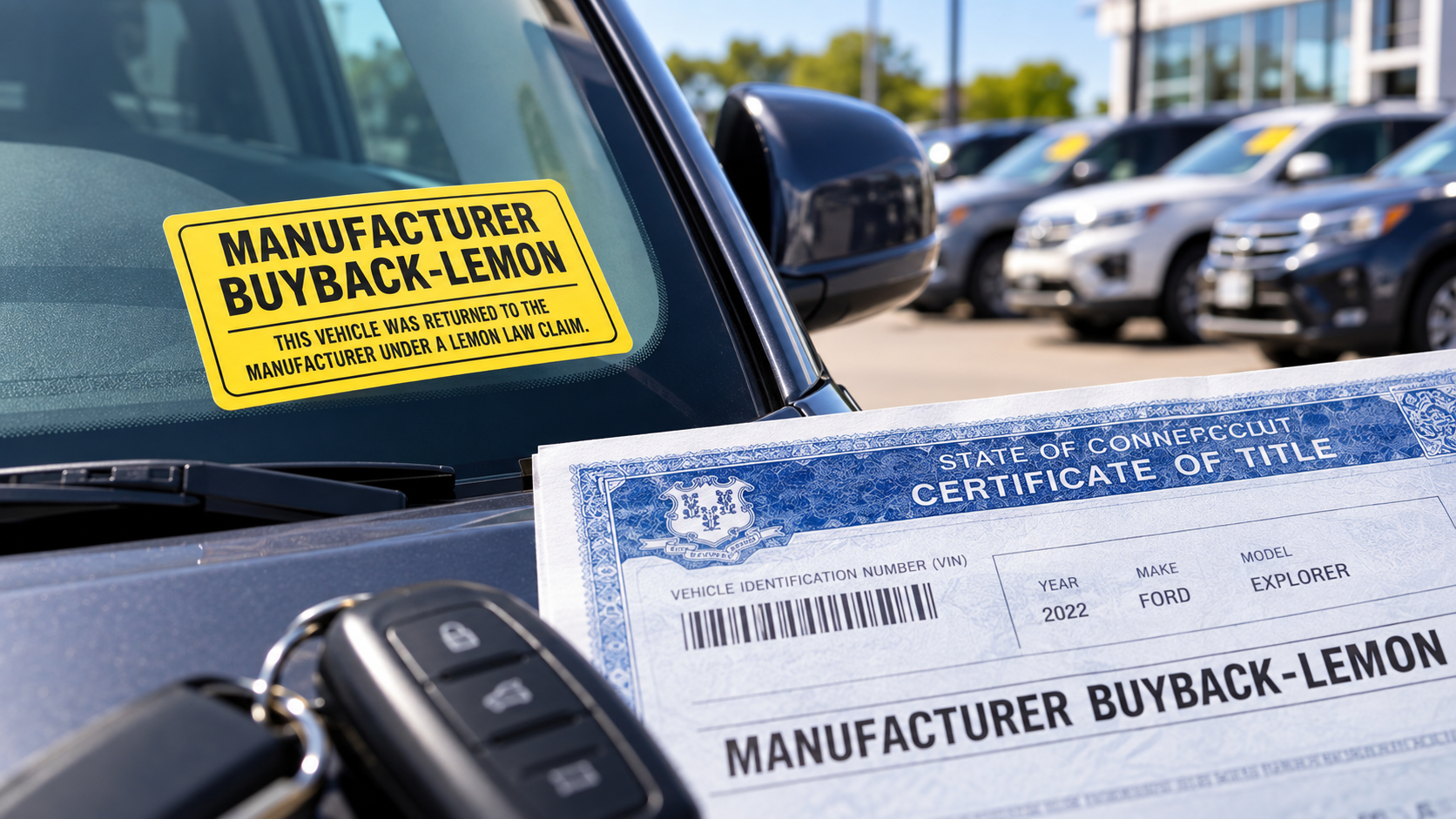
  • Lemon Titles in Connecticut: How Buyback Disclosure Works

    Lemon Titles in Connecticut: How Buyback Disclosure Works

    Lemon Titles in Connecticut: How Buyback Disclosure Works

    You find a nearly new SUV on a used car lot for thousands less than the others. Then you spot two words on the paperwork: manufacturer buyback. That usually means a lemon title was issued, and the car came back to the automaker because of a defect it couldn’t fix.

    Connecticut doesn’t ban the resale of these cars. It requires that the next buyer be told. This guide explains how a Connecticut lemon title gets branded, what the seller has to disclose, and whether that brand can ever come off.

    If you’re new to the topic, our complete guide to Connecticut lemon law covers how a car qualifies in the first place. This article picks up after the buyback. For how the buyback amount itself gets calculated, see our guide to the Connecticut lemon law refund and mileage offset.

    What Is a Lemon Title?

    A lemon title is a vehicle title that carries a permanent label, called a brand, showing the car was returned to the manufacturer under a lemon law claim or settlement. States use brands to flag a car’s history. You’ve probably heard of salvage or flood brands. A lemon brand works the same way.

    The exact wording changes from state to state. Some states say “Lemon Law Buyback.” Others say “Manufacturer Buyback” or “Lemon.” In Connecticut, the wording is set by statute, and it’s spelled out in the next section.

    How Connecticut Brands a Buyback Title

    The rules live in subsection (g) of Conn. Gen. Stat. § 42-179, the same law that gives Connecticut drivers the right to a refund or replacement for a lemon. When a manufacturer takes a car back because of a defect, the law puts several duties on it.

    1. Notify the Connecticut Department of Motor Vehicles and give it the year, make, model, VIN, and prior title number.
    2. Stamp the words “MANUFACTURER BUYBACK-LEMON” on the face of the original title in letters at least one-quarter inch high.
    3. Send a copy of the stamped title to the DMV within 30 days of receiving the title.
    4. Under the current version of the statute, send proof of that submission to the Department of Consumer Protection within the same 30 days.

    The DMV keeps a list of these buyback vehicles. When anyone later applies for a new title on one of them, the DMV prints “MANUFACTURER BUYBACK-LEMON” on the new title too. The person applying for the title also has to tell the DMV that the car was returned. That’s how the brand follows the car from owner to owner.

    Up to $10,000: the fine the Department of Consumer Protection can impose on a manufacturer that misses the 30-day stamping and submission deadline. The manufacturer can ask for a hearing within 10 days of getting notice of the fine.

    It Covers Settlements, Not Just Arbitration Wins

    A lot of people assume the brand only applies when a consumer wins a formal case. That’s not how the statute reads. The duty applies whether the car came back through a court ruling, an arbitration award, or a voluntary settlement.

    Say Daniela in Waterbury has a new crossover that stalls on I-84 four separate times. Before her arbitration hearing, the manufacturer offers to buy the car back, and she accepts. No arbitrator ever rules. The car still gets the lemon title, because the return happened in settlement of a lemon law complaint. Our walkthrough of how a CT lemon law claim works shows where settlements and arbitration fit in the process.


    What a Connecticut Buyer Must Be Told

    The title brand is one layer. The second layer is a written disclosure. Under § 42-179(g)(1), no returned lemon can be resold, transferred, or leased in Connecticut without a clear and conspicuous written disclosure that it was returned. The law requires that disclosure to show up in two places.

    • On the car itself. The disclosure has to be physically attached to the vehicle.
    • In the sale or lease contract. The disclosure also has to be written into the paperwork the buyer signs.

    The DMV’s regulations fill in the details. Conn. Agencies Regs. § 42-179-7 says the disclosure statement goes on the lower corner of the windshield farthest from the driver, where it can be read from outside the car. It also says the person who takes the car back has to file a copy of that statement with the DMV within 20 days, and the car can’t be sold or auctioned in Connecticut until that’s done.

    Key takeaway: In Connecticut, a returned lemon carries three separate signals. There’s the branded title, the windshield disclosure, and the disclosure written into the sale or lease contract.

    Cars Bought Back in Another State

    Buybacks often get shipped to auctions far from where they were returned. Connecticut’s law reaches those cars too. Subsection (g)(4) applies the disclosure rules to vehicles returned in another state when the seller or lessor knows about the return and then sells, transfers, or leases the car in Connecticut.

    Picture a pickup that was bought back in New York, sold at auction, and then put on a used lot along the Berlin Turnpike. If that Connecticut dealer actually knows it’s a buyback, the Connecticut disclosure rules apply. Note the “actual knowledge” piece. It’s one of the details that can matter a lot when a later buyer says nobody told them.

    A Hypothetical: Julian Buys a Buyback in New Haven

    Julian is shopping for a used sedan in New Haven. He finds one that’s two years old with 18,000 miles, listed at $19,500. Similar sedans nearby are going for around $24,000. A yellow sticker sits in the bottom corner of the passenger side of the windshield.

    The sticker says the car was returned to the manufacturer. The contract has a matching disclosure, and the title reads “MANUFACTURER BUYBACK-LEMON.” In this version, the system worked the way the statute describes. Julian can see the history before he signs.

    Now change one fact. The sticker is gone, the contract says nothing, and Julian only learns the truth six months later when a trade-in appraiser pulls a vehicle history report. That’s the scenario the disclosure rules exist to stop. Section 42-179(i) says the lemon law doesn’t limit rights a consumer has under any other law, so a buyer in Julian’s position might look at Connecticut’s general consumer protection statute, the Connecticut Unfair Trade Practices Act, along with contract and fraud principles. Whether any of those fit depends on the specific facts, including who knew what and when.

    Can a Lemon Title Be Removed in Connecticut?

    This is one of the most searched questions on the topic, and the honest answer has two parts. The statute and the regulations treat the windshield disclosure and the title brand differently.

    The Windshield Disclosure

    Section 42-179(g)(1) lets the Commissioner of Motor Vehicles set up a way to remove the written disclosure once the car is no longer defective. Under § 42-179-7(c), removal requires the commissioner’s written approval. That approval depends on an engineering inspection report signed by a licensed professional engineer with expertise in the specific defect.

    The report has to list the VIN, the defects behind the buyback, every diagnostic step, every part replaced or repaired, and the engineer’s license and qualifications. Whoever asks for removal pays for the inspection. The commissioner is supposed to approve or deny the request in writing within 60 days.

    The Title Brand

    The statute tells the DMV to print “MANUFACTURER BUYBACK-LEMON” on any new title issued for a listed buyback vehicle. It doesn’t spell out a process for taking that brand off the title. On top of that, state title brands get reported to the federal National Motor Vehicle Title Information System, where a brand becomes a permanent part of the car’s record.

    Watch for: A seller who says a lemon title was “cleared” because the car got repaired. A repair may support removing the windshield sticker through the engineering process. It doesn’t erase the car’s branded history in the national title database.

    Should You Buy a Car With a Lemon Title?

    That’s a personal decision, and nothing here is a recommendation either way. What the law does is make sure the information is on the table. People weighing a buyback car in Connecticut commonly look at a few things.

    • What the defect was. A rattling trim panel and a transmission that slips on the highway are very different problems.
    • Whether it was fixed. Repair records and any engineering report under the DMV regulations help show this.
    • Remaining warranty. Some manufacturers offer a warranty on buyback cars they resell, and terms vary.
    • Financing and insurance. Some lenders and insurers treat branded titles differently than clean ones.
    • Future resale. The brand stays with the car, so it will likely affect the price when you sell or trade it in later.

    On value, there’s no fixed formula. Buyback cars generally sell for less than comparable clean-title cars, which is why they can look like a bargain. The size of the gap depends on the model, the defect, and how much buyers in your area care about the brand. Buying one from a private seller instead of a dealer adds its own wrinkles, covered in our post on CT private car sale laws.

    How Connecticut Compares to Other States

    There’s no single federal lemon law title brand. Lemon laws are state laws, so each state picks its own wording, deadlines, and disclosure forms. The federal title database collects those state brands, but it doesn’t make them uniform, and brand definitions vary by state.

    That’s why a buyback car that started in another state might show a differently worded brand on an older title. Connecticut’s own label is “MANUFACTURER BUYBACK-LEMON,” and Connecticut’s rules can still apply to an out-of-state buyback that a knowing seller brings here. Older versions of the Connecticut statute used just “MANUFACTURER BUYBACK,” so you may still see that wording on titles from years past.

    Common Questions About Lemon Titles in Connecticut

    What does “lemon title issued” mean?

    It usually means a state branded the vehicle’s title after the manufacturer took it back under a lemon law claim or settlement. On a vehicle history report, it shows up as a title brand event tied to a specific state and date.

    Is it illegal to sell a lemon car in Connecticut?

    No. Selling or leasing a returned lemon is allowed. What the statute prohibits is selling, transferring, or leasing one without the required written disclosure on the car and in the contract.

    Who has to stamp the title, the dealer or the manufacturer?

    The manufacturer. Section 42-179(g) puts the stamping and DMV submission duties on the manufacturer that accepts the return. The disclosure duty, by contrast, follows the car into any later sale, transfer, or lease in Connecticut.

    How can I tell if a used car is a buyback?

    Look at the face of the title for the brand, check the lower passenger-side corner of the windshield for the disclosure sticker, and read the contract. A vehicle history report that draws on the federal title database will also list state brands.

    The Bottom Line

    Connecticut lets returned lemons go back on the road, but not quietly. Under § 42-179(g), the manufacturer brands the title “MANUFACTURER BUYBACK-LEMON,” and every later sale or lease in the state comes with a written disclosure on the car and in the contract. The windshield sticker can come off through an engineering review, but the title brand stays part of the car’s history.

    This article is for educational purposes only and is not legal advice. Reading it does not create an attorney-client relationship. For advice on your specific situation, consult a licensed attorney in your state.

  • Connecticut Lemon Law for Leased Cars Explained

    Connecticut Lemon Law for Leased Cars Explained

    Connecticut Lemon Law for Leased Cars Explained

    You signed a lease, drove a brand-new car off the lot, and now it spends more time at the service department than in your driveway. That’s usually when the big question comes up. Does the lemon law apply to leased vehicles, or only to cars people buy outright?

    In Connecticut, the answer is yes. The state’s lemon law for leased cars treats a lessee the same as a buyer when it comes to who can bring a claim. What changes is the money side. A lease has no single purchase price, and there’s a third party in the picture: the leasing company.

    This article explains how Connecticut lemon law handles a leased car, what happens to the lease contract, and how a refund gets divided. For the full picture of the law itself, see our Connecticut lemon law guide.


    Does Connecticut Lemon Law Apply to Leased Cars?

    The core law is Conn. Gen. Stat. § 42-179. Its definition of “consumer” includes a buyer, a lessee, anyone the car is transferred to while the warranty is still running, and anyone entitled to enforce the warranty. A lessee is named directly. Nobody has to argue their way in.

    Lease coverage isn’t new, either. Connecticut lawmakers extended the lemon law to leased vehicles in 1987, and the state arbitration program covers leases signed on or after June 17, 1987.

    The car still has to fit the law’s other rules. It must be a passenger vehicle, a combination passenger and commercial vehicle, or a motorcycle. It also has to be sold or leased in Connecticut.

    Quick answer: Yes. Connecticut’s lemon law lists lessees by name in its definition of “consumer.” A leased car gets the same basic lemon protections as a purchased one.

    What Makes a Leased Car a Lemon in Connecticut

    The test is the same whether you lease or buy. The car has to have a defect covered by the manufacturer’s express warranty that substantially impairs its use, safety, or value. Then the manufacturer or its dealers have to fail to fix it after a reasonable number of attempts. Our post on what qualifies as a lemon in CT breaks down each part of that test.

    The law presumes a reasonable number of attempts happened in any of these situations:

    • The same problem was repaired four or more times within two years of delivery or the first 24,000 miles, whichever ends first, and it still isn’t fixed.
    • The car was out of service for repairs a total of 30 or more calendar days during that same two-year or 24,000-mile window.
    • A defect likely to cause death or serious injury was repaired at least twice within the warranty term or one year from delivery, whichever ends first, and it still exists.

    At least one repair attempt is required before any claim, unless the dealer refused to try. On a typical 36-month lease, the main protected window covers the first two years, or the first 24,000 miles if the odometer gets there sooner.

    How a Lemon Law Refund Works on a Lease

    Here’s where leases get tricky. For a purchase, the statute lists what gets refunded. That’s the full contract price, collateral charges like sales tax and registration fees, certain finance charges, and incidental damages, minus a reasonable allowance for use. Our guide to the Connecticut lemon law refund and mileage offset works through that purchase math step by step.

    A lease doesn’t fit neatly into that list. A lessee never paid a “full contract price.” They paid a down payment, some fees, and a stream of monthly payments. Meanwhile, the leasing company paid the dealer for the car and still owns it.

    Connecticut handles this with one short phrase. The refund goes to “the consumer, lessor and lienholder, if any, as their interests may appear.” In plain English, each party gets back an amount that reflects its own stake in the car.

    The Lessee’s Share

    Generally, the lessee’s share reflects money they actually put into the lease. That can include the down payment (often called a capitalized cost reduction), the monthly payments made so far, and fees and taxes paid at signing. Incidental costs tied to the defect, like towing or a rental car during repairs, can come into play too.

    The Leasing Company’s Share

    The leasing company, called the lessor, has its own stake. It bought the car and expects to be paid for it over the life of the lease. Its share generally reflects what it’s still owed on the vehicle.

    Once the manufacturer takes the car back and pays both sides, the lease is generally closed out. The lessee isn’t left making monthly payments on a car the manufacturer has already reclaimed.

    Why There’s No Fixed Lease Formula

    Connecticut’s statute doesn’t spell out a separate refund formula for leases. The Department of Consumer Protection says the law gives basic guidelines but no fixed rule, and that each arbitration award is decided case by case.

    The mileage deduction shows why. The statute’s use allowance multiplies the total contract price by the miles driven before the manufacturer accepted the car back, then divides by 120,000. On a lease, it isn’t obvious what “total contract price” means. DCP also notes that an arbitrator may or may not award a mileage deduction at all.

    How Connecticut Differs From New York on Leased Lemons

    New York’s lemon law, N.Y. General Business Law § 198-a, takes a much more detailed approach. It defines terms like “lease price” and “capitalized cost,” then says exactly how a refund splits. The lessee receives the capitalized cost, and the lessor receives the lease price minus the deposit and rental payments already paid.

    Connecticut keeps it short and leaves more to the arbitrator. That allows flexibility for unusual lease deals. It also means less certainty about the final number before a decision comes down. For drivers who live in one state and lease in the other, that difference is worth understanding.


    Hypothetical: Danielle’s Leased SUV in West Hartford

    Say Danielle, who lives in West Hartford, leases a new compact SUV from a dealership on the Berlin Turnpike in Newington. She puts $2,500 down and agrees to 36 payments of $449. Within ten months, the transmission shudders on every highway on-ramp. The dealer works on it four times, and the shudder is still there at 9,000 miles.

    Four repairs for the same problem inside the two-year, 24,000-mile window fits the presumption in § 42-179. When Danielle files for state arbitration, she sends her leasing company a certified letter saying she’s applying. The leasing company can then ask to join the case.

    Now the money. By month eleven, Danielle has paid $2,500 down plus 11 payments of $449, which is $4,939. That’s $7,439 in lease payments. Say she also paid $600 in fees and taxes at signing. Her side of a refund would generally reflect the roughly $8,000 she put in, plus documented costs like the $180 she spent on rental cars while the SUV sat at the dealer.

    The leasing company’s side would generally reflect what it’s still owed on the SUV. Say that’s $29,000. The manufacturer pays the leasing company, takes the SUV back, and the lease ends.

    $38,000 x 9,000 miles / 120,000 = $2,850
    What the statute’s use allowance would look like if an arbitrator applied it to a $38,000 contract price.

    That deduction is the open question in Danielle’s case. Whether any mileage deduction applies, how it’s calculated on a lease, and whose share it comes out of are all things the arbitrator decides.

    The Lessor Notice Rule for Connecticut Lessees

    Connecticut adds a step that only applies to people who lease. When a lessee files for arbitration, Conn. Gen. Stat. § 42-181 requires notice to the lessor by registered or certified mail, return receipt requested. The lessor can then petition the arbitrator to become a party. This letter is separate from any notice to the manufacturer the warranty may require.

    The same idea applies in court. Under Conn. Gen. Stat. § 42-186, a lessee who sues the manufacturer must notify the lessor the same way when the manufacturer is served. The lessor can then ask the court to join the case.

    Watch the paperwork: The lessor notice letter is a step the statute builds in for lessees. DCP’s consumer guidance also says to keep a copy of the letter and the postal receipt for a possible arbitration hearing.

    Leasing companies have duties of their own. Under Conn. Gen. Stat. § 42-179b, anyone in the business of leasing new vehicles must give the lessee written information about the new car warranty and dispute program when the lease is signed.

    Arbitration or Superior Court for a Leased Lemon

    Most Connecticut lemon claims go through the Connecticut Lemon Law Arbitration Program, run by the Department of Consumer Protection. The consumer filing fee is $50, and the statute calls for a decision within 60 days of filing. DCP says consumers aren’t required to use an attorney, though they’re free to.

    If a manufacturer has its own dispute program certified by the Connecticut Attorney General, the law says a consumer has to go through that program first before the refund and replacement rules kick in. After an arbitration decision, either side can ask the Connecticut Superior Court to confirm, vacate, or modify the award.

    A lessee can also file a lawsuit in Superior Court. In warranty cases tied to a sale or lease, Conn. Gen. Stat. § 42-180 lets the court award the consumer costs and reasonable attorney’s fees.

    Common Questions About Leased Cars and Lemon Law in Connecticut

    Does lemon law apply to leased vehicles from another state?

    Connecticut’s law covers vehicles sold or leased in Connecticut. A car leased in New York or New Jersey generally falls under that state’s lemon law instead. DCP has also said that someone living out of state can be covered if the car was leased in Connecticut and meets the other rules.

    Does a lessee need the leasing company’s permission to file?

    The statute doesn’t require permission. It requires notice. The lessee sends the lessor a registered or certified letter, and the lessor decides whether it wants to join.

    Does a lemon law refund pay back monthly lease payments?

    The refund is split among the lessee, the lessor, and any lienholder based on their interests. In general, the lessee’s share reflects what they paid into the lease. Connecticut has no fixed formula, though, and the arbitrator decides each award individually.

    Can a leased lemon get a replacement car instead of a refund?

    The statute allows either one. A manufacturer can replace the car with a new vehicle acceptable to the consumer, or take it back and pay the refund. Arbitration awards can include either remedy.

    Can a returned lemon be leased to someone else?

    Yes, but only with clear written disclosure. The disclosure has to be attached to the car and included in the new sale or lease contract. The manufacturer also has to stamp “MANUFACTURER BUYBACK-LEMON” on the title. Our guide to lemon titles in Connecticut explains how that disclosure follows the car.


    The Bottom Line on Leased Lemons in Connecticut

    Connecticut treats a lessee as a full consumer under its lemon law, so a leased car can qualify just like a purchased one. The big differences are the notice letter to the leasing company and a refund that gets divided between lessee and lessor instead of paid to one person. For deadlines, repair rules, and the arbitration process in more depth, our Connecticut lemon law guide covers the full law.

    This article is for educational purposes only and is not legal advice. Reading it does not create an attorney-client relationship. For advice on your specific situation, consult a licensed attorney in your state.