NJ Used Car Lemon Law: Do Used Cars Actually Qualify?
If you bought a used car in New Jersey and it started breaking down within weeks, you have probably found conflicting answers about whether the NJ used car lemon law covers you. Most people assume lemon laws only protect new car buyers. In New Jersey, that assumption is wrong.
New Jersey is one of a small group of states with a separate lemon law written just for used vehicles. It works nothing like the new car version. Instead of a two year protection window, it forces the dealer to hand you a written warranty that can be as short as 30 days.
Whether your car qualifies comes down to four numbers on your sales paperwork. Here is how the law actually operates, which cars it leaves out, and what other options exist when it does not apply.
Does the NJ Lemon Law Apply to Used Cars?
Yes, but through a completely different statute than the one people usually mean. New Jersey runs two lemon laws side by side. The New Car Lemon Law, at N.J.S.A. 56:12-29 and following, covers vehicles for two years or 24,000 miles from original delivery.
The Used Car Lemon Law is found at N.J.S.A. 56:8-67 and following, tucked inside the Consumer Fraud Act. It does not go after the manufacturer. It puts the obligation on the New Jersey dealer who sold you the car, and it only lasts as long as a short mileage based warranty.
The short version: New Jersey used cars are covered, but only when sold by a dealer, only if four thresholds are met, and only for 30, 60, or 90 days depending on the odometer.
Which Used Cars Qualify Under New Jersey Law
Under N.J.A.C. 13:45A-26F.3, a New Jersey dealer has to give you a written warranty on a used car unless one of five things is true. Flip that around and you get the eligibility test. Your car generally qualifies when all of these are met at the time of sale.
- The purchase price was $3,000 or more
- The vehicle is seven model years old or less
- The odometer read 100,000 miles or less
- The vehicle was not declared a total loss by an insurance company
Miss one and the statutory warranty never attaches. A $2,700 commuter car bought in Bayonne is outside the law. So is a nine model year old pickup, and so is a car that crossed 100,000 miles before you signed.
Vehicles the Used Car Lemon Law Leaves Out
The statute defines a used motor vehicle as a passenger vehicle and specifically excludes motorcycles, motor homes, and off road vehicles. So a used Harley bought from a Jersey dealer gets no statutory warranty under this law, even though a new motorcycle is covered by the New Car Lemon Law.
There is also a lease loophole most buyers never hear about. If you leased a car for more than 90 days and then bought it out at lease end from the same leasing company, that sale falls outside the definition. The same exclusion covers a family member or employee of the lessee.
Private sales are the biggest gap. The law reaches dealers, and it defines a dealer as any person or business that has sold or offered three or more used vehicles in the previous 12 months. That definition matters. Someone flipping cars out of a driveway in Elizabeth can meet it without holding a license.
The Warranty New Jersey Dealers Have to Give You
For qualifying cars, the length of the warranty scales to the mileage on the odometer when you bought it. These are floors, not ceilings. A dealer can always offer more.
- 24,000 miles or less: 90 days or 3,000 miles, whichever comes first
- More than 24,000 but less than 60,000 miles: 60 days or 2,000 miles, whichever comes first
- 60,000 miles or more: 30 days or 1,000 miles, whichever comes first
Two details do a lot of work here. First, you can be charged a deductible of up to $50 for each repair of a covered item, so warranty work is not automatically free. Second, the warranty period stretches for any time the car sits waiting for the dealer to start or finish a repair, which keeps a slow shop from running out your clock.
If a New Jersey dealer never hands you the written warranty and you never signed a valid waiver, the regulation treats the dealer as having given it anyway. The paperwork gap does not erase the obligation.
What Counts as a Covered Item
This is where a lot of online summaries get New Jersey wrong by borrowing New York’s list. Under N.J.A.C. 13:45A-26F, covered items are drivetrain parts. Engine internals and related components, the automatic or manual transmission and transfer case, front wheel drive components, and rear wheel drive components.
Brakes, steering, air conditioning, and electronics are not on that list. A failing infotainment screen in a used SUV from Paramus is a real annoyance, but it is not what this warranty was built to catch.
The warranty also excludes repairs already covered by a manufacturer warranty or recall, plus damage from collision, abuse, commercial use, skipped maintenance, or work done by someone other than the dealer.
When As Is Sales Are Legal in New Jersey
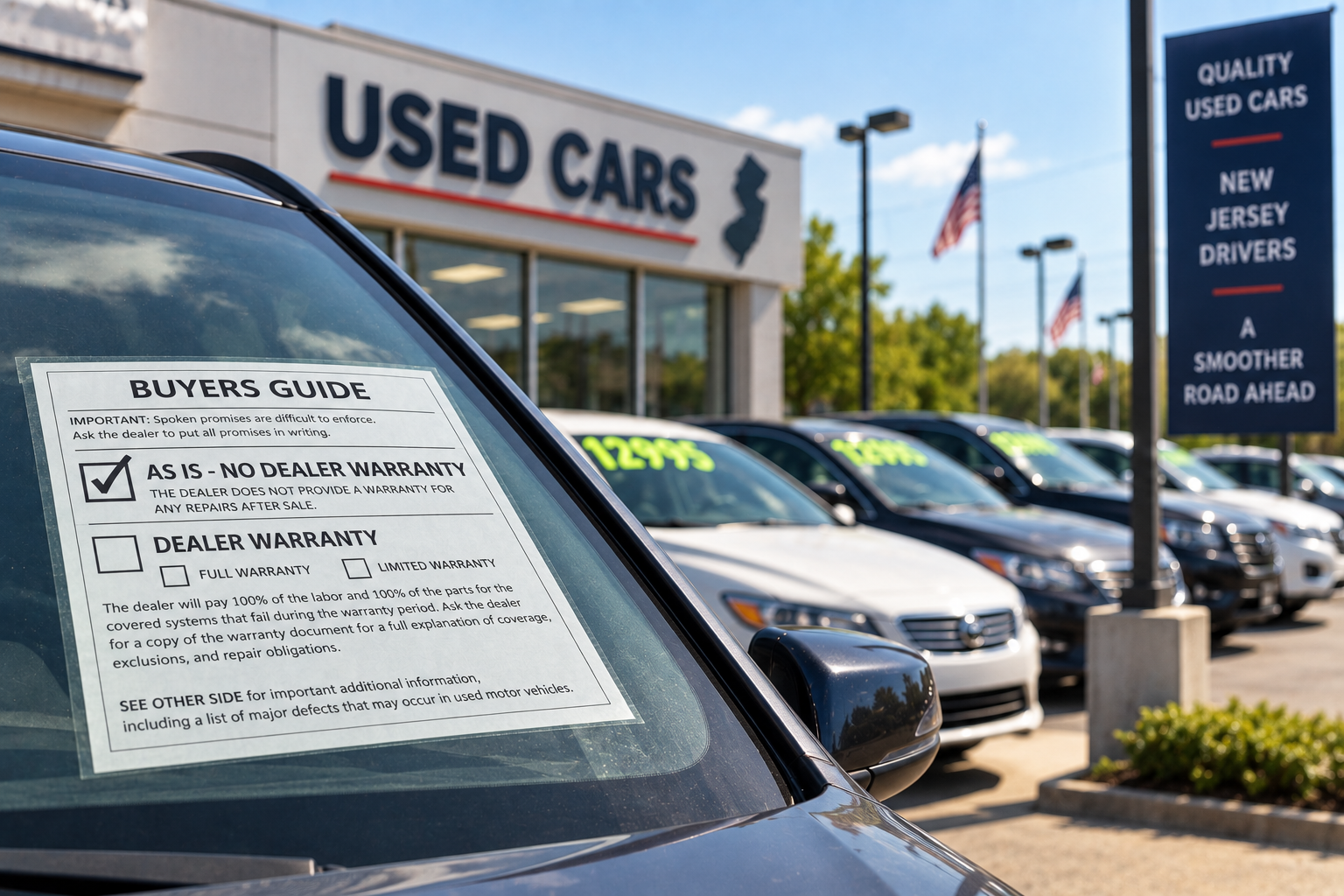
Plenty of New Jersey buyers are told the car is sold as is and assume that settles it. Under the Used Car Lemon Law, a waiver only works on vehicles with more than 60,000 miles. Below that, a dealer cannot waive the warranty at all.
Even above 60,000 miles the waiver has to follow a strict format. It must be in writing, use the state’s As Is Disclosure and Waiver forms, and be signed separately from the contract of sale. A checkbox buried in a sales agreement does not meet that standard.
An as is sticker on a 38,000 mile car at a licensed New Jersey dealership does not override the statutory warranty. The mileage tier decides that question, not the window sticker.
Three Repair Attempts or 20 Days Out of Service
A covered car becomes a lemon under this law when a material defect survives the repair process. A material defect is a malfunction that substantially impairs the car’s use, value, or safety. Two triggers exist, and hitting either one is enough.
- The same material defect has been in for repair three or more times and still exists
- The car has been out of service a cumulative total of 20 or more days waiting on the dealer
The consumer’s side of the bargain is notice and access. You have to tell the dealer about the defect and deliver the car to the dealer’s regular place of business before the warranty period runs out.
Where the dealer refuses to refund, a consumer can go to the Division of Consumer Affairs dispute resolution program run with the Office of Administrative Law, use the Division’s alternative dispute resolution track, go through a dealer’s own informal program, or file in the Superior Court of New Jersey. Filing a used car claim with the Lemon Law Unit carries no fee, while a Superior Court filing does, according to the Division’s used car consumer brief.
How the Refund Math Works
A used car refund starts with the total purchase price. Sales tax, title and registration fees, and similar government charges come out. So does a reasonable allowance for excessive wear and tear.
Then there is a deduction for personal use. New Jersey calculates it using the IRS business mileage rate in effect on the repurchase date, multiplied by every mile driven since purchase. The longer you drive a disputed car, the smaller the check gets.
An Example: Rosa’s Sedan in Passaic County
Say Rosa buys a four year old sedan from a licensed dealer on Route 46 in Clifton. She pays $9,800 and the odometer reads 41,000 miles. That drops her into the middle tier, so the dealer owes her a 60 day or 2,000 mile warranty.
Eleven days in, the transmission starts slipping between second and third gear. She brings it back and the dealer replaces a solenoid. Three weeks later it slips again, and the dealer keeps it four days for a fluid service and software update.
On day 52 it slips a third time. The dealer keeps the car six days and cannot find the cause. Rosa now has three documented attempts at the same material defect, on a covered drivetrain component, inside her warranty window. That combination is what the statute describes.
Now change one fact. If Rosa had paid $2,800 instead of $9,800, no statutory warranty would have attached at all, and the same transmission would be her problem. Rosa is made up, and every real situation turns on its own paperwork and timing.
When a Used Car Is Still Under the New Car Lemon Law
Here is the overlap almost nobody mentions. The New Car Lemon Law defines a consumer to include a person the vehicle is transferred to during the duration of an applicable warranty. Its protection period runs two years or 24,000 miles from the original delivery date, not from your purchase date.
So a lightly used car can sit inside both laws at once. Picture a 14 month old crossover with 16,000 miles bought off a lot in Cherry Hill. The used car warranty tier applies, and the original two year and 24,000 mile window has not closed yet either.
That distinction changes who is on the hook. The used car law points at the dealer. The new car law points at the manufacturer and requires a certified mail final chance letter. Our complete New Jersey Lemon Law guide walks through that notice step and the hearing process in detail.
What Happens When the Used Car Lemon Law Does Not Apply
Falling outside the thresholds is not the end of the analysis. The New Jersey Consumer Fraud Act reaches deception in the sale itself, like a rolled back odometer, a hidden accident history, or a branded title nobody disclosed. Violations of the used car regulations are themselves subject to Consumer Fraud Act sanctions.
If the car came with any written warranty or a service contract, the federal Magnuson-Moss Warranty Act can apply on top of state law. It governs written warranties on consumer products nationwide, including cars.
There is also the ordinary court route. New Jersey’s Special Civil Part hears money claims up to $20,000, and its Small Claims Section handles disputes of $5,000 or less. That is a realistic forum for a repair bill fight in Toms River or Hackensack that never reaches lemon law territory.
Common Questions About the NJ Used Car Lemon Law
Does the NJ lemon law cover a car bought from a private seller?
Generally no. The Used Car Lemon Law runs against dealers. A seller who has sold or offered three or more used vehicles in the past 12 months can meet the definition of dealer, so the label on the transaction is not always the end of the question.
Can a New Jersey dealer sell a used car as is?
Only in narrow circumstances. Above 100,000 miles the law does not require a warranty. Between 60,000 and 100,000 miles the buyer can waive it, but only in a separately signed writing on the state’s forms. Under 60,000 miles a dealer cannot waive it.
Does the NJ used car lemon law cover motorcycles or RVs?
No. Motorcycles, motor homes, and off road vehicles are written out of the definition of a used motor vehicle. New motorcycles and the vehicle portion of new motor homes are handled under the New Car Lemon Law instead.
What if the dealer never gave me a written warranty?
The regulation says a dealer who fails to provide the required warranty is deemed to have given it as a matter of law, unless the buyer signed a valid waiver. Missing paperwork does not automatically mean missing coverage.
How long does a used car lemon law warranty last in New Jersey?
Thirty, 60, or 90 days, keyed to the odometer at sale, with a matching mileage cap of 1,000, 2,000, or 3,000 miles. The period also extends by any time the car spends waiting on the dealer to begin or finish a repair.
The Bottom Line on Used Cars in New Jersey
New Jersey does protect used car buyers, and it does it through a dealer warranty that turns on price, model year, mileage, and total loss history. The window is short and the covered parts list is narrower than most people expect.
Because the warranty can expire in as little as 30 days, the calendar tends to decide these questions faster than the mechanics do. Understanding which tier a car falls into is where the analysis starts.
This article is for educational purposes only and is not legal advice. Reading it does not create an attorney-client relationship. For advice on your specific situation, consult a licensed attorney in your state.