How a New Jersey Traffic Ticket Works, From the Stop to the Surcharge Bill
Most people think a New Jersey traffic ticket ends when the fine is paid. It usually doesn’t. One ticket passes through three different offices: the municipal court that hears it, the Motor Vehicle Commission that records the points, and the state program that bills surcharges. Each one can cost money, and some of those costs show up a year later.
The easiest way to see how it all fits together is to follow one ticket from start to finish. So that’s what this guide does.
Meet Carla. She lives in Hoboken, drives a Jeep Grand Cherokee, and just got stopped in Secaucus doing 72 in a 50 mph zone. We’ll follow her ticket through every stage.
Carla is fictional, and nothing here is advice about any real ticket. This is general education about how New Jersey law works.
Stage 1: Reading a New Jersey Traffic Ticket
Carla’s ticket tells her three important things. The charge, which cites N.J.S.A. 39:4-98, New Jersey’s speeding statute. The court, which is Secaucus Municipal Court, because New Jersey tickets go to the municipal court in the town where the stop happened. And whether a court appearance is required.
Her ticket doesn’t require an appearance, so she could pay it online through NJMCdirect, the Judiciary’s municipal court system. According to the New Jersey Courts, NJMCdirect lets people plead guilty and pay, set up installment payments, enter a not guilty plea, and request a plea agreement from the municipal prosecutor for certain charges.
What Carla Might Not Realize About NJMCdirect
Paying online is a guilty plea. The conviction goes to the MVC, the points attach, and any chance to negotiate the charge is over.
There’s also a practical trap. Several lookalike websites use “njmcdirect” in their web addresses, and some show up in search ads. The New Jersey Courts link to the real system from their municipal court self-help page, which also explains how to find a lost ticket. Drivers who don’t know which town wrote a ticket can call the Judiciary at 609-421-6100 and have it looked up by license number.
Stage 2: Municipal Court and the Plea Offer
Say Carla doesn’t pay. She enters a not guilty plea and gets a court date. This is where New Jersey looks very different from New York City, where traffic tickets go to a DMV bureau with no prosecutor at all. New Jersey municipal courts have municipal prosecutors, and plea agreements are a routine part of resolving traffic cases.
A plea agreement usually means pleading guilty to a different charge. The prosecutor decides whether to offer one, and the judge has to approve it. If there’s no deal, the case goes to trial, and the State has to prove the charge.
The “No-Point” Charge: Unsafe Driving
The charge that comes up most often in New Jersey plea talks is unsafe driving under N.J.S.A. 39:4-97.2. It’s a catch-all offense for driving in an unsafe manner likely to endanger a person or property. What makes it popular is how it handles points:
First conviction: $50 to $150 fine, no points
Second conviction: $100 to $250 fine, no points
Third conviction: $200 to $500 fine, plus 4 points if it falls within five years of the second
The catch is a $250 surcharge the court adds to every unsafe driving conviction. A no-point plea trades points for a bigger bill up front.
Carla’s Two Paths
Carla was 22 over. Convicted as charged, that’s 4 points. And because she was 20 mph or more over the limit, N.J.S.A. 39:4-98.7 doubles the fine.
If the prosecutor offers unsafe driving instead, and it’s her first, she’d pay the unsafe driving fine, the $250 surcharge, and court costs, with no points. Nothing requires the prosecutor to make that offer. Whether it’s offered, and whether it’s worth taking, depends on the facts and the driver’s record.
Heads up: Under New Jersey’s cell phone statute, when a handheld phone violation is used as the substitute charge in a plea, it carries the same penalty as unsafe driving, including the $250 surcharge, and counts toward the unsafe driving tally.
Stage 3: What the NJ MVC Does With a Conviction
Once the court enters a conviction, it reports it to the Motor Vehicle Commission. The MVC adds points using the official NJ points schedule. Say Carla’s case ends with a speeding conviction as charged. Her record picks up 4 points.
Here’s how some of the most common charges score in New Jersey:
Speeding: 2 points (1 to 14 over), 4 points (15 to 29 over), 5 points (30 or more over)
Careless driving: 2 points
Reckless driving, tailgating, or improperly passing a school bus: 5 points
Improper passing on the right or in a no passing zone: 4 points
Improper turn or U-turn: 3 points
Running a red light, stop sign, or yield sign: 2 points
Leaving the scene of an accident with personal injury: 8 points
Any moving violation committed in another state: 2 points
12 points is where New Jersey suspends driving privileges, according to the MVC. Carla, at 4, is well under it, for now.
The Out-of-State Rule That Surprises New York Commuters
That last line on the list matters for anyone who drives into New York for work. New Jersey adds 2 points for a moving violation committed in another state. New York generally does the opposite and doesn’t add points for out-of-state convictions.
So if Carla later gets a speeding ticket on the West Side Highway and is convicted in New York, her New Jersey record picks up 2 more points. She’d be at 6.
How Points Come Down in NJ
New Jersey points don’t simply expire on a date. The violation stays on the driving record, and the point total shrinks over time. According to the MVC’s FAQ, a driver who goes one year from the most recent violation without new points or violations gets 3 points deducted. There are two other routes:
Time. Three points come off for each violation-free year.
A defensive driving course. The MVC’s driver programs page says a state-approved New Jersey course may remove 2 points, once every five years, and only if there are points on the record when the course is finished.
An MVC-ordered program. The MVC can direct drivers into a Driver Improvement Program or, for newer drivers, a Probationary Driver Program. These are based on the driving record, not something a driver just signs up for.
Here’s the part most drivers miss. None of those reductions touch the surcharge. That’s the next stage.
Stage 4: The NJ MVC Surcharge Bill
Surcharges are a separate state charge, billed through the New Jersey Surcharge Violation System. They have nothing to do with the court fine, and the MVC says it has no authority to waive them.
According to the MVC’s surcharge page, a driver with six or more points within three years gets a $150 surcharge plus $25 for each point over six, and it can be billed every year for three years. The clock runs from the date each violation is posted to the driving record, not the date of the ticket.
Back to Carla. Her 4-point speeding conviction alone doesn’t trigger anything. But add that 2-point New York ticket, and she’s at 6 points within three years. That’s a $150 surcharge, and it can come back each year for three years. A defensive driving course might bring her point total down, but the MVC says the course and the safe driving credit don’t reduce surcharge points.
Surcharges That Don’t Depend on Points
Some convictions carry their own surcharge, billed every year for three years:
Unlicensed driver or expired license: $100 a year ($300 total)
Driving with a suspended license: $250 a year ($750 total)
Operating an uninsured vehicle: $250 a year ($750 total)
First or second DWI: $1,000 a year ($3,000 total)
Unpaid surcharges can lead to collection action, including a judgment filed with the Superior Court. The MVC notes that judgments can lead to wage garnishment and can be paid from state tax refunds.
Stage 5: A Suspended License in NJ
Suppose Carla had ignored her court date instead. The municipal court could suspend her driving privileges for failure to appear. Reaching 12 points is another path to suspension, and some offenses carry their own suspensions regardless of points.
How to Check If a License Is Suspended in NJ
The MVC mails suspension notices to the address on file, so an outdated address can mean a driver never sees one. A driver history abstract, requested through the MVC’s online services, shows violations, points, and suspensions on the record.
Driving While Suspended
Driving during a suspension is a separate offense under N.J.S.A. 39:3-40. A first conviction carries a $500 fine, and repeat convictions bring higher fines and jail. It also triggers that $250-a-year surcharge.
How License Restoration Works in NJ
A New Jersey license doesn’t switch back on by itself. Based on the MVC’s suspensions and restorations page and its surcharge guidance, restoration generally runs in this order:
Resolve whatever caused the suspension, such as the open ticket or unpaid fine.
Send the MVC proof that outstanding fines or tickets are paid. The MVC says this is the driver’s responsibility.
If surcharges are owed, pay at least 5 percent of the outstanding surcharge balance.
Pay the $100 driver license restoration fee.
Wait for written notice of restoration from the MVC before driving.
That last step is the one people skip. The MVC is explicit that a suspended driver can’t drive until the written restoration notice arrives. Driving in the gap risks a brand new 39:3-40 charge.
Quick Reference: New Jersey’s Most Common Traffic Charges
Carla’s ticket was for speeding. Here’s how the other charges New Jersey drivers ask about most often compare.
Careless Driving (N.J.S.A. 39:4-97): 2 Points
N.J.S.A. 39:4-97 covers driving without due caution in a way that endangers, or is likely to endanger, people or property. It’s often written after a fender bender the officer didn’t witness. Say Dana rear-ends a pickup in stop-and-go traffic on Route 17 in Paramus. No one’s hurt, but the responding officer writes careless driving, which would add 2 points if Dana is convicted.
Reckless Driving (N.J.S.A. 39:4-96): 5 Points
N.J.S.A. 39:4-96 covers driving heedlessly, in willful or wanton disregard of others’ safety. A first conviction can bring up to 60 days in jail, a $50 to $200 fine, or both. A second can bring up to three months and a $100 to $500 fine. It isn’t a felony. It’s a Title 39 motor vehicle offense heard in municipal court.
Handheld Cell Phone Use (N.J.S.A. 39:4-97.3): 0 to 3 Points
Under N.J.S.A. 39:4-97.3, fines run $200 to $400 for a first offense, $400 to $600 for a second, and $600 to $800 for a third or later. Points only start at the third offense, which carries 3 points and a possible 90-day suspension at the judge’s discretion. Offenses more than 10 years apart are treated as a lower-level offense for sentencing.
Red Lights: Officers Only
New Jersey’s red light camera pilot program ended in December 2014, and the state doesn’t run red light cameras today. A red light ticket in New Jersey comes from an officer and carries 2 points.
Default Speed Limits
When no other limit is posted, N.J.S.A. 39:4-98 sets 25 mph in business and residential districts, 35 mph in suburban business and residential districts, and 50 mph elsewhere. Some highways are posted at 65 mph under a separate law.
Five Myths About New Jersey Traffic Tickets
Myth: “Points stay on your NJ license for exactly three years.”
Not quite. The violation stays on the record, and the point total drops by 3 for each violation-free year. The three-year number people remember comes from the surcharge lookback, which is a different system.
Myth: “A defensive driving course lowers my surcharge.”
It doesn’t. The MVC says the 2-point course reduction and the 3-point safe driving credit don’t reduce surcharge points.
Myth: “A ticket in New York won’t affect my New Jersey license.”
It can. New Jersey assigns 2 points for moving violations committed out of state.
Myth: “Paying online just makes the ticket go away.”
Paying is a guilty plea. The conviction and points go to the MVC, and the option to negotiate is gone.
Myth: “Once my suspension ends, I can drive again.”
Restoration isn’t automatic. The MVC requires the restoration fee and any other conditions first, and says not to drive until written notice of restoration arrives.
Where Carla Ends Up
One stop in Secaucus put Carla in front of a municipal court, onto the MVC point system, and potentially into the surcharge program years later. Which of those she feels depends on what happens at each stage, starting with whether that first online payment ever gets made.
That’s the core of how New Jersey traffic tickets work. The court, the MVC, and the surcharge system each keep their own rules, and understanding all three is the only way to see what a single ticket really costs.
This article is for educational purposes only and is not legal advice. Reading it does not create an attorney-client relationship. For advice on your specific situation, consult a licensed attorney in your state.
NJ Used Car Lemon Law: Do Used Cars Actually Qualify?
If you bought a used car in New Jersey and it started breaking down within weeks, you have probably found conflicting answers about whether the NJ used car lemon law covers you. Most people assume lemon laws only protect new car buyers. In New Jersey, that assumption is wrong.
New Jersey is one of a small group of states with a separate lemon law written just for used vehicles. It works nothing like the new car version. Instead of a two year protection window, it forces the dealer to hand you a written warranty that can be as short as 30 days.
Whether your car qualifies comes down to four numbers on your sales paperwork. Here is how the law actually operates, which cars it leaves out, and what other options exist when it does not apply.
Does the NJ Lemon Law Apply to Used Cars?
Yes, but through a completely different statute than the one people usually mean. New Jersey runs two lemon laws side by side. The New Car Lemon Law, at N.J.S.A. 56:12-29 and following, covers vehicles for two years or 24,000 miles from original delivery.
The Used Car Lemon Law is found at N.J.S.A. 56:8-67 and following, tucked inside the Consumer Fraud Act. It does not go after the manufacturer. It puts the obligation on the New Jersey dealer who sold you the car, and it only lasts as long as a short mileage based warranty.
The short version: New Jersey used cars are covered, but only when sold by a dealer, only if four thresholds are met, and only for 30, 60, or 90 days depending on the odometer.
Which Used Cars Qualify Under New Jersey Law
Under N.J.A.C. 13:45A-26F.3, a New Jersey dealer has to give you a written warranty on a used car unless one of five things is true. Flip that around and you get the eligibility test. Your car generally qualifies when all of these are met at the time of sale.
The purchase price was $3,000 or more
The vehicle is seven model years old or less
The odometer read 100,000 miles or less
The vehicle was not declared a total loss by an insurance company
Miss one and the statutory warranty never attaches. A $2,700 commuter car bought in Bayonne is outside the law. So is a nine model year old pickup, and so is a car that crossed 100,000 miles before you signed.
Vehicles the Used Car Lemon Law Leaves Out
The statute defines a used motor vehicle as a passenger vehicle and specifically excludes motorcycles, motor homes, and off road vehicles. So a used Harley bought from a Jersey dealer gets no statutory warranty under this law, even though a new motorcycle is covered by the New Car Lemon Law.
There is also a lease loophole most buyers never hear about. If you leased a car for more than 90 days and then bought it out at lease end from the same leasing company, that sale falls outside the definition. The same exclusion covers a family member or employee of the lessee.
Private sales are the biggest gap. The law reaches dealers, and it defines a dealer as any person or business that has sold or offered three or more used vehicles in the previous 12 months. That definition matters. Someone flipping cars out of a driveway in Elizabeth can meet it without holding a license.
The Warranty New Jersey Dealers Have to Give You
For qualifying cars, the length of the warranty scales to the mileage on the odometer when you bought it. These are floors, not ceilings. A dealer can always offer more.
24,000 miles or less: 90 days or 3,000 miles, whichever comes first
More than 24,000 but less than 60,000 miles: 60 days or 2,000 miles, whichever comes first
60,000 miles or more: 30 days or 1,000 miles, whichever comes first
Two details do a lot of work here. First, you can be charged a deductible of up to $50 for each repair of a covered item, so warranty work is not automatically free. Second, the warranty period stretches for any time the car sits waiting for the dealer to start or finish a repair, which keeps a slow shop from running out your clock.
If a New Jersey dealer never hands you the written warranty and you never signed a valid waiver, the regulation treats the dealer as having given it anyway. The paperwork gap does not erase the obligation.
What Counts as a Covered Item
This is where a lot of online summaries get New Jersey wrong by borrowing New York’s list. Under N.J.A.C. 13:45A-26F, covered items are drivetrain parts. Engine internals and related components, the automatic or manual transmission and transfer case, front wheel drive components, and rear wheel drive components.
Brakes, steering, air conditioning, and electronics are not on that list. A failing infotainment screen in a used SUV from Paramus is a real annoyance, but it is not what this warranty was built to catch.
The warranty also excludes repairs already covered by a manufacturer warranty or recall, plus damage from collision, abuse, commercial use, skipped maintenance, or work done by someone other than the dealer.
When As Is Sales Are Legal in New Jersey
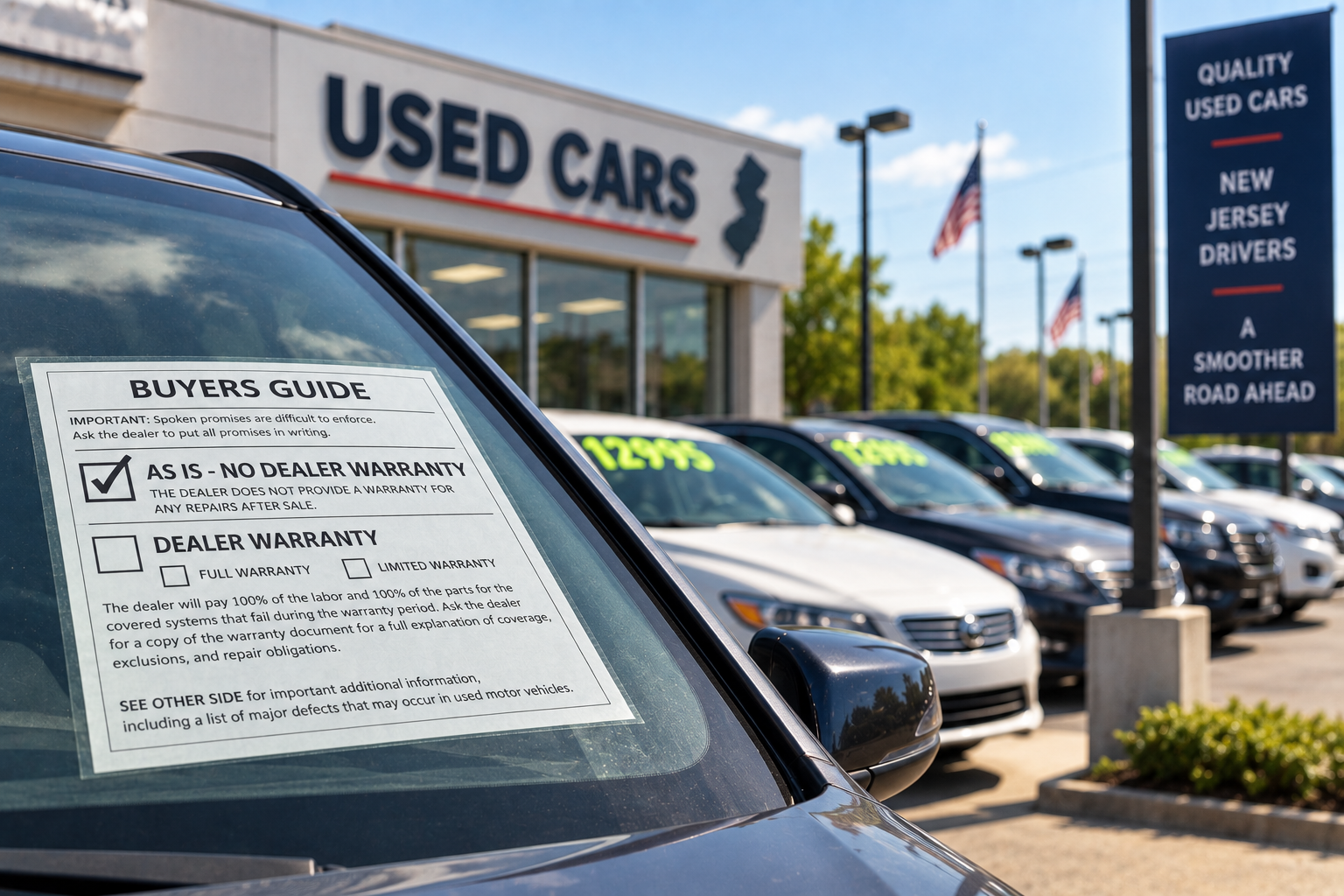
Plenty of New Jersey buyers are told the car is sold as is and assume that settles it. Under the Used Car Lemon Law, a waiver only works on vehicles with more than 60,000 miles. Below that, a dealer cannot waive the warranty at all.
Even above 60,000 miles the waiver has to follow a strict format. It must be in writing, use the state’s As Is Disclosure and Waiver forms, and be signed separately from the contract of sale. A checkbox buried in a sales agreement does not meet that standard.
An as is sticker on a 38,000 mile car at a licensed New Jersey dealership does not override the statutory warranty. The mileage tier decides that question, not the window sticker.
Three Repair Attempts or 20 Days Out of Service
A covered car becomes a lemon under this law when a material defect survives the repair process. A material defect is a malfunction that substantially impairs the car’s use, value, or safety. Two triggers exist, and hitting either one is enough.
The same material defect has been in for repair three or more times and still exists
The car has been out of service a cumulative total of 20 or more days waiting on the dealer
The consumer’s side of the bargain is notice and access. You have to tell the dealer about the defect and deliver the car to the dealer’s regular place of business before the warranty period runs out.
Where the dealer refuses to refund, a consumer can go to the Division of Consumer Affairs dispute resolution program run with the Office of Administrative Law, use the Division’s alternative dispute resolution track, go through a dealer’s own informal program, or file in the Superior Court of New Jersey. Filing a used car claim with the Lemon Law Unit carries no fee, while a Superior Court filing does, according to the Division’s used car consumer brief.
How the Refund Math Works
A used car refund starts with the total purchase price. Sales tax, title and registration fees, and similar government charges come out. So does a reasonable allowance for excessive wear and tear.
Then there is a deduction for personal use. New Jersey calculates it using the IRS business mileage rate in effect on the repurchase date, multiplied by every mile driven since purchase. The longer you drive a disputed car, the smaller the check gets.
An Example: Rosa’s Sedan in Passaic County
Say Rosa buys a four year old sedan from a licensed dealer on Route 46 in Clifton. She pays $9,800 and the odometer reads 41,000 miles. That drops her into the middle tier, so the dealer owes her a 60 day or 2,000 mile warranty.
Eleven days in, the transmission starts slipping between second and third gear. She brings it back and the dealer replaces a solenoid. Three weeks later it slips again, and the dealer keeps it four days for a fluid service and software update.
On day 52 it slips a third time. The dealer keeps the car six days and cannot find the cause. Rosa now has three documented attempts at the same material defect, on a covered drivetrain component, inside her warranty window. That combination is what the statute describes.
Now change one fact. If Rosa had paid $2,800 instead of $9,800, no statutory warranty would have attached at all, and the same transmission would be her problem. Rosa is made up, and every real situation turns on its own paperwork and timing.
When a Used Car Is Still Under the New Car Lemon Law
Here is the overlap almost nobody mentions. The New Car Lemon Law defines a consumer to include a person the vehicle is transferred to during the duration of an applicable warranty. Its protection period runs two years or 24,000 miles from the original delivery date, not from your purchase date.
So a lightly used car can sit inside both laws at once. Picture a 14 month old crossover with 16,000 miles bought off a lot in Cherry Hill. The used car warranty tier applies, and the original two year and 24,000 mile window has not closed yet either.
That distinction changes who is on the hook. The used car law points at the dealer. The new car law points at the manufacturer and requires a certified mail final chance letter. Our complete New Jersey Lemon Law guide walks through that notice step and the hearing process in detail.
What Happens When the Used Car Lemon Law Does Not Apply
Falling outside the thresholds is not the end of the analysis. The New Jersey Consumer Fraud Act reaches deception in the sale itself, like a rolled back odometer, a hidden accident history, or a branded title nobody disclosed. Violations of the used car regulations are themselves subject to Consumer Fraud Act sanctions.
If the car came with any written warranty or a service contract, the federal Magnuson-Moss Warranty Act can apply on top of state law. It governs written warranties on consumer products nationwide, including cars.
There is also the ordinary court route. New Jersey’s Special Civil Part hears money claims up to $20,000, and its Small Claims Section handles disputes of $5,000 or less. That is a realistic forum for a repair bill fight in Toms River or Hackensack that never reaches lemon law territory.
Common Questions About the NJ Used Car Lemon Law
Does the NJ lemon law cover a car bought from a private seller?
Generally no. The Used Car Lemon Law runs against dealers. A seller who has sold or offered three or more used vehicles in the past 12 months can meet the definition of dealer, so the label on the transaction is not always the end of the question.
Can a New Jersey dealer sell a used car as is?
Only in narrow circumstances. Above 100,000 miles the law does not require a warranty. Between 60,000 and 100,000 miles the buyer can waive it, but only in a separately signed writing on the state’s forms. Under 60,000 miles a dealer cannot waive it.
Does the NJ used car lemon law cover motorcycles or RVs?
No. Motorcycles, motor homes, and off road vehicles are written out of the definition of a used motor vehicle. New motorcycles and the vehicle portion of new motor homes are handled under the New Car Lemon Law instead.
What if the dealer never gave me a written warranty?
The regulation says a dealer who fails to provide the required warranty is deemed to have given it as a matter of law, unless the buyer signed a valid waiver. Missing paperwork does not automatically mean missing coverage.
How long does a used car lemon law warranty last in New Jersey?
Thirty, 60, or 90 days, keyed to the odometer at sale, with a matching mileage cap of 1,000, 2,000, or 3,000 miles. The period also extends by any time the car spends waiting on the dealer to begin or finish a repair.
The Bottom Line on Used Cars in New Jersey
New Jersey does protect used car buyers, and it does it through a dealer warranty that turns on price, model year, mileage, and total loss history. The window is short and the covered parts list is narrower than most people expect.
Because the warranty can expire in as little as 30 days, the calendar tends to decide these questions faster than the mechanics do. Understanding which tier a car falls into is where the analysis starts.
This article is for educational purposes only and is not legal advice. Reading it does not create an attorney-client relationship. For advice on your specific situation, consult a licensed attorney in your state.
Lucid Air Fire Recall and the New Jersey Lemon Law
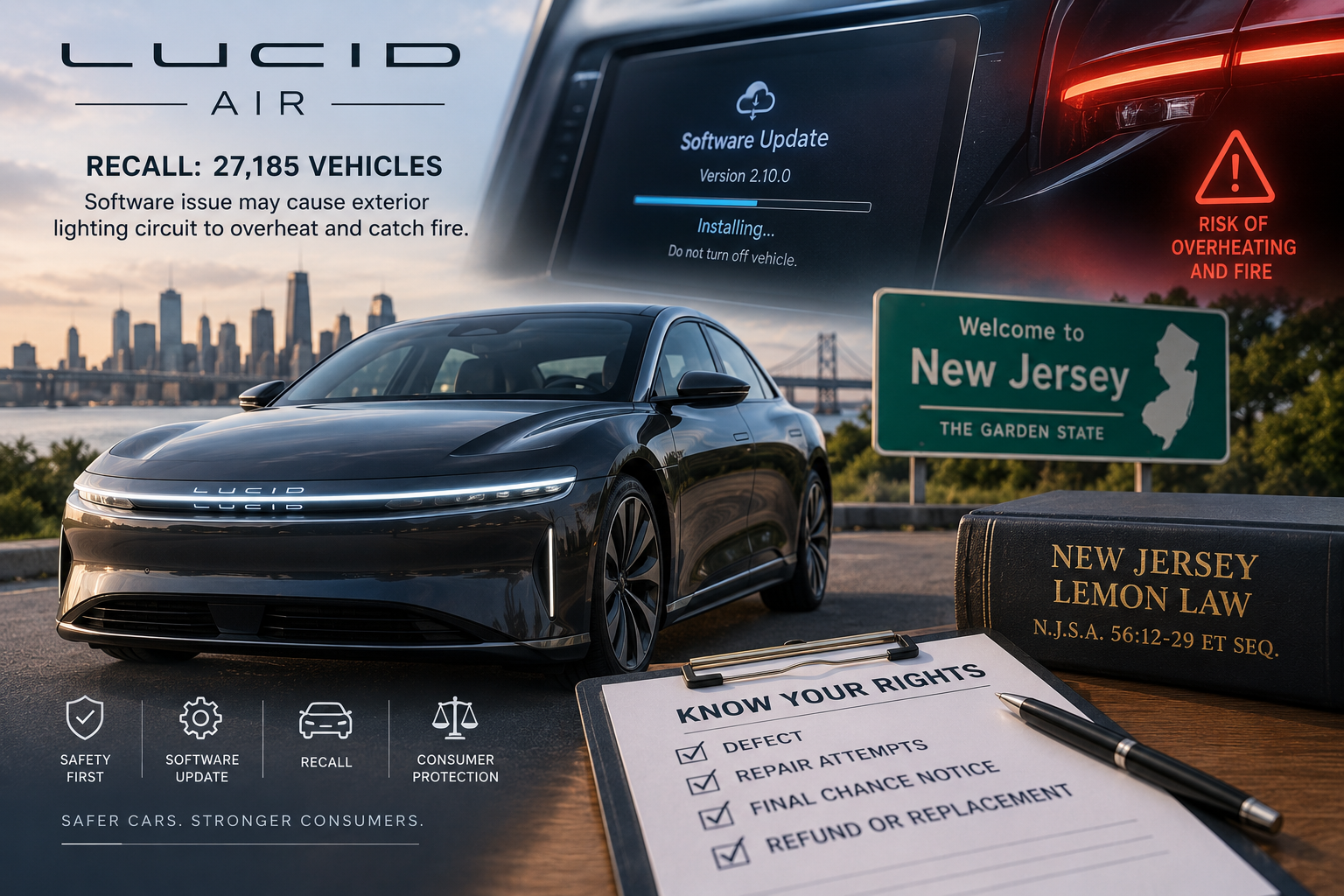
Lucid is recalling 27,185 Air sedans because a software problem can let an exterior lighting circuit overheat and catch fire. If you drive one in New Jersey, the first question is usually about safety. The second question is almost always whether the New Jersey lemon law gives you a way out of the car.
Those are two different questions with two different answers. A recall is a federal safety process. The lemon law is a state warranty statute with its own deadlines, its own counting rules, and its own paperwork.
This article walks through both, and through a wrinkle that comes up more and more with electric cars. What happens when the fix arrives over the air while your car sits in your driveway?
This is general educational information about how New Jersey law works. It is not legal advice, and reading it does not create an attorney-client relationship. Outcomes depend on the specific vehicle, dates, mileage, and repair records involved.
What the Lucid Air Recall Actually Says
Lucid filed the recall with the National Highway Traffic Safety Administration in August 2026 under campaign number 26V540000. It covers roughly 27,185 Air sedans from the 2022 through 2026 model years, built between October 2021 and July 2026.
The problem is software, not a broken part. In an older car, a fuse is a strip of metal that melts when too much current runs through a circuit. The Air uses an eFuse instead, where code watches the current and shuts the circuit down, and the recall filing says that threshold was set too high on the low voltage circuits that run the exterior lights.
So a circuit could keep drawing more amperage than the wiring was built for. Wire that runs hot enough melts its insulation, which is how you get smoke and, in rare cases, fire. The same fault can kill the center brake light or the front lights, and Lucid reported 33 warranty claims involving damaged wiring near that third brake light.
Three fires tied to front lighting over roughly three years. Thirty-three warranty reports of damaged wiring near the center brake light. One free software update, version 2.10.0, pushed over the air starting in July 2026. Owner notification letters were set to go out beginning October 16, 2026.
Until the update is installed, the recall notice tells owners to park outside and away from buildings. That guidance matters no matter what you decide about the legal side.
A Recall Is Not a Lemon Law Claim
A federal safety recall gets you one thing. A free fix. It does not get you a refund, a replacement car, or money for the hassle.
The New Jersey Lemon Law is separate. It lives at N.J.S.A. 56:12-29 and following, and the rules that put it into practice are in N.J.A.C. 13:45A-26. It asks a narrower question. Did the manufacturer get a fair number of chances to fix a serious defect inside a set window, and does the defect still exist?
So a recall can be evidence in a lemon law claim. It is not the claim itself.
What Qualifies as a Lemon in New Jersey
New Jersey calls the covered window the term of protection. It runs for the first 24,000 miles of operation or two years from the original delivery date, whichever comes first. Everything else has to happen inside that window.
The defect also has to be a nonconformity, meaning something that substantially impairs the use, value, or safety of the vehicle. A rattle in the door trim will not get there. A circuit that can catch fire is a different conversation.
The Three Triggers
Under the regulations, a consumer can send the manufacturer written notice of a potential claim once one of these happens inside the term of protection:
Substantially the same problem has been examined or repaired two or more times and it still exists
The car has been out of service for repairs for 20 or more days total, or 45 days for a motor home
The problem is one that is likely to cause death or serious bodily injury if the vehicle is driven, and one attempt has already been made
That third trigger is why a fire risk gets attention. New Jersey treats defects that could kill or seriously injure a driver differently from ordinary defects, and the number of chances the manufacturer gets shrinks accordingly.
The Certified Mail Step Most People Skip
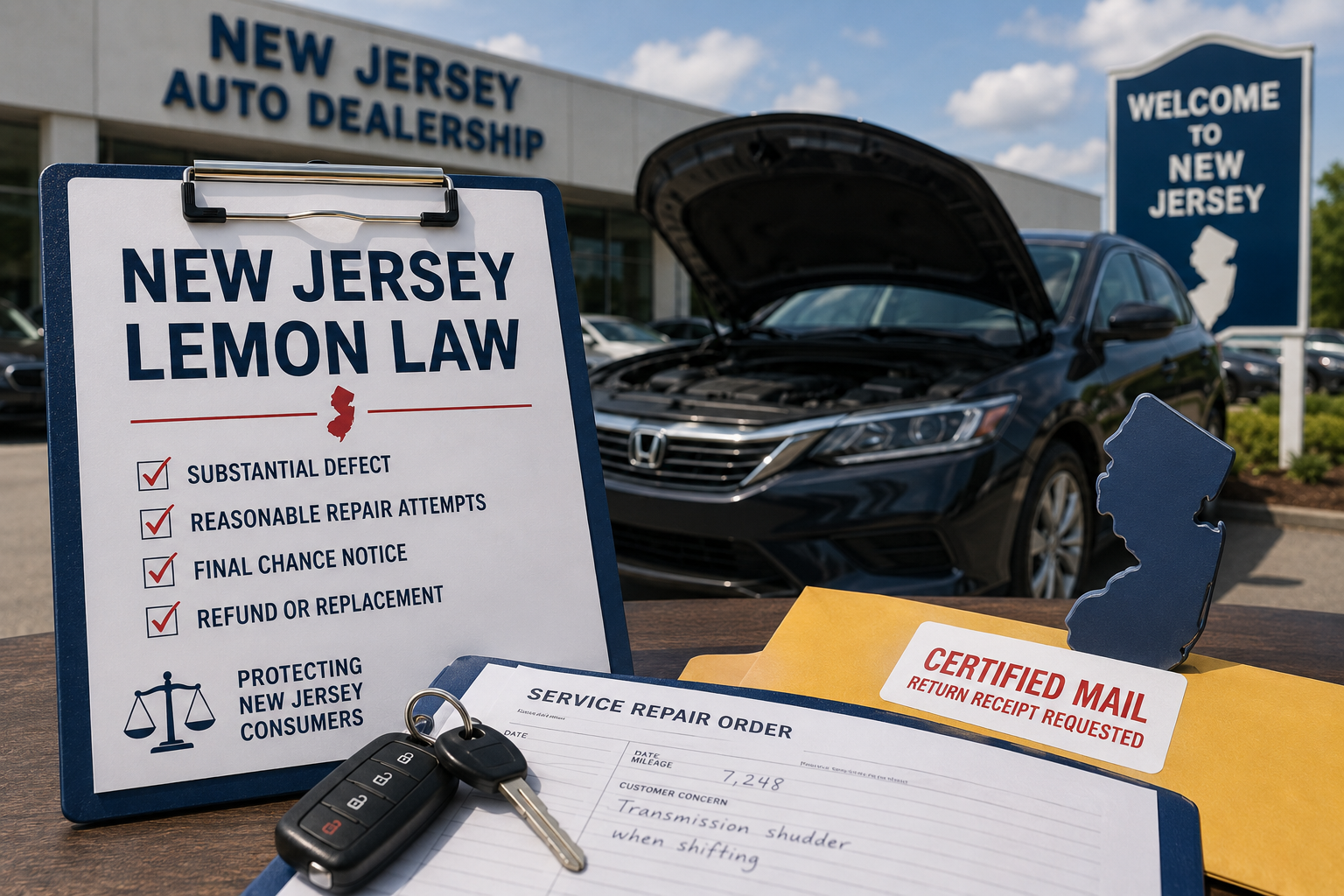
New Jersey requires written notice to the manufacturer by certified mail, return receipt requested. The manufacturer then gets one final opportunity to fix the problem within 10 calendar days of receiving it.
The notice has to be received inside the term of protection, not just mailed inside it. Claims fall apart on that detail more than on anything else.
Do Over the Air Updates Count as Repair Attempts?
Here is where the Lucid recall gets interesting. The fix is wireless. No appointment, no service advisor, no repair order.
New Jersey’s regulations were written around dealer visits. An examination means an inspection by a service technician for or on behalf of the manufacturer. Out of service means days the vehicle sits on the premises of a repair facility. A software patch installed overnight in your own driveway does not obviously produce either one.
Say Dev in Edison wakes up to a notification that his car installed version 2.10.0 while he slept. Nothing was fixed at a shop. No days were lost. If the update works, there is no continuing defect and no claim. If it does not work, he has zero countable repair attempts on paper, because nothing was ever documented by a technician.
Software recalls create a records problem that mechanical recalls do not. Written repair orders showing dates in and dates out are the backbone of a New Jersey claim, and a wireless update generates none of them.
How a New Jersey Buyback Gets Calculated
If a claim succeeds, the refund is broader than the sticker price. Under the regulations it can include the total purchase or lease price with finance charges, sales tax, license and registration fees, and any trade-in credit. It can also include options installed within 30 days of delivery, towing, rental car costs while the vehicle was out of service, the filing fee, and reasonable attorney and expert fees.
From that total comes one deduction, called the allowance for vehicle use. The formula is fixed. Take the mileage at the moment the car was first brought in for the defect, multiply by the purchase price, and divide by 100,000.
A Hypothetical Cherry Hill Example
Say Renata buys a new electric sedan in Cherry Hill for $74,000. At 3,100 miles the headlights cut out on Route 70 at night, and she brings it in. Over the next four months the car goes back twice more for the same fault and sits at the shop for 22 days total.
Her use allowance would be 3,100 times $74,000, divided by 100,000, which comes to $2,294. That figure is locked to the mileage at her first visit, not the mileage today. Every mile she drives after that first appointment costs her nothing under the formula.
The offset is anchored to the odometer reading at the first repair visit for the defect. That is one reason the date of that first appointment is worth documenting carefully.
What About a 2022 or 2023 Air?
Most of the recalled Airs are years past two years and 24,000 miles. For those cars the New Car Lemon Law window has closed, and a recall does not reopen it.
New Jersey has a second statute, the Used Car Lemon Law at N.J.S.A. 56:8-67 and following, with rules at N.J.A.C. 13:45A-26F. It applies to used vehicles bought from a New Jersey dealer for more than $3,000, seven model years old or newer, under 100,000 miles, and not a prior total loss. It runs on a dealer warranty scaled to mileage, and it covers a specific list of parts rather than the whole car, so whether a given electrical component falls inside that list is its own question.
Two other bodies of law come up in these situations. The federal Magnuson-Moss Warranty Act allows breach of warranty claims that are not bound by state lemon law deadlines. And the New Jersey Consumer Fraud Act, N.J.S.A. 56:8-1 and following, carries treble damages plus fees when a dealer or manufacturer engages in unconscionable practices, which is a different theory with a different proof burden.
New Jersey Compared to New York and Pennsylvania
If you commute across state lines, the numbers change with the plates. New York’s new car law runs to two years or 18,000 miles and generally looks for four repair attempts or 30 days out of service. Pennsylvania runs one year or 12,000 miles and generally looks for three attempts or 30 days.
New Jersey’s 24,000 mile ceiling and 20 day out of service trigger are friendlier than both. Coverage follows where the vehicle was purchased, leased, or registered, not where you happen to be driving when the dash lights up.
Where New Jersey Lemon Law Cases Get Decided
New Jersey routes these through the Division of Consumer Affairs Lemon Law Unit in Newark. An accepted application carries a $50 filing fee, which is recoverable as a cost if the consumer prevails.
The Lemon Law Unit refers accepted applications to the Office of Administrative Law for a summary hearing, generally set within 20 days of acceptance. The Director of the Division issues the final decision, and either side can appeal to the Appellate Division of the Superior Court within 45 days. Filing in Superior Court instead of using the administrative track is also an option.
Common Questions About Recalls and the NJ Lemon Law
Does a recall automatically make my car a lemon in NJ?
No. A recall shows the manufacturer identified a safety defect across a model line. New Jersey’s statute asks about your specific vehicle, your repair history, and whether the defect still exists after the manufacturer’s chances ran out.
How many recalls before the lemon law applies?
There is no recall count in the statute. New Jersey counts repair attempts for substantially the same problem and days out of service. Ten recalls for ten unrelated issues fixed on the first try would not satisfy the presumption.
Is a fire risk a serious safety defect?
The statute uses the phrase likely to cause death or serious bodily injury if the vehicle is driven. Defects with fire risk are the kind of thing that provision is aimed at, though whether a particular defect clears that bar is decided case by case on the evidence.
Does the NJ lemon law cover leased cars?
Yes. Lessees are covered, and the refund is built from lease payments and related charges rather than a purchase price. The same use allowance formula applies.
What if the vehicle was bought out of state?
New Jersey’s law reaches vehicles purchased, leased, or registered in New Jersey, and it applies whether the repairs happened inside the state or outside it. A car registered in Bergen County but serviced in Manhattan is still a New Jersey vehicle for these purposes.
The Short Version
The Lucid Air recall is a real safety issue with a free fix, and the parking guidance is worth following until the update lands. Whether it becomes a New Jersey lemon law matter depends on the term of protection, documented repair attempts, and whether the defect survives the manufacturer’s final chance.
For most of the 27,185 recalled cars, that window closed long ago. For the newest ones, the calendar and the odometer are doing the deciding.
This article is for educational purposes only and is not legal advice. Reading it does not create an attorney-client relationship. For advice on your specific situation, consult a licensed attorney in your state.
If you bought or leased a car in New Jersey and the same problem keeps coming back no matter how many times the dealer says it’s fixed, you may be wondering whether the New Jersey Lemon Law actually applies to you. That’s the right question to ask, and this guide is built to answer it.
What follows is a plain English walkthrough of how the NJ Lemon Law works. Who it covers. How repair attempts get counted. What the certified mail final chance letter is and why so many claims fall apart on that one step. How new car protections differ from used car protections. What the Lemon Law Unit process looks like from application to hearing.
The same rules apply whether you bought your car in Jersey City, Cherry Hill, Paterson, or Toms River. Only the hearing location changes.
This is general educational information about how New Jersey law works. It is not legal advice, and reading it does not create an attorney-client relationship. Lemon law outcomes depend heavily on the specific facts, documents, vehicle, and timing involved.
What Is a Lemon Law?
A “lemon” is a vehicle with a serious, repeating defect that the manufacturer or dealer can’t fix in a reasonable number of tries. The term goes back decades in the auto industry. It basically means a car you got stuck with that should have worked.
Every state has some version of a lemon law. The general purpose is the same everywhere. If you bought a defective car, the manufacturer or dealer should fix it, replace it, or buy it back, instead of leaving you making payments on something that doesn’t run right.
The specifics vary a lot from state to state. Some states only cover new cars. A small handful, including New Jersey, also cover certain used cars. A claim generally requires three things. A substantial defect. A reasonable opportunity for the manufacturer or dealer to fix it. And the right procedural steps by the consumer, which usually includes written notice.
What Is the New Jersey Lemon Law?
The New Jersey Lemon Law is a state consumer protection statute that may entitle qualifying consumers to a refund, replacement, or buyback when a vehicle has a substantial defect the manufacturer or dealer cannot fix after a reasonable number of attempts.
New Jersey actually has two separate lemon laws that tend to get talked about as one.
The New Car Lemon Law
The first is the New Car Lemon Law, found at N.J.S.A. 56:12-29 and following. It covers new cars, motorcycles, authorized emergency vehicles, farm tractors, and the vehicle portion of motor homes that are purchased, leased, or registered in New Jersey. The term of protection runs for two years or 24,000 miles from delivery, whichever comes first.
The Used Car Lemon Law
The second is the Used Car Lemon Law, found at N.J.S.A. 56:8-67 and following. It covers used passenger vehicles bought from a licensed New Jersey dealer that meet certain price, age, and mileage thresholds. Instead of a flat two year window, it requires a tiered dealer warranty of 90, 60, or 30 days depending on the mileage at the time of sale.
Both laws are administered by the New Jersey Division of Consumer Affairs through its Lemon Law Unit, located at P.O. Box 45026, Newark, NJ 07101, and reachable at (973) 504-6226. When a hearing is scheduled, it takes place at the Office of Administrative Law in Newark, Trenton, or Atlantic City.
How the NJ Lemon Law Process Works, Step by Step
At a high level, a New Jersey Lemon Law claim moves through the same stages every time.
A defect shows up and the consumer takes the vehicle to an authorized dealer for repair.
The dealer either fixes the problem or doesn’t. The consumer keeps every repair order.
The same defect keeps happening, and the repair attempts start adding up.
The consumer sends the manufacturer a certified mail final chance letter, and the manufacturer gets 10 days to make one last repair attempt.
If the defect is still there, the consumer files an application with the Lemon Law Unit.
If the application is accepted, the case is scheduled for a hearing at the Office of Administrative Law, where an administrative law judge issues an initial decision.
That’s the structure. The details matter, because most consumers who never get relief make a procedural mistake somewhere in the first four steps. The rest of this guide breaks each one down.
What Qualifies as a Lemon in New Jersey?
To qualify under the New Jersey Lemon Law, the defect has to substantially impair the vehicle’s use, value, or safety. It can also qualify if it’s a serious safety defect likely to cause death or serious bodily injury if the vehicle is driven.
That phrase, “use, value, or safety,” shows up over and over in NJ lemon law materials. It’s the legal heart of the standard. A scratch on the bumper doesn’t impair use, value, or safety in a substantial way. A transmission that randomly drops into neutral on the Turnpike does.
Defects that have historically raised lemon law questions in New Jersey include engine stalling, no start conditions, and sudden power loss. Transmission failures and repeated shifting problems come up often. Brake and steering defects are frequently treated as serious safety defects. Electrical malfunctions that affect drivability, airbag and safety system defects, and persistent water intrusion that damages wiring all show up regularly.
Minor cosmetic issues, problems fixed on a single visit, and rattles that don’t affect use or safety usually don’t meet the standard on their own. Buyer’s remorse doesn’t qualify either. You can’t return a car under the lemon law just because you don’t like how it drives or because gas prices went up.
The New Car Lemon Law does not cover vehicles registered for commercial use, the living quarters of motor homes, defects caused by accident, vandalism, abuse, or neglect, or defects caused by someone other than the manufacturer, its agent, or an authorized dealer.
How Many Repair Attempts Are Needed Under NJ Lemon Law?
This is where a lot of confusion lives, because New Jersey uses two different counts for two different purposes.
The Count That Lets You Send the Letter
Under the Division’s New Car Lemon Law guidance, the final chance letter can go out to the manufacturer once any one of these has happened inside the protection period:
Two repair attempts for the same defect have failed to fix the problem
The vehicle has been out of service for a total of 20 days, or 45 days for a motor home
A single repair attempt has failed on a serious safety defect
The Count That Gets You a Hearing
To qualify for a hearing at the Office of Administrative Law, the Division looks for a fuller record. Three repair attempts. Certified mail notice to the manufacturer within 24,000 miles and two years from delivery. Proof from the return receipt that the manufacturer got that notice. A real final chance to repair. And a defect that still exists after that final attempt.
Two failed attempts opens the door to the letter. Three attempts is generally what gets the case in front of an administrative law judge. Twenty cumulative days out of service is its own separate trigger, and it counts even if the days came from a series of different problems.
People often search “what if my car is out of service for 20 days in NJ” or “what if my car is out of service for 30 days in NJ.” Twenty cumulative calendar days is the number built into the process. Thirty exceeds it. Once you cross 20 days while the dealer is trying to fix something, that prong is satisfied.
The Certified Mail Final Chance Letter
This is the step where the most New Jersey lemon law claims fall apart, so it deserves its own section.
Inside the protection period, the consumer sends the manufacturer, not the dealer, a written notice by certified mail with return receipt requested. The letter says the consumer may have a lemon law claim and is giving the manufacturer one last chance to repair the defect. The manufacturer then has 10 days from the date on the return receipt to make that repair.
A phone call to customer service doesn’t count. An email doesn’t count. A complaint posted on social media tagging the manufacturer doesn’t count. The process uses certified mail with a return receipt because that’s how the consumer proves the manufacturer actually received notice and had its 10 day window.
One detail that trips people up: the letter has to go to the manufacturer’s regional office, and the Lemon Law Unit is the source for that address. Sending it to the dealership, or to a corporate address pulled off a website, can undercut the whole step.
Three pieces of paper come out of this step and all three matter. A copy of the letter itself. The certified mail return receipt showing the date the manufacturer received it. And the final repair attempt invoice showing what the dealer did during those 10 days.
Without that return receipt, an application can stall before it ever reaches a hearing. Plenty of otherwise strong cases have been weakened by a consumer skipping or fumbling this single step. The Division’s New Car Lemon Law consumer brief includes a sample version of the letter, which shows the kind of information the notice is expected to contain.
People search for this step under a lot of names. “NJ lemon law certified letter.” “New Jersey lemon law demand letter.” “NJ lemon law final chance letter.” They’re all the same thing.
How the NJ New Car Lemon Law Works
Who Is Covered
The New Car Lemon Law applies to anyone who buys, leases, or registers a new car or motorcycle in New Jersey. The term of protection is two years or 24,000 miles from delivery, whichever comes first.
Does it apply to leased cars? Yes. Leased new vehicles registered in New Jersey are covered, and a manufacturer can be ordered to release the lease without an early termination penalty if the consumer wins.
Motorcycles are explicitly covered. SUVs and trucks are covered as passenger vehicles, as long as they aren’t registered for commercial use. As of January 2010 the law also reaches authorized emergency vehicles, and a 2016 amendment added farm tractors.
Motor homes are partly covered. The vehicle portion counts. The living quarters don’t. So if the engine, transmission, or steering has a substantial defect, the New Car Lemon Law may apply. If the problem is the refrigerator, the bed, or the bathroom, it probably won’t.
What the Protection Period Looks Like in Practice
The two year and 24,000 mile clock starts at delivery. Buy a new car on March 1, 2026 with 12 miles on the odometer, and the protection period runs until March 1, 2028 or until the odometer hits 24,012, whichever happens first.
That second condition catches New Jersey commuters off guard all the time. If you drive from Newark to Princeton every weekday, you can put 20,000 miles a year on a car without trying. In that case your protection period might really run out around month 14, not month 24, because you’d hit the mileage cap first.
The defect has to appear and be reported inside that window. A problem that surfaces at 26,000 miles or in month 25 typically won’t qualify, even if you’d only just noticed it.
Filing a New Car Lemon Law Claim
If the manufacturer doesn’t resolve the issue after the final chance letter, the next step is a Lemon Law application to the Division of Consumer Affairs. The Unit reviews it and either approves it, rejects it, or sends it back for edits. Once approved, a $50 filing fee is requested, and that fee is refunded if the consumer wins.
After the fee is paid, a copy of the application goes to the manufacturer and a hearing date is set, usually within about 20 days of acceptance, subject to the OAL’s calendar. The administrative law judge issues an initial decision within 20 days of the hearing. The Director of Consumer Affairs then issues a final decision within 15 days, adopting, modifying, or rejecting that initial decision.
Some manufacturers also run their own informal arbitration programs. The state process through the Lemon Law Unit is the one with the built in deadlines described above.
If a consumer prevails, the manufacturer may be ordered to:
Refund the purchase price, or the lease payments and remaining lease obligation
Release the lease without an early termination penalty
Reimburse collateral charges such as registration fees, taxes, towing, and rental car costs
Pay reasonable attorney’s fees
The refund is reduced by a deduction for personal use, based on how many miles the consumer drove between delivery and the buyback.
How the NJ Used Car Lemon Law Works
New Jersey is one of a small group of states with a dedicated used car lemon law. It applies only to used vehicles bought from a licensed New Jersey dealer, which means private party sales aren’t covered at all.
NJ Used Car Lemon Law Eligibility Thresholds
To fall under the Used Car Lemon Law, the vehicle has to meet all of the following at the time of sale:
Purchase price of more than $3,000
Seven model years old or less
Odometer reading of 100,000 miles or less
Not declared a total loss by an insurance company
Miss even one of those and the Used Car Lemon Law doesn’t apply, though other consumer protection laws like the New Jersey Consumer Fraud Act may still be in play.
This is why so many people search “does NJ lemon law apply to used cars.” The answer is yes, with real limits. A $2,500 used hatchback from a dealer isn’t covered. A nine year old used pickup isn’t covered. A used car with 110,000 miles isn’t covered. And a used car sold privately isn’t covered, no matter how new or expensive it is.
Required Dealer Warranty, Tiered by Mileage
For qualifying used vehicles, the dealer has to provide a written warranty. How long that warranty runs depends on the odometer reading at the time of sale.
Mileage at Sale
Minimum Dealer Warranty
0 to 24,000 miles
90 days or 3,000 miles, whichever comes first
24,001 to 60,000 miles
60 days or 2,000 miles, whichever comes first
60,001 to 100,000 miles
30 days or 1,000 miles, whichever comes first
A waiver of this warranty is only valid for vehicles between 60,001 and 100,000 miles, and only if it’s in a signed writing. For vehicles under 60,000 miles, a dealer can’t sidestep the warranty by selling the car “as is.”
NJ Used Car Lemon Law Repair Attempt Rule
The used car standard mirrors the new car standard. A consumer may be entitled to a refund of the full purchase price if, during the dealer warranty period, the dealer has been unsuccessful at fixing the same material defect after at least three attempts, or the vehicle has been out of service for 20 cumulative days while the dealer is trying to fix it.
Consumers may be charged a deductible of up to $50 per repair of each covered item. The regulations that govern this process are set out in N.J.A.C. 13:45A-26F.
Filing a NJ Used Car Lemon Law Claim
Unlike the New Car Lemon Law, filing a Used Car Lemon Law application with the Lemon Law Unit is free. There’s no $50 fee. The Division publishes the Used Car Lemon Law dispute resolution application on its site in several languages.
If the consumer wins, the dealer may be ordered to repurchase the vehicle and refund the purchase price, reduced by a deduction for the miles the consumer drove.
NJ New Car vs. Used Car Lemon Law: Quick Comparison
Factor
New Car Lemon Law
Used Car Lemon Law
Statute
N.J.S.A. 56:12-29 et seq.
N.J.S.A. 56:8-67 et seq.
Protection period
2 years or 24,000 miles
30, 60, or 90 days, tiered by mileage
Hearing threshold
3 attempts or 20 days out of service
3 attempts or 20 days out of service
Final chance certified letter
Required, sent to the manufacturer
Dealer warranty procedure applies
Filing fee
$50, refunded if you win
$0
Private sales covered
Not applicable
No, licensed NJ dealers only
Per repair deductible
None
Up to $50 per repair
Attorney’s fees if you win
Manufacturer pays
Dealer pays
Refunds Under the NJ Lemon Law
A refund is one of the available remedies under both New Jersey lemon laws. It isn’t automatic, and the amount follows a formula rather than a round number.
A typical New Car Lemon Law refund includes the full purchase price, or the total of lease payments plus the residual obligation, minus a deduction for personal use based on miles driven. It also typically includes collateral charges like registration fees and sales tax, plus documented expenses tied to the defect such as towing and rental cars.
A “manufacturer buyback” is essentially the same thing as a refund. People search both phrases interchangeably. Under New Jersey procedure, a buyback can arrive in a few ways. Through a settlement with the manufacturer before a hearing. Through an order from the administrative law judge after a hearing. Or through a manufacturer’s own arbitration program.
Replacement Vehicles Under the NJ Lemon Law
A replacement vehicle is another possible outcome, but in practice refunds are far more common in New Jersey than replacements. The math on a replacement is messier. The manufacturer has to provide a vehicle of comparable value, and both sides have to agree on what “comparable” means.
Refunds are cleaner administratively, so they tend to be the default in NJ buybacks. Where a consumer specifically wants a replacement instead of money back, that generally becomes a negotiation point raised early rather than something the process produces on its own.
Records That Matter in a NJ Lemon Law Case
Lemon law cases are built on documentation. Whether or not a claim ever gets filed, these are the records that carry weight.
Repair orders for every visit, showing the date, the mileage at drop off, the complaint in the consumer’s own words, and the technician’s notes
The purchase or lease agreement, including any addenda
The finance contract or lease payment history
The warranty booklet
The certified mail return receipt from the final chance letter
Photos or video of the defect actually happening, which matters most for intermittent problems like a stall that shows up once a week
Tow and rental car receipts
Every email, text, and letter exchanged with the dealer and the manufacturer
One practical habit is worth more than the rest combined. Read each repair order before leaving the service department. If it says “no problem found” or just “customer states issue,” but you described stalling at 60 miles per hour on the Garden State Parkway, that gap can matter a lot at a hearing months later. The repair order is the official record of what happened.
Example: Maria’s New Car in Bergen County
Say Maria lives in Hackensack. She picks up a brand new sedan from a dealership in Paramus on a Saturday in April. The car has 8 miles on the odometer when she drives it home.
At about 3,800 miles she notices a transmission shudder when the car shifts from second to third. It’s mild at first. Over a couple of weeks it gets worse, so she brings the car in.
Visit one, at 4,400 miles. The dealer keeps the car two days and replaces the transmission valve body. Maria picks it up and the shudder seems gone.
Visit two, at 6,100 miles, about three weeks later. The shudder is back. The dealer keeps the car four days and reflashes the transmission control module software. The repair order documents the same complaint.
At this point Maria has two failed repair attempts for the same defect, well inside her two year and 24,000 mile window. Under the Division’s guidance, that’s already enough to send the manufacturer a certified mail final chance letter.
Visit three, at 7,200 miles, about a month after that. The shudder is still there, and now there’s a delayed engagement shifting from reverse to drive. The dealer keeps the car 11 days waiting on a part. Total time out of service across the three visits is 17 days, and Maria now has three documented attempts at substantially the same defect.
If the manufacturer’s final repair attempt fails after the certified letter, the next procedural step would be a Lemon Law application to the Division of Consumer Affairs, the $50 filing fee, and a hearing date at the OAL.
This is a made up scenario. Every real case turns on its own facts, documents, and timing. The point is just to show how the procedural pieces stack up.
Example: David’s Used SUV in Union County
Now say David lives in Elizabeth. He buys a five year old SUV from a licensed dealer for $11,500. The odometer reads 48,000 miles at the time of sale.
Because the SUV falls between 24,001 and 60,000 miles, the Used Car Lemon Law puts him in the 60 day or 2,000 mile warranty tier. He drives off the lot on a Tuesday.
Two weeks later the check engine light comes on and the SUV starts running rough. He brings it back. The dealer replaces a coil pack and says it’s fixed. That’s visit one.
A week after that the same misfire returns. Visit two, and the dealer replaces all the spark plugs. Three days later the misfire is still happening. Visit three, and the dealer keeps the SUV three days running diagnostics before admitting they can’t find the root cause.
David now has three documented repair attempts for substantially the same material defect, all inside the 60 day warranty window. Under the Used Car Lemon Law, that’s the point at which a consumer may be entitled to a refund from the dealer, not the manufacturer, and may file a free application with the Lemon Law Unit if the dealer refuses.
Hypothetical again. Every real used car situation depends on its own paperwork, timing, and vehicle history.
Common Mistakes New Jersey Consumers Make
The first is skipping or botching the certified mail final chance letter. Plenty of people call the manufacturer’s customer service line or send an email and assume it counts. The process contemplates certified mail with a return receipt, sent to the regional address the Lemon Law Unit provides.
The second is letting the dealer write vague repair orders. “Customer concern” is not the same thing as a document that describes a stalling defect, and that difference can decide a case months later.
The third is assuming a private used car sale is covered. The Used Car Lemon Law reaches licensed New Jersey dealers only. A car bought from someone on Facebook Marketplace falls outside it, though the Consumer Fraud Act may still apply if the seller misrepresented the vehicle.
The fourth is waiting past the protection period. New cars get two years or 24,000 miles, whichever comes first. Used cars can be down to a 30 day dealer warranty. The window can close before a serious problem even fully reveals itself.
The fifth is signing a buyback or settlement without reading it closely. Releases, confidentiality clauses, and “as is” language in settlement papers can have effects that outlast the car itself.
The sixth is trading in or selling the vehicle before the claim is resolved. Once the car is gone, the remedies often go with it.
The seventh is taking the car to an independent shop for warranty work. Repairs generally have to be done by the manufacturer, its agent, or an authorized dealer to count toward the lemon law thresholds.
When People Consider Talking to a New Jersey Lemon Law Attorney
The Lemon Law Unit notes that an attorney isn’t required at an OAL hearing, and that a consumer who wins is entitled to reasonable attorney’s fees paid by the manufacturer. That fee shifting rule is why many New Jersey lemon law attorneys handle qualifying cases on contingency.
Consumers commonly start looking for representation when:
The same defect keeps returning after multiple repairs
The manufacturer has denied a claim or made a low buyback offer
The defect involves a safety system such as brakes, airbags, steering, or stalling
It isn’t clear whether a used car meets the eligibility thresholds
A hearing has been scheduled at the OAL
Settlement paperwork has arrived and needs a careful read
How the NJ Lemon Law Applies Across the State
The Lemon Law Unit handles applications from every county in New Jersey. Hearings are held at the Office of Administrative Law in Newark, Trenton, and Atlantic City, so consumers statewide move through the same process.
The same rules apply whether the vehicle was bought or registered in Bergen County towns like Hackensack, Paramus, and Fort Lee, or in Hudson County cities like Jersey City, Hoboken, and Bayonne. Essex County residents in Newark, East Orange, and Montclair follow the same steps as Passaic County residents in Paterson, Clifton, and Wayne.
It works the same way in Union County, Middlesex County, Monmouth County, Ocean County, Mercer County, Camden County, Burlington County, and Atlantic County, and in the rest of the state’s counties as well. Whether you bought in Elizabeth, Edison, Toms River, Cherry Hill, or Trenton, the standards don’t change. Only the hearing location does.
Frequently Asked Questions About the NJ Lemon Law
What is the New Jersey Lemon Law in simple terms?
It’s a state consumer protection statute that may require a manufacturer or dealer to refund or replace a vehicle when a substantial defect can’t be repaired after a reasonable number of attempts during the protection period.
How long is the lemon law period in New Jersey?
For new cars, two years or 24,000 miles from delivery, whichever comes first. For used cars, a tiered dealer warranty of 30, 60, or 90 days depending on mileage at sale.
How many repair attempts are required under NJ lemon law?
Two failed attempts at the same defect generally allow the final chance letter to go out. Three attempts is what the Division looks for to qualify a case for a hearing. Twenty cumulative days out of service is a separate trigger on its own.
What qualifies as a lemon in New Jersey?
A vehicle with a substantial defect that impairs its use, value, or safety, or a serious safety defect likely to cause death or serious bodily injury, where the manufacturer or dealer has had a reasonable opportunity to repair it.
Does the NJ Lemon Law cover used cars?
Yes, but only used cars sold by a licensed New Jersey dealer for more than $3,000, with 100,000 miles or less, seven model years old or less, and not declared a total loss.
Does the NJ Lemon Law cover private used car sales?
No. Private party sales fall outside the Used Car Lemon Law. Other laws such as the Consumer Fraud Act may still apply.
Does the NJ Lemon Law cover leased vehicles?
Yes. Purchased and leased new vehicles registered in New Jersey both fall under the New Car Lemon Law, and a manufacturer can be ordered to release the lease without an early termination penalty.
Does the NJ Lemon Law cover motorcycles, SUVs, and trucks?
Motorcycles are explicitly covered. SUVs and trucks are covered as passenger vehicles, as long as they aren’t registered for commercial use.
Does the NJ Lemon Law cover motor homes and RVs?
The vehicle portion is covered, including the engine, transmission, and steering. The living quarters are not. Motor homes also get a 45 day out of service trigger instead of the usual 20.
What if my car is out of service for 20 days in NJ?
Twenty cumulative calendar days out of service for repairs is one of the qualifying thresholds under both New Jersey lemon laws.
What if the dealer cannot fix my car in NJ?
Under the New Car Lemon Law, the next procedural step is a certified mail final chance letter to the manufacturer. Under the Used Car Lemon Law, it depends on whether the problem happened during the dealer warranty period.
How much does it cost to file a NJ Lemon Law claim?
Fifty dollars under the New Car Lemon Law, refunded if the consumer wins. The Used Car Lemon Law has no filing fee.
How do I file a lemon law claim in NJ?
An application goes to the Division of Consumer Affairs Lemon Law Unit with supporting documentation, including the purchase or lease agreement, repair orders, the certified mail receipt, and manufacturer correspondence. If accepted, the case is scheduled at the OAL.
Where are NJ Lemon Law hearings held?
At the Office of Administrative Law in Newark, Trenton, or Atlantic City. Consumers can choose from the available hearing dates.
How do I contact the NJ Lemon Law Unit?
New Jersey Division of Consumer Affairs, Lemon Law Unit, P.O. Box 45026, Newark, NJ 07101, (973) 504-6226. The Unit’s page is on the Division of Consumer Affairs website.
Official New Jersey Lemon Law Resources
Division of Consumer Affairs Lemon Law Unit, the main state hub for both laws
The New Jersey Lemon Law gives consumers a real path to a refund when a vehicle can’t be fixed, but that path runs on deadlines and paperwork. The protection period is short. The certified mail step is easy to get wrong. And the repair orders written at the service desk end up being the record everything else is judged against.
Understanding how the process is built is the first step to recognizing where a case stands.
This article is for educational purposes only and is not legal advice. Reading it does not create an attorney-client relationship. For advice on your specific situation, consult a licensed attorney in your state.