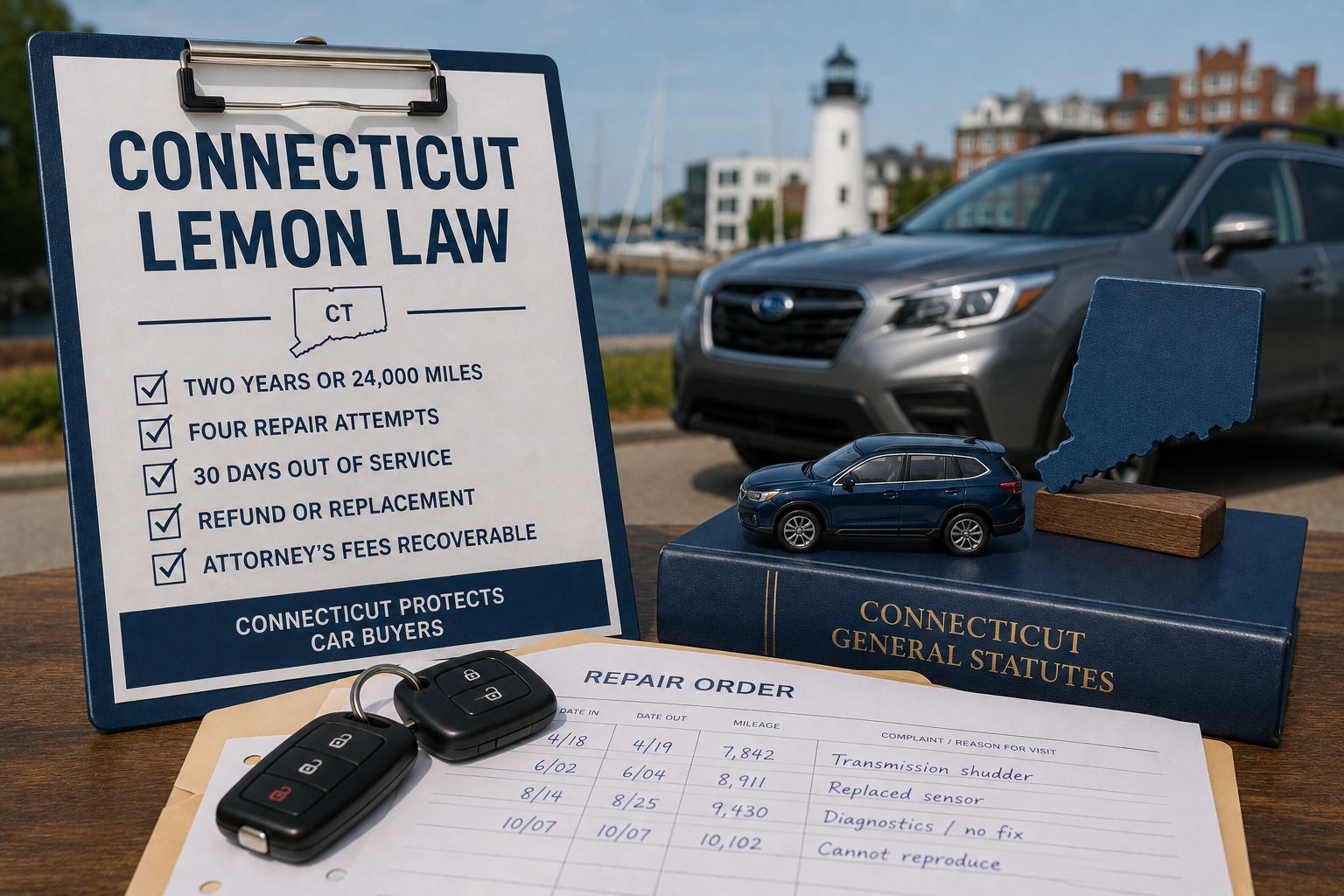
Connecticut Lemon Law: A Complete Guide for CT Drivers
You bought a new car. Maybe an SUV for the family, a truck for the job site, or your first electric vehicle. Within a few months something is wrong. The check engine light won’t quit. The transmission slips. The brakes shudder. You take it to the dealer once, then twice, then a third time, and the problem keeps coming back.
This is the situation the Connecticut lemon law was written for. Here is something most drivers don’t know. Connecticut wrote the country’s first state lemon law in 1982. Every other state copied the idea. So when you hear that Connecticut has strong protections for car buyers, that isn’t marketing. That’s the history of the law.
This guide walks through the CT lemon law in plain English. What the law is, what counts as a lemon, how the two year and 24,000 mile rule works, how state arbitration runs, what you can recover, and how used car protections fit in. Hypothetical examples throughout make the moving parts easier to follow.
What is the Connecticut lemon law?
The Connecticut lemon law is the nickname for Chapter 743b of the Connecticut General Statutes, titled “New Automobile Warranties.” The core section is § 42-179. The law sets rules for what happens when a brand new vehicle has a serious defect the manufacturer cannot fix after a reasonable number of repair attempts.
The law has two jobs. First, it defines when a vehicle qualifies as a lemon. Second, it gives Connecticut consumers a way to make the manufacturer either replace the car or refund the purchase price. That decision usually comes out of a state run arbitration program housed in the Connecticut Department of Consumer Protection, not a courtroom.
The whole system is built to be consumer friendly. A lawyer isn’t required to file. Plenty of people handle it alone. The law also lets a consumer who wins recover attorney’s fees, which matters a lot when the dollar amounts are tight.
Which vehicles does the CT lemon law cover?
The law reaches vehicles that meet all of the following:
- Bought or leased new in Connecticut
- Registered as a passenger vehicle, a combination passenger and commercial vehicle, or a motorcycle
- Still covered by the manufacturer’s express warranty
- Used mainly for personal, family, or household purposes
That’s broad coverage. New cars, SUVs, pickups, minivans, and motorcycles bought from a Connecticut dealer all fit. Leases fit. Electric vehicles and hybrids fit too, which comes up more often now that EVs with software and battery problems are showing up in service bays across the state.
What falls outside the new car law? Cars bought used, motor homes, and vehicles purchased in another state. Used cars have a separate Connecticut law, covered further down.
What qualifies as a lemon in Connecticut?
Three pieces have to line up.
1. The defect has to be substantial
The statute uses the phrase “substantially impairs the use, safety, or value” of the vehicle. A radio that crackles is not a lemon. A transmission that drops out of gear at 65 mph on I-95 is. The test is both personal and objective. Does the defect actually bother this driver, and would a reasonable person also call it a major problem? Connecticut courts have applied that two part test for decades.
2. The defect has to show up during the protection period
In Connecticut the protection period runs two years from the original delivery date, or the first 24,000 miles on the odometer, whichever comes first. If a problem first appears in month 25, it falls outside the new car law. That’s why drivers in Hartford, New Haven, Bridgeport, and Stamford are usually better off documenting any repeat issue the moment it starts.
3. The manufacturer has to fail a reasonable number of repair attempts
This is where most cases turn. Connecticut gives three separate ways to hit the threshold, and only one has to apply:
- The same defect has been the subject of four or more repair attempts and still exists
- The vehicle has been out of service for repairs for a cumulative total of 30 or more calendar days
- A defect likely to cause death or serious injury has been the subject of two repair attempts within the first year or the warranty term, whichever ends first, and still exists
That second path matters more than people realize. The 30 days are cumulative and can include time for completely unrelated repairs. A car that bounces in and out of the shop for several different issues can qualify even if no single defect ever hits four attempts.
The four numbers to remember: two years, 24,000 miles, four repair attempts for the same defect, and 30 cumulative calendar days out of service.
A simple Connecticut lemon law example
Say a driver named Marisol lives in West Hartford. She buys a new Honda Pilot off the lot in February. By April she notices a hard shudder when the transmission shifts from second to third. She brings it to her local dealer.
- April. The dealer reflashes the transmission computer. Problem still there.
- June. The dealer replaces a sensor. Problem returns two weeks later.
- August. The dealer keeps the car 11 days to investigate. Problem still there.
- October. The dealer says it can’t reproduce the issue and sends her home.
By the fourth visit Marisol has given the manufacturer four repair attempts for the same defect. The car is well inside two years and under 24,000 miles. A transmission shudder substantially impairs both safety and use. On those facts the vehicle would generally line up with what the Connecticut lemon law describes as a lemon.
Notice the 30 day rule could get her there on its own. If her car sat 11 days in August, 8 more days for a brake issue in September, and 12 days for an electrical issue in October, that’s 31 days out of service in the first year. That alone can meet the standard with no repeated defect at all.
How does Connecticut lemon law arbitration work?
The Connecticut Department of Consumer Protection Lemon Law Program runs the arbitration. This is where most CT lemon law disputes get decided. The general flow looks like this.
- Notice to the manufacturer. Connecticut only requires written notice if the manufacturer clearly and conspicuously disclosed that requirement in the warranty or owner’s manual. When it applies, notice by certified mail with a copy kept is the standard practice.
- Application to DCP. The form asks for vehicle information, purchase details, every repair order, and a description of the defect.
- Eligibility review. DCP confirms the vehicle meets the basic requirements, including the Connecticut purchase, the protection period, and the vehicle type.
- Hearing. An arbitration panel hears both sides. Consumers and manufacturers both present evidence and witnesses. Hearings are informal compared to court.
- Decision. The panel issues a written decision. A consumer who wins gets a refund or a comparable replacement vehicle.
- Appeal. Either side can appeal to Connecticut Superior Court.
Panel members are trained arbitrators rather than DCP staff deciding cases on their own. Manufacturers almost always appear with a lawyer or a company representative. A consumer can appear alone, with a friend, or with an attorney.
What can you recover under the Connecticut lemon law?
When an arbitrator rules for the consumer, Connecticut law offers a choice between two remedies.
Refund, also called a repurchase
A refund generally covers the full contract purchase price, collateral charges like sales tax and registration and title and doc fees, finance charges already paid, and reasonable incidental costs such as towing and rental car expenses.
The manufacturer is allowed to subtract a reasonable allowance for use, often called a mileage offset. The statute ties that figure to the miles driven before the defect was first reported. The idea is to account for the value the driver actually got out of the car before it went bad.
Replacement vehicle
The other option is a comparable new vehicle of equivalent value. Many consumers prefer the refund, since a replacement keeps them with the same manufacturer. For drivers who like the brand and just want a car that works, the replacement option is there.
Attorney’s fees
Under § 42-180, a consumer who succeeds on a warranty claim can recover reasonable costs and attorney’s fees. That provision is what makes these cases workable. Without it, paying a lawyer would often cost more than the car is worth. With it, attorneys can take qualifying cases without charging the consumer up front, because the manufacturer covers the fees when the consumer wins.
Title branding
When a manufacturer buys back a vehicle as a lemon in Connecticut, the law requires the title to be marked “MANUFACTURER BUYBACK-LEMON” in letters at least a quarter inch high, with a copy sent to the Connecticut Department of Motor Vehicles. That stops manufacturers from quietly reselling lemons and protects the next buyer.
What if my car is out of service for 30 days in CT?
Run another hypothetical. A driver named Devon in New Haven leases a new BMW X3 in January. The car has a run of unrelated problems through the year.
- March. Coolant leak. In the shop 7 days.
- June. Faulty driver assistance system. In the shop 9 days.
- September. Electrical fault that randomly kills the headlights. In the shop 11 days.
- November. Steering wheel vibration. In the shop 5 days.
That’s 32 calendar days out of service in the first year. None of these were the same defect and none hit four attempts. Together they cross the 30 day cumulative threshold, which is a separate path to qualifying under Connecticut law.
Paperwork is the whole ballgame here. Every repair order should show the date the car went in, the date it came out, and the reason for the visit. Without that trail, the 30 day rule is very hard to prove.
What about used cars? Connecticut’s used car warranty law
Chapter 743b only covers new vehicles. Connecticut has a separate law for used cars in Chapter 743f, and the key section is Conn. Gen. Stat. § 42-221. People often call it the CT used car warranty law. This is one area where the rules are actively changing, so the timing of your purchase matters.
The rules for purchases before October 1, 2026
Buy a used car from a licensed Connecticut dealer, and if the car is less than seven years old and costs $3,000 or more, the dealer has to provide a written express warranty. The length depends on price.
- $3,000 to just under $5,000: 30 days or 1,500 miles, whichever comes first
- $5,000 or more: 60 days or 3,000 miles, whichever comes first
What changes on October 1, 2026
Connecticut rewrote § 42-221 in 2026. The change started as Senate Bill 119 and was enacted as part of Public Act 26-100, signed on June 2, 2026. The new rules take effect October 1, 2026 and simplify the old two tier structure.
- The $3,000 price floor goes away. Sale price no longer decides whether the warranty applies.
- Coverage extends to used vehicles less than ten years old, up from seven.
- One warranty length replaces two. Every covered vehicle gets at least 60 days or 3,000 miles.
- “As is” sales are limited to vehicles ten years old or older.
Timing note: the rules that apply to a used car sale are the rules in effect on the date of the sale. A car bought in September 2026 follows the older two tier version. A car bought in November 2026 follows the new uniform 60 day standard.
What the warranty actually requires
During the warranty period the dealer has to keep the vehicle mechanically operational and sound. If a covered part breaks, the dealer repairs it at no cost. The warranty period also stretches for every day the car sits at the dealer for warranty repair, so ten days in the shop adds ten days back onto the clock.
A few details that trip people up. The law only reaches sales by licensed Connecticut dealers, so private sales are out. A dealer can’t cut the warranty down with phrases like “fifty fifty,” “labor only,” or “drive train only.” Cosmetic items like paint and upholstery aren’t covered.
A used car example in Waterbury
Say a driver named Tariq in Waterbury buys a four year old Toyota Camry from a licensed CT dealer for $14,500. Three weeks later the transmission starts slipping badly. He brings it back and the dealer tells him he bought it as is.
Under Connecticut law that as is claim doesn’t hold up. The car came from a licensed dealer, is well under the age limit, and is over $5,000. A 60 day or 3,000 mile warranty attached automatically by operation of law. That’s true under the older version of the statute and under the version taking effect in October 2026.
When a dealer refuses to honor the warranty, Connecticut consumers generally have a few routes, including a complaint to the DMV Consumer Complaint Center. The state DMV publishes a plain language overview in its Connecticut used car warranty guide.
What about leased vehicles and electric vehicles?
Leases
Connecticut’s lemon law covers leased vehicles, not just purchased ones. That’s worth knowing in Greenwich, Westport, and Fairfield, where leasing is common. A leased Audi or Mercedes with a serious defect is treated much like a purchased one. The refund math works differently because there’s no outright purchase price, but the underlying rights are the same.
Electric vehicles
The statute doesn’t carve out EVs. A new electric vehicle with a battery or software defect that survives four repair attempts, or that sits in service for more than 30 cumulative days, can qualify the same way a gas car would.
The wrinkle with EVs is the repair pipeline. Several EV makers run service through a small number of authorized centers, which stretches out repair times. Long shop stays actually make the 30 day rule easier to trigger. Service appointments, mobile service visits, and tow records all belong in the file.
How does the Connecticut lemon law compare to neighboring states?
Connecticut sits on the more generous end for the Northeast, largely because of the state run arbitration program and the length of the protection period.
- New York’s new car lemon law also uses four attempts or 30 days out of service, but the window is two years or 18,000 miles.
- Massachusetts runs a one year or 15,000 mile protection period, shorter than Connecticut on both counts.
- Rhode Island’s lemon law uses one year or 15,000 miles, with four repair attempts or 30 days out of service.
A Connecticut driver gets a full two years and a full 24,000 miles. That’s a real edge for anyone who doesn’t rack up miles quickly, since a low mileage driver in Connecticut stays protected roughly twice as long as the same driver would in Rhode Island.
Common Connecticut lemon law misconceptions
“I signed an as is agreement, so I have no rights.”
For a used car from a licensed Connecticut dealer that falls inside the statute, as is language doesn’t erase the warranty the law requires. For new cars, as is isn’t really a thing, because a manufacturer warranty comes with the vehicle.
“I have to use the manufacturer’s own arbitration first.”
Many manufacturers run private arbitration programs through outside organizations. The Connecticut DCP program is open to qualifying consumers directly.
“If the dealer finally fixes it, I lose.”
Not necessarily. Once four attempts on the same defect or 30 cumulative days out of service have happened, the standard has been met. A successful repair on attempt five doesn’t erase attempts one through four.
“Lemon law only applies if the car is dangerous.”
The standard is substantial impairment of use, safety, or value. Any one of the three can be enough. A defect that isn’t dangerous but tanks the car’s market value or makes it unusable for its purpose can still meet the test.
“I have to pay a lawyer up front.”
Under § 42-180, attorney’s fees are recoverable from the manufacturer when the consumer wins. Many Connecticut lemon law attorneys structure qualifying cases around that fee shifting provision rather than billing the consumer out of pocket.
Connecticut lemon law deadlines to watch
Three timing rules do most of the work.
- The defect has to arise inside the two year or 24,000 mile protection period. Problems that first appear outside that window fall outside the new car law, though federal warranty law may still apply.
- Arbitration applications have their own filing rules, and DCP publishes current guidance on eligibility and timing. Checking that guidance before applying avoids a preventable rejection.
- For used car warranty claims, the defect has to be reported to the dealer during the warranty window. A dealer can still owe the repair after the window closes, but only when the problem was reported in time.
Connecticut lemon law FAQs
Does the CT lemon law cover used cars?
The new car law in Chapter 743b does not. Connecticut has a separate used car warranty law in Chapter 743f at § 42-221 that requires licensed dealers to warranty qualifying used vehicles.
What is the Connecticut lemon law protection period?
Two years from the original delivery date, or the first 24,000 miles on the odometer, whichever comes first.
Can I get a refund, or only a replacement?
An arbitrator can order either one. The consumer’s preference usually carries weight, though both options have to be reasonable under the circumstances.
Does the Connecticut lemon law apply to motorcycles?
Yes. The statute includes motorcycles in its definition of motor vehicle, so a new motorcycle bought or leased in Connecticut can qualify if the other requirements are met.
What if the dealer can’t fix my new car?
If an authorized dealer can’t fix a substantial defect after a reasonable number of attempts, the vehicle may fit the definition of a lemon, and the manufacturer can be ordered to refund or replace it.
Do I have to live in Connecticut to use the CT lemon law?
The law reaches vehicles purchased or leased new in Connecticut. Where the vehicle was originally sold or leased matters more than where the owner currently lives.
A quick word on federal law: Magnuson-Moss
Even when the Connecticut lemon law doesn’t fit, the federal Magnuson-Moss Warranty Act may still apply. That law lets consumers sue for breach of a written or implied warranty, and it allows recovery of attorney’s fees much like the Connecticut statute does.
This comes up most often for cars past the two year or 24,000 mile window but still under a manufacturer’s warranty, and for vehicle types the state law excludes, like motor homes.
Wrap up
The Connecticut lemon law gives drivers some of the oldest consumer protections in the country. Two years, 24,000 miles, four repair attempts for the same defect, and 30 cumulative days out of service are the numbers that carry the most weight. Chapter 743b is the statute for new cars, and Chapter 743f covers used ones.
Keep every repair order, watch the calendar, and pay attention to whether a defect substantially impairs the car’s use, safety, or value. Those three habits give a driver a clear picture of how their situation lines up with the law.
This article is for educational purposes only and is not legal advice. Reading it does not create an attorney-client relationship. For advice on your specific situation, consult a licensed attorney in your state.