CT Private Car Sale Laws: What Buyers Can Still Claim
You found the car in an online listing, met the seller in a supermarket parking lot in Meriden, handed over the cash, and drove home. Two weeks later the temperature gauge climbs every time you get on I-91. The first thing most people search is whether the Connecticut lemon law can help.
Usually it can’t. Connecticut private car sale laws work very differently from the rules for dealer sales. The state’s lemon law is built for new vehicles, and its used car warranty law is built for licensed dealers. A neighbor selling a car out of the driveway sits outside both.
That doesn’t leave a private buyer with nothing. This post walks through what’s actually left when you’re buying a used car from a private seller in Connecticut. Mostly, it comes down to what the seller said, what the seller hid, and whether the title and mileage are real.
The short version: A one-time private seller in Connecticut generally gives no statutory used car warranty. What survives is the seller’s specific promises, the warranty of title, the federal odometer rules, and the law of misrepresentation.
Does the Connecticut lemon law cover private car sales?
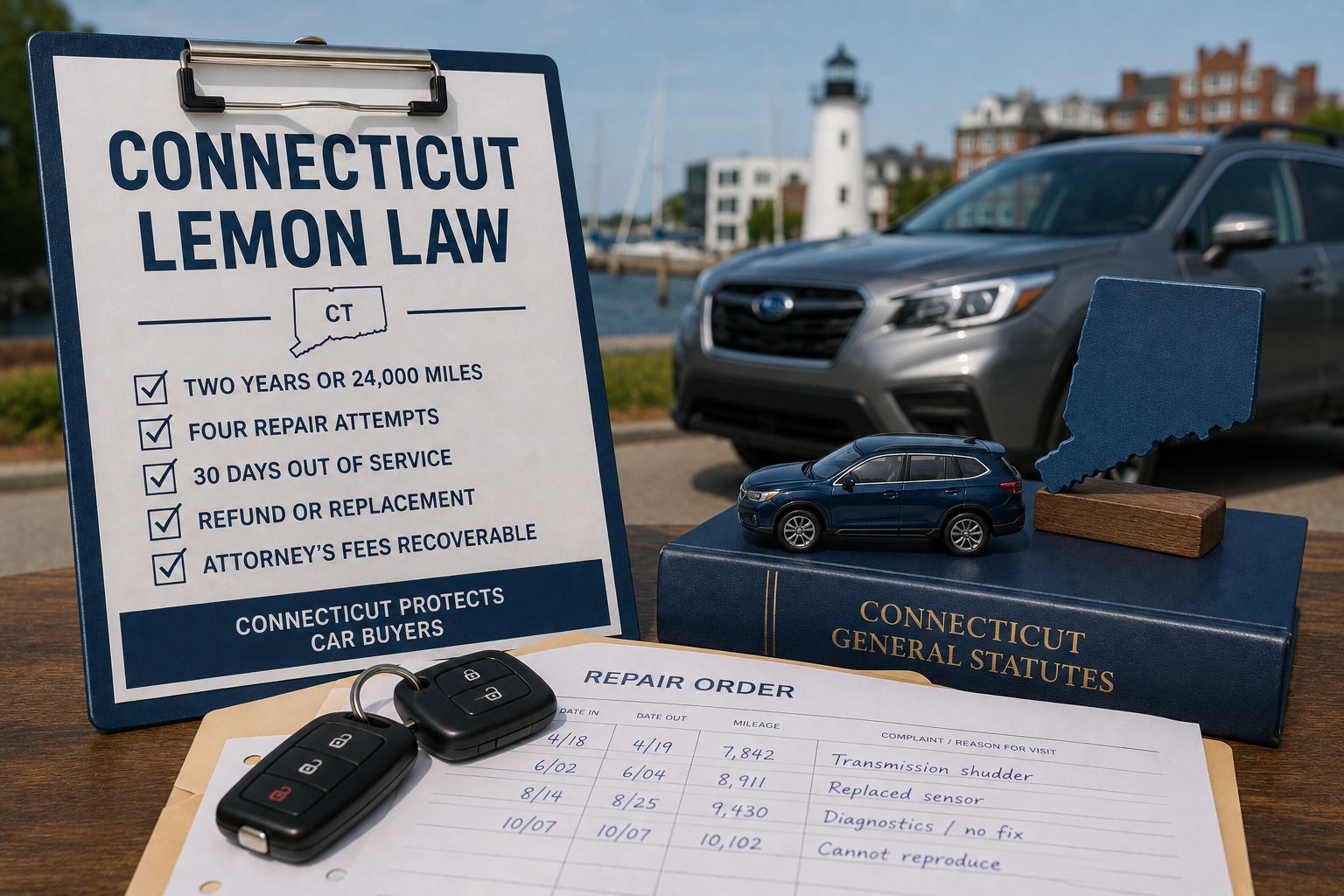
In most cases, no. The Connecticut lemon law lives in Chapter 743b, Conn. Gen. Stat. section 42-179, and it runs against the manufacturer of a new vehicle. It covers defects reported during the first two years or 24,000 miles, whichever comes first. Our complete Connecticut lemon law guide covers how those claims work.
There’s one narrow exception worth knowing. The statute’s definition of “consumer” includes anyone the vehicle is transferred to while an express warranty still applies. So a buyer who picks up a nearly new car privately, still inside that two year or 24,000 mile window, may be able to use the lemon law against the manufacturer. The private seller still isn’t the one on the hook.
Say Rachel buys a 14-month-old Hyundai Tucson with 11,000 miles from a coworker in Glastonbury. The transmission has already been in the shop twice for the same problem. Her coworker owes her nothing under the lemon law, but the manufacturer’s obligations under Chapter 743b may still follow the car.
Why the CT used car warranty law stops at the dealer
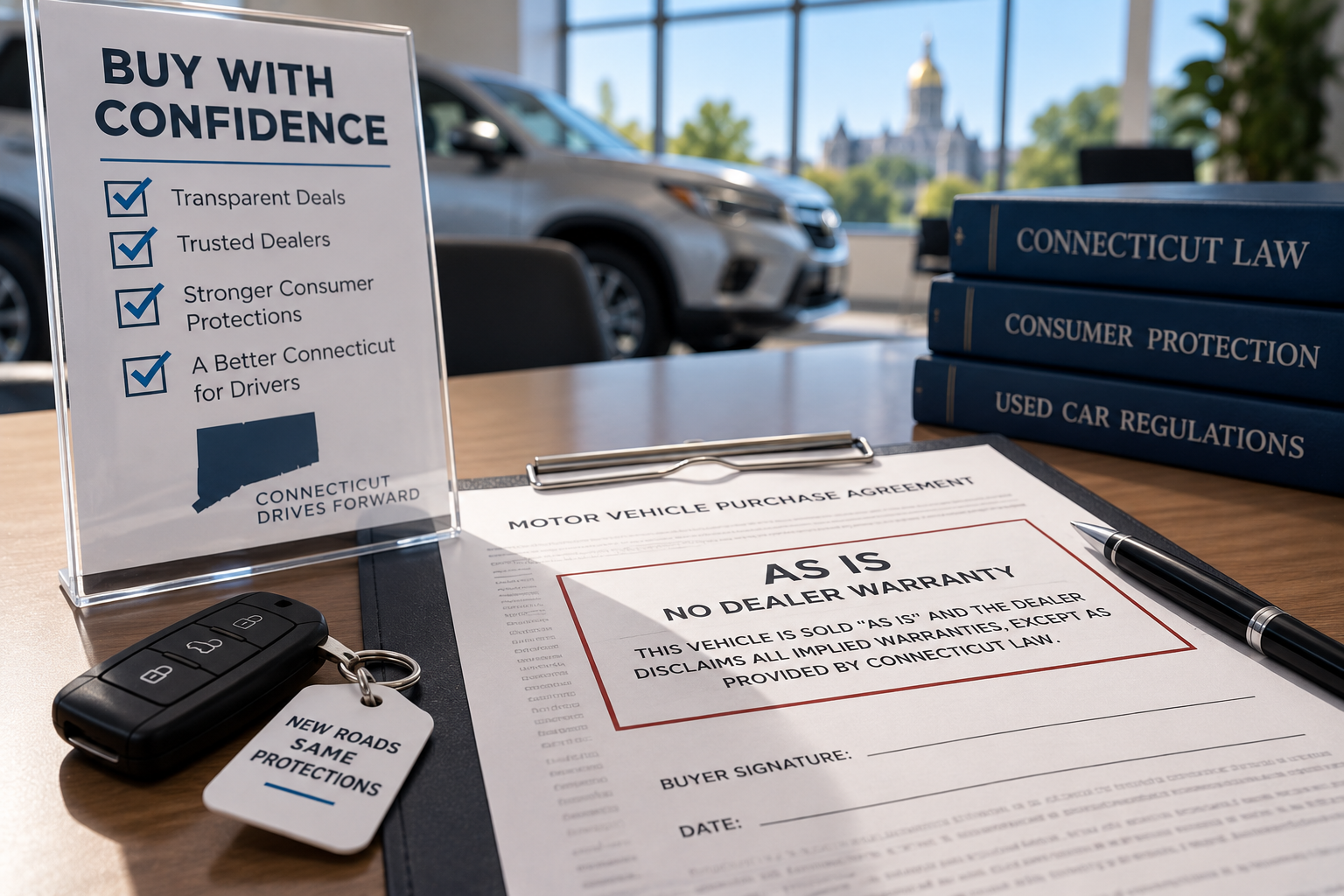
Connecticut’s Used Automobile Warranties Act, in Chapter 743f, requires a written warranty on many used cars. But section 42-220 defines “dealer” as a person or business licensed by the state as a new or used car dealer, or a licensed leasing or rental company that sells used vehicles to consumers. An individual selling a personal car isn’t licensed as any of those things.
So the statutory warranty, the “deemed given” rule, and the limits on as is sales don’t reach a true private sale. Our guide to Connecticut used car warranty rules explains what Chapter 743f does for people who buy from a dealer, including when a dealer can still sell a car as is.
Chapter 743f protects buyers from dealers. It doesn’t protect buyers from neighbors.
What warranties can come with a private sale in Connecticut
Once the lemon law and the used car warranty law drop out, the main source of rules is Connecticut’s version of the Uniform Commercial Code, Article 2. It governs sales of goods, and a car is a good. Several Article 2 warranties apply to every seller, including someone selling a personal car.
Express warranties: what the seller actually promised
Under Conn. Gen. Stat. section 42a-2-313, any statement of fact or promise about the car that becomes part of the basis of the bargain creates an express warranty. The seller doesn’t need to use the word “warranty” or “guarantee.” This rule applies to private sellers just as it does to dealers.
The line that matters is fact versus opinion. The same section says a statement about the car’s value, or the seller’s opinion or praise of the car, doesn’t create a warranty. “Runs great” and “best car I ever owned” are opinions. “New brakes in March,” “never been in an accident,” and “timing belt done at 100,000 miles” are facts that can be checked.
Fitness for a particular purpose
Section 42a-2-315 creates an implied warranty when the seller has reason to know the buyer’s specific purpose and the buyer relies on the seller’s skill or judgment to pick a suitable vehicle. It applies to any seller. It’s narrow, though, and it rarely fits a typical private sale.
Picture Priya in Danbury telling a seller she needs something to tow a 5,000 pound camper up to Candlewood Lake. The seller owns two pickups and points her to the smaller one, saying it’s the right truck for the job. If it can’t safely handle the load, that exchange looks a lot like the situation this section describes.
Warranty of title
Every seller, private or not, warrants under section 42a-2-312 that the title is good, that the transfer is rightful, and that the car is free of liens the buyer didn’t know about. Say Luis buys a Civic in New Britain and later learns a lender still has a security interest in it. That’s a title problem, and the warranty applies to private sellers too.
About “as is” in a private sale: Writing “sold as is” on a bill of sale mainly targets implied warranties. Under section 42a-2-316, courts read a promise and a disclaimer together where that’s reasonable, and a disclaimer is inoperative to the extent it can’t reasonably be squared with a specific promise. “As is” also isn’t a license to lie. It doesn’t erase fraud.
Misrepresentation claims under Connecticut law
Outside the warranty rules, Connecticut common law recognizes a few kinds of misrepresentation claims. They turn on what the seller knew when the statement was made.
- Fraudulent misrepresentation. The seller made a false statement of fact, knew it was false, made it to get the buyer to act, and the buyer acted on it and was harmed. The Connecticut Supreme Court discussed the elements of both fraudulent and negligent misrepresentation in Sturm v. Harb Development, LLC, 298 Conn. 124 (2010).
- Negligent misrepresentation. The seller didn’t know the statement was false but should have, and the buyer reasonably relied on it.
- Innocent misrepresentation. The seller honestly believed the statement. In Johnson v. Healy, 176 Conn. 97 (1978), the court said strict liability for innocent misrepresentation in the sale of goods is well established in Connecticut. That case involved a builder selling a house, so how far the doctrine reaches a casual one-time seller is a less settled question.
Johnson v. Healy also gave a damages measure that comes up often in these disputes. It’s the difference between the value of the property as it was represented and its value as it actually was.
The federal Odometer Act applies to private sellers
Mileage fraud is one area where federal law gives private buyers real teeth. Under 49 U.S.C. section 32710, a person who violates the federal odometer law with intent to defraud is liable for three times the actual damages or $10,000, whichever is greater. The court also awards costs and a reasonable attorney’s fee to a buyer who wins.
The statute says “a person,” not “a dealer.” Say Kevin buys a 2017 Toyota Camry in Norwalk showing 68,000 miles, then finds old oil change receipts in the glovebox showing 141,000. If the seller rolled back the odometer or knowingly gave a false mileage statement, the federal claim is on the table. It has its own deadline, generally two years after the claim accrues.
When a Connecticut “private seller” is really a dealer
Some sellers who look private are running an unlicensed business. This is often called curbstoning. Under Conn. Gen. Stat. section 14-52, no one may engage in the business of buying, selling, or offering motor vehicles for sale without a dealer’s license from the Commissioner of Motor Vehicles.
Federal law draws its own line. The FTC’s Used Car Rule, 16 C.F.R. section 455.1, treats anyone who sells a used vehicle after selling five or more in the previous twelve months as a dealer who has to post a Buyers Guide. Connecticut’s licensing statute asks the broader question of whether someone is engaged in the business.
Whether a seller crossed that line matters a lot. A seller who is really in the car business may be reachable under the Connecticut Unfair Trade Practices Act, section 42-110b, which targets unfair or deceptive acts in the conduct of trade or commerce. A true one-time sale of a personal car generally isn’t trade or commerce, so CUTPA usually doesn’t reach it.
A Connecticut private sale, worked through
Derek, who lives in Meriden, buys a 2016 Subaru Outback with 112,000 miles for $9,400 from a seller in Wallingford. The online listing says “no accidents, head gaskets replaced at 90k, clean title.” The handwritten bill of sale says “sold as is.” Three weeks later the car overheats. A mechanic finds the original head gaskets and signs of a prior frame repair.
Here’s how the rules above sort out:
- Lemon law. Out. The car is ten model years old and well past 24,000 miles.
- Used car warranty law. Out. The seller isn’t a licensed dealer.
- Express warranty. In play. “Head gaskets replaced at 90k” and “no accidents” are checkable facts, and they were in writing in the listing.
- Misrepresentation. Depends on what she knew. If she knew about the frame repair, that points toward fraud. If her ex-husband handled all the maintenance and she honestly believed the gasket story, the analysis shifts toward negligent or innocent misrepresentation.
Notice what did the work. It wasn’t a statute written for car buyers. It was the specific words in the listing. The “as is” line on the bill of sale doesn’t automatically cancel those statements, but how a court reads the two together depends on the documents and the facts.
Deadlines and where these cases are heard in Connecticut
Breach of warranty claims under the UCC generally must be brought within four years after the car was delivered, under section 42a-2-725. Misrepresentation claims run on their own, generally shorter, limitation periods, and the federal odometer claim has its two year window.
Many private car disputes are small enough for the small claims session of the Connecticut Superior Court, which hears cases for money damages up to $5,000. Magistrates, who are lawyers appointed by the Chief Court Administrator, usually decide them, and there’s no right to appeal. Larger claims go to the Superior Court’s regular civil docket.
Common questions about buying a used car from a private seller in CT
Can I return a used car I bought from a private seller in Connecticut?
Connecticut has no general cooling-off period or return right for private car sales. Undoing a sale usually depends on a legal claim like fraud or breach of an express warranty, or on the seller agreeing to take the car back.
Is there a used car lemon law for private sales in CT?
No. What people call the Connecticut used car lemon law is Chapter 743f, and it applies to licensed dealers. The only lemon law path for a private buyer is the new car statute, and only when the car is still inside its original two year or 24,000 mile coverage.
Does “sold as is” mean the seller can’t be sued?
No. An as is sale mainly affects implied warranties. It doesn’t protect a seller who lied about the car, rolled back the odometer, or sold a car with a hidden lien.
Does it matter that the seller only made a promise out loud?
An express warranty can be oral. Oral promises are harder to prove, though, and a written bill of sale that claims to be the whole agreement can make them harder to enforce. Listings, texts, and emails often end up as the best evidence of what was said.
Connecticut isn’t unusual here. Used car warranty statutes in neighboring states are generally aimed at dealers too. The federal Odometer Act stands out because it reaches every seller and carries a $10,000 minimum recovery when fraud is proven.
The takeaway for Connecticut private buyers
A private car sale in Connecticut falls outside the lemon law in most cases and outside the used car warranty law entirely. What’s left is the seller’s specific statements, the warranty of title, the federal odometer rules, and misrepresentation law. Whether a particular seller is really a dealer can change the analysis a lot.
How those rules apply to one car, one listing, and one bill of sale is a question for a licensed Connecticut attorney who can read the paperwork.
This article is for educational purposes only and is not legal advice. Reading it does not create an attorney-client relationship. For advice on your specific situation, consult a licensed attorney in your state.