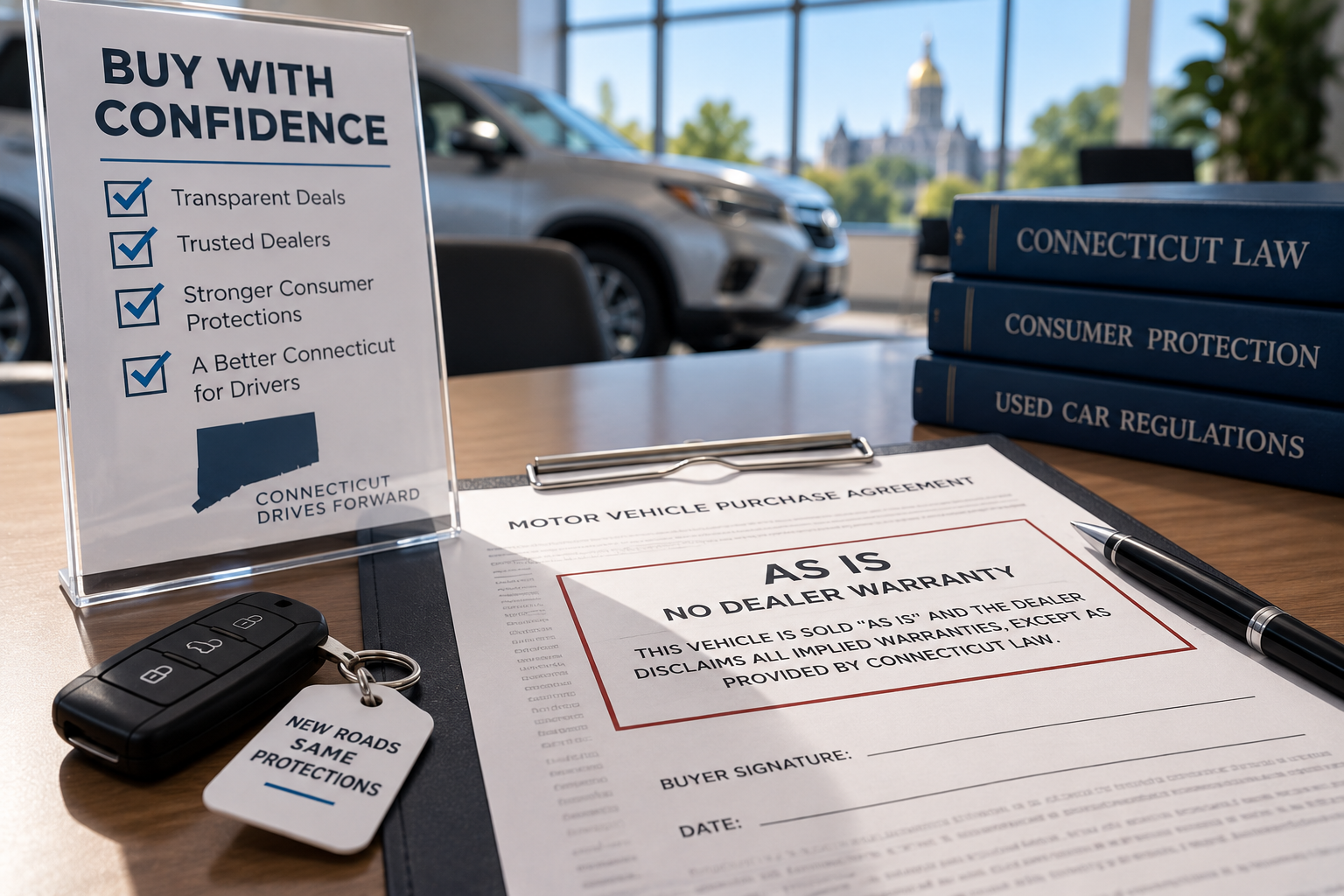
CT Used Car As Is Sales Rules, as of October 1, 2026
You’re standing at a dealership in Connecticut and the window sticker says the car is sold “as is.” Most buyers read that as a closed door. Sign here, and whatever breaks tomorrow is your problem.
That’s not quite how it works here. Connecticut is one of the states that limits when a dealer can sell a used car as is at all, and as of October 1, 2026, that limit changes in a way that pulls a lot of vehicles out of the as is category.
This post covers what an as is sale does and doesn’t do under Connecticut law, which cars can still be sold that way, and the specific things those two words never erase.
The short version: Connecticut’s old test asked about price or age. As of October 1, 2026, it asks about age only. A dealer can sell a used vehicle as is if the vehicle is ten years of age or older. Under that line, a statutory warranty attaches instead.
What an “as is” sale actually means in Connecticut
An as is sale waives implied warranties. Those are the unwritten promises that come with a sale by a merchant, like the idea that a car is fit to be driven. When a dealer sells as is and does it correctly, those drop away.
That’s the whole of it. As is is about warranties. It isn’t a general release that covers everything a dealer said or did.
The rules live in Conn. Gen. Stat. section 42-224, part of Chapter 743f, the Used Automobile Warranties Act. That’s a separate statute from the Connecticut lemon law, which applies only to new vehicles. If you’re sorting out which one covers your situation, our guide to Connecticut used car warranty rules lays out the split, and the complete Connecticut lemon law guide handles the new vehicle side.
When a CT dealer can sell a used car as is
The prior version of section 42-224 gave dealers two doors. A vehicle could be sold as is if the cash purchase price was under $3,000, or if the vehicle was seven years of age or older. Either one was enough.
As of October 1, 2026, the price door closes and the age door moves. Under the amended statute, a Connecticut dealer can sell a used vehicle as is only if the vehicle is ten years of age or older.
Ten years or older. That’s the whole test.
How Connecticut counts the ten years
Not from the purchase date. Not from when the car was built. Connecticut measures from the first day of January of the vehicle’s designated model year.
So during 2026, a 2016 model year vehicle is ten years old and can be sold as is. A 2017 model is nine, and it can’t. That 2017 model becomes eligible on January 1, 2027, when it turns ten.
The model year on the title is what matters, and it’s a bright line. A dealer can’t round up because a car has high miles or looks rough.
What Public Act 26-100 changed for as is sales
The change came through Public Act 26-100, signed June 2, 2026. The used vehicle warranty provisions started as Senate Bill 119 and were folded into the larger consumer protection act. The dollar thresholds being removed had been sitting in the statute since 1987, back when $3,000 bought a very different car than it does today.
Three shifts matter for as is sales specifically.
- Price stops mattering. A dealer can no longer sell a $1,900 car as is just because it’s cheap. If it’s under ten years old, the warranty attaches.
- The age line moves from seven to ten. Every vehicle in that seven to ten year band leaves the as is category.
- What replaces as is is a real warranty. Covered vehicles get an express written warranty on parts and labor, promising the car is mechanically operational and sound for at least 60 days or 3,000 miles, whichever ends first.
Put together, a large slice of Connecticut’s cheaper and older used car inventory moves from no protection to real protection. Those are often the cars bought by people who can least afford a surprise transmission.
The as is disclaimer has to be done a specific way
Even when a vehicle qualifies, the as is sale only sticks if the paperwork follows section 42-224. The statute says no as is disclaimer is enforceable unless every condition is met. All of them, not most.
- The disclaimer appears on the front page of the contract of sale, not buried later in the stack.
- It uses the exact wording the statute spells out, which tells the buyer they’re losing implied warranties, that they’ll pay for repairs after the sale, and that any promises the dealer made still have to be kept.
- The text is printed in twelve point boldface, with the heading in sixteen point extra boldface.
- The entire notice is boxed.
- The buyer signs inside the box to show assent.
Formatting is not a technicality here. The statute ties enforceability to the format. A disclaimer in small type, unboxed, on page three, without a signature inside the box, is a disclaimer Connecticut law treats as unenforceable.
What “as is” never wipes out
This is the part people get wrong most often. Section 42-224 says an as is sale waives implied warranties but does not waive express warranties, whether spoken or written. It also doesn’t affect the dealer’s responsibility for representations the buyer relied on in making the deal.
So a salesperson who says “the timing belt was just done” has made a representation. Selling the car as is doesn’t unsay it.
Waiving coverage on one disclosed defect
There’s a separate, much narrower path in section 42-221. A buyer can waive the statutory warranty for one particular defect the dealer disclosed before the sale. That waiver only works if it’s in writing, conspicuous, in plain language, names the exact defect, states what warranty still applies, and is signed by both the buyer and the dealer before the sale.
It covers the named defect and nothing else. Dealers sometimes treat this like a back door to as is on a newer car. It isn’t one.
Agreements that try to sign away the whole chapter
Section 42-223 addresses contracts that waive, limit, or disclaim the rights in Chapter 743f outside that narrow disclosed defect exception. Those agreements are voidable at the buyer’s option. The same section adds that when a dealer fails to give a written warranty the statute requires, the dealer is deemed to have given it anyway.
A hypothetical: two trucks on the same lot in Bristol
Say Devon walks onto a licensed dealer’s lot on Farmington Avenue in Bristol in November 2026. Two pickups, similar mileage, similar price around $13,000.
The first is a 2015 model. Counting from January 1, 2015, it’s eleven years old. That’s over the line, so the dealer can sell it as is, as long as the boxed disclaimer on the front page is formatted correctly and Devon signs inside the box.
The second is a 2018 model. That’s eight years old. Under the old rules, seven years or older meant as is was fine. As of October 1, 2026, eight is under ten, so the dealer can’t sell it as is. The contract has to include the 60 day or 3,000 mile warranty on parts and labor.
Now add one detail. Devon asks about the clutch on the 2015, and the salesperson says it was replaced last spring. Devon buys that truck as is. Three weeks later the clutch fails and a mechanic in New Britain says it’s the original.
The as is sale waived Devon’s implied warranties. It did not waive an express statement about the clutch, and under section 42-224 it doesn’t erase the dealer’s responsibility for a representation Devon relied on. Those are separate questions from the warranty, and they survive the sticker.
The federal Buyers Guide sticker and Connecticut’s limits
That window sticker isn’t a dealer’s idea. The FTC’s Used Car Rule requires it, and the rule lives at 16 C.F.R. section 455.2. Dealers have to post a Buyers Guide on used vehicles they offer for sale, disclosing whether the sale comes with a warranty and what it covers.
There are two versions of the Guide. One says “As Is, No Dealer Warranty.” The other says “Implied Warranties Only.” The rule is explicit that where state law limits or prohibits as is sales, the state law controls and the federal rule doesn’t give a dealer the right to sell as is. In those states the as is heading comes off the form and the implied warranties language goes on.
Connecticut is a partial case, and the FTC’s guidance for dealers on the Used Car Rule speaks to exactly that. Where a state allows as is sales for some used cars but not all, a dealer may use the as is Guide on the vehicles the state permits. So in Connecticut, the sticker version should track the age line. As of October 1, 2026, that means the as is Guide belongs on vehicles ten years and older, and the other version belongs on everything younger.
The Buyers Guide isn’t just signage. Under the federal rule, the final Guide becomes part of the sales contract, and information on it overrides contrary provisions in the contract. Keep your copy.
Separately, the federal Magnuson-Moss Warranty Act governs written warranties on consumer products. It doesn’t require anyone to offer a warranty, but once a written warranty exists, it restricts a seller’s ability to disclaim implied warranties alongside it.
Private sellers in Connecticut are outside all of this
Chapter 743f applies to licensed dealers. Buying a car from someone in Norwich who posted it on a marketplace app doesn’t put you inside the statute, so the as is rules and the age line don’t apply. The federal Buyers Guide requirement is also aimed at dealers, not private individuals selling their own vehicle.
A private sale is effectively an as is sale by default. Claims about fraud or misrepresentation come from other bodies of law and have their own separate elements.
Common questions about as is sales in Connecticut
Can a CT dealer sell any used car as is?
No. Connecticut has restricted as is sales for decades. As of October 1, 2026, the restriction is tied purely to age, and only vehicles ten years of age or older can be sold that way by a licensed dealer.
Does “as is” mean I can’t do anything if the car breaks?
As is waives implied warranties. It does not waive express promises the dealer made, spoken or written, and it doesn’t affect the dealer’s responsibility for representations the buyer relied on. Those are separate from the warranty question.
Is there a CT used car return policy or cooling off period?
Chapter 743f is a repair warranty statute, not a return statute. It doesn’t create a general right to bring a car back and undo the sale because you changed your mind. People search for a Connecticut used car return policy fairly often, and this law isn’t it.
What if the as is disclaimer wasn’t formatted right?
Section 42-224 conditions enforceability on the format and the signature. A disclaimer that misses those requirements is one Connecticut law treats as unenforceable, which changes what warranties were actually waived.
Which version of the Buyers Guide should be on the window?
It depends on the vehicle. Because Connecticut permits as is sales for some used cars and not others, the as is Guide belongs only on the vehicles the state actually allows to be sold that way. As of October 1, 2026, that’s the ten year and older group.
The takeaway
As is is a narrower tool in Connecticut than most buyers assume, and as of October 1, 2026, it’s narrower still. Age is the only gate, the disclaimer has to meet strict formatting rules, and the two words never reach express promises or representations the buyer relied on.
The model year, the sale date, and what the paperwork actually says are the facts that drive the analysis. The Connecticut Judicial Branch keeps a research guide collecting both warranty chapters if you want to read the statutes directly, and how any of it applies to a specific contract is a question for a licensed attorney.
This article is for educational purposes only and is not legal advice. Reading it does not create an attorney-client relationship. For advice on your specific situation, consult a licensed attorney in your state.