
Category: Lemon Law

If your new vehicle spends more time in the shop than on the road, your state’s lemon law may entitle you to a refund or replacement. Learn how to recognize a lemon, document repair attempts, understand the buyback process, and know exactly what the manufacturer owes you.

  • What Qualifies as a Lemon in CT? The Three New Car Tests

    What Qualifies as a Lemon in CT? The Three New Car Tests

    What Qualifies as a Lemon in CT? The Three New Car Tests

    The dealer calls to say your car is ready. You drive it home, and two days later the same problem is back. Most people stuck in that loop end up asking the same thing: at what point does this car legally count as a lemon?

    In Connecticut, the answer starts with numbers. The CT lemon law for new cars, found in Conn. Gen. Stat. § 42-179, sets out three tests. Meet one of them, and the law presumes the manufacturer has had a reasonable number of attempts to fix the problem.

    This post zooms in on that one question: what qualifies as a lemon in CT. For the full picture, including arbitration and refunds, see our complete guide to Connecticut lemon law.

    4 / 30 / 2

    Four repair attempts on the same defect. Thirty cumulative calendar days out of service for repair. Two attempts on a defect likely to cause death or serious bodily injury. Any one of these can trigger Connecticut’s lemon law presumption.

    Before the Tests: Is Your Car Even Covered?

    The repair counts only matter if the car and the owner fit the statute. Connecticut’s law covers new passenger vehicles, combination (passenger and commercial) vehicles, and motorcycles that are sold or leased in Connecticut.

    The law protects a “consumer,” and that word is broader than many people expect. It includes the buyer (as long as the car wasn’t bought to resell), a lessee, and anyone the vehicle is transferred to while an express warranty still applies. So a leased car counts. A nearly new car bought from a friend can count too, as long as the warranty is still running. Keep in mind the clock runs from the car’s original delivery. It doesn’t restart for a second owner.

    Say Gavin leases a new Jeep Grand Cherokee from a dealer in Hartford. He never owns it, but he’s still a “consumer” under the statute. The lease doesn’t knock him out of the lemon law.

    The Defect Has to Be a Big Deal

    Not every annoyance makes a lemon. The law kicks in when a new car doesn’t conform to the manufacturer’s express warranty and the manufacturer or its dealers can’t fix a defect or condition that substantially impairs the use, safety, or value of the car to the consumer.

    In General Motors Corp. v. Dohmann, 247 Conn. 274 (1998), the Connecticut Supreme Court held that this test is both subjective and objective. The fact finder first looks at the needs and circumstances of the particular owner. Then it asks whether, from an objective point of view, the car’s use, safety, or value to that owner really has been substantially impaired. The owner’s needs also have to be reasonable.

    That means the same defect can play out differently for different people. In Dohmann, paint flaws on a new pickup were enough, because the owner kept his vehicles in factory condition and an expert confirmed the damage was real and hard to fix. A faint dashboard squeak that bothers nobody else is a much harder case. Our post on what defects and recalls the CT lemon law covers runs through common problems one by one.

    The manufacturer can push back. It’s an affirmative defense under the statute to show the problem doesn’t substantially impair use, safety, or value. It’s also a defense to show the problem came from the consumer’s abuse, neglect, or unauthorized modifications or alterations.


    Test One: Four Repair Attempts on the Same Problem

    The first path is the one most people have heard of. The presumption applies if the same nonconformity has been subject to repair four or more times by the manufacturer, its agents, or its authorized dealers within the protection period, and the problem still exists.

    Three details matter. It has to be the same defect each time, not four different issues. The four attempts have to fall inside the two-year or 24,000-mile window. And the problem has to still be there after the fourth try. If the fourth repair actually fixes it, the presumption doesn’t kick in.

    Picture Aaliyah in New Haven, who buys a new Kia Telluride in January. The infotainment screen keeps going black and takes the backup camera with it. She brings it to the dealer in March, May, July, and September. After the fourth visit, the screen still cuts out. That pattern fits the four-attempt test on its face, though the manufacturer could still argue the defect isn’t substantial.

    Test Two: 30 Days Out of Service in Connecticut

    The second path doesn’t count visits. It counts days. The presumption applies if the vehicle is out of service by reason of repair for a cumulative total of 30 or more calendar days during the same two-year or 24,000-mile window.

    “Cumulative” means the days add up across separate visits. “Calendar days” means weekends and holidays count, not just business days. Unlike the first test, this part of the statute doesn’t use the words “same nonconformity.” Still, the overall claim needs a warranty defect that substantially impairs the car and hasn’t been fixed.

    Say Hector in Danbury buys a new Subaru Outback. The transmission starts slipping. The car sits at the dealer for 12 days waiting on a part, then 11 more when the slipping returns, then 9 more after that. That’s 32 calendar days in total, which clears the 30-day mark even though there were only three visits.

    Test Three: Two Attempts on a Dangerous Defect

    Connecticut gives safety defects their own, faster track. Under subsection (f), if a defect results in a condition likely to cause death or serious bodily injury if the car is driven, the presumption applies after the defect has been subject to repair at least twice and still exists.

    Watch the shorter clock. The safety test doesn’t use the usual two-year, 24,000-mile window. Both attempts must happen within the express warranty term or within one year after the car was first delivered to a consumer, whichever ends first.

    Take Rosa in Waterbury, who buys a new Ford F-150 in January. In April, the brakes fade on a downhill stretch of Route 8. The dealer works on them. In August, it happens again, and a second repair doesn’t solve it. Both attempts fall inside the first year, so the two-attempt safety test could apply.

    The Window Behind Tests One and Two

    For the first two tests, everything happens inside one window. It runs two years from the date the car was first delivered to a consumer, or the first 24,000 miles, whichever ends first. If the defect is reported inside that window, the manufacturer still has to make the needed repairs even after it closes.

    Our post on how long the lemon law is good for in Connecticut covers the timing rules in detail, including how mileage can end the window early and when the clock can be extended.

    What Doesn’t Count Toward a Connecticut Lemon Claim

    A few rules trip up owners who otherwise seem to have a strong case.

    • The defect has to be covered by the manufacturer’s express warranty. Problems outside that coverage don’t count.
    • The presumption counts repairs by the manufacturer, its agents, or its authorized dealers. Visits to an independent shop don’t fit that language.
    • No claim can be made unless at least one repair attempt was made, or the manufacturer or dealer refused to try.
    • Problems caused by the consumer’s abuse, neglect, or unauthorized modifications give the manufacturer a defense.
    • Written notice to the manufacturer is required under the statute only if the warranty or owner’s manual clearly and conspicuously says so.

    Records matter too. Under § 42-179a, a dealer or authorized agent of the manufacturer has to give the consumer copies of repair paperwork and invoices on request. Those repair orders are usually how visits and days out of service get proven.

    The Presumption Is a Shortcut, Not a Finish Line

    Here’s a point that often gets lost. Under subsection (d), the real legal standard is whether the manufacturer couldn’t fix the defect after a “reasonable number of attempts.” The three tests are ways to presume that standard has been met. They aren’t the only way to meet it.

    Dohmann shows how far that can go. The dealer made one attempt, swapping the truck’s hood, and it failed. The arbitration panel credited an expert who said no body shop repaint could match the factory finish. The Supreme Court upheld the finding that, on those facts, a single attempt was a reasonable number.

    It cuts the other way too. A car that meets one of the tests isn’t automatically a lemon. The manufacturer can still argue the defect isn’t substantial or was caused by abuse or modifications.

    Key takeaway: Meeting one of the three tests shifts the argument in the consumer’s favor. It doesn’t end the argument. The defect still has to substantially impair use, safety, or value, judged by both the owner’s reasonable needs and an objective look at the car.

    A Near Miss, Worked Through

    Let’s run one fictional case start to finish. Dev buys a new Honda CR-V in Stamford. In his first month of ownership, the car starts shaking hard at highway speed. The dealer tries a fix three times over the next seven months. The shaking keeps coming back, and the car has spent 22 days in the shop.

    Dev is inside the two-year, 24,000-mile window. But three attempts isn’t four, and 22 days isn’t 30, so the first two tests aren’t met yet. The safety test is a closer call. If violent shaking at speed is likely to cause serious bodily injury, the three failed attempts inside the first year would clear the two-attempt bar. Whether it meets that standard is a factual question.

    Even if no presumption applies, Dev’s situation isn’t necessarily over. The question would still be whether three failed attempts is a reasonable number for this defect. Situations like this are why the facts and the repair records matter so much.

    How Connecticut Differs From Federal Law

    The federal Magnuson-Moss Warranty Act doesn’t set any fixed number of repair attempts or days. Its refund-or-replacement rule after a reasonable number of tries applies to warranties labeled “full,” and many new car warranties are labeled “limited.” Connecticut’s law, first passed in 1982, goes further by spelling out the 4, 30, and 2 benchmarks for new cars.

    Connecticut also offers its own arbitration program for new car disputes under § 42-181, run by the Department of Consumer Protection’s Lemon Law Program. Two wrinkles are worth knowing. If a manufacturer has an informal dispute program certified by the Attorney General, the statute’s refund and replacement remedies don’t apply until the consumer first uses that program. And DCP’s own application materials ask for proof that the manufacturer or leasing company was notified.


    FAQs About the Connecticut Lemon Law for New Cars

    How many times does a car have to be in the shop to be a lemon in CT?

    Four repair attempts on the same defect creates the presumption, or two for a defect likely to cause death or serious bodily injury. A separate test looks at 30 cumulative calendar days out of service, no matter how many visits that took. As Dohmann shows, fewer attempts can sometimes still be enough.

    What if the dealer can’t find anything wrong?

    The Department of Consumer Protection’s arbitration requirements page lists situations where the defect was brought to the dealer’s attention and the dealer decided it wasn’t a defect, or the mechanic couldn’t verify it. That’s DCP’s program guidance rather than statutory text, but it’s one reason a written repair order for every visit matters, even the “no problem found” ones.

    Does the Connecticut lemon law apply to leased vehicles?

    Yes. The statute’s definition of “consumer” expressly includes a lessee, and it covers vehicles leased in Connecticut. Our post on the Connecticut lemon law for leased cars explains how the refund gets split with the leasing company.

    How many recalls before the lemon law applies?

    The statute doesn’t mention recalls. It counts repair attempts on a nonconformity and days out of service for repair. A recall isn’t one of the three tests, and the statute doesn’t say whether a recall visit counts as a repair attempt on an ongoing defect.

    Is the lemon law only for new cars in Connecticut?

    Section 42-179 is built around new vehicles and runs from the original delivery date. A later owner can still be covered if the car changed hands while the express warranty was active and the window hasn’t closed. Used cars bought from dealers fall under a separate law, covered in our post on the CT used car rules that changed October 1, 2026.

    The Bottom Line

    What qualifies as a lemon in CT comes down to a covered vehicle, a warranty defect that substantially impairs use, safety, or value, and a reasonable number of failed repair attempts. The three presumption tests (four attempts, 30 days, or two attempts on a dangerous defect) are the usual way to show that, but they’re a starting point, not an automatic win.

    This article is for educational purposes only and is not legal advice. Reading it does not create an attorney-client relationship. For advice on your specific situation, consult a licensed attorney in your state.
  • Florida Lemon Law Statute of Limitations: 3 Deadlines

    Florida Lemon Law Statute of Limitations: 3 Deadlines

    Florida Lemon Law Statute of Limitations: 3 Deadlines

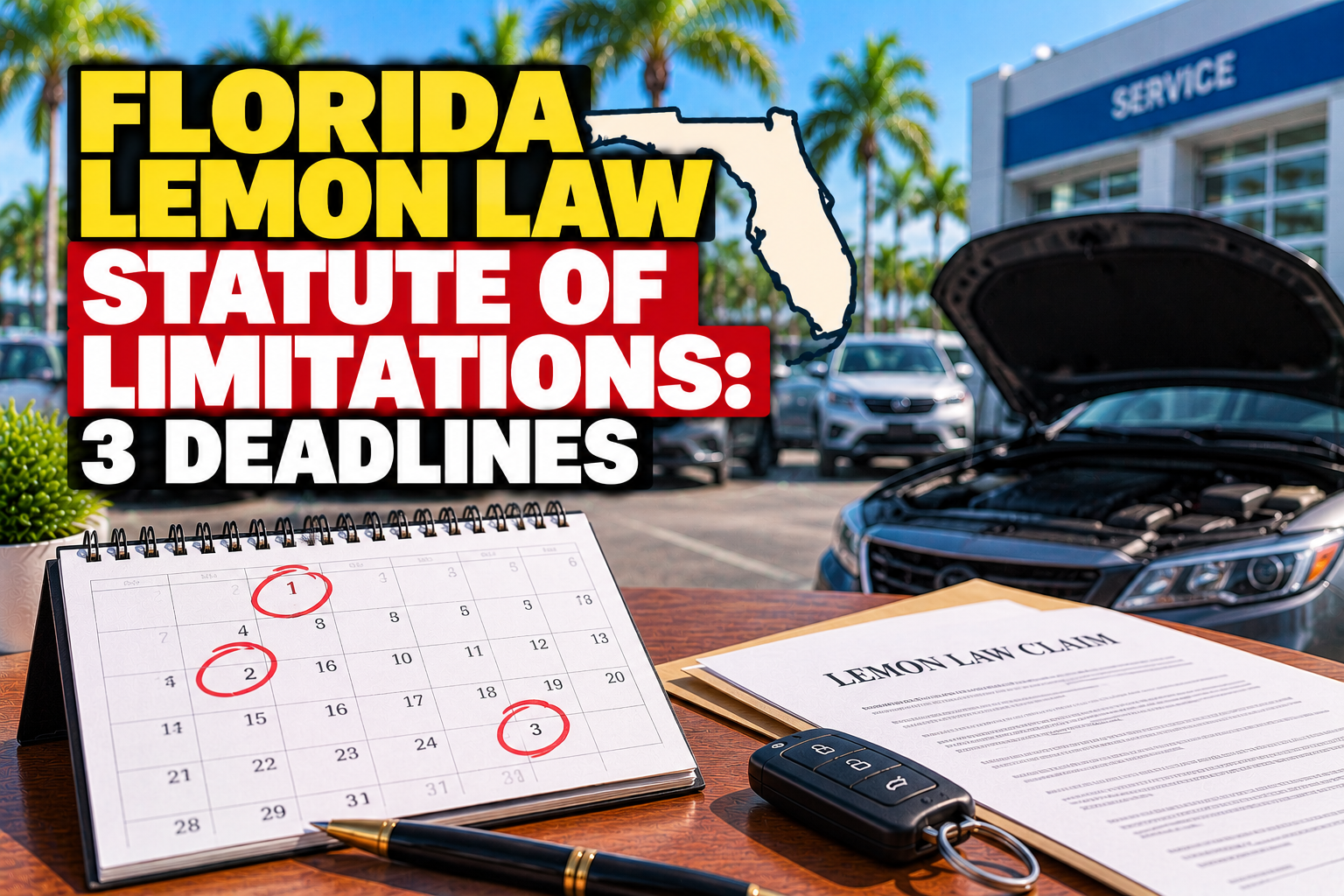
    Most Florida lemon law claims don’t die because the car was fine. They die because a date slipped by. The Florida lemon law statute of limitations isn’t one deadline. It’s three separate clocks, and each one can end a claim on its own.

    The first is the 24-month Lemon Law rights period. The second is a 60-day window to get into arbitration after that period ends. The third is a one-year deadline to file a lawsuit. They overlap in ways that confuse almost everyone, including some people who deal with car warranties for a living.

    This guide walks through each clock in plain English, with the statute sections behind them and a worked example with real dates. For the full picture of how Florida’s lemon law works, start with our plain-English guide to the Florida lemon law. This article zooms in on timing only.


    The Three Florida Lemon Law Deadlines at a Glance

    All three deadlines come from Chapter 681 of the Florida Statutes, officially called the Motor Vehicle Warranty Enforcement Act. Here’s how they line up.

    DeadlineWhen it startsHow long it runsWhere it comes from
    Lemon Law rights periodOriginal delivery of the vehicle24 monthsFla. Stat. § 681.102(9)
    Arbitration request windowEnd of the rights period (or final action of a certified program)60 days (or 30 days after the program’s final action, whichever is later)Fla. Stat. § 681.109
    Lawsuit deadlineEnd of the rights period (or final action of the program, department, or board)1 yearFla. Stat. § 681.112(2)

    One detail trips people up. Florida counts calendar days, not business days. The definitions section says so directly, so weekends and holidays count toward every day-based deadline in the chapter.

    Deadline One: The 24-Month Lemon Law Rights Period

    Under Fla. Stat. § 681.102(9), the Lemon Law rights period is the period ending 24 months after the original delivery of the vehicle to a consumer. That’s the answer to the common search “how long is the lemon law good for in Florida.” It’s two years from delivery.

    Notice the word “original.” The clock starts when the car was first delivered to a consumer, not when a later owner bought it. If a car changes hands during those 24 months, the new owner can still count as a consumer, but only for whatever time is left on the original clock.

    No Mileage Cap in Florida

    Many states end lemon law coverage at a set time or a set number of miles, whichever comes first. Florida’s definition has no mileage limit at all. A rideshare driver in Miami who puts 50,000 miles on a new car in 18 months is still inside the rights period, as long as the 24 months haven’t run out.

    What Has to Happen Inside the 24 Months

    The key event is the first report of the problem. Under Fla. Stat. § 681.103(1), if the consumer first reports a defect to the manufacturer or its authorized service agent during the rights period, the manufacturer has to keep repairing it, even after the 24 months end. But that same section says this doesn’t extend the rights period or the time to file a claim.

    The repair presumptions work the same way. Under Fla. Stat. § 681.104(3), the law presumes the manufacturer had a reasonable number of attempts if, during the rights period, either of these happened:

    • The same defect was repaired at least three times, the manufacturer got a final repair attempt after written notice, and the problem still exists.
    • The vehicle was out of service for repairs for a total of 30 or more days (60 for a recreational vehicle), not counting routine maintenance.

    Watch the written notice steps. Section 681.104(1) requires written notice to the manufacturer by registered or express mail after three repair attempts on the same defect. A separate written notice is required once the car has been out of service for a total of 15 or more days. After the three-attempt notice, the manufacturer has 10 days to respond and direct the car to a repair shop, then 10 days after delivery to fix it.

    Deadline Two: The 60-Day Arbitration Window

    This is the deadline people forget exists. Florida runs a state arbitration board, the Florida New Motor Vehicle Arbitration Board, through the Attorney General’s office. Before a consumer can sue over a defect covered by section 681.104, Fla. Stat. § 681.1095(4) requires the dispute to go to the Department of Legal Affairs first, and to the board if the department finds it eligible.

    That makes the arbitration deadline more than a side option. For most claims, it’s the gateway to everything else.

    When the Manufacturer Has No Certified Program

    Under Fla. Stat. § 681.109(4), a request for board arbitration on a claim that arose during the rights period is due no later than 60 days after the rights period ends. The request goes on a state form. The Attorney General’s office explains on its page about how to submit the Request for Arbitration form that the form must be received by that deadline, not just mailed.

    When the Manufacturer Has a Certified Program

    Some manufacturers run their own dispute programs that the state has certified. If a manufacturer has one and told the buyer in writing how to use it, the consumer generally has to go through that program first. Section 681.109 says a claim with a certified program must be filed no later than 60 days after the rights period ends.

    If the program doesn’t decide within 40 days, or the consumer is unhappy with the result, the dispute can move to the state board. In that case, the board request is due 60 days after the rights period ends or 30 days after the program’s final action, whichever date is later.

    RVs Have Their Own Program Deadline

    Recreational vehicles skip the state board in most cases and go to a separate RV mediation and arbitration program. Under Fla. Stat. § 681.1097(2), the RV application is due no later than 60 days after the rights period ends. Our guide to boats, RVs, and motorcycles under Florida lemon law explains how that program works.

    After the Board Decides

    A board decision becomes final unless someone appeals to circuit court within 30 days of receiving it. Our walkthrough of how Florida lemon law arbitration works covers the hearing, the 40-day compliance window, and the appeal process.

    Deadline Three: The One-Year Lawsuit Deadline in Florida

    This is what most people mean by the Florida lemon law statute of limitations. Fla. Stat. § 681.112(2) says a lawsuit under the chapter must be started within one year after the rights period ends.

    There’s an important twist. If the consumer uses a certified manufacturer program, or submits the dispute to the department or the board, the one-year clock runs from the final action of that program, department, or board instead. Since most defect claims have to pass through the department first, the “final action” version is the one that often applies in practice.

    The one-year deadline can run later than it looks, but it isn’t a substitute for the 60-day arbitration window. Missing the arbitration deadline closes the state board route and can complicate everything that comes after it.

    Chapter 681 also says it doesn’t block other legal remedies. Claims under other laws, like the federal warranty statute, have their own timing rules that fall outside this article.

    A Florida Lemon Law Timeline, Worked Out With Real Dates

    Say Gloria Reyes takes delivery of a brand-new Chrysler Pacifica from a dealership on Malabar Road in Palm Bay on June 3, 2024. She’s the first owner. Her Lemon Law rights period ends on June 3, 2026.

    In the fall of 2025, the rear suspension starts clunking over every bump, and the van pulls hard to the right at highway speed on I-95. The dealer tries to fix it three times between September and December. After the third try, Gloria sends written notice to the manufacturer by registered mail. The manufacturer’s final repair attempt fails in January 2026. All of this happened inside her rights period.

    In this example, the manufacturer has no certified program. Here’s how her three clocks line up:

    1. Her rights period ends June 3, 2026.
    2. The Attorney General’s office must receive her arbitration request by August 2, 2026, which is 60 calendar days later.
    3. Her one-year lawsuit clock runs from the final action of the department or board, since the dispute goes through that process.

    Now picture Phil Kowalski, who has the same problem with the same model and the same delivery date. He assumes he has “a year” after his rights period ends and doesn’t look into arbitration until October 2026. Under section 681.109(4), his window to request board arbitration closed on August 2. He has lost the free state arbitration route that Gloria still has. What path, if any, he has left is a harder question the statute doesn’t answer cleanly, and that uncertainty is exactly the problem the 60-day rule creates.

    Delay has a second cost too. If a case ends in a buyback, the mileage deduction grows with every mile driven until the settlement or hearing date. Our guide to the Florida lemon law refund calculation shows how that offset works.

    The Most Common Ways Florida Lemon Law Claims Die on Timing

    Missed deadlines tend to follow the same patterns. These are the ones that come up again and again.

    • Reporting the first problem after the 24 months have already ended, so the claim never enters the lemon law at all.
    • Assuming the rights period stretches while the dealer is still working on the car. Section 681.103(1) says it doesn’t.
    • Treating the one-year lawsuit deadline as the only deadline and missing the 60-day arbitration window.
    • Mailing the arbitration form close to day 60, when the rule is based on when the office receives it.
    • Skipping the written notice to the manufacturer, which can undercut the presumption that a reasonable number of repairs happened.

    Key takeaway: In Florida, the rights period is 24 months from original delivery with no mileage cap. The arbitration request is due 60 days after that period ends, or later if a certified program was used. The lawsuit deadline is one year after the rights period ends, or one year after the final action of the program, department, or board.

    Florida Lemon Law Deadlines: Common Questions

    What is the statute of limitations for lemon law in Florida?

    Under section 681.112(2), a lawsuit must be filed within one year after the Lemon Law rights period ends. If the dispute went through a certified manufacturer program, the department, or the arbitration board, the year runs from that body’s final action instead.

    Does the rights period get extended if my car is still in the shop?

    No. Section 681.103(1) requires the manufacturer to keep fixing a defect first reported during the rights period, even after it ends. But the same section says that duty doesn’t extend the rights period or the time to file a claim. Some states handle this differently, which is part of why Florida’s rule surprises people.

    Does the Florida lemon law notice have to go by certified mail?

    The statute doesn’t say certified mail. Section 681.104(1) names registered or express mail for both the three-attempt notice and the 15-day out-of-service notice. A lot of online sources say “certified letter,” but that isn’t the wording the Legislature used.

    How much time does a second owner get?

    Only what’s left on the original clock. A second owner who buys a 14-month-old car has about 10 months of rights period remaining. Once 24 months from original delivery pass, Chapter 681 no longer covers new problems. Our guide on whether the lemon law applies to used cars with no warranty in Florida covers the rules that take over after that.

    Do the 30 days out of service have to happen inside the 24 months?

    Yes. The 30-day presumption counts only days during the rights period. Our breakdown of Florida’s 30-day out-of-service rule explains how those days add up and when the 15-day notice comes in.


    The Bottom Line on Florida Lemon Law Timing

    Florida’s lemon law runs on three clocks: 24 months from delivery, 60 days to reach arbitration, and one year to sue. The 60-day window is the one that catches people off guard, because most claims have to pass through the state process before a lawsuit is even possible. Refunds, replacements, and what counts as a defect all sit on top of these three dates.

    This article is for educational purposes only and is not legal advice. Reading it does not create an attorney-client relationship. For advice on your specific situation, consult a licensed attorney in your state.
  • NY Lemon Law Refund Calculation: How the Buyback Math Works

    NY Lemon Law Refund Calculation: How the Buyback Math Works

    NY Lemon Law Refund Calculation: How the Buyback Math Works

    Your new car has been back at the dealer four times for the same problem. Now you’re wondering what a buyback would actually be worth. The NY lemon law refund calculation follows a formula written into state law, and once you see the pieces, the math is simpler than most people expect.

    This guide walks through each piece. That means what gets added in, what gets subtracted, how the mileage offset works, and how the numbers change for leased and used cars. For the basics on who qualifies in the first place, see our complete guide to New York lemon law.

    What Goes Into a New York Lemon Law Refund?

    New York’s new car lemon law is General Business Law § 198-a. It covers cars with a defect that shows up within the first 18,000 miles or two years after delivery, whichever comes first. When a car qualifies and the owner picks a refund instead of a replacement, the manufacturer has to take the car back and pay an amount set by the statute.

    What gets added

    • The full purchase price of the car (or the lease price for a leased car)
    • Any trade-in allowance applied to the deal
    • License fees, registration fees, and similar government charges

    What gets subtracted

    • An allowance for miles driven beyond the first 12,000
    • A reasonable allowance for damage beyond normal wear, or for improvements

    Notice what isn’t named. The statute says fees and charges “include but not be limited to” government charges, but it doesn’t specifically list towing bills, rental cars, or other incidental damages. Florida’s law does. A pending New York bill would add them, which we cover further down.


    The NY Lemon Law Mileage Offset Formula

    The biggest deduction in most buybacks is the mileage offset. New York calls it the “mileage deduction formula,” and it’s defined in § 198-a(a)(4). The key feature is simple. The first 12,000 miles are free, and you only pay for miles beyond that.

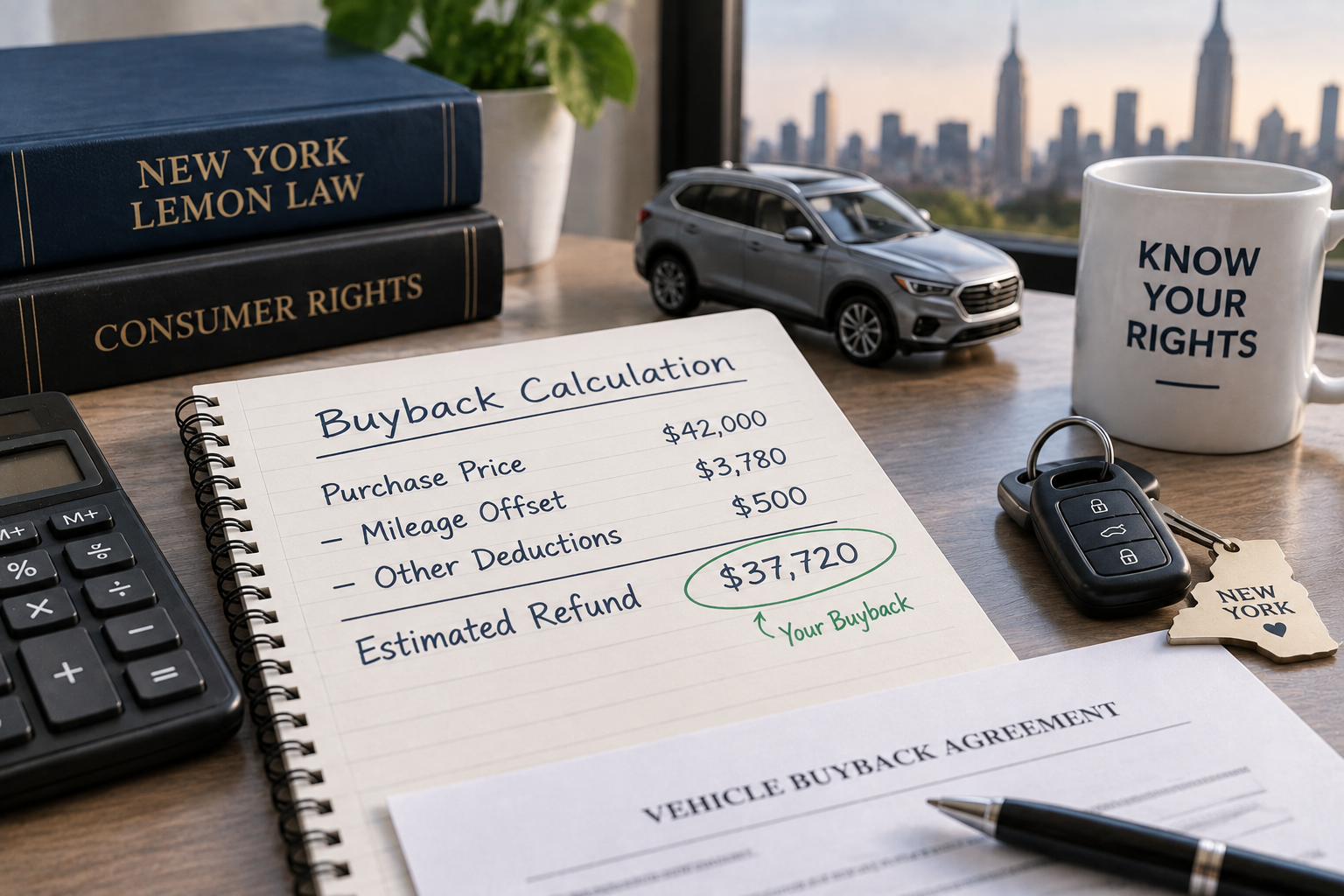
    Mileage offset = (miles over 12,000 × purchase price) ÷ 100,000

    Put another way, each mile past 12,000 costs one hundred-thousandth of the price. On a $40,000 car, that works out to 40 cents per mile.

    If the car has fewer than 12,000 miles, the offset is zero. Say Derek in Albany buys a new pickup for $52,000 and the transmission starts slipping in month three. If his claim is resolved at 9,800 miles, there’s no mileage deduction at all.

    Which odometer reading counts?

    The statute refers to mileage in excess of 12,000 but doesn’t pin down the exact date the odometer is read. It’s commonly tied to the mileage when the car goes back. That detail can matter a lot when a dispute drags on for months and the car keeps getting driven.

    Key takeaway: New York only charges for miles driven past 12,000. Many other states charge for every mile from day one.

    Worked Example: A Lemon Law Buyback Calculation in Yonkers

    Maria buys a new Subaru Forester from a dealer on Central Park Avenue in Yonkers. The price is $36,000. She trades in her old sedan for a $5,000 credit and finances the rest. Registration, title, and plate fees come to $310.

    The engine keeps stalling on the Saw Mill River Parkway, and repeat repairs don’t fix it. By the time the manufacturer agrees to a buyback, the Forester has 19,400 miles on it and no damage beyond normal wear. Here’s how the math would generally run.

    1. Start with the full purchase price: $36,000. The $5,000 trade-in credit is already part of that number, so its value comes back to her in the refund.
    2. Add government fees: $36,000 plus $310 equals $36,310.
    3. Find the miles over 12,000: 19,400 minus 12,000 equals 7,400.
    4. Apply the formula: 7,400 × $36,000 ÷ 100,000 equals $2,664.
    5. Subtract the offset: $36,310 minus $2,664 equals $33,646.

    So the manufacturer’s refund would be about $33,646. If Maria still owes money on her loan, part of that check goes to the lender first. The statute says refunds are paid to the consumer and any lienholder as their interests appear on DMV records. If she owes $22,000, the lender would get $22,000 and Maria would get $11,646.

    Where Does the Sales Tax Come From?

    This part surprises a lot of people. Under the new car statute, the sales tax isn’t part of the manufacturer’s refund formula. Instead, the manufacturer has to include an application form and a notice explaining that the sales tax on the refunded amount can be refunded by the New York State Department of Taxation and Finance.

    That process comes from Tax Law § 1139(f). A request is timely if it’s made within three years of the date the consumer receives the refund from the manufacturer.

    Watch the clock: The sales tax refund is a separate application with its own three-year window. It doesn’t happen automatically just because the manufacturer paid.

    Leased Cars: How the Refund Gets Split

    Leased cars are covered too, but the money is divided between the driver and the leasing company. The driver gets back what § 198-a calls the “capitalized cost.” In this statute, that means the deposit plus the lease payments already made, minus “service fees.” It’s not the same thing as the cap cost printed on a lease worksheet.

    Service fees are mostly an interest charge figured at two points above the prime rate, plus any insurance or other costs the leasing company paid for the driver’s benefit. The leasing company receives the balance it’s owed. The lease ends on the date of the arbitrator’s decision, and no early termination penalty can be charged.

    Say Kevin in Buffalo leases a new Chevy Equinox. He paid $2,500 at signing and has made 14 payments of $420, for $8,380 total. In a buyback, his share would be that $8,380 minus the service fees, which might run a few hundred dollars depending on the prime rate when he signed.

    Used Car Refunds Under New York’s Used Car Lemon Law

    Used cars bought from a dealer fall under a separate statute, General Business Law § 198-b. The refund math works differently in a few important ways.

    • The dealer pays the refund, not the manufacturer.
    • The refund includes the sales tax the buyer paid.
    • There’s no mileage deduction formula. The refund can be reduced for damage beyond normal wear and adjusted for modifications that raise or lower the car’s value.
    • If the dealer keeps a trade-in, it’s valued at NADA Used Car Guide wholesale value, adjusted for mileage and condition, instead of the number on the sales contract.

    Say Tanya buys a used Toyota Camry with 45,000 miles from a lot in Rochester for $21,000. At that mileage, the law requires a dealer warranty of at least 60 days or 3,000 miles, whichever comes first. The dealer gives her $4,000 for her trade-in, so her cash difference is $17,000. The trade-in’s NADA wholesale value is only $3,200.

    If Tanya qualifies for a refund and the dealer keeps the trade-in, her refund base would be $17,000 plus $3,200, or $20,200, plus the sales tax she paid. Her trade-in credit shrinks by $800 because of the wholesale valuation rule.

    There’s one more wrinkle. If the refund isn’t enough to pay off the car loan, the dealer has to send written notice by registered or certified mail. The buyer then has 30 days to pay the lender the difference, or the dealer’s refund obligation ends.

    How New York’s Math Compares to Florida and Federal Law

    New York’s formula is friendlier to drivers than many states. Florida’s definition of a “reasonable offset for use” in Fla. Stat. § 681.102 counts every mile the consumer drove up to the settlement or arbitration hearing. It uses the base price of the car without taxes and fees, and it divides by 120,000.

    Run Maria’s Forester through Florida’s formula: 19,400 × $36,000 ÷ 120,000 equals $5,820. That’s more than double New York’s $2,664 deduction for the same car and the same miles. Florida does add back collateral charges like sales tax and earned finance charges, plus incidental charges caused by the defect, so the final totals aren’t an apples-to-apples comparison.

    Federal law is different again. The Magnuson-Moss Warranty Act sets refund-or-replace duties for products sold with a “full” warranty under 15 U.S.C. § 2304, but it has no mileage formula like New York’s. Most new car warranties are labeled “limited,” which is a big reason state lemon laws do most of the work.

    A Pending Bill Could Change the NY Lemon Law Refund Formula

    As of September 2026, the New York Legislature is considering Assembly Bill A8594A. It hasn’t passed either house or been signed, so it isn’t law. If it’s enacted as written, it would take effect one year after it becomes law.

    • Free miles would rise from 12,000 to 24,000.
    • The divisor would go from 100,000 to 200,000, which cuts the per-mile charge in half.
    • Title fees, document fees, and incidental damages such as reasonable repair, towing, and rental car costs would be added to the refund.
    • New car coverage would expand to 36,000 miles or three years.

    Under that version, Maria’s 19,400 miles would fall under the free threshold, and her mileage offset would drop from $2,664 to zero. We’ll update this article if the bill moves.

    What Happens When the Refund Amount Is Disputed?

    Disagreements over the numbers often end up in arbitration. The Attorney General’s Lemon Law Arbitration Program lets consumers take a claim to an independent arbitrator for a filing fee. Manufacturers can also run their own informal programs. Under § 198-a(g), an arbitrator in a manufacturer’s program can’t reduce a refund award below the full purchase price plus fees, except for the deductions the statute allows.

    After a consumer accepts an arbitrator’s decision, the manufacturer has up to 30 days to comply. Missing that deadline can add $25 per business day, up to $500. A court may also award reasonable attorney’s fees to a consumer who wins.

    Any lawsuit under § 198-a has to be filed within four years of the car’s original delivery. These cases are commonly heard in New York State Supreme Court, which is the state’s main trial court despite its name. Court proceedings to challenge or confirm an AG program award go through Article 75 of the Civil Practice Law and Rules and must be brought in the county where the consumer lives or where the arbitration was held.


    Common Questions About NY Lemon Law Refunds

    Does a New York lemon law refund include my down payment?

    The refund is based on the full purchase price, and a down payment is part of that price. So the down payment and trade-in value come back through the calculation, minus the allowed deductions. Any loan balance is paid to the lender first.

    Do I pay anything for the first 12,000 miles?

    Not under current New York law. The mileage offset only applies to miles driven past 12,000 on a new car.

    Is loan interest refunded under New York lemon law?

    Section 198-a doesn’t specifically list finance charges the way Florida’s law lists earned finance charges. Whether interest gets recovered is something that can come up in settlement talks or litigation, and it depends on the facts.

    Is a lemon law buyback the same as a settlement?

    Not always. A buyback, or repurchase, means the car goes back and the formula above sets the payment. A settlement can take other forms, like a cash payment where the owner keeps the car. Nothing stops a manufacturer from offering less than the formula, but the statute says any agreement that waives new car lemon law rights at purchase is void.

    Does the refund formula change for a car bought outside New York?

    The new car statute can cover a car that’s registered in New York even if it wasn’t bought here. The AG’s program also screens for cars purchased or registered in the state. Which state’s formula applies in a cross-border case can get complicated.

    The Bottom Line

    A New York lemon law refund starts with the full purchase price and government fees, then subtracts a mileage offset only for miles past 12,000. Sales tax comes back through a separate Tax Department application, leases split the money with the leasing company, and used cars follow their own rules under § 198-b. A pending bill could make the math even more favorable to drivers, so the formula is worth watching.

    This article is for educational purposes only and is not legal advice. Reading it does not create an attorney-client relationship. For advice on your specific situation, consult a licensed attorney in your state.
  • CT Private Car Sale Laws: What Buyers Can Still Claim

    CT Private Car Sale Laws: What Buyers Can Still Claim

    CT Private Car Sale Laws: What Buyers Can Still Claim

    You found the car in an online listing, met the seller in a supermarket parking lot in Meriden, handed over the cash, and drove home. Two weeks later the temperature gauge climbs every time you get on I-91. The first thing most people search is whether the Connecticut lemon law can help.

    Usually it can’t. Connecticut private car sale laws work very differently from the rules for dealer sales. The state’s lemon law is built for new vehicles, and its used car warranty law is built for licensed dealers. A neighbor selling a car out of the driveway sits outside both.

    That doesn’t leave a private buyer with nothing. This post walks through what’s actually left when you’re buying a used car from a private seller in Connecticut. Mostly, it comes down to what the seller said, what the seller hid, and whether the title and mileage are real.

    The short version: A one-time private seller in Connecticut generally gives no statutory used car warranty. What survives is the seller’s specific promises, the warranty of title, the federal odometer rules, and the law of misrepresentation.

    Does the Connecticut lemon law cover private car sales?

    In most cases, no. The Connecticut lemon law lives in Chapter 743b, Conn. Gen. Stat. section 42-179, and it runs against the manufacturer of a new vehicle. It covers defects reported during the first two years or 24,000 miles, whichever comes first. Our complete Connecticut lemon law guide covers how those claims work.

    There’s one narrow exception worth knowing. The statute’s definition of “consumer” includes anyone the vehicle is transferred to while an express warranty still applies. So a buyer who picks up a nearly new car privately, still inside that two year or 24,000 mile window, may be able to use the lemon law against the manufacturer. The private seller still isn’t the one on the hook.

    Say Rachel buys a 14-month-old Hyundai Tucson with 11,000 miles from a coworker in Glastonbury. The transmission has already been in the shop twice for the same problem. Her coworker owes her nothing under the lemon law, but the manufacturer’s obligations under Chapter 743b may still follow the car.

    Why the CT used car warranty law stops at the dealer

    Connecticut’s Used Automobile Warranties Act, in Chapter 743f, requires a written warranty on many used cars. But section 42-220 defines “dealer” as a person or business licensed by the state as a new or used car dealer, or a licensed leasing or rental company that sells used vehicles to consumers. An individual selling a personal car isn’t licensed as any of those things.

    So the statutory warranty, the “deemed given” rule, and the limits on as is sales don’t reach a true private sale. Our guide to the CT used car rules that changed October 1, 2026 explains what Chapter 743f does for people who buy from a dealer, including when a dealer can still sell a car as is.

    Chapter 743f protects buyers from dealers. It doesn’t protect buyers from neighbors.

    What warranties can come with a private sale in Connecticut

    Once the lemon law and the used car warranty law drop out, the main source of rules is Connecticut’s version of the Uniform Commercial Code, Article 2. It governs sales of goods, and a car is a good. Several Article 2 warranties apply to every seller, including someone selling a personal car.

    Express warranties: what the seller actually promised

    Under Conn. Gen. Stat. section 42a-2-313, any statement of fact or promise about the car that becomes part of the basis of the bargain creates an express warranty. The seller doesn’t need to use the word “warranty” or “guarantee.” This rule applies to private sellers just as it does to dealers.

    The line that matters is fact versus opinion. The same section says a statement about the car’s value, or the seller’s opinion or praise of the car, doesn’t create a warranty. “Runs great” and “best car I ever owned” are opinions. “New brakes in March,” “never been in an accident,” and “timing belt done at 100,000 miles” are facts that can be checked.

    Fitness for a particular purpose

    Section 42a-2-315 creates an implied warranty when the seller has reason to know the buyer’s specific purpose and the buyer relies on the seller’s skill or judgment to pick a suitable vehicle. It applies to any seller. It’s narrow, though, and it rarely fits a typical private sale.

    Picture Nadia in Danbury telling a seller she needs something to tow a 5,000 pound camper up to Candlewood Lake. The seller owns two pickups and points her to the smaller one, saying it’s the right truck for the job. If it can’t safely handle the load, that exchange looks a lot like the situation this section describes.

    Warranty of title

    Every seller, private or not, warrants under section 42a-2-312 that the title is good, that the transfer is rightful, and that the car is free of liens the buyer didn’t know about. Say Omar buys a Civic in New Britain and later learns a lender still has a security interest in it. That’s a title problem, and the warranty applies to private sellers too.

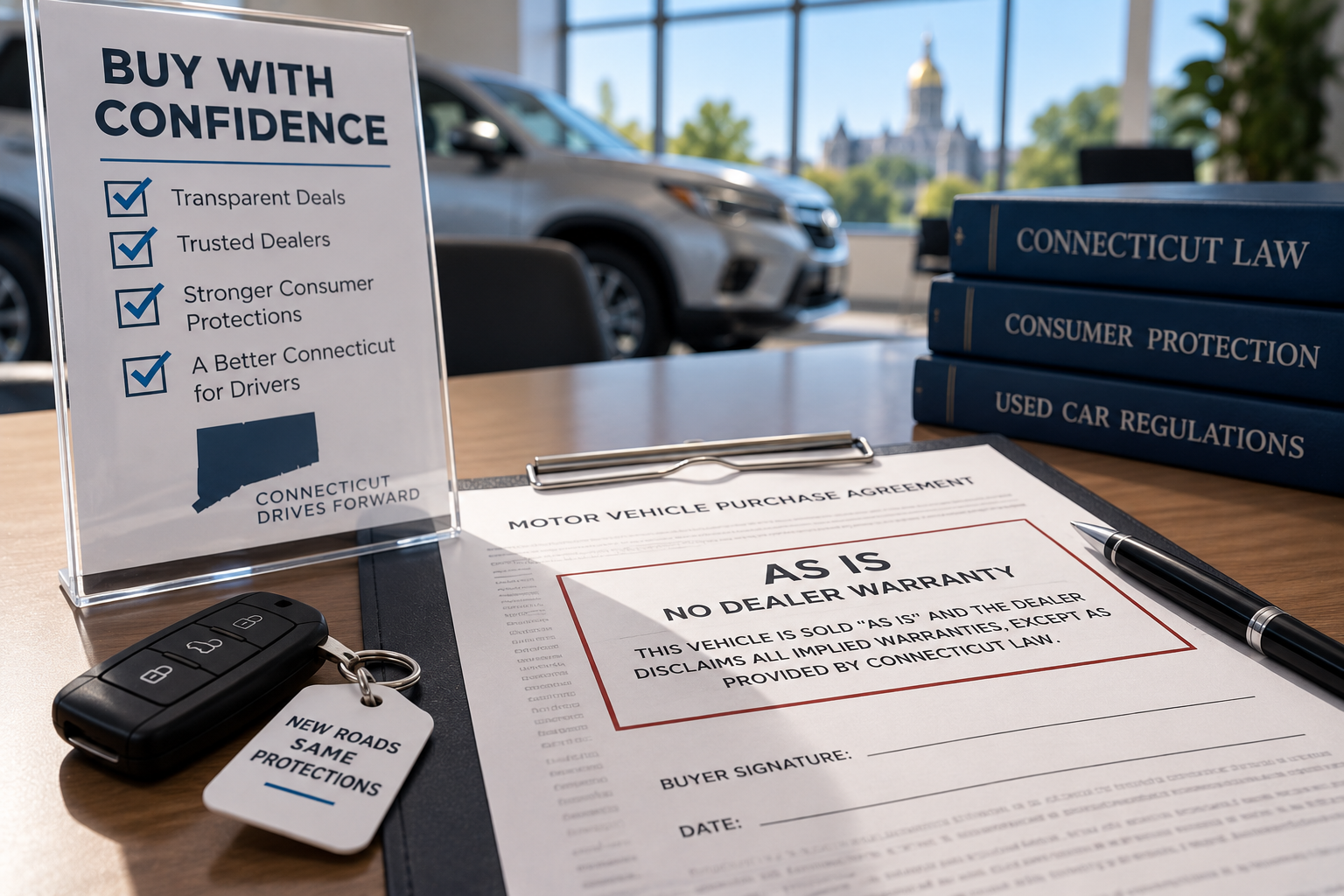
    About “as is” in a private sale: Writing “sold as is” on a bill of sale mainly targets implied warranties. Under section 42a-2-316, courts read a promise and a disclaimer together where that’s reasonable, and a disclaimer is inoperative to the extent it can’t reasonably be squared with a specific promise. “As is” also isn’t a license to lie. It doesn’t erase fraud. Dealer sales follow stricter rules, covered in our post on CT used car as is sales.

    Misrepresentation claims under Connecticut law

    Outside the warranty rules, Connecticut common law recognizes a few kinds of misrepresentation claims. They turn on what the seller knew when the statement was made.

    • Fraudulent misrepresentation. The seller made a false statement of fact, knew it was false, made it to get the buyer to act, and the buyer acted on it and was harmed. The Connecticut Supreme Court discussed the elements of both fraudulent and negligent misrepresentation in Sturm v. Harb Development, LLC, 298 Conn. 124 (2010).
    • Negligent misrepresentation. The seller didn’t know the statement was false but should have, and the buyer reasonably relied on it.
    • Innocent misrepresentation. The seller honestly believed the statement. In Johnson v. Healy, 176 Conn. 97 (1978), the court said strict liability for innocent misrepresentation in the sale of goods is well established in Connecticut. That case involved a builder selling a house, so how far the doctrine reaches a casual one-time seller is a less settled question.

    Johnson v. Healy also gave a damages measure that comes up often in these disputes. It’s the difference between the value of the property as it was represented and its value as it actually was.

    The federal Odometer Act applies to private sellers

    Mileage fraud is one area where federal law gives private buyers real teeth. Under 49 U.S.C. section 32710, a person who violates the federal odometer law with intent to defraud is liable for three times the actual damages or $10,000, whichever is greater. The court also awards costs and a reasonable attorney’s fee to a buyer who wins.

    The statute says “a person,” not “a dealer.” Say Kevin buys a 2017 Toyota Camry in Norwalk showing 68,000 miles, then finds old oil change receipts in the glovebox showing 141,000. If the seller rolled back the odometer or knowingly gave a false mileage statement, the federal claim is on the table. It has its own deadline, generally two years after the claim accrues.

    When a Connecticut “private seller” is really a dealer

    Some sellers who look private are running an unlicensed business. This is often called curbstoning. Under Conn. Gen. Stat. section 14-52, no one may engage in the business of buying, selling, or offering motor vehicles for sale without a dealer’s license from the Commissioner of Motor Vehicles.

    Federal law draws its own line. The FTC’s Used Car Rule, 16 C.F.R. section 455.1, treats anyone who sells a used vehicle after selling five or more in the previous twelve months as a dealer who has to post a Buyers Guide. Connecticut’s licensing statute asks the broader question of whether someone is engaged in the business.

    Whether a seller crossed that line matters a lot. A seller who is really in the car business may be reachable under the Connecticut Unfair Trade Practices Act, section 42-110b, which targets unfair or deceptive acts in the conduct of trade or commerce. A true one-time sale of a personal car generally isn’t trade or commerce, so CUTPA usually doesn’t reach it.

    A Connecticut private sale, worked through

    Derek, who lives in Meriden, buys a 2016 Subaru Outback with 112,000 miles for $9,400 from a seller in Wallingford. The online listing says “no accidents, head gaskets replaced at 90k, clean title.” The handwritten bill of sale says “sold as is.” Three weeks later the car overheats. A mechanic finds the original head gaskets and signs of a prior frame repair.

    Here’s how the rules above sort out:

    1. Lemon law. Out. The car is ten model years old and well past 24,000 miles.
    2. Used car warranty law. Out. The seller isn’t a licensed dealer.
    3. Express warranty. In play. “Head gaskets replaced at 90k” and “no accidents” are checkable facts, and they were in writing in the listing.
    4. Misrepresentation. Depends on what she knew. If she knew about the frame repair, that points toward fraud. If her ex-husband handled all the maintenance and she honestly believed the gasket story, the analysis shifts toward negligent or innocent misrepresentation.

    Notice what did the work. It wasn’t a statute written for car buyers. It was the specific words in the listing. The “as is” line on the bill of sale doesn’t automatically cancel those statements, but how a court reads the two together depends on the documents and the facts.

    Deadlines and where these cases are heard in Connecticut

    Breach of warranty claims under the UCC generally must be brought within four years after the car was delivered, under section 42a-2-725. Misrepresentation claims run on their own, generally shorter, limitation periods, and the federal odometer claim has its two year window.

    Many private car disputes are small enough for the small claims session of the Connecticut Superior Court, which hears cases for money damages up to $5,000. Magistrates, who are lawyers appointed by the Chief Court Administrator, usually decide them, and there’s no right to appeal. Larger claims go to the Superior Court’s regular civil docket.

    Common questions about buying a used car from a private seller in CT

    Can I return a used car I bought from a private seller in Connecticut?

    Connecticut has no general cooling-off period or return right for private car sales. Undoing a sale usually depends on a legal claim like fraud or breach of an express warranty, or on the seller agreeing to take the car back.

    Is there a used car lemon law for private sales in CT?

    No. What people call the Connecticut used car lemon law is Chapter 743f, and it applies to licensed dealers. The only lemon law path for a private buyer is the new car statute, and only when the car is still inside its original two year or 24,000 mile coverage.

    Does “sold as is” mean the seller can’t be sued?

    No. An as is sale mainly affects implied warranties. It doesn’t protect a seller who lied about the car, rolled back the odometer, or sold a car with a hidden lien.

    Does it matter that the seller only made a promise out loud?

    An express warranty can be oral. Oral promises are harder to prove, though, and a written bill of sale that claims to be the whole agreement can make them harder to enforce. Listings, texts, and emails often end up as the best evidence of what was said.

    Connecticut isn’t unusual here. Used car warranty statutes in neighboring states are generally aimed at dealers too. The federal Odometer Act stands out because it reaches every seller and carries a $10,000 minimum recovery when fraud is proven.

    The takeaway for Connecticut private buyers

    A private car sale in Connecticut falls outside the lemon law in most cases and outside the used car warranty law entirely. What’s left is the seller’s specific statements, the warranty of title, the federal odometer rules, and misrepresentation law. Whether a particular seller is really a dealer can change the analysis a lot.

    How those rules apply to one car, one listing, and one bill of sale is a question for a licensed Connecticut attorney who can read the paperwork.

    This article is for educational purposes only and is not legal advice. Reading it does not create an attorney-client relationship. For advice on your specific situation, consult a licensed attorney in your state.
  • CT Used Car As Is Sales Rules, as of October 1, 2026

    CT Used Car As Is Sales Rules, as of October 1, 2026

    CT Used Car As Is Sales Rules, as of October 1, 2026

    You’re standing at a dealership in Connecticut and the window sticker says the car is sold “as is.” Most buyers read that as a closed door. Sign here, and whatever breaks tomorrow is your problem.

    That’s not quite how it works here. Connecticut is one of the states that limits when a dealer can sell a used car as is at all, and as of October 1, 2026, that limit changes in a way that pulls a lot of vehicles out of the as is category.

    This post covers what an as is sale does and doesn’t do under Connecticut law, which cars can still be sold that way, and the specific things those two words never erase.

    The short version: Connecticut’s old test asked about price or age. As of October 1, 2026, it asks about age only. A dealer can sell a used vehicle as is if the vehicle is ten years of age or older. Under that line, a statutory warranty attaches instead.

    What an “as is” sale actually means in Connecticut

    An as is sale waives implied warranties. Those are the unwritten promises that come with a sale by a merchant, like the idea that a car is fit to be driven. When a dealer sells as is and does it correctly, those drop away.

    That’s the whole of it. As is is about warranties. It isn’t a general release that covers everything a dealer said or did.

    The rules live in Conn. Gen. Stat. section 42-224, part of Chapter 743f, the Used Automobile Warranties Act. That’s a separate statute from the Connecticut lemon law, which applies only to new vehicles. If you’re sorting out which one covers your situation, our guide to the CT used car rules that changed October 1, 2026 lays out the split, and the complete Connecticut lemon law guide handles the new vehicle side.

    When a CT dealer can sell a used car as is

    The prior version of section 42-224 gave dealers two doors. A vehicle could be sold as is if the cash purchase price was under $3,000, or if the vehicle was seven years of age or older. Either one was enough.

    As of October 1, 2026, the price door closes and the age door moves. Under the amended statute, a Connecticut dealer can sell a used vehicle as is only if the vehicle is ten years of age or older.

    Ten years or older. That’s the whole test.

    How Connecticut counts the ten years

    Not from the purchase date. Not from when the car was built. Connecticut measures from the first day of January of the vehicle’s designated model year.

    So during 2026, a 2016 model year vehicle is ten years old and can be sold as is. A 2017 model is nine, and it can’t. That 2017 model becomes eligible on January 1, 2027, when it turns ten.

    The model year on the title is what matters, and it’s a bright line. A dealer can’t round up because a car has high miles or looks rough.

    What Public Act 26-100 changed for as is sales

    The change came through Public Act 26-100, signed June 2, 2026. The used vehicle warranty provisions started as Senate Bill 119 and were folded into the larger consumer protection act. The dollar thresholds being removed had been sitting in the statute since 1987, back when $3,000 bought a very different car than it does today.

    Three shifts matter for as is sales specifically.

    • Price stops mattering. A dealer can no longer sell a $1,900 car as is just because it’s cheap. If it’s under ten years old, the warranty attaches.
    • The age line moves from seven to ten. Every vehicle in that seven to ten year band leaves the as is category.
    • What replaces as is is a real warranty. Covered vehicles get an express written warranty on parts and labor, promising the car is mechanically operational and sound for at least 60 days or 3,000 miles, whichever ends first.

    Put together, a large slice of Connecticut’s cheaper and older used car inventory moves from no protection to real protection. Those are often the cars bought by people who can least afford a surprise transmission.

    The as is disclaimer has to be done a specific way

    Even when a vehicle qualifies, the as is sale only sticks if the paperwork follows section 42-224. The statute says no as is disclaimer is enforceable unless every condition is met. All of them, not most.

    1. The disclaimer appears on the front page of the contract of sale, not buried later in the stack.
    2. It uses the exact wording the statute spells out, which tells the buyer they’re losing implied warranties, that they’ll pay for repairs after the sale, and that any promises the dealer made still have to be kept.
    3. The text is printed in twelve point boldface, with the heading in sixteen point extra boldface.
    4. The entire notice is boxed.
    5. The buyer signs inside the box to show assent.

    Formatting is not a technicality here. The statute ties enforceability to the format. A disclaimer in small type, unboxed, on page three, without a signature inside the box, is a disclaimer Connecticut law treats as unenforceable.

    What “as is” never wipes out

    This is the part people get wrong most often. Section 42-224 says an as is sale waives implied warranties but does not waive express warranties, whether spoken or written. It also doesn’t affect the dealer’s responsibility for representations the buyer relied on in making the deal.

    So a salesperson who says “the timing belt was just done” has made a representation. Selling the car as is doesn’t unsay it.

    Waiving coverage on one disclosed defect

    There’s a separate, much narrower path in section 42-221. A buyer can waive the statutory warranty for one particular defect the dealer disclosed before the sale. That waiver only works if it’s in writing, conspicuous, in plain language, names the exact defect, states what warranty still applies, and is signed by both the buyer and the dealer before the sale.

    It covers the named defect and nothing else. Dealers sometimes treat this like a back door to as is on a newer car. It isn’t one.

    Agreements that try to sign away the whole chapter

    Section 42-223 addresses contracts that waive, limit, or disclaim the rights in Chapter 743f outside that narrow disclosed defect exception. Those agreements are voidable at the buyer’s option. The same section adds that when a dealer fails to give a written warranty the statute requires, the dealer is deemed to have given it anyway.

    A hypothetical: two trucks on the same lot in Bristol

    Say Andre walks onto a licensed dealer’s lot on Farmington Avenue in Bristol in November 2026. Two pickups, similar mileage, similar price around $13,000.

    The first is a 2015 model. Counting from January 1, 2015, it’s eleven years old. That’s over the line, so the dealer can sell it as is, as long as the boxed disclaimer on the front page is formatted correctly and Andre signs inside the box.

    The second is a 2018 model. That’s eight years old. Under the old rules, seven years or older meant as is was fine. As of October 1, 2026, eight is under ten, so the dealer can’t sell it as is. The contract has to include the 60 day or 3,000 mile warranty on parts and labor.

    Now add one detail. Andre asks about the clutch on the 2015, and the salesperson says it was replaced last spring. Andre buys that truck as is. Three weeks later the clutch fails and a mechanic in New Britain says it’s the original.

    The as is sale waived Andre’s implied warranties. It did not waive an express statement about the clutch, and under section 42-224 it doesn’t erase the dealer’s responsibility for a representation Andre relied on. Those are separate questions from the warranty, and they survive the sticker.

    The federal Buyers Guide sticker and Connecticut’s limits

    That window sticker isn’t a dealer’s idea. The FTC’s Used Car Rule requires it, and the rule lives at 16 C.F.R. section 455.2. Dealers have to post a Buyers Guide on used vehicles they offer for sale, disclosing whether the sale comes with a warranty and what it covers.

    There are two versions of the Guide. One says “As Is, No Dealer Warranty.” The other says “Implied Warranties Only.” The rule is explicit that where state law limits or prohibits as is sales, the state law controls and the federal rule doesn’t give a dealer the right to sell as is. In those states the as is heading comes off the form and the implied warranties language goes on.

    Connecticut is a partial case, and the FTC’s guidance for dealers on the Used Car Rule speaks to exactly that. Where a state allows as is sales for some used cars but not all, a dealer may use the as is Guide on the vehicles the state permits. So in Connecticut, the sticker version should track the age line. As of October 1, 2026, that means the as is Guide belongs on vehicles ten years and older, and the other version belongs on everything younger.

    The Buyers Guide isn’t just signage. Under the federal rule, the final Guide becomes part of the sales contract, and information on it overrides contrary provisions in the contract. Keep your copy.

    Separately, the federal Magnuson-Moss Warranty Act governs written warranties on consumer products. It doesn’t require anyone to offer a warranty, but once a written warranty exists, it restricts a seller’s ability to disclaim implied warranties alongside it.

    Private sellers in Connecticut are outside all of this

    Chapter 743f applies to licensed dealers. Buying a car from someone in Norwich who posted it on a marketplace app doesn’t put you inside the statute, so the as is rules and the age line don’t apply. The federal Buyers Guide requirement is also aimed at dealers, not private individuals selling their own vehicle.

    A private sale is effectively an as is sale by default. Claims about fraud or misrepresentation come from other bodies of law and have their own separate elements. Our post on CT private car sale laws covers what a private buyer can still claim.

    Common questions about as is sales in Connecticut

    Can a CT dealer sell any used car as is?

    No. Connecticut has restricted as is sales for decades. As of October 1, 2026, the restriction is tied purely to age, and only vehicles ten years of age or older can be sold that way by a licensed dealer.

    Does “as is” mean I can’t do anything if the car breaks?

    As is waives implied warranties. It does not waive express promises the dealer made, spoken or written, and it doesn’t affect the dealer’s responsibility for representations the buyer relied on. Those are separate from the warranty question.

    Is there a CT used car return policy or cooling off period?

    Chapter 743f is a repair warranty statute, not a return statute. It doesn’t create a general right to bring a car back and undo the sale because you changed your mind. People search for a Connecticut used car return policy fairly often, and this law isn’t it. Our post on whether there’s a 30 day lemon law on used cars in CT explains where that idea comes from.

    What if the as is disclaimer wasn’t formatted right?

    Section 42-224 conditions enforceability on the format and the signature. A disclaimer that misses those requirements is one Connecticut law treats as unenforceable, which changes what warranties were actually waived.

    Which version of the Buyers Guide should be on the window?

    It depends on the vehicle. Because Connecticut permits as is sales for some used cars and not others, the as is Guide belongs only on the vehicles the state actually allows to be sold that way. As of October 1, 2026, that’s the ten year and older group.

    The takeaway

    As is is a narrower tool in Connecticut than most buyers assume, and as of October 1, 2026, it’s narrower still. Age is the only gate, the disclaimer has to meet strict formatting rules, and the two words never reach express promises or representations the buyer relied on.

    The model year, the sale date, and what the paperwork actually says are the facts that drive the analysis. The Connecticut Judicial Branch keeps a research guide collecting both warranty chapters if you want to read the statutes directly, and how any of it applies to a specific contract is a question for a licensed attorney.

    This article is for educational purposes only and is not legal advice. Reading it does not create an attorney-client relationship. For advice on your specific situation, consult a licensed attorney in your state.
  • CT Lemon Law Used Car Rules Changed October 1, 2026

    CT Lemon Law Used Car Rules Changed October 1, 2026

    CT Lemon Law Used Car Rules Changed October 1, 2026

    You bought a used car in Connecticut. Two weeks later the transmission started slipping. So you went looking for the Connecticut lemon law, and that’s where most people hit a wall.

    Here’s the part that surprises almost everyone. The CT lemon law does not cover used cars. It covers new vehicles, full stop. Searching “connecticut lemon law used car” sends people to a statute that was never written for them.

    That doesn’t mean used car buyers are on their own. Connecticut has a completely separate law for used vehicles, and as of October 1, 2026, it covers a lot more cars than it did before. This post walks through how that law works and what just changed.

    The short version: Two different Connecticut laws, two different worlds. New cars go to Chapter 743b. Used cars go to Chapter 743f. As of October 1, 2026, Chapter 743f covers used vehicles under ten years old at any price, with a uniform 60 day or 3,000 mile dealer warranty.

    Does the Connecticut lemon law apply to used cars?

    No. Connecticut’s lemon law lives in Chapter 743b of the General Statutes, and it’s built around new vehicles bought or leased in Connecticut. It covers cars registered as passenger, combination, or motorcycle, and it runs against the manufacturer, not the dealer who sold you the car.

    That law also comes with an arbitration program run by the Department of Consumer Protection. You can read the state’s own description of the Connecticut new vehicle lemon law program on the DCP website. If you want the full picture on how that side works, our complete guide to the Connecticut lemon law covers the repair attempt thresholds, the two year window, and the arbitration process.

    Used car buyers are pointed somewhere else entirely. Connecticut’s Used Automobile Warranties Act sits in Chapter 743f, Conn. Gen. Stat. sections 42-220 through 42-226a. It runs against the dealer, not the manufacturer, and it doesn’t use arbitration at DCP.

    What the CT used car warranty law requires now

    Under the version of section 42-221 that takes effect October 1, 2026, a Connecticut dealer selling a used vehicle that’s less than ten years old has to include an express written warranty in the sales contract. That warranty covers the full cost of parts and labor, and it promises the vehicle is mechanically operational and sound and will stay that way for at least 60 days or 3,000 miles, whichever ends first.

    There’s no minimum price anymore. A $2,200 car and a $32,000 car get the same coverage as long as the vehicle is under ten years old.

    60 days or 3,000 miles. One standard, every covered vehicle, no price tiers.

    How Connecticut counts a car’s age

    This trips people up, so it’s worth slowing down. Connecticut doesn’t count from the date you bought the car or the date it rolled off the line. It counts from the first day of January of the vehicle’s designated model year.

    So a 2017 model year car is nine years old for this purpose throughout 2026. It hits ten on January 1, 2027, and drops out of coverage on that date no matter when in 2026 you bought it.

    What “mechanically operational and sound” covers

    The statute doesn’t hand you a parts list. The phrase points at the systems that make a car work, meaning things like the engine, transmission, brakes, and steering. A worn armrest isn’t a breach. An engine that won’t hold oil pressure is a different conversation.

    Two things fall outside the warranty by statute. Damage from an accident after the sale, and damage from the buyer misusing the vehicle. A dealer isn’t on the hook because you redlined a used sedan up Avon Mountain.

    Who counts as a dealer

    Chapter 743f defines a dealer as a business licensed as a new car dealer or used car dealer in Connecticut, or otherwise licensed to sell used vehicles to consumers. Sales between two dealers don’t trigger the warranty requirement. That’s a wholesale transaction, not a consumer sale.

    What Public Act 26-100 actually changed

    The used car warranty rewrite started as Senate Bill 119 and was enacted as part of Public Act 26-100, signed June 2, 2026. The old framework dated to 1987, and the dollar thresholds in it had stopped making sense as used car prices climbed.

    Here’s the before and after.

    • The $3,000 price floor is gone. Cheap cars used to fall through the cracks entirely. Now price doesn’t determine coverage.
    • The age cutoff moved from seven years to ten years. Vehicles in that seven to ten year band used to be exempt. They’re covered now.
    • The two warranty tiers collapsed into one. The old 30 day or 1,500 mile tier for cheaper cars is gone. Everything covered gets 60 days or 3,000 miles.
    • Implied warranty protection expanded. A dealer’s ability to exclude or disclaim implied warranties on a used vehicle is narrower, and the protection now reaches every vehicle under ten years old.
    • “As is” sales shrank. A Connecticut dealer can only sell a vehicle as is if the vehicle is ten years old or older.

    The practical effect is that a whole category of Connecticut used car sales that used to carry no statutory warranty now carries one. Cars in the $1,500 to $3,000 range at buy-here-pay-here lots, and eight or nine year old vehicles at franchise dealers, both moved inside the line.

    When a Connecticut dealer can still sell a used car “as is”

    Section 42-224 governs as is sales, and after October 1, 2026, the gate is age. Ten years or older, and a dealer can sell as is. Under ten, and the warranty attaches.

    Even for an older car, the as is disclaimer has to follow strict formatting rules to be enforceable, and it never wipes out express promises the dealer made. Our post on CT used car as is sales rules covers both. Separately, a buyer of a covered car can waive the warranty for one specific defect the dealer disclosed in writing before the sale, but that waiver reaches only the named defect.

    A hypothetical: buying a used SUV in Meriden

    Say Tanya buys a 2019 SUV from a licensed dealer on East Main Street in Meriden in October 2026. She pays $11,400. Counting from January 1, 2019, the vehicle is seven years old.

    Under the old rules, that car was exempt. Seven years of age or older meant no statutory warranty at all, regardless of price. Tanya would have had whatever the dealer chose to offer and nothing more.

    Under the rules effective October 1, 2026, the car is under ten years old, so the sales contract has to include a 60 day or 3,000 mile express warranty on parts and labor. On day twelve, with about 900 miles on the odometer, the transmission starts slipping hard between second and third. That’s a mechanical soundness problem, not cosmetic wear, and it’s not accident damage or misuse.

    Now the timing rules matter. Section 42-222 says the dealer has to honor the warranty even after the period runs out, as long as the buyer notified the dealer of the claimed breach during the warranty period. So notice inside the window preserves the claim.

    Section 42-223 adds to that. The warranty term gets extended by the time the vehicle sits with the dealer for warranty repairs. If Tanya’s SUV is in the shop for nine days, her 60 days stretches to 69. The clock doesn’t burn while the dealer has the keys.

    Change one fact and the outcome flips. If Tanya had bought a 2014 model instead, the vehicle would be twelve years old, the dealer could sell it as is with a proper boxed disclaimer, and Chapter 743f would give her nothing on the transmission.

    Private sales in Connecticut work differently

    Chapter 743f only reaches licensed dealers, so a car bought from a neighbor in Torrington through a Facebook group carries no statutory warranty, no matter the price or model year. Our post on CT private car sale laws covers what a private buyer can still claim.

    How Connecticut compares to federal law and its neighbors

    The federal Magnuson-Moss Warranty Act sits on top of all of this. It doesn’t force anyone to give a warranty. What it does is set rules for written warranties on consumer products once they exist, and it restricts a seller’s ability to disclaim implied warranties when a written warranty is in play. Connecticut’s law sets a floor. Federal law shapes how warranties have to be written and disclosed.

    Connecticut’s approach is also distinct from its neighbors. New York, for example, ties used car warranty coverage to the vehicle’s mileage at delivery rather than its model year, with different durations at different mileage bands. Connecticut keys everything to age and now uses one duration across the board. A car that’s covered on one side of the state line may not be on the other.

    Enforcement also splits along the new and used line. The DCP arbitration program handles new vehicle lemon law claims against manufacturers. On the used side, section 42-226a routes dealer violations to the penalties in section 14-64, the motor vehicle dealer licensing statute, which can include license suspension and fines. Complaints about dealers go to the Connecticut DMV Consumer Complaint Center. Disputes that head to court in Connecticut go to the Superior Court, which handles both regular civil matters and the small claims session. The Connecticut Judicial Branch maintains a research guide on Connecticut lemon law with the statutes for both chapters collected in one place.

    Common questions about used cars and CT lemon law

    Can you lemon law a used car in Connecticut?

    Not under the CT lemon law itself, since Chapter 743b is limited to new vehicles. Used buyers look to the Used Automobile Warranties Act in Chapter 743f instead. People often call that the “used car lemon law,” but it’s a different statute with different rules and a different target.

    What if the dealer never gave me a written warranty?

    Chapter 743f addresses that directly. When a dealer fails to provide a written warranty that the statute requires, the dealer is deemed to have given it. The warranty doesn’t disappear because the paperwork was skipped.

    Does the Connecticut used car warranty cover a $2,000 car?

    As of October 1, 2026, yes, if the vehicle is less than ten years old and sold by a licensed Connecticut dealer. The old $3,000 minimum is gone. Before the change, that same car would have fallen outside the statute on price alone.

    Does a CT dealer have to fix a used car during the warranty period?

    The statutory warranty covers the full cost of parts and labor for covered defects during the period. Whether a particular failure is covered depends on whether it goes to the vehicle being mechanically operational and sound, and whether it falls into the accident or misuse exclusions. It’s a promise to repair, though, not a right to return the car. There’s no 30 day lemon law on used cars in CT.

    Because the change took effect October 1, 2026, the sale date matters. Contracts signed before that date are generally measured against the older framework, with its $3,000 floor, seven year cutoff, and two warranty tiers.

    The takeaway for Connecticut used car buyers

    Connecticut’s lemon law and its used car warranty law are two separate systems, and looking in the wrong one is the most common mistake people make. The used car side got meaningfully broader on October 1, 2026, with the price floor removed, the age cutoff pushed to ten years, and a single 60 day or 3,000 mile standard replacing the old tiers.

    The vehicle’s model year and the sale date are the two facts that decide almost everything. How any of it applies to a particular car and a particular contract is a question for a licensed attorney who can read the paperwork.

    This article is for educational purposes only and is not legal advice. Reading it does not create an attorney-client relationship. For advice on your specific situation, consult a licensed attorney in your state.
  • How Many Recalls Before Lemon Law Applies in Florida?

    How Many Recalls Before Lemon Law Applies in Florida?

    How Many Recalls Before Lemon Law Applies in Florida?

    You open the mailbox and find another recall notice for your new car. It’s the second one this year. Maybe the third. At some point you start wondering how many recalls it takes before lemon law protection kicks in.

    The short answer surprises most people. In Florida, there’s no magic number of recalls. A recall on its own doesn’t make a car a lemon, and it doesn’t restart the 24-month clock. But a recall repair can still matter a lot, depending on what the defect is and whether the dealer actually fixes it.

    This guide walks through how recalls fit into Florida’s lemon law, in plain English. For how the law works from start to finish, see our plain-English guide to the Florida Lemon Law.

    How Many Recalls Before Lemon Law Protection Applies?

    Florida’s lemon law is officially called the Motor Vehicle Warranty Enforcement Act, and it lives in Chapter 681 of the Florida Statutes. If you read the whole chapter, you won’t find the word “recall” anywhere.

    That’s the key point. The law doesn’t count recalls. It counts repair attempts and days out of service for a defect that seriously affects the car. A recall is simply the manufacturer’s announcement that a defect exists. What the law cares about is what happens to your specific car after that.

    Key takeaway: Five recalls for five different minor issues, each fixed on the first try, generally won’t make a car a lemon. One recall defect that the dealer fails to fix again and again might.

    What Florida’s Lemon Law Actually Counts

    To see where a recall fits, it helps to know the three building blocks the law uses. Each one comes straight from the statute.

    The “Nonconformity” Test

    The law only covers a “nonconformity.” Under Fla. Stat. § 681.102, that means a defect or condition that substantially impairs the use, value, or safety of the vehicle. Damage from an accident, abuse, neglect, or outside modifications doesn’t count.

    Many safety recalls involve problems like stalling, brake issues, or airbags, which easily touch “safety.” But some recalls are for things like a mislabeled sticker or a warning chime that doesn’t sound. A defect that small may not meet the “substantially impairs” standard, and the manufacturer can raise that as a defense under Fla. Stat. § 681.104(4).

    Three Repair Attempts Plus a Final Chance

    Under section 681.104(3)(a), the law presumes the manufacturer had a reasonable number of repair attempts when the same nonconformity has been repaired at least three times, the manufacturer got a final repair attempt, and the problem still exists. All of this has to happen during the Lemon Law rights period.

    The final attempt has its own rules. After the third try, section 681.104(1)(a) calls for written notice to the manufacturer by registered or express mail. The manufacturer then has 10 days to respond, and 10 days after the car is delivered to its chosen repair shop to fix it. If it doesn’t respond or repair in time, the final attempt requirement drops away.

    30 Days Out of Service

    The second path is time. Under section 681.104(3)(b), the presumption also applies when the car has been out of service for repair of one or more nonconformities for a total of 30 or more days. The days don’t have to be in a row, and the problems don’t have to be the same. Routine maintenance doesn’t count.

    There’s a notice step here too. Once the car hits 15 days out of service, the statute calls for written notice to the manufacturer, which then gets at least one chance to inspect or repair the car. Our breakdown of Florida’s 30-day out-of-service rule shows how the day count works in detail.

    When a Recall Repair Counts Toward Florida’s Repair Attempts

    Here’s where recalls come back in. A trip to the dealer for recall work is still a trip to the manufacturer’s authorized service agent to fix a defect. If that defect is a nonconformity, and it’s the same problem the car has already been in for, the visit can generally be argued as a repair attempt.

    Say Tyrone buys a new Nissan Rogue in Pensacola. Twice in his first six months, the steering suddenly goes heavy while he’s turning into parking lots off Nine Mile Road, and twice the dealer can’t find the cause. Then the manufacturer issues a recall for a power steering motor that can lose assist without warning. Tyrone brings the car in for the recall repair, and a week later the steering goes heavy again. That recall visit looks a lot like a third attempt at the same problem.

    Now compare Brianna in Melbourne. Her new Honda Accord gets three recall notices in a year: a software update for the backup camera, a trunk latch bolt, and a seat belt warning label. Each is fixed on the first visit. That’s three recalls, but three different issues that were each resolved. On those facts, the three-attempt path generally wouldn’t be met.

    Heads up: Chapter 681 doesn’t directly address recall visits. Whether a particular recall repair counts as an attempt is decided case by case, often by the state arbitration board. What the repair orders say can make a big difference.

    What About a Recall With No Fix Available Yet?

    Sometimes a manufacturer announces a recall before parts are ready. If the dealer keeps the car because it’s unsafe to drive, those days may count toward the 30-day total, since the car is out of service because of the defect. If the car sits in the owner’s driveway waiting for parts, the answer is less clear. The statute counts days out of service “by reason of repair,” and a car that was never dropped off is harder to fit into that language.

    Picture Ana in Hialeah. Her new SUV gets a do-not-drive recall for a fuel leak in month 11. The dealer tows it in and holds it for 34 days waiting on parts. Those 34 days in the shop are the kind of time section 681.104(3)(b) is built to capture, as long as the notice steps are followed.


    Does a Recall Restart the 24-Month Lemon Law Period?

    No. Under section 681.102, the Lemon Law rights period ends 24 months after the car was first delivered to a consumer. It’s a fixed window tied to the delivery date, and nothing in the chapter pauses or restarts it when a recall is announced.

    One related rule is worth knowing. If a problem is first reported during the 24 months, Chapter 681 requires the manufacturer to keep fixing it even after the period ends. But that duty doesn’t extend the rights period itself or the time to file a claim.

    24 months + 60 days: Under Fla. Stat. § 681.109(4), a request for state arbitration generally has to be made no later than 60 days after the rights period ends, or 30 days after a manufacturer’s certified program finishes, whichever is later.

    So think about Omar in Naples. In month 26, a recall comes out for an airbag sensor in his model. If Omar never reported an airbag problem during his first 24 months, the recall alone doesn’t open a new lemon law window for him. The recall repair itself is still free under federal law, which we cover next.

    Federal Recall Remedy vs. Florida Lemon Law Remedy

    Recalls are a federal system run through the National Highway Traffic Safety Administration. Under 49 U.S.C. § 30120, the manufacturer has to remedy a recalled defect free of charge. But the manufacturer picks the remedy. It can repair the car, replace it, or refund the price minus a reasonable allowance for depreciation. In practice, most recalls end in a repair.

    Florida’s lemon law works differently. When a car can’t be fixed after a reasonable number of attempts, section 681.104(2)(a) requires the manufacturer to repurchase or replace it within 40 days. And the consumer, not the manufacturer, has an unconditional right to choose a refund over a replacement.

    The two systems also cover different cars. A federal recall applies to every affected vehicle, new or used. Florida’s lemon law covers new vehicles, demonstrators, and certain leases, plus people who acquire the car during the original 24-month window. Chapter 681 also says it doesn’t limit rights under other laws, so a recall and a lemon law claim can exist side by side.

    Some states give a shorter path when a defect could cause death or serious injury, counting fewer repair attempts. Florida’s statute has no special shortcut for safety defects. A serious safety recall still runs through the same three-attempt and 30-day rules.

    A Hypothetical Walkthrough: Denise’s SUV in St. Petersburg

    Denise buys a new Toyota Highlander from a dealer on 34th Street North in St. Petersburg for $44,000. Here’s how a recall could play into her situation, step by step.

    In month 4, her brakes feel soft and the warning light flickers. The dealer bleeds the lines. In month 7, it happens again, and the dealer replaces a sensor. In month 9, the manufacturer recalls her model for a brake booster defect that causes the same symptoms. The dealer does the recall repair, and the repair order notes “customer reports soft brake pedal.”

    Two weeks later, the soft pedal is back. On these facts, Denise’s car has arguably had three repair attempts for the same nonconformity, and one of them was the recall. The next step under the statute would be written notice to the manufacturer by registered or express mail, giving it a final chance to fix the brakes.

    If the final repair fails, the presumption kicks in. A refund would then follow the statutory formula, with a mileage offset based on the base price on her invoice. Our guide to the Florida lemon law refund calculation walks through that math.

    Where a Recall-Related Claim Goes From Here

    Florida routes most lemon law disputes through state arbitration before any lawsuit. Under Fla. Stat. § 681.1095, the dispute generally goes to the Attorney General’s office first, and sometimes to a manufacturer’s certified program before that. Our walkthrough of how Florida lemon law arbitration works covers each stage, and our guide to the Florida lemon law statute of limitations lines up the filing deadlines.

    Paperwork matters throughout. Florida law requires the dealer to hand over an itemized repair order every time the car comes back, showing the reported problem, the work done, the dates, and the mileage. For recall visits, those orders are often what shows whether the recall fixed the same problem the owner had already complained about.

    Common Questions About Recalls and Florida Lemon Law

    Does a recall automatically make my car a lemon?

    No. Millions of cars are recalled every year, and most are fixed on the first try. Florida’s law looks at whether a substantial defect survived a reasonable number of repair attempts, not at how many recall notices went out.

    Can I get a refund just because my car was recalled?

    Under federal recall law, the manufacturer decides whether to repair, replace, or refund, and it usually repairs. A refund the consumer gets to choose comes from the lemon law, which has its own requirements.

    Does Florida lemon law cover recalls on used cars?

    Florida’s lemon law is built for new vehicles, though a used car can still be covered if it changed hands during the original owner’s 24-month window. Recall repairs are free on used cars too, and open recalls can be looked up by VIN or plate with NHTSA’s recall lookup tool. For the other rules that apply to used cars, see our guide on whether the lemon law applies to used cars with no warranty in Florida.

    Do recall repairs count toward the 30 days out of service?

    They can, if the recall defect is a nonconformity and the car was actually in the shop for that repair. Time the car spends parked at home waiting for parts is a harder argument.

    Does a safety recall get a faster lemon law track in Florida?

    No. Unlike some states, Florida doesn’t lower the number of repair attempts for defects that could cause serious injury. Safety recalls run through the same three-attempt and 30-day rules as any other defect.

    The Bottom Line

    There’s no set number of recalls that turns a car into a lemon in Florida. What counts is whether a substantial defect keeps coming back after repeated repairs, or keeps the car in the shop for 30 days, all within the fixed 24-month window. A recall repair can be one of those attempts when it targets the same problem.

    This article is for educational purposes only and is not legal advice. Reading it does not create an attorney-client relationship. For advice on your specific situation, consult a licensed attorney in your state.
  • Is There a 30-Day Lemon Law in Florida? The Real Rule

    Is There a 30-Day Lemon Law in Florida? The Real Rule

    Is There a 30-Day Lemon Law in Florida? The Real Rule

    People search “is there a 30-day lemon law in Florida” for one of two reasons. Either they just bought a car they already regret, or their new car has spent most of the last two months at the dealership. Those are very different problems, and Florida law treats them very differently.

    Here’s the short version. Florida has no law that lets you return a car within 30 days because you changed your mind. There’s no 30-day return window, and there’s no 3-day one either. Both are myths that get repeated on car forums and in dealership parking lots all over the state.

    What Florida does have is a 30-day number inside its lemon law. It has nothing to do with returns. It’s one way of showing that a manufacturer got enough chances to fix a broken new car. This article walks through what that number actually does.

    The short answer: Florida’s “30 days” is a cumulative repair-shop count that helps trigger a manufacturer buyback on a new vehicle. It isn’t a 30-day return policy, and it doesn’t apply to buyer’s remorse.

    Where the “30-Day Lemon Law” Idea Comes From

    Florida’s lemon law is officially the Motor Vehicle Warranty Enforcement Act, found in Chapter 681, Florida Statutes. Inside it is a rule that says 30 days in the shop can be enough to show a car is a lemon.

    Somewhere along the way, “30 days in the shop” got shortened to “30-day lemon law.” Then it got twisted again into “you have 30 days to return a car.” That last version isn’t real anywhere in Florida law.

    The actual rule lives in Fla. Stat. § 681.104. It’s a presumption, which is a legal shortcut. It doesn’t hand anyone a refund on day 30. It says the manufacturer is presumed to have had a reasonable number of chances to get the car right.

    What Florida’s 30-Day Out-of-Service Rule Actually Says

    Under section 681.104(3)(b), the presumption applies when a vehicle has been out of service for repair of one or more nonconformities for a cumulative total of 30 or more days during the Lemon Law rights period. For recreational vehicles, the number is 60 days. Downtime for routine maintenance listed in the owner’s manual doesn’t count.

    Two phrases do a lot of work there. “Cumulative” means the days don’t have to run back to back. Three separate ten-day visits get to the same place as one thirty-day stretch. And “one or more nonconformities” means the days can come from different problems. They don’t all have to be the same defect.

    “Nonconformity” is defined in Fla. Stat. § 681.102 as a defect or condition that substantially impairs the use, value, or safety of the vehicle. A rattling cupholder won’t qualify. Brakes that fade on the Florida Turnpike are a different conversation.

    The 15-Day Letter Comes First

    This is the part most articles skip. The 30-day count doesn’t stand on its own. Section 681.104(1)(b) says that once the vehicle has been out of service for repair for a cumulative total of 15 or more days, the consumer notifies the manufacturer in writing by registered or express mail.

    That letter gives the manufacturer or its service agent a chance to inspect or repair the vehicle. The statute requires at least one such opportunity after the notice before the 30-day presumption kicks in.

    Common trap: Notice goes to the manufacturer, not the dealership. A service advisor knowing about the problem isn’t the same as the manufacturer receiving written notice under section 681.104.

    The Other Road: Three Repair Attempts

    The 30-day count isn’t the only path. The presumption also applies when the same nonconformity has been repaired at least three times, the manufacturer has had a final attempt, and the problem still exists.

    After the third attempt, written notice goes to the manufacturer by registered or express mail. The manufacturer then has 10 days to respond and offer a repair facility, and 10 more days to fix the car once it’s delivered there. For RVs, that final repair window is 45 days. A recall repair aimed at the same defect can be one of those attempts, which our guide on how many recalls before lemon law applies in Florida explains.

    How the 30 Days Add Up: A Port St. Lucie Example

    Say Yesenia buys a new Hyundai Santa Fe from a dealership on US-1 in Port St. Lucie in January. In March, the temperature gauge spikes and the engine overheats from a coolant leak. The SUV sits in the shop for 12 days.

    In May, a different problem shows up. The ABS warning light comes on and the brake pedal feels uneven, and the Santa Fe is out for another 9 days. That’s 21 cumulative days, past the 15-day mark, so Yesenia sends written notice to the manufacturer by registered mail. The manufacturer has its service agent inspect the car.

    In July, the coolant leak comes back, and the car is in the shop 11 more days. Yesenia is now at 32 cumulative days inside the 24-month rights period, and the manufacturer had its post-notice opportunity. Under section 681.104(3)(b), a reasonable number of attempts is presumed, even though no single defect was repaired three times.

    Notice what didn’t happen. Nobody handed her the keys on day 30 and wrote a check. The presumption is a starting position in a dispute, not an automatic refund. If the manufacturer does repurchase the Santa Fe, the payout follows the formula in our Florida lemon law refund calculation guide.

    The count in Yesenia’s case: 12 days + 9 days = 21 (notice sent after 15) + 11 days = 32 cumulative days, across two different defects.

    Florida’s Lemon Law Rights Period and the Hurricane Clause

    All of these days have to fall inside what Florida calls the Lemon Law rights period. Section 681.102 defines it as the period ending 24 months after the vehicle’s original delivery to a consumer. It doesn’t run from the model year, and it doesn’t run from when the problem started.

    Florida also added something many states didn’t. The statute lets the 30-day period be extended by any time when repair services aren’t available because of war, invasion, strike, fire, flood, or natural disaster. If a hurricane shuts down a dealer’s service department for a week, that week can push the 30-day mark out.

    Other states set their own day counts, which is part of why advice online often doesn’t match Florida’s rules. Federal law doesn’t set a day count at all. The 30-day figure comes purely from Chapter 681.

    The 3-Day Right to Cancel a Car Purchase in Florida

    This myth is the 30-day myth’s cousin. It comes from a real rule that just doesn’t cover car dealers.

    The federal cooling-off rule, 16 C.F.R. Part 429, gives buyers until midnight of the third business day to cancel certain sales made away from the seller’s place of business, like at a home or a hotel conference room. But the rule expressly exempts cars, vans, and trucks sold at auctions, tent sales, or other temporary locations, as long as the seller has a permanent place of business.

    Florida’s version works the same way. Fla. Stat. § 501.025 gives a buyer until midnight of the third business day to cancel a home solicitation sale. The definition in Fla. Stat. § 501.021 leaves out sales by a licensed motor vehicle dealer at a location open to the public.

    Picture Brooke signing for a sedan at a dealership on International Speedway Boulevard in Daytona Beach on a Saturday. By Monday, she’s decided the payment is too high. Neither rule reaches her purchase. They wouldn’t reach it even if she’d signed at a weekend tent sale in a mall parking lot. Whether she has any way out depends on her contract or what the dealer chooses to offer.

    A return policy at a Florida dealership, when one exists at all, is a business decision written into the paperwork. It isn’t a right granted by statute.

    Used Car Problems Within 30 Days in Florida

    The 30-day rule is part of a law built for new vehicles. The Florida Attorney General’s vehicle coverage page says the lemon law applies to new or demonstrator vehicles sold in the state, along with qualifying leases. The one used car exception is a car that changes hands during the original 24-month rights period.

    So when Hector buys a nine-year-old sedan on Tennessee Street in Tallahassee and the check engine light comes on in week two, the 30-day rule isn’t in play. What matters instead is the federal Buyers Guide on the window, which the FTC explains in its guide to buying a used car from a dealer. Our guide on whether the lemon law applies to used cars with no warranty in Florida covers the rules that apply to Hector’s situation.

    Where a 30-Day Claim Goes Next

    Reaching 30 days doesn’t send a case to court. In most cases, Florida requires the dispute to go through the Attorney General’s Lemon Law Arbitration Division first, and sometimes through a manufacturer’s certified program before that. Our walkthrough of how Florida lemon law arbitration works covers that process.

    The filing windows are short. The request for state arbitration is generally due within 60 days after the rights period ends. Our guide to the Florida lemon law statute of limitations lines up every deadline.

    Common Questions About the 30-Day Lemon Law in Florida

    Is there a 30-day lemon law on used cars in Florida?

    No. The 30-day presumption is part of Chapter 681, which covers new vehicles, demonstrators, and qualifying leases. It only reaches a used car that changed hands during the original owner’s 24-month rights period.

    Do the 30 days have to be in a row?

    No. The statute uses the word cumulative. Separate repair visits add up across the rights period, and they can involve different defects.

    Does an oil change count toward the 30 days?

    No. The count covers days out of service for repair of a nonconformity, and routine maintenance from the owner’s manual is expressly excluded. How a specific service visit gets classified is decided case by case.

    Can you return a car in Florida within three days?

    Not as a general right. The federal cooling-off rule exempts car dealers selling at temporary locations, and Florida’s home solicitation law leaves out licensed dealers selling at locations open to the public. A dealership sale sits outside both.

    What happens once the 30-day presumption applies?

    Section 681.104(2) says a manufacturer that can’t fix the vehicle after a reasonable number of attempts has 40 days to repurchase it or replace it. The consumer has an unconditional right to choose the refund over a replacement.

    The Bottom Line on Florida’s 30-Day Rule

    Florida’s 30-day figure is a proof standard for new vehicles that keep breaking, not a return window for cars people regret buying. It works alongside a 15-day notice requirement, a 24-month rights period, and an arbitration system run by the Attorney General’s office.

    For how the whole statute fits together, our Florida lemon law guide in plain English covers coverage, notice, remedies, and deadlines in one place.

    This article is for educational purposes only and is not legal advice. Reading it does not create an attorney-client relationship. For advice on your specific situation, consult a licensed attorney in your state.

  • New Jersey Used Car Lemon Law: Do Used Cars Actually Qualify

    New Jersey Used Car Lemon Law: Do Used Cars Actually Qualify

    NJ Used Car Lemon Law: Do Used Cars Actually Qualify?

    If you bought a used car in New Jersey and it started breaking down within weeks, you have probably found conflicting answers about whether the NJ used car lemon law covers you. Most people assume lemon laws only protect new car buyers. In New Jersey, that assumption is wrong.

    New Jersey is one of a small group of states with a separate lemon law written just for used vehicles. But not every used car gets it. Whether a car qualifies comes down to who sold it and a handful of facts on the sales paperwork.

    This post covers that qualification test. It explains which used cars are in, which are out, what parts the protection actually reaches, and when a used car is still covered by the new car law instead.

    Does the NJ Lemon Law Apply to Used Cars?

    Yes, but through a completely different statute than the one people usually mean. New Jersey runs two lemon laws side by side. The New Car Lemon Law, at N.J.S.A. 56:12-29 and following, covers vehicles for two years or 24,000 miles from original delivery.

    The Used Car Lemon Law is found at N.J.S.A. 56:8-67 and following, tucked inside the Consumer Fraud Act. It doesn’t go after the manufacturer. It puts the obligation on the dealer who sold you the car, in the form of a short written warranty. Our complete New Jersey lemon law guide compares the two laws side by side.

    The short version: New Jersey used cars are covered, but only when sold by a dealer, only if the car meets the price, age, mileage, and total loss tests, and only for the defects the warranty actually reaches.

    Which Used Cars Qualify Under New Jersey Law

    The Division of Consumer Affairs regulations at N.J.A.C. 13:45A-26F list the situations where a dealer doesn’t have to give a warranty. Flip those around and you get the eligibility test. A used car generally qualifies when all of these are true at the time of sale:

    • The purchase price was $3,000 or more
    • The vehicle is seven model years old or less
    • The odometer read 100,000 miles or less
    • The vehicle wasn’t a disclosed total loss, meaning an insurer declared it a total loss and the buyer was told so in writing at or before the sale

    Miss one and the statutory warranty never attaches. A $2,700 commuter car bought in Bayonne is outside the law. So is a nine model year old pickup, and so is a car that crossed 100,000 miles before you signed.

    The total loss test has a detail that matters. The exemption only applies if the dealer told the buyer about the total loss in writing, at or before the sale. A totaled car sold without that written notice doesn’t drop out of the law just because of its history.

    Vehicles the Used Car Lemon Law Leaves Out

    The regulations define a used motor vehicle as a passenger vehicle and specifically exclude motorcycles, motor homes, and off road vehicles. So a used Harley bought from a Jersey dealer gets no statutory warranty under this law, even though a new motorcycle is covered by the New Car Lemon Law.

    There’s also a lease gap most buyers never hear about. A car that was under lease for more than 90 days and then sold to the lessee, or to the lessee’s family member or employee, falls outside the definition. Our post on the New Jersey lemon law for leased cars explains how that lease buyout gap plays out.

    Private sales are the biggest gap. The law reaches dealers, and it defines a dealer as any person or business that sold or offered three or more used vehicles in the previous 12 months. Someone flipping cars out of a driveway in Elizabeth can meet that test without a sign or a lot. Our guide to private car sales in NJ covers what a true private buyer can still claim.

    What Parts the NJ Used Car Warranty Covers

    This is where a lot of online summaries get New Jersey wrong by borrowing other states’ lists. In New Jersey, the warranty reaches what the regulations call “covered items,” which are drivetrain parts:

    • Engine internal lubricated parts, timing chain or belt, and related components
    • The automatic or manual transmission and the transfer case
    • Front wheel drive components
    • Rear wheel drive components

    Brakes, steering, air conditioning, and electronics are not on that list. A frozen touchscreen in a used SUV from Paramus is a real annoyance, but it’s not what this warranty was built to catch.

    The warranty also steps aside for repairs already covered by a remaining manufacturer warranty or a recall. It excludes damage from collisions, abuse, commercial use, skipped maintenance, driving without proper oil or coolant, and work done by someone other than the dealer.

    How Long the Coverage Lasts, in Brief

    A qualifying car gets a dealer warranty of 90, 60, or 30 days depending on the mileage at sale, each with its own mileage cap. A dealer can only get out of it with a separately signed waiver, and only on cars with more than 60,000 miles. Our post on whether there’s a 30 day lemon law on used cars in NJ breaks down each tier, the waiver, and how repair time extends the clock.

    If a New Jersey dealer never hands over the written warranty and the buyer never signed a valid waiver, the regulations treat the dealer as having given it anyway. The paperwork gap doesn’t erase the obligation.

    When a Covered Defect Can’t Be Fixed

    Qualifying is only the first step. A refund comes into play when the dealer fails to fix the same covered defect after three tries within the warranty, or when the car spends 20 or more cumulative days waiting on the dealer’s repairs. Our post on the 20 day out of service rule explains how that waiting time is counted for used cars.

    A used car claim is filed against the dealer, and the application with the Lemon Law Unit is free. The steps from there are covered in our guide to the NJ lemon law hearing process, and the refund formula is in our post on how a NJ lemon law buyback is calculated.


    An Example: Rosa Compares Three Cars in Wayne

    Say Rosa is shopping at a used car lot on Route 23 in Wayne in October 2026. She narrows it down to three cars, all from the same licensed dealer.

    1. A 2021 Kia Sorento with 52,000 miles for $15,900
    2. A 2017 Ford F-150 with 68,000 miles for $13,500
    3. A 2022 Hyundai Elantra with 104,000 miles, a former rideshare car, for $8,200

    Only the Sorento clears every test. The F-150 is more than seven model years old. The Elantra is new enough and pricey enough, but it crossed 100,000 miles before the sale. Neither one comes with the statutory warranty, no matter how they run.

    Rosa buys the Sorento. Five weeks later, the all wheel drive starts grinding on Route 80, and the shop traces it to the transfer case. That’s a covered item, so the dealer’s warranty duty applies. The same week, her backup camera screen goes black. That’s an electronics problem, so it’s not covered by the used car warranty at all. Rosa is made up, and every real situation turns on its own paperwork.

    When a Used Car Is Still Under the New Car Lemon Law

    Here’s the overlap almost nobody mentions. The New Car Lemon Law defines a consumer to include a person the vehicle is transferred to during the duration of an applicable warranty. Its protection period runs two years or 24,000 miles from the original delivery date, not from your purchase date.

    So a lightly used car can sit inside both laws at once. Picture a 14 month old crossover with 16,000 miles bought off a lot in Cherry Hill. The used car warranty applies, and the original two year and 24,000 mile window hasn’t closed yet either.

    That changes who’s on the hook. The used car law points at the dealer. The new car law points at the manufacturer, uses a different repair count, and requires a certified mail final chance letter. Our breakdown of what qualifies as a lemon under the NJ new car law covers that side.

    What Happens When the Used Car Lemon Law Doesn’t Apply

    Falling outside the thresholds isn’t the end of the analysis. The New Jersey Consumer Fraud Act reaches deception in the sale itself, like a rolled back odometer, a hidden accident history, or a branded title nobody disclosed. A car that was once bought back as a lemon is a common example, and our post on what a lemon title in NJ means explains the disclosure a dealer owes.

    If the car came with any written warranty, the federal Magnuson-Moss Warranty Act can apply on top of state law. It governs written warranties on consumer products nationwide, including cars.

    Common Questions About Used Car Eligibility in NJ

    Does a certified pre-owned car qualify for the NJ used car lemon law?

    It can, if it meets the price, age, mileage, and total loss tests and came from a dealer. But the dealer warranty excludes repairs already covered by a remaining manufacturer warranty, so those repairs generally run through the manufacturer’s coverage first.

    Does an extended service contract count as the lemon law warranty?

    No. The Division’s used car consumer brief notes the law doesn’t apply to extended service contracts. A service contract sold with the car is a separate agreement with its own terms.

    Does a car with a total loss history qualify?

    Only if the buyer wasn’t told. A car an insurer declared a total loss is exempt when the dealer disclosed that fact in writing at or before the sale. Without that written notice, the exemption doesn’t apply.

    Does the NJ used car lemon law cover motorcycles or RVs?

    No. Motorcycles, motor homes, and off road vehicles are written out of the definition of a used motor vehicle. New motorcycles and the vehicle portion of new motor homes are handled under the New Car Lemon Law instead.

    What if the dealer never gave me a written warranty?

    The regulations say a dealer who fails to provide a required warranty is deemed to have given it as a matter of law, unless the buyer signed a valid waiver. Missing paperwork doesn’t automatically mean missing coverage.

    The Bottom Line on Used Cars in New Jersey

    New Jersey does protect used car buyers, but only for cars bought from a dealer that clear the price, age, mileage, and total loss tests. Even then, the warranty reaches drivetrain parts, not everything that can go wrong. Knowing whether a car qualifies is where every other used car question starts.

    This article is for educational purposes only and is not legal advice. Reading it does not create an attorney-client relationship. For advice on your specific situation, consult a licensed attorney in your state.
  • New York Lemon Law Attorney Fees: Who Pays the Lawyer?

    New York Lemon Law Attorney Fees: Who Pays the Lawyer?

    New York Lemon Law Attorney Fees: Who Pays the Lawyer?

    Your car has been in the shop four times for the same problem and the dealer still can’t fix it. You’ve read enough to know you might have a claim. Then the practical question hits: what does a lawyer cost, and can you even afford to find out? New York lemon law attorney fees work differently from most legal bills, and that difference is the whole reason these cases get filed at all.

    New York’s lemon law includes what lawyers call a fee-shifting provision. When a consumer wins, the court can order the manufacturer or the dealer to pay the consumer’s reasonable attorney fees on top of the refund. The money doesn’t come out of the refund. It’s a separate item.

    This article walks through what the statute actually says, how New York judges calculate a fee award, why arbitration is different from court, and where the federal warranty law fits in. For the broader framework, see the complete guide to the New York lemon law.

    Key takeaway: New York’s lemon law lets a court shift a winning consumer’s reasonable attorney fees onto the manufacturer or dealer. The award is discretionary, it’s calculated from hours and rates rather than a percentage, and it’s separate from the refund.

    Why fee shifting exists in consumer cases

    Think about the math without it. A defective sedan might be worth a $24,000 refund. Fighting a manufacturer with a full-time defense firm can take a year of motions, depositions, and expert work. If the consumer had to fund that out of pocket, almost nobody would bother. The right would exist on paper and nowhere else.

    New York courts have said this directly. Fee shifting exists so the cost of litigating a lemon law claim doesn’t outweigh what the consumer stands to recover, which keeps the remedy meaningful. That reasoning shows up in New York appellate decisions interpreting the fee provision.

    It also changes how manufacturers behave. Every month a defense lawyer drags out a weak case, the manufacturer’s own exposure for the consumer’s fees grows. That pressure is why a lot of New York lemon law cases settle before trial.

    What the New York statute says about attorney fees

    New cars: General Business Law section 198-a(l)

    The new car lemon law is New York General Business Law section 198-a. Subdivision (l) is the fee provision. It says a court may award reasonable attorney’s fees to a prevailing plaintiff, or to a consumer who prevails in a judicial action or proceeding that arises out of the state arbitration program.

    There’s a second piece people miss. If a consumer wins an award and the manufacturer won’t pay, and the consumer has to hire a lawyer just to collect, the court can assess those collection fees against the manufacturer too.

    Used cars: General Business Law section 198-b(f)(5)

    New York is one of the few states with a separate used car lemon law, found at General Business Law section 198-b. Its fee provision sits in subdivision (f)(5) and reads almost identically to the new car version.

    The difference is who writes the check. Under the new car law, the defendant is the manufacturer. Under the used car law, the obligation runs against the dealer who sold the car. A used car buyer in Brooklyn suing over a failed transmission is looking at the dealership, not Detroit.

    Worth knowing: the statute says a court “may” award fees, not “must.” Fee shifting in New York is discretionary. A consumer who wins is eligible for a fee award, not automatically guaranteed the full amount requested.

    How New York courts calculate a reasonable fee

    New York courts use a method called the lodestar. The judge multiplies the number of hours reasonably spent on the case by a reasonable hourly rate for that kind of work in that area, then adds reasonable expenses. It is arithmetic, not a percentage of the recovery.

    You can see it applied in DaimlerChrysler Corp. v. Karman, where a New York court worked through a consumer’s fee request under section 198-a(l) hour by hour. The request covered roughly 47 hours at rates running from about $100 for paralegal time up to $325 for experienced counsel.

    Judges trim. If a lawyer bills 57 hours on an appeal that raised no novel issues, a court can decide that number was unreasonable and cut it. Vague time entries and duplicated work get reduced. So does time spent on parts of the case the consumer lost.

    The fee can be larger than the refund

    This surprises people, so it’s worth stating plainly. A fee award doesn’t have to stay proportional to the money the consumer recovers. In Diaz v. Audi of America, Inc., a used car case under section 198-b, the consumer’s damages came to about $16,500 and the trial court set the attorney fee at $25,000.

    The Appellate Division, Second Department also confirmed that the fee provision reaches work done on an appeal, not just work in the trial court. A prevailing consumer who has to defend a win on appeal can seek fees for that stage too.

    Attorney fees and the New York Attorney General’s arbitration program

    New York runs something most states don’t have. The Attorney General’s Lemon Law Arbitration Program gives consumers a fast, binding hearing without filing a lawsuit. The new car filing fee is $250, and a consumer who wins gets that fee back as part of the award.

    Here’s the part that trips people up. The program’s rules, at 13 NYCRR section 300.16, direct the arbitrator to award the specific remedies the statute prescribes, meaning a refund or a replacement vehicle plus the filing fee. Attorney fees are something a court awards, not something the arbitrator hands out.

    That’s why the statutory language mentions a consumer who prevails in a judicial proceeding arising out of the arbitration. If a manufacturer runs to court to vacate an arbitration award and the consumer beats that petition, the consumer is in a position to ask the court for fees. Karman was exactly that situation.

    New York trial courts hear these matters in Supreme Court, organized by county, with appeals going to the Appellate Division for that judicial department. A Nassau County case and a Monroe County case can land in front of different appellate panels, which is one reason outcomes aren’t uniform statewide.

    The federal backup: Magnuson-Moss fee shifting

    Warranty claims in New York often carry a federal count alongside the state lemon law count. The Magnuson-Moss Warranty Act, at 15 U.S.C. section 2310, has its own fee provision in subsection (d)(2).

    Under that subsection, a consumer who finally prevails can recover costs and expenses including attorney fees based on actual time expended, as long as the court finds those fees were reasonably incurred. Same idea as the state statute, same hours-times-rate logic, same judicial discretion.

    Why does the second route matter? Federal warranty coverage can sometimes reach vehicles or timelines the New York lemon law’s 2-year and 18,000-mile window leaves out. Two fee-shifting statutes covering one set of facts gives a consumer more than one path to a fee award.

    A hypothetical: how the fee math plays out

    Say Denise buys a new crossover from a dealership on Northern Boulevard in Queens for $34,000. Over ten months the electrical system fails five separate times, killing the dashboard and leaving her stranded twice on the Grand Central. Five repair orders, same complaint each time, all inside her first 12,000 miles.

    The manufacturer refuses a buyback, so Denise sues in Supreme Court, Queens County. Fourteen months later she wins a refund of roughly $33,000 after the mileage offset. Her lawyer then files a fee application showing 62 hours at $425 an hour, which comes to $26,350, plus about $900 in filing fees and deposition transcripts.

    The manufacturer objects, arguing the rate is too high and that 11 of those hours were duplicated between two attorneys. The judge agrees in part, knocks out the duplicated time, and awards $21,675 in fees plus the expenses. Denise keeps her full $33,000 refund. The fee award is a separate line the manufacturer pays.

    Now change one fact. Denise loses at trial because the court finds the electrical fault didn’t substantially impair the vehicle’s use, value, or safety. She isn’t a prevailing plaintiff, so section 198-a(l) never comes into play. What happens to her own legal bill then depends entirely on what her retainer agreement said.

    Fee shifting rewards winning. It does not guarantee that a consumer who loses walks away owing nothing. The retainer agreement, not the statute, governs that side of the arrangement.

    Questions people ask about New York lemon law attorney fees

    Does the manufacturer always pay the attorney fees?

    No. The statute makes a fee award available to a prevailing plaintiff and leaves the decision to the court. In practice New York courts regularly award fees to winning consumers, but the amount is reviewed and frequently reduced from what was requested.

    Do lemon law fees come out of the refund?

    A statutory fee award is separate from the consumer’s recovery. It is calculated on hours and rates and paid by the losing manufacturer or dealer. That’s different from a contingency arrangement, where a percentage is taken from the client’s recovery.

    Can I get attorney fees through the state arbitration program?

    The arbitrator’s job under the program rules is to award the remedies the statute prescribes plus a refund of the filing fee. Attorney fee awards come from courts. A consumer who ends up in court over an arbitration outcome and prevails there may be able to seek fees under section 198-a(l).

    How do lemon law attorneys charge in New York?

    Arrangements vary by firm. Some rely entirely on the statutory fee award, some use a contingency percentage, and some blend the two in the retainer. Nothing in the lemon law dictates the structure. It’s a contract between the consumer and the firm, and reading it closely before signing is how you find out which one you have.

    Does New York handle fees differently than New Jersey or Connecticut?

    Every state in the region has some form of fee shifting in its lemon law, but the details differ, and so do the arbitration systems that sit alongside them. New York’s setup is unusual in two ways: a separate fee provision for used car claims against dealers, and a free state-run arbitration track that resolves many claims before a fee question ever reaches a judge.


    The short version

    New York’s lemon law lets a court shift a prevailing consumer’s reasonable attorney fees onto the manufacturer under section 198-a(l) or onto the dealer under section 198-b(f)(5), with the federal Magnuson-Moss Warranty Act offering a parallel route. Courts calculate those awards from reasonable hours and reasonable rates, and the number can exceed the refund itself.

    The award is discretionary, it depends on winning, and it does not by itself determine what a consumer owes their own lawyer. That part lives in the retainer agreement.

    This article is for educational purposes only and is not legal advice. Reading it does not create an attorney-client relationship. For advice on your specific situation, consult a licensed attorney in your state.
  • Does Lemon Law Apply to Used Cars with No Warranty in Florida?

    Does Lemon Law Apply to Used Cars with No Warranty in Florida?

    Does the Lemon Law Apply to Used Cars With No Warranty in Florida?

    Say Calvin buys a 2019 Nissan Altima for $11,400 from a small used car lot on Cypress Gardens Boulevard in Winter Haven. The Buyers Guide on the window has a check mark next to “As Is.” Nine days later, the check engine light starts flashing and the engine misfires every time he climbs onto US-27.

    Calvin has the same question thousands of Florida drivers type into a search bar. Does the lemon law apply to used cars with no warranty? In most cases, Florida’s Lemon Law says no. But that isn’t the end of the story, because federal warranty law, Florida’s title disclosure rules, and the state’s dealer practices statute can still come into play.

    For how the statute works on new cars, see our plain-English guide to the Florida Lemon Law.

    Does Florida’s Lemon Law Cover Used Cars?

    Florida’s Lemon Law is officially called the Motor Vehicle Warranty Enforcement Act, and it lives in Chapter 681 of the Florida Statutes. It was written with new vehicles in mind. Under the definitions in Fla. Stat. § 681.102, a “motor vehicle” means a new vehicle sold in Florida, along with certain demonstrator and leased vehicles.

    The law also targets the manufacturer, not the dealer. The warranty it enforces is the manufacturer’s written warranty, and statements made by the dealer are specifically left out. For a typical used car that’s several years old, Chapter 681 won’t provide a refund or a replacement.

    Key takeaway: “No warranty” on a used car sticker usually means no dealer warranty. It doesn’t automatically mean the manufacturer’s original warranty is gone, and it doesn’t switch off federal warranty law or Florida’s disclosure rules.

    When a Used Car Can Still Qualify Under Chapter 681

    There’s one big exception. Florida defines a “consumer” to include anyone the car is transferred to for personal, family, or household use during the Lemon Law rights period, which ends 24 months after the car was first delivered to its original owner. Fla. Stat. § 681.115 adds that Chapter 681 rights extend to later owners, and any agreement waiving those rights is void. An “As Is” sticker from a used car dealer doesn’t cancel the manufacturer’s obligations.

    The clock doesn’t restart when the car is sold. The defect generally has to be reported to the manufacturer or its authorized service agent inside the original 24 months, and the factory warranty has to cover the problem. Because the definition refers to a new vehicle “sold in this state,” a car first sold new in another state can raise extra questions.

    Picture Priya, who buys a 2025 Honda CR-V Hybrid “As Is” from a used car lot on Okeechobee Road in Fort Pierce in August 2026. The CR-V was first sold new in Florida in March 2025, and its factory warranty is still active. When the hybrid system warning comes on and the car drops into reduced power on I-95, she’s still inside a rights period that runs until March 2027. Chapter 681 may still apply.

    Three numbers to know: 24 months, Florida’s Lemon Law rights period from original delivery. 90 days, the federal window in which a seller’s service contract can block an “As Is” disclaimer. 1 year or 12,000 miles, the manufacturer warranty required on a resold lemon law buyback.

    What “As Is” Means Under Florida Law

    When a business sells goods it regularly deals in, the sale usually comes with an unwritten promise called the implied warranty of merchantability. In plain terms, it’s a promise that the product is fit for its ordinary purpose.

    Florida lets sellers get rid of that promise. Under Fla. Stat. § 672.316, words like “as is” or “with all faults” generally exclude all implied warranties, unless the circumstances indicate otherwise. Under Fla. Stat. § 501.976, a dealer’s disclaimer also has to be in writing, conspicuous, and in lay terms.

    Florida doesn’t have a separate used car lemon law. So for Calvin, the “As Is” box generally means the dealer made no implied promise about the engine. Unless another rule applies, the repair bill usually falls on him.

    The FTC Buyers Guide on Florida Used Car Lots

    That “As Is” box comes from a federal regulation. The FTC Used Car Rule, 16 C.F.R. Part 455, requires dealers to post a Buyers Guide on the used vehicles they offer for sale. It generally covers any seller who has sold or offered five or more used vehicles in the previous 12 months. The guide shows which warranty setup applies:

    • As Is (No Dealer Warranty). The dealer offers no warranty and disclaims implied warranties.
    • Implied Warranties Only. The dealer makes no written promises, but implied warranties under state law still apply.
    • Dealer Warranty (Full or Limited). The dealer gives a written warranty, and the guide lists the covered systems, how long coverage lasts, and what share of repair costs the dealer pays.

    The final Buyers Guide becomes part of the sales contract and overrides anything contrary in it. If a sale is conducted in Spanish, as happens every day from Hialeah to Kissimmee, the guide must be in Spanish too.

    Private sales work differently. The Used Car Rule applies to dealers, not to a neighbor selling a car through an online classified ad. Florida’s implied warranty of merchantability also generally depends on the seller being a merchant who deals in that kind of goods, so a one-time private seller usually isn’t making that promise.

    How the Magnuson-Moss Warranty Act Can Undo an “As Is” Sale

    The federal Magnuson-Moss Warranty Act is where a lot of no-warranty situations get interesting. Under 15 U.S.C. § 2308, a seller can’t disclaim implied warranties if it gives the buyer a written warranty, or if it enters into a service contract with the buyer at the time of sale or within 90 days after. A disclaimer that breaks this rule is ineffective under both federal and state law.

    Service Contracts and Short Dealer Warranties

    Plenty of “As Is” cars leave the lot with an extended service contract folded into the finance paperwork. If the dealer itself is a party to that contract, federal law can bring the implied warranty of merchantability back, even with the “As Is” box checked. Many are issued by third-party companies, though, and courts look closely at whether the dealer entered into the contract or just sold it.

    A short dealer warranty counts too. Coverage like “30 days or 1,000 miles” on the engine and transmission is still a written warranty. The dealer can limit implied warranties to that same length if the limit is conscionable and clearly and prominently stated.

    Under 15 U.S.C. § 2310, a consumer can sue over a seller’s failure to honor a written warranty, an implied warranty, or a service contract, and a court may award attorney’s fees to a consumer who wins. These claims can go to Florida county court or circuit court, and federal court is only an option when at least $50,000 is in controversy. Our breakdown of Florida lemon law attorney fees compares the federal fee rule with Florida’s.

    Florida’s Used Vehicle Disclosure Rules

    Even when a car is sold “As Is,” Florida doesn’t let sellers hide certain history. Under Fla. Stat. § 319.14, a person can’t knowingly sell a vehicle with certain past uses or conditions unless the title carries a brand and the buyer gets written disclosure before the sale. The categories include:

    • Former taxicabs, police vehicles, and short-term lease vehicles like rental cars
    • Rebuilt vehicles built from salvage
    • Flood vehicles declared a total loss because of water damage
    • Florida lemon law buybacks, which carry a “Manufacturer’s Buy Back” title brand

    Buying a Car That Was Already a Lemon

    A car returned under Florida’s Lemon Law, or under a similar law in another state, can’t be knowingly resold unless the defect is disclosed and the manufacturer warrants a fix for 1 year or 12,000 miles. Say Ray buys a 2023 Ford Explorer in Bradenton that, unknown to him, was bought back under Georgia’s lemon law over a recurring cabin water leak. Because Florida’s rule reaches buybacks under other states’ laws, that’s where the analysis would start.

    The Florida Attorney General publishes a list of vehicles reported as bought back under Florida’s Lemon Law, though the office notes it isn’t complete. Our explainer on lemon title meaning in Florida covers the title brand, the disclosure rules, and how a branded title can later be corrected.

    When What the Dealer Said Matters More Than the Sticker

    An “As Is” disclaimer covers warranties. It doesn’t give a dealer permission to mislead. Section 501.976 lists dealer practices that are actionable under the Florida Deceptive and Unfair Trade Practices Act, including:

    • Misrepresenting a vehicle’s previous use or status
    • Describing a car’s condition or service history unless the dealer knows it’s true and can back it up
    • Saying a car has no structural damage unless the statement is made in good faith after an inspection
    • Misrepresenting warranty coverage

    Under Fla. Stat. § 501.211, a person who suffers a loss from a violation can recover actual damages, and attorney’s fees and court costs may be awarded. Under Fla. Stat. § 501.98, if the dealer gave the buyer a specific written notice at the sale, the buyer generally has to send a written demand letter at least 30 days before suing.

    Say Carla buys a 2021 Chevrolet Malibu “As Is” from a lot in Fort Myers, and the salesperson promises it has “never been in a flood.” Two months later, a mechanic finds silt and rust under the carpet, and a title check shows a flood brand. The “As Is” box doesn’t answer whether that statement, or the missing written disclosure, broke Florida law.

    Hypothetical: One Clearwater Used Car, Four Legal Questions

    Angela buys a 2020 Jeep Grand Cherokee with 68,000 miles for $19,500 from a used car lot on US-19 in Clearwater. The Buyers Guide has “As Is” checked. At signing, the dealer also sells her a $2,400 service contract, and the salesperson tells her the Jeep has “no frame damage, we checked.” Five weeks later, the transfer case fails, and her mechanic spots a repaired frame rail.

    Under general Florida and federal law, each question would typically be analyzed like this:

    1. Does Chapter 681 apply? Probably not. A 2020 model first delivered years ago is well past the 24-month Lemon Law rights period.
    2. Did the “As Is” disclaimer hold up? It depends on the service contract. If the dealer is a party to it, the Magnuson-Moss Warranty Act generally blocks the dealer from disclaiming implied warranties.
    3. What does the paperwork say? The final Buyers Guide is part of the contract, so if the guide and the sales contract conflict, the guide controls.
    4. Was the frame statement lawful? Florida’s dealer statute bars “no structural damage” claims unless they’re made in good faith after an inspection. A claim under that section would generally begin with a written demand letter if the dealer gave the required notice.

    None of this means Angela automatically wins or loses, since each answer turns on facts that would have to be proven. The point is that “no warranty” is where the legal analysis starts, not where it ends.


    Common Questions About Used Cars With No Warranty in Florida

    Can you return a used car in Florida within 30 days?

    Not as a general rule. Florida doesn’t give dealership buyers a cooling-off period, and a return right usually has to come from the contract itself. Our guide on whether there’s a 30-day lemon law in Florida explains where that myth comes from.

    Does the lemon law apply to private sales in Florida?

    Only in a narrow situation. Chapter 681 protection follows a car to a new owner who uses it for personal purposes during the original 24-month rights period, and a private sale doesn’t change that. Outside that window, private sales usually fall outside the Used Car Rule and the implied warranty of merchantability.

    Does a certified pre-owned car count as having a warranty?

    Usually, yes. Certified pre-owned programs typically include a written warranty from the manufacturer or the dealer. A written warranty brings the Magnuson-Moss Warranty Act into play, and if the dealer is the one giving it, the dealer generally can’t also disclaim implied warranties.

    Does “As Is” mean the dealer can say anything about the car?

    No. “As Is” removes implied warranties, but Florida’s dealer practices statute still bars misrepresenting a car’s history, condition, or warranty coverage. Title brands and written disclosures for things like flood damage still apply too.

    The Bottom Line

    Florida’s Lemon Law rarely covers a used car sold with no warranty, but a car still inside its original 24-month rights period can be the exception. Beyond Chapter 681, federal warranty law, the Buyers Guide, Florida’s title branding rules, and its dealer practices statute all shape what an “As Is” sale really means.

    This article is for educational purposes only and is not legal advice. Reading it does not create an attorney-client relationship. For advice on your specific situation, consult a licensed attorney in your state.

  • Lemon Title Meaning: What It Is and How Florida Handles It

    Lemon Title Meaning: What It Is and How Florida Handles It

    Lemon Title Meaning: What It Is and How Florida Handles It

    You’re scrolling used car listings and one of them mentions a lemon title. Maybe the price looks too good. A lemon title generally means the manufacturer bought the car back after a dispute over a defect. The car isn’t necessarily wrecked, and it isn’t junk. But its title history shows that it was once repurchased under a lemon law process.

    Florida handles this differently than many buyers expect. Florida doesn’t print the words “lemon title” on the certificate of title. The state uses its own phrase, and Florida law also provides a limited route for certain owners to request a corrected title later.

    Here’s what the brand actually means, where it comes from, and what Florida law requires a seller to disclose before the deal closes.

    What a Lemon Title Actually Means

    “Lemon title” is everyday slang, not a legal term. People use it to describe a title showing that a manufacturer previously repurchased the vehicle under a state lemon law process.

    In Florida, the relevant category covers a vehicle purchased by a manufacturer pursuant to a settlement, determination, or decision under Chapter 681, Florida’s Lemon Law. The manufacturer then owns a vehicle with a documented history of a defect serious enough to lead to a statutory repurchase.

    Florida requires that history to be reflected on the certificate of title so a later buyer can see it. That recorded history is what people mean when they say lemon title, lemon law title, or buyback lemon title.

    Key takeaway: A lemon title is a title-history designation, not a description of the car’s current mechanical condition. It tells you something important about the vehicle’s past, not necessarily whether the car runs properly today.

    Florida Calls It a “Manufacturer’s Buy Back,” Not a Lemon Title

    If you’re looking at a Florida title and hunting for the word “lemon,” you won’t find it. Under Fla. Stat. § 319.14, the Florida Department of Highway Safety and Motor Vehicles stamps the certificate of title with the words “Manufacturer’s Buy Back” when a manufacturer repurchased the vehicle pursuant to a settlement, determination, or decision under Chapter 681.

    The statute has a formal name for these cars. It calls them nonconforming vehicles.

    Nonconforming vehicle: Under section 319.14(1)(c)9, a motor vehicle purchased by a manufacturer pursuant to a settlement, determination, or decision under Chapter 681, Florida’s lemon law.

    So what consumers call a Florida “lemon title” is a Florida certificate of title bearing the “Manufacturer’s Buy Back” notation. A listing might use one phrase while the official paperwork uses the other.

    The Brand Shows Up on the Registration Too

    Section 319.14(4) says that when a title, including an out-of-state title, is branded to show a condition or prior use, the brand also has to appear on the registration certificate. As a general rule, the brand is then carried forward onto later titles and registrations for the life of the vehicle.

    That rule covers foreign titles too. A car with a qualifying brand from another state doesn’t ordinarily get a clean slate just by being titled in Florida.

    How a Car Gets a Lemon Title in the First Place

    A car doesn’t get the “Manufacturer’s Buy Back” brand just because it had a bad week at the repair shop. It has to have been repurchased under Chapter 681, after the defect survived the repair rules described in our plain-English guide to the Florida Lemon Law.

    The word “settlement” also has a specific meaning here. Under section 319.14(1)(c)10, it’s an agreement reached after the dispute was submitted to a manufacturer’s program or approved for state arbitration, the process covered in our walkthrough of how Florida lemon law arbitration works. Whether an informal goodwill buyback before any filing triggers the brand is a closer question. The payout math on the original owner’s side is covered in our Florida lemon law refund calculation guide.

    Once a manufacturer accepts a return, Fla. Stat. § 681.114 requires it to report the vehicle identification number to the state within 10 days. That reporting is part of how the vehicle’s history gets tracked.

    What a Florida Seller Has to Tell You

    Florida stacks two separate disclosure duties on top of each other, and they come from two different chapters of the statutes.

    The first is section 681.114. Nobody may knowingly lease, sell at wholesale or retail, or transfer title to a returned vehicle unless the nature of the defect is clearly and conspicuously disclosed to the buyer. The manufacturer also has to warrant a fix for that defect for one year or 12,000 miles, whichever comes first.

    That warranty matters because it applies to the disclosed defect. It isn’t necessarily a new bumper-to-bumper warranty covering everything that could go wrong with the car.

    The second duty comes from section 319.14 itself. Subsection (2) requires written disclosure of the vehicle’s nonconforming status before the sale, exchange, or transfer is completed. Subsection (3) goes further. Any advertisement knowingly offering the vehicle for sale or exchange has to clearly and precisely state that it’s a nonconforming vehicle.

    Worth knowing: Under section 319.14(6), knowingly selling, exchanging, or offering to sell or exchange a vehicle contrary to the section is a second degree misdemeanor in Florida. A violation of the advertising rule in subsection (3) is also expressly a second degree misdemeanor.

    There’s also a shield built in. Section 319.14(9) says a person isn’t liable in a civil action under that section when the vehicle’s prior-use or condition designation wasn’t noted on the title and registration they received, unless that person actively concealed the vehicle’s history from the buyer.

    Say You’re Buying a Buyback in Lakeland

    Say Wendell finds a three-year-old crossover on a small lot on South Florida Avenue in Lakeland. Comparable cars are running around $24,000. This one is priced at $17,500. The salesperson says it’s a manufacturer buyback and hands him a disclosure form describing an engine that burned through oil between changes, a problem that went back for repair again and again.

    That form isn’t just a courtesy. Section 681.114 requires clear and conspicuous disclosure of the defect when a returned vehicle is knowingly transferred, and the manufacturer has to warrant a fix for that oil problem for one year or 12,000 miles, whichever comes first.

    Wendell checks the Florida title and sees “Manufacturer’s Buy Back” stamped on it, as section 319.14 requires for a qualifying Chapter 681 repurchase.

    Now flip the story. Say a different lot on US-192 in Kissimmee advertises a similarly branded car, but the ad says nothing about its nonconforming status and no written disclosure ever appears. Florida separately regulates the title notation, the pre-sale written disclosure, and the advertising of these vehicles. Skipping those steps is where serious legal problems can start.

    Both names and both lots are invented for illustration.


    Can a Lemon Title Be Removed in Florida?

    This is one of the more unusual parts of Florida’s title law.

    Section 319.14 generally requires title brands to carry forward for the life of the vehicle. But subsection (10) creates a specific exception for certain nonconforming vehicles and lets an eligible private-use owner request a corrected certificate of title.

    The statute applies to the transfer of a nonconforming vehicle “with 36,000 or more miles on its odometer, or 34 months whichever is later” once ownership has passed to an owner for private use. The owner shown on the title may then ask the department for a corrected certificate without the nonconforming-vehicle statement.

    The wording is unusual. It compares a mileage threshold with a time threshold using “whichever is later,” so it’s safer to quote the statute than to reduce it to a simpler rule the Legislature didn’t write.

    Two other things are worth understanding. First, a corrected title isn’t automatic. The titled private-use owner has to request it from the department.

    Second, subsection (10) lifts the requirements of subsections (1), (2), and (3) of section 319.14 in the situations it describes. Section 681.114 is a separate statute that independently regulates the knowing transfer of returned vehicles, and nothing in subsection (10) expressly removes that separate disclosure duty. A corrected title also doesn’t necessarily erase history already reported to government or commercial vehicle-history databases.

    What a Lemon Title Does to a Car’s Value

    A manufacturer buyback history can make a vehicle worth less than a comparable car with a clean title.

    The reason is straightforward. Some buyers won’t consider a buyback at all. Financing can be harder depending on the lender, and reselling the car later may be harder too, since buyers often weigh its history heavily.

    The flip side in Florida is the one-year or 12,000-mile warranty on the disclosed defect. That protection is real, but it’s tied to fixing that one problem, not a blanket warranty against every future repair.

    How to Check for a Lemon Title Before Buying in Florida

    A vehicle’s buyback history can show up in several places:

    A price far below comparable listings with no explanation attached is worth a second look at the paperwork. For the other rules that apply to used car purchases, including “As Is” sales and the Buyers Guide, see our guide on whether the lemon law applies to used cars with no warranty in Florida.

    Common Questions About Lemon Titles in Florida

    Is a lemon title the same as a salvage title?

    No. They come from completely different events. A salvage or rebuilt title concerns a vehicle’s damage or total-loss history. Florida’s “Manufacturer’s Buy Back” brand concerns a vehicle repurchased by its manufacturer under Chapter 681. Section 319.14 covers several kinds of brands, and they shouldn’t be treated as interchangeable.

    Should I buy a car with a lemon title?

    That’s a personal decision that depends on the specific car. What Florida law provides is information and some added protection: disclosure of the defect and a one-year or 12,000-mile warranty to fix it. A buyer can weigh the price against the repair history, current condition, remaining warranty coverage, financing options, and resale prospects.

    Does a lemon title from another state carry over to Florida?

    Generally, yes. Section 319.14(4) expressly covers foreign titles and carries qualifying brands onto Florida title and registration documents. Section 681.114 also reaches vehicles returned under a similar statute of another state, so Florida’s disclosure rules aren’t limited to cars bought back under Florida law.

    Do lemon law rights pass to the next owner?

    Partly. Fla. Stat. § 681.115 says Chapter 681 rights extend to a later transferee and voids agreements that waive them. But buying the car doesn’t start a fresh rights period. Florida measures that period from the vehicle’s original delivery, so a buyer of a manufacturer buyback shouldn’t assume they get a new 24 months.

    What does “lemon title issued” mean on a report?

    It generally means a state motor vehicle agency recorded a lemon law or buyback designation against that VIN. The wording varies by state. A national report might say “lemon title issued,” while the Florida certificate of title uses the statutory wording “Manufacturer’s Buy Back.”

    The Short Version

    A lemon title means a manufacturer previously repurchased the vehicle through a lemon law process. Florida marks those titles “Manufacturer’s Buy Back,” requires written and advertised disclosure under section 319.14, and separately requires disclosure of the defect plus a one-year or 12,000-mile warranty under section 681.114.

    Florida is unusual because section 319.14(10) offers a limited path for certain private-use owners to request a corrected title. That doesn’t necessarily make the vehicle’s history disappear, and it doesn’t clearly remove every separate disclosure duty under Chapter 681.

    This article is for educational purposes only and is not legal advice. Reading it does not create an attorney-client relationship. For advice on your specific situation, consult a licensed attorney in your state.
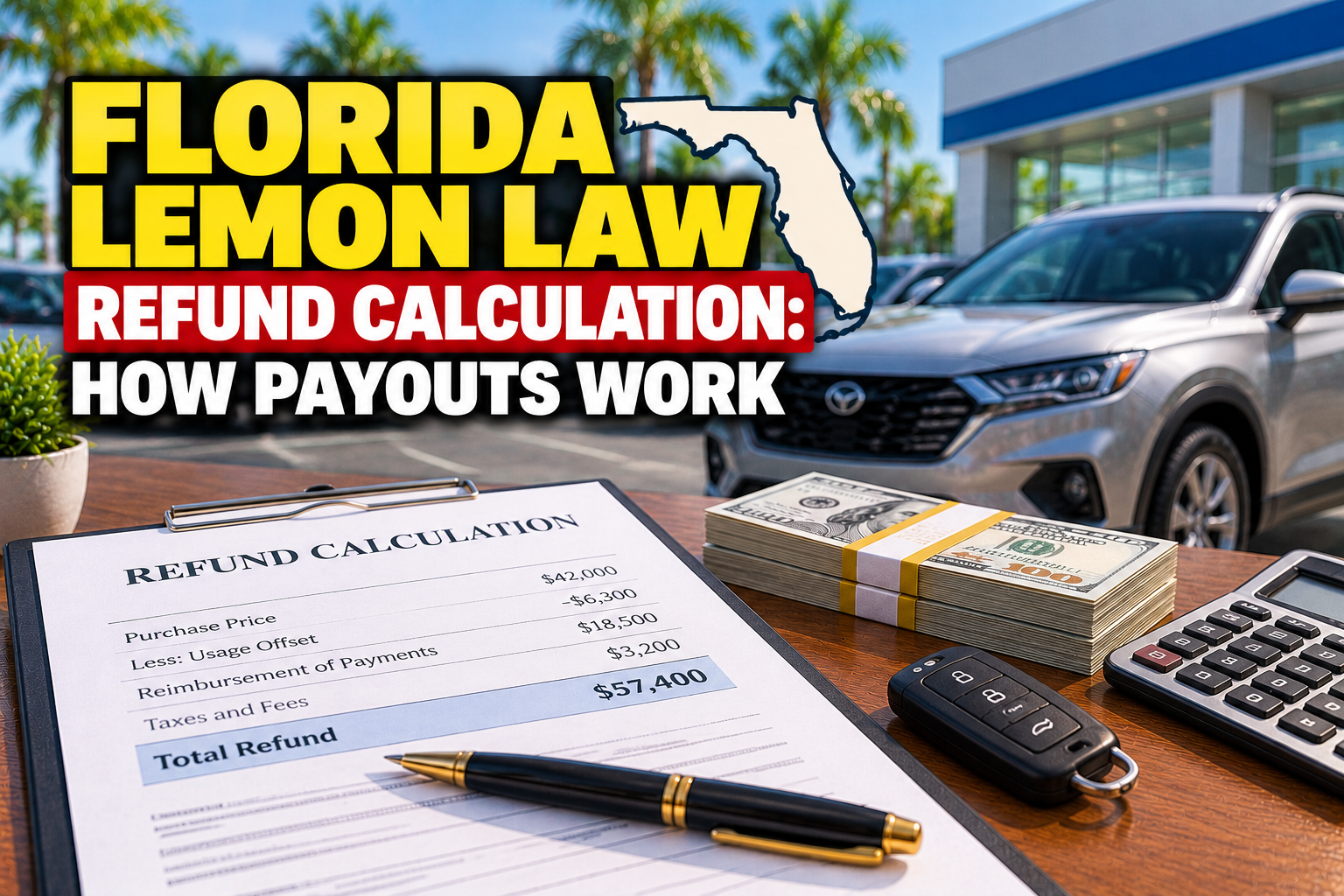
  • Lucid Air Fire Recall and the New Jersey Lemon Law

    Lucid Air Fire Recall and the New Jersey Lemon Law

    Lucid Air Fire Recall and the New Jersey Lemon Law

    Lucid is recalling 27,185 Air sedans because a software problem can let an exterior lighting circuit overheat and catch fire. If you drive one in New Jersey, the first question is usually about safety. The second question is almost always whether the New Jersey lemon law gives you a way out of the car.

    Those are two different questions with two different answers. A recall is a federal safety process. The lemon law is a state warranty statute with its own deadlines, its own counting rules, and its own paperwork.

    This article walks through both, and through a wrinkle that comes up more and more with electric cars. What happens when the fix arrives over the air while your car sits in your driveway?

    This is general educational information about how New Jersey law works. It is not legal advice, and reading it does not create an attorney-client relationship. Outcomes depend on the specific vehicle, dates, mileage, and repair records involved.

    What the Lucid Air Recall Actually Says

    Lucid filed the recall with the National Highway Traffic Safety Administration in August 2026 under campaign number 26V540000. It covers roughly 27,185 Air sedans from the 2022 through 2026 model years, built between October 2021 and July 2026.

    The problem is software, not a broken part. In an older car, a fuse is a strip of metal that melts when too much current runs through a circuit. The Air uses an eFuse instead, where code watches the current and shuts the circuit down, and the recall filing says that threshold was set too high on the low voltage circuits that run the exterior lights.

    So a circuit could keep drawing more amperage than the wiring was built for. Wire that runs hot enough melts its insulation, which is how you get smoke and, in rare cases, fire. The same fault can kill the center brake light or the front lights, and Lucid reported 33 warranty claims involving damaged wiring near that third brake light.

    Three fires tied to front lighting over roughly three years. Thirty-three warranty reports of damaged wiring near the center brake light. One free software update, version 2.10.0, pushed over the air starting in July 2026. Owner notification letters were set to go out beginning October 16, 2026.

    Until the update is installed, the recall notice tells owners to park outside and away from buildings. That guidance matters no matter what you decide about the legal side.

    A Recall Is Not a Lemon Law Claim

    A federal safety recall gets you one thing. A free fix. It does not get you a refund, a replacement car, or money for the hassle.

    The New Jersey Lemon Law is separate. It lives at N.J.S.A. 56:12-29 and following, and the rules that put it into practice are in N.J.A.C. 13:45A-26. It asks a narrower question. Did the manufacturer get a fair number of chances to fix a serious defect inside a set window, and does the defect still exist?

    So a recall can be evidence in a lemon law claim. It is not the claim itself.

    What Qualifies as a Lemon in New Jersey

    New Jersey calls the covered window the term of protection. It runs for the first 24,000 miles of operation or two years from the original delivery date, whichever comes first. Everything else has to happen inside that window.

    The defect also has to be a nonconformity, meaning something that substantially impairs the use, value, or safety of the vehicle. A rattle in the door trim will not get there. A circuit that can catch fire is a different conversation.

    The Three Triggers

    Under the regulations, a consumer can send the manufacturer written notice of a potential claim once one of these happens inside the term of protection:

    • Substantially the same problem has been examined or repaired two or more times and it still exists
    • The car has been out of service for repairs for 20 or more days total, or 45 days for a motor home
    • The problem is one that is likely to cause death or serious bodily injury if the vehicle is driven, and one attempt has already been made

    That third trigger is why a fire risk gets attention. New Jersey treats defects that could kill or seriously injure a driver differently from ordinary defects, and the number of chances the manufacturer gets shrinks accordingly.

    The Certified Mail Step Most People Skip

    New Jersey requires written notice to the manufacturer by certified mail, return receipt requested. The manufacturer then gets one final opportunity to fix the problem within 10 calendar days of receiving it.

    The notice has to be received inside the term of protection, not just mailed inside it. Claims fall apart on that detail more than on anything else.

    Do Over the Air Updates Count as Repair Attempts?

    Here is where the Lucid recall gets interesting. The fix is wireless. No appointment, no service advisor, no repair order.

    New Jersey’s regulations were written around dealer visits. An examination means an inspection by a service technician for or on behalf of the manufacturer. Out of service means days the vehicle sits on the premises of a repair facility. A software patch installed overnight in your own driveway does not obviously produce either one.

    Say Dev in Edison wakes up to a notification that his car installed version 2.10.0 while he slept. Nothing was fixed at a shop. No days were lost. If the update works, there is no continuing defect and no claim. If it does not work, he has zero countable repair attempts on paper, because nothing was ever documented by a technician.

    Software recalls create a records problem that mechanical recalls do not. Written repair orders showing dates in and dates out are the backbone of a New Jersey claim, and a wireless update generates none of them.

    How a New Jersey Buyback Gets Calculated

    If a claim succeeds, the refund is broader than the sticker price. Under the regulations it can include the total purchase or lease price with finance charges, sales tax, license and registration fees, and any trade-in credit. It can also include options installed within 30 days of delivery, towing, rental car costs while the vehicle was out of service, the filing fee, and reasonable attorney and expert fees.

    From that total comes one deduction, called the allowance for vehicle use. The formula is fixed. Take the mileage at the moment the car was first brought in for the defect, multiply by the purchase price, and divide by 100,000.

    A Hypothetical Cherry Hill Example

    Say Renata buys a new electric sedan in Cherry Hill for $74,000. At 3,100 miles the headlights cut out on Route 70 at night, and she brings it in. Over the next four months the car goes back twice more for the same fault and sits at the shop for 22 days total.

    Her use allowance would be 3,100 times $74,000, divided by 100,000, which comes to $2,294. That figure is locked to the mileage at her first visit, not the mileage today. Every mile she drives after that first appointment costs her nothing under the formula.

    The offset is anchored to the odometer reading at the first repair visit for the defect. That is one reason the date of that first appointment is worth documenting carefully.

    What About a 2022 or 2023 Air?

    Most of the recalled Airs are years past two years and 24,000 miles. For those cars the New Car Lemon Law window has closed, and a recall does not reopen it.

    New Jersey has a second statute, the Used Car Lemon Law at N.J.S.A. 56:8-67 and following, with rules at N.J.A.C. 13:45A-26F. It applies to used vehicles bought from a New Jersey dealer for more than $3,000, seven model years old or newer, under 100,000 miles, and not a prior total loss. It runs on a dealer warranty scaled to mileage, and it covers a specific list of parts rather than the whole car, so whether a given electrical component falls inside that list is its own question.

    Two other bodies of law come up in these situations. The federal Magnuson-Moss Warranty Act allows breach of warranty claims that are not bound by state lemon law deadlines. And the New Jersey Consumer Fraud Act, N.J.S.A. 56:8-1 and following, carries treble damages plus fees when a dealer or manufacturer engages in unconscionable practices, which is a different theory with a different proof burden.

    New Jersey Compared to New York and Pennsylvania

    If you commute across state lines, the numbers change with the plates. New York’s new car law runs to two years or 18,000 miles and generally looks for four repair attempts or 30 days out of service. Pennsylvania runs one year or 12,000 miles and generally looks for three attempts or 30 days.

    New Jersey’s 24,000 mile ceiling and 20 day out of service trigger are friendlier than both. Coverage follows where the vehicle was purchased, leased, or registered, not where you happen to be driving when the dash lights up.

    Where New Jersey Lemon Law Cases Get Decided

    New Jersey routes these through the Division of Consumer Affairs Lemon Law Unit in Newark. An accepted application carries a $50 filing fee, which is recoverable as a cost if the consumer prevails.

    The Lemon Law Unit refers accepted applications to the Office of Administrative Law for a summary hearing, generally set within 20 days of acceptance. The Director of the Division issues the final decision, and either side can appeal to the Appellate Division of the Superior Court within 45 days. Filing in Superior Court instead of using the administrative track is also an option.

    Common Questions About Recalls and the NJ Lemon Law

    Does a recall automatically make my car a lemon in NJ?

    No. A recall shows the manufacturer identified a safety defect across a model line. New Jersey’s statute asks about your specific vehicle, your repair history, and whether the defect still exists after the manufacturer’s chances ran out.

    How many recalls before the lemon law applies?

    There is no recall count in the statute. New Jersey counts repair attempts for substantially the same problem and days out of service. Ten recalls for ten unrelated issues fixed on the first try would not satisfy the presumption.

    Is a fire risk a serious safety defect?

    The statute uses the phrase likely to cause death or serious bodily injury if the vehicle is driven. Defects with fire risk are the kind of thing that provision is aimed at, though whether a particular defect clears that bar is decided case by case on the evidence.

    Does the NJ lemon law cover leased cars?

    Yes. Lessees are covered, and the refund is built from lease payments and related charges rather than a purchase price. The same use allowance formula applies.

    What if the vehicle was bought out of state?

    New Jersey’s law reaches vehicles purchased, leased, or registered in New Jersey, and it applies whether the repairs happened inside the state or outside it. A car registered in Bergen County but serviced in Manhattan is still a New Jersey vehicle for these purposes.

    The Short Version

    The Lucid Air recall is a real safety issue with a free fix, and the parking guidance is worth following until the update lands. Whether it becomes a New Jersey lemon law matter depends on the term of protection, documented repair attempts, and whether the defect survives the manufacturer’s final chance.

    For most of the 27,185 recalled cars, that window closed long ago. For the newest ones, the calendar and the odometer are doing the deciding.

    This article is for educational purposes only and is not legal advice. Reading it does not create an attorney-client relationship. For advice on your specific situation, consult a licensed attorney in your state.
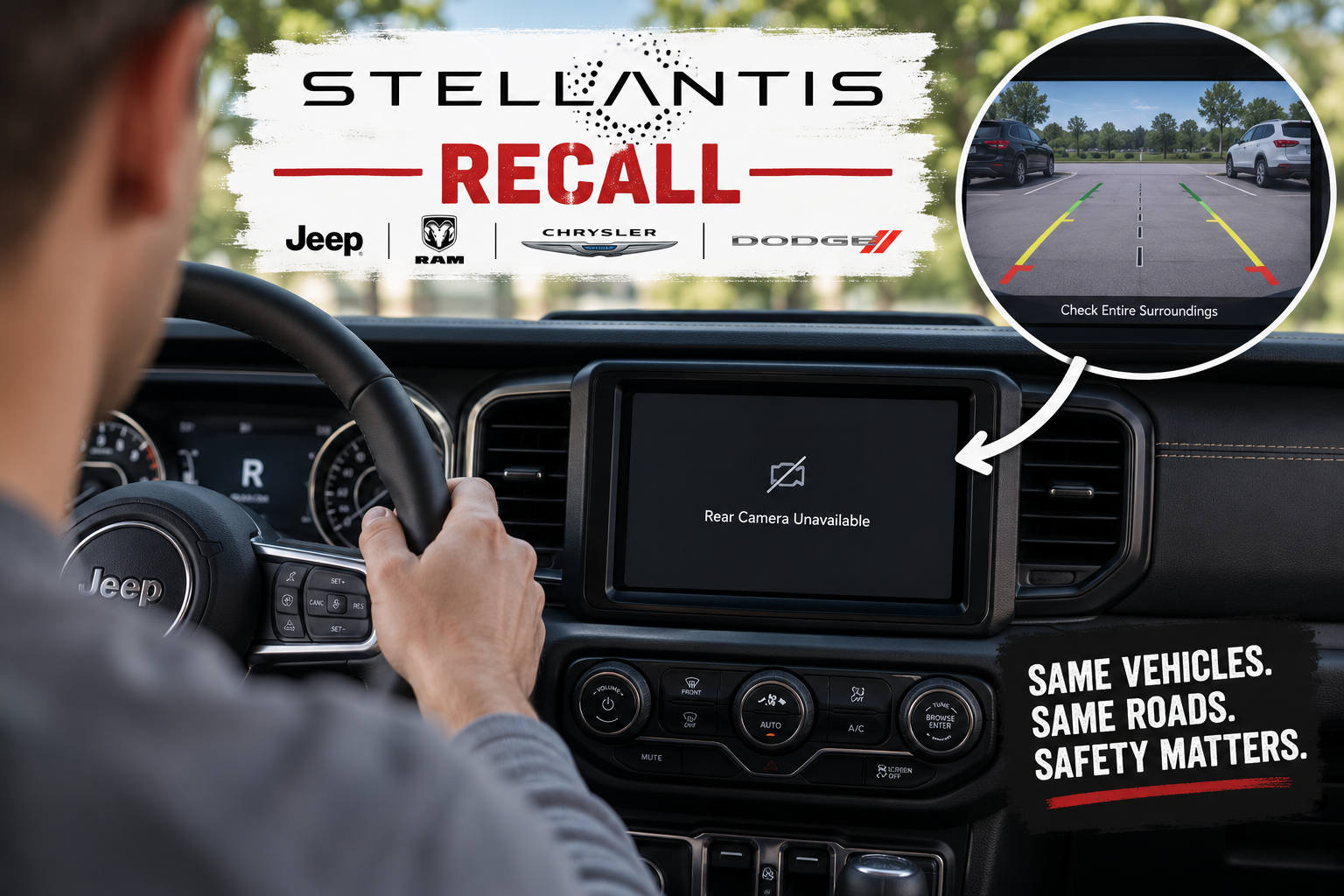
  • Florida Lemon Law Refund Calculation: How Payouts Work

    Florida Lemon Law Refund Calculation: How Payouts Work

    Florida Lemon Law Refund Calculation: How Payouts Work

    Most people who look up the Florida lemon law refund calculation want one number. What is the car actually worth back to me? The honest answer is that Florida doesn’t pay a settlement the way a car accident case does. It runs a formula.

    Florida’s lemon law lives in Chapter 681, Florida Statutes, also called the Motor Vehicle Warranty Enforcement Act. It doesn’t award pain and suffering or punitive damages. What it does is unwind the purchase, hand the vehicle back to the manufacturer, and put money back in the buyer’s pocket using a calculation the Legislature wrote down.

    This article covers that calculation only: what gets added, what gets subtracted, and where the money goes. For how a car qualifies as a lemon in the first place, see our plain-English guide to the Florida Lemon Law.

    What Florida’s Lemon Law Pays: Refund or Replacement

    Under Fla. Stat. § 681.104, once a manufacturer can’t fix a defect after a reasonable number of attempts, it has 40 days to do one of two things. It either repurchases the vehicle and refunds the full purchase price minus a reasonable offset for use, or it replaces the vehicle with one the consumer accepts.

    There’s an important imbalance in that section. The consumer has an unconditional right to choose the refund over the replacement. The manufacturer doesn’t get to force a swap, which is why most Florida lemon law buybacks end in cash rather than a new car.

    If the consumer picks a replacement, it has to be identical or reasonably equivalent. Section 681.102 defines reasonably equivalent as a vehicle whose manufacturer’s suggested retail price is no more than 105 percent of the original’s. In that case the consumer pays the offset for use to the manufacturer instead of having it subtracted from a refund.

    Key takeaway: Chapter 681 is built to undo the transaction, not to compensate for the hassle of owning a broken car. The refund formula reflects that.

    How the Florida Lemon Law Repurchase Calculation Works

    A Florida repurchase figure is built from four parts. Three add to the number and one subtracts. Each is defined in Fla. Stat. § 681.102, which is where most of the real math lives.

    Purchase Price

    Section 681.102 defines purchase price as the cash price from the contract, including any allowance for a trade-in vehicle. It leaves out debt from any other transaction, so negative equity rolled over from an old loan doesn’t get refunded.

    Trade-ins get their own rule. The net trade-in allowance in the contract controls if both the consumer and the manufacturer accept it. If they don’t, the statute sets the allowance at 100 percent of the trade-in’s retail value in the NADA guide in effect at the time of the trade, and the manufacturer has to supply the book.

    Collateral Charges

    These are the extra costs that came purely from acquiring the vehicle. Section 681.102 lists manufacturer-installed or agent-installed items, service charges, earned finance charges, sales taxes, and title charges. Sales tax on a new car in Florida often runs a couple thousand dollars by itself, so this category matters.

    Incidental Charges

    Incidental charges are reasonable costs caused directly by the defect, like a tow when the car dies on the highway or a rental while it sits in the service bay. Section 681.104 requires a refund or replacement to include all reasonably incurred collateral and incidental charges. That’s why receipts matter as much as repair orders.

    The Reasonable Offset for Use

    This is the deduction, and it’s the part almost everyone gets wrong. Section 681.102 spells it out precisely.

    The Florida offset formula: Miles attributable to the consumer, multiplied by the base selling price on the purchase invoice, divided by 120,000. For a recreational vehicle, divide by 60,000 instead.

    Two details move the number a lot. First, the multiplier is the base selling price on the invoice, not the out-the-door total. The statute expressly leaves out taxes, government fees, and dealer fees, so the offset is figured on a smaller number than most people expect.

    Second, the miles count up to the date of a settlement agreement or arbitration hearing, whichever comes first. Not the date the defect showed up, and not the date the notice went out. Every mile driven while a claim is pending adds to the deduction.

    Florida spreads the offset across 120,000 miles. Other states use different starting points and divisors, so a New York or New Jersey number won’t match a Florida number for the same car at the same odometer reading.

    A Worked Example: A Buyback in Gainesville

    Say Terrence buys a new Subaru Outback from a dealership on Archer Road in Gainesville. The invoice shows a base selling price of $36,000. After sales tax, title and tag, and a dealer fee, his total contract price comes to $39,834.

    At 1,800 miles, the dashboard starts going black at random and the car loses power to its headlights. It goes back to the dealer four times over eleven months for the same electrical fault. One night the car shuts down on I-75 near Micanopy, and Terrence pays $340 for a tow. He spends another $520 on a rental while the Outback sits in the shop. By the time his arbitration hearing is scheduled, the odometer reads 9,000 miles.

    His offset for use is 9,000 miles times $36,000, divided by 120,000. That comes to $2,700.

    • Purchase price and collateral charges: $39,834
    • Incidental charges (tow plus rental): $860
    • Less reasonable offset for use: $2,700
    • Net repurchase figure: $37,994

    Notice that the offset was figured on $36,000, not $39,834. Running it on the higher number would have produced $2,987 and cost Terrence close to $300. That gap is the most common math error in Florida repurchase calculations.

    Terrence is a fictional example used to show how the statutory formula works. Real calculations depend on the actual contract documents and the odometer reading on the settlement or hearing date.

    Where the Refund Money Goes

    The net figure isn’t always one check to the owner. Section 681.104 says refunds go to the consumer and to any lienholder of record, as their interests appear. If Terrence still owed $22,000 on his loan, the lender would receive that amount and he’d receive the remaining $15,994. In exchange, he hands over clear title and possession of the Outback.

    Leases are split a different way. The lessee gets back the deposit and lease payments already made, the leasing company gets the rest of the lease price, and the offset runs on the lease’s agreed upon value instead of an invoice. Our guide to the Florida lemon law for leased cars works through that split with its own example.

    One more detail affects how willing manufacturers are to pay. The same section lets a manufacturer that refunded sales tax request that tax back from the Florida Department of Revenue, with proof that the tax was paid and refunded. So the sales tax piece of a buyback doesn’t come out of the manufacturer’s pocket for good.

    Why the Hearing Date Moves the Number

    Because the offset counts miles up to a settlement or hearing, timing changes the payout. A car driven 1,500 miles a month while a claim is pending loses about 1.25 percent of its base price to the offset every month.

    Most Florida buybacks are decided through state arbitration. Under Fla. Stat. § 681.1095, the board generally hears an approved dispute within 40 days and decides within 60, and the panel applies this same formula to set the award. Our walkthrough of how Florida lemon law arbitration works covers the hearing itself. The filing windows that come before it are covered in our guide to the three Florida lemon law deadlines.

    Watch the odometer: The offset uses the miles on the settlement or hearing date, not the miles when the defect first showed up. Weeks of delay mean more miles, and more miles mean a bigger deduction.

    Money That Sits Outside the Refund Formula

    The formula above covers the vehicle itself. Attorney’s fees aren’t part of it. Under Fla. Stat. § 681.112, a court must award reasonable fees and costs to a consumer who wins a lemon law lawsuit, and a manufacturer that loses an appeal of a board award faces extra penalties. Our breakdown of Florida lemon law attorney fees explains how those amounts are figured.

    Fines are different. When a manufacturer neither pays a board award nor appeals it, the state can seek fines of up to $1,000 per day. That money goes into the state’s Motor Vehicle Warranty Trust Fund, not to the consumer.

    Common Questions About Florida Lemon Law Refunds

    Do I get my down payment back in a Florida lemon law buyback?

    A down payment is part of the purchase price the refund is built on. How the total gets divided depends on the loan. The lender is paid what it’s owed, and the rest goes to the consumer.

    Does a Florida lemon law refund include sales tax?

    Yes. Sales tax is listed as a collateral charge in section 681.102, and collateral charges are part of the refund. The manufacturer can then ask the Department of Revenue to return the tax it refunded.

    Is negative equity from my old car refunded?

    No. The definition of purchase price leaves out debt from any other transaction. Money rolled over from a previous loan generally isn’t part of the refund.

    Does the refund formula apply to a used car?

    Only when the used car still qualifies under Chapter 681, which generally means it changed hands during the original 24-month rights period. Our guide on whether the lemon law applies to used cars with no warranty in Florida covers the other rules that apply outside that window.

    What happens to the car after a buyback?

    The manufacturer owns it, and Florida brands the title so later buyers know its history. Our explainer on lemon title meaning in Florida covers the “Manufacturer’s Buy Back” brand and the disclosure rules that follow the car.


    The Short Version

    A Florida lemon law payout is the purchase price plus collateral and incidental charges, minus a mileage offset figured on the base selling price and spread over 120,000 miles. The money is split with any lender, and a replacement uses the same offset in reverse.

    The math is fixed by statute, but the inputs aren’t. The invoice, the trade-in allowance, the receipts, and the odometer reading on the settlement or hearing date all move the final number.

    This article is for educational purposes only and is not legal advice. Reading it does not create an attorney-client relationship. For advice on your specific situation, consult a licensed attorney in your state.
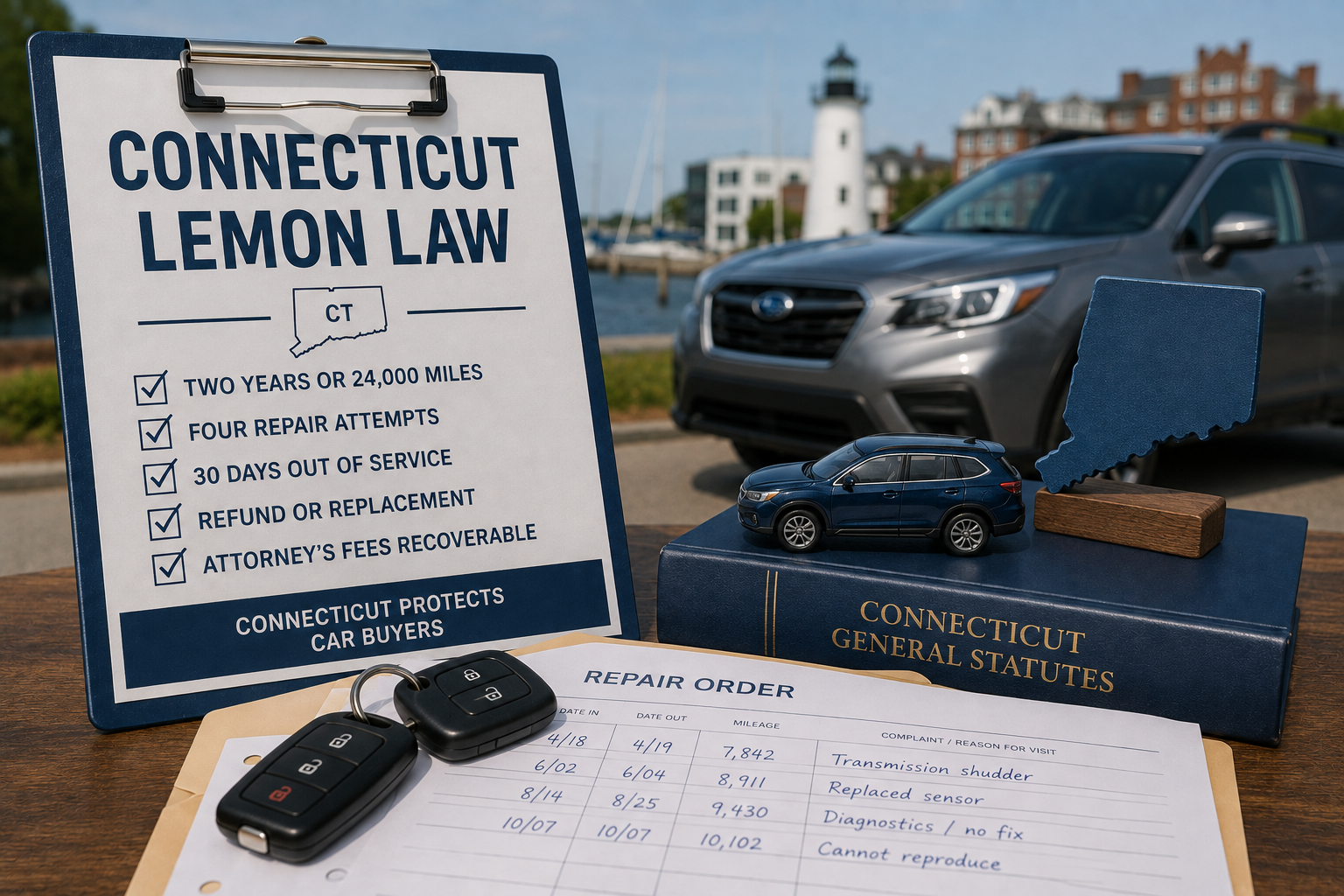
  • Florida Lemon Law and the Stellantis Backup Camera Recall

    Florida Lemon Law and the Stellantis Backup Camera Recall

    Florida Lemon Law and the Stellantis Backup Camera Recall

    You shift your brand new Jeep into reverse and the screen stays black. No camera image, no warning, nothing. That is the problem behind one of the largest vehicle recalls of the year, and it is why a lot of Florida drivers are suddenly reading up on Florida lemon law.

    In August 2026, Stellantis recalled roughly 955,000 vehicles worldwide because of a radio software problem that can stop the rearview camera image from appearing when you back up. The camera itself is fine. The software that puts the picture on your center screen is the part that fails.

    For most owners this will end with a free software update and nothing more. For a smaller group, the fix will not stick. This article explains what the recall actually covers and how Florida’s lemon law generally treats a defect that keeps coming back after repairs.

    What Went Wrong With the Camera

    The recall is filed with federal regulators as NHTSA campaign number 26V531000. Stellantis calls it recall 78D internally. It covers vehicles built with a specific Uconnect 5 radio unit, and the bug lives in that radio’s software.

    When it happens, you get no alert. You put the car in reverse and the image that should appear on the media screen simply does not load. There is no pattern the driver can predict and no way to tell in advance whether this trip will be the one where the screen goes dark.

    Federal safety records list 844,027 affected vehicles in the United States. Stellantis originally told reporters the number was closer to 848,511. The gap is normal. Manufacturer press estimates and the final federal count often differ slightly once the vehicle list is nailed down.

    Which Vehicles Are Covered

    The list runs across all four Stellantis brands and covers mostly 2026 model year vehicles, with the Chrysler Pacifica and Dodge Charger stretching into 2027.

    • Jeep Wrangler, Gladiator, Compass, Cherokee, Grand Cherokee, Grand Cherokee L, Grand Wagoneer and Grand Wagoneer L
    • Ram 1500, Ram 2500, ProMaster and ProMaster EV
    • Chrysler Pacifica, Pacifica Plug-In Hybrid and Voyager
    • Dodge Charger

    Owner notification letters started going out around September 1, 2026. Vehicle identification numbers became searchable on the federal database on August 20, so owners can check a specific vehicle through NHTSA’s VIN lookup tool without waiting for mail. The repair is free either way, whether it arrives as an over the air update or gets loaded at a dealership.

    Why a Dark Screen Counts as a Safety Problem

    It would be easy to write this off as an infotainment annoyance. Federal regulators do not see it that way. Backup cameras have been required equipment on new light duty vehicles since the 2018 model year under Federal Motor Vehicle Safety Standard 111, 49 C.F.R. section 571.111, which says the rear image has to appear by default at the start of every backing event.

    Because the image can fail to show up, these vehicles are recorded as failing to meet that standard. That makes this a noncompliance recall, not just a defect recall. The distinction matters. It means a federal agency has already written down that the vehicle does not meet a safety requirement, which is a useful fact for anyone later arguing the defect affects safety.

    Stellantis says it is not aware of any crashes or injuries connected to this defect. The company’s interim guidance is to stay alert and use the rearview and side mirrors when reversing until the update is installed.

    How Florida Lemon Law Handles a Defect Like This

    Florida’s lemon law is officially the Motor Vehicle Warranty Enforcement Act, found at Chapter 681, Florida Statutes. It applies to new and demonstrator vehicles bought or leased in Florida for personal, family or household use.

    The law does not cover every flaw. Fla. Stat. section 681.102 defines a nonconformity as a defect or condition that substantially impairs the use, value or safety of the vehicle. A camera that will not display when you back up is a reasonable candidate for the safety half of that test, especially given how federal regulators classified it.

    That same section sets the clock. The Lemon Law rights period runs 24 months from the day the vehicle was originally delivered, and the defect has to be reported to the manufacturer or an authorized dealer inside that window.

    Does a Recall Count as a Repair Attempt?

    This is the question people ask most often, and the answer surprises them. A recall notice by itself is not a lemon law claim. It is a notice that a fix exists. What the statute counts is documented repair attempts for the same nonconformity.

    Under Fla. Stat. section 681.104, the law presumes a manufacturer has had a reasonable number of chances in one of two situations. The first is when the same problem has gone in for repair at least three times, the consumer then sends the manufacturer written notice by registered or express mail, the manufacturer gets a final attempt, and the problem still exists. The second is when the vehicle has been out of service for repairs for 30 or more cumulative days.

    Florida spells out what those terms mean in its regulations, not just its statutes. Rule 2-30.001, Florida Administrative Code defines a repair attempt as replacing a component or making an adjustment to correct a nonconformity, and it counts an out of service day as any day, weekends and holidays included, that the vehicle sits at an authorized service agent for examination or repair.

    There is a separate written notice step that catches people off guard. Section 681.104 also says that once a vehicle has been out of service for 15 or more cumulative days, the consumer notifies the manufacturer in writing by registered or express mail so it gets a chance to inspect or repair. Skipping that step can undercut the 30 day path later.

    For a software glitch with an over the air fix, most owners will never get near those numbers. One update, one backup camera that works again, done. The owners who end up with a real claim are the ones where the screen keeps failing after the update and the dealer keeps writing repair orders for it.

    A Hypothetical: Danielle in Hillsborough County

    Say Danielle buys a new 2026 Jeep Grand Cherokee from a dealership off Dale Mabry Highway in Tampa. Base price on the invoice is $52,000 before taxes and fees. She takes delivery in March.

    In September the recall notice arrives and the over the air update installs itself. Two weeks later the camera goes black again while she is backing out of a spot at her kid’s school. She brings it in. The dealer reloads the software and hands the Jeep back.

    It fails again in October. Third visit in November, and the service department keeps the vehicle for eleven days waiting on a replacement radio module. The camera works for a month and then quits a fourth time.

    By this point Danielle has three documented repair attempts for the same problem, all inside her 24 month rights period, all written up on repair orders that describe the same symptom. That is the fact pattern the statute is built around. Written notice to the manufacturer by registered or express mail would give it a final attempt, and if the camera still failed after that, the presumption in section 681.104 would generally be available to her.

    What a Florida Buyback Would Look Like

    If a Florida claim succeeds, the manufacturer has to repurchase the vehicle and refund the purchase price less a mileage offset, or provide a replacement vehicle the consumer accepts. The consumer has an unconditional right to pick the refund instead of the replacement, and the manufacturer has 40 days to comply.

    Florida’s mileage offset formula is written into section 681.102 as the reasonable offset for use. It is the miles you drove, multiplied by the base selling price before taxes and dealer fees, divided by 120,000.

    Running Danielle’s numbers: 9,000 miles multiplied by her $52,000 base price, divided by 120,000, comes to $3,900. That is the offset subtracted from her refund. Recreational vehicles use 60,000 as the divisor instead of 120,000, which makes the offset twice as large per mile.

    The refund also has to include reasonably incurred collateral and incidental charges. Collateral charges include things like sales tax, title charges and earned finance charges.

    Where These Disputes Get Decided in Florida

    Florida does something most states do not. It runs its own arbitration board through the Attorney General’s office. Fla. Stat. section 681.1095 creates the Florida New Motor Vehicle Arbitration Board, which hears cases in three member panels at locations around the state. The Attorney General’s office publishes its own walkthrough of how the Florida lemon law works.

    There is a wrinkle. Fla. Stat. section 681.108 says that if the manufacturer runs its own dispute program that Florida has certified, the consumer generally has to go through that program first. If that program does not decide within 40 days, or the consumer is unhappy with the outcome, the dispute can move to the state board.

    Deadlines are strict. Under Fla. Stat. section 681.109, a request for arbitration has to be filed no later than 60 days after the Lemon Law rights period expires, or 30 days after a certified program’s final action, whichever is later. Once approved, the board is supposed to hear the case within 40 days and decide within 60. The Attorney General also publishes guidance on hearings before the arbitration board.

    Court is a separate track with its own clock. Fla. Stat. section 681.112 requires an action under the chapter to be filed within one year after the rights period expires, or within one year after the final action of a certified program, the department or the board.

    Questions Florida Owners Are Asking

    How many recalls before lemon law applies?

    There is no recall count in the statute. Florida measures repair attempts for the same nonconformity and days out of service, not how many recall notices arrived in the mail. A vehicle with five unrelated recalls that were all fixed on the first try generally does not fit the presumption. A vehicle with one defect that came back four times might.

    Does an over the air update count as a repair attempt?

    This is genuinely unsettled territory, and Florida’s regulation is the place to start. Rule 2-30.001 says examination or repair performed by anyone other than the manufacturer or its authorized service agent is not considered a repair attempt. A wireless update pushed by the manufacturer is not a third party fix, but it also does not produce the paperwork the law expects.

    That paperwork matters. Fla. Stat. section 681.103 requires the manufacturer, through its service agent, to hand the consumer an itemized repair order every time the vehicle comes back from warranty work, listing the reported problem, the diagnosis, the work performed, the date and the odometer reading. An update that installs in your driveway does not generate one of those. Owners who bring the vehicle in and collect the paperwork end up with a much clearer record.

    Does Florida lemon law cover used cars?

    Chapter 681 applies to new and demonstrator vehicles. It is not a used car statute. That said, Fla. Stat. section 681.115 extends these rights to a later transferee of the vehicle, and it voids any agreement that tries to waive or limit them. A 2026 Jeep sold secondhand nine months into its life is a different situation than a ten year old trade in.

    Can the dealership be held responsible?

    Generally not under this chapter. Fla. Stat. section 681.113 is unusually direct and says the lemon law does not create a cause of action against a dealer, with narrow exceptions such as written express warranties the dealer made on its own. The obligation to buy back or replace sits with the manufacturer.

    Is there a federal option too?

    Yes. The Magnuson-Moss Warranty Act is a federal warranty law that runs alongside state lemon laws. Section 681.112 says explicitly that Chapter 681 does not prohibit a consumer from pursuing other rights or remedies under other law.

    The Short Version

    For the overwhelming majority of the 844,027 affected owners, this recall ends with a free software update and a working camera. Florida’s lemon law is not built for problems that get fixed on the first try.

    Where it becomes relevant is the smaller set of vehicles where the same defect keeps returning after multiple documented repair attempts, or where the vehicle piles up 30 or more cumulative days in the shop. Repair orders, dates and written notice sent by registered or express mail are what the statute runs on.

    This article is for educational purposes only and is not legal advice. Reading it does not create an attorney-client relationship. For advice on your specific situation, consult a licensed attorney in your state.

  • A Complete Guide for Connecticut Lemon Law

    A Complete Guide for Connecticut Lemon Law

    Connecticut Lemon Law: The 2026 Guide for CT Drivers

    You bought a car in Connecticut. Maybe a new SUV for the family, a pickup for the job site, or a used sedan to get to work. Within a few weeks something is wrong. The transmission slips, the check engine light won’t quit, and the dealer keeps saying it’s fixed when it isn’t. This is exactly the situation the Connecticut lemon law was written for.

    Connecticut passed the country’s first lemon law in 1982, and every state has since adopted its own version. The state is also changing with the times. On October 1, 2026, Connecticut’s used car warranty rules got their biggest overhaul in almost 40 years.

    This guide walks through the CT lemon law in plain English. You’ll see what counts as a lemon, how the two year and 24,000 mile rule works, how state arbitration runs, what a refund looks like, and exactly what the 2026 update means for used car buyers. Hypothetical examples along the way make the moving parts easier to follow.

    2026 update at a glance: For used cars sold by licensed Connecticut dealers on or after October 1, 2026, the $3,000 price floor is gone, coverage now reaches cars under ten years old, every covered car gets at least 60 days or 3,000 miles of warranty, and “as is” sales are limited to cars ten years old or older. The new car lemon law did not change.

    What Is the Connecticut Lemon Law?

    “Lemon law” is the nickname for Chapter 743b of the Connecticut General Statutes, titled “New Automobile Warranties.” The core section is Conn. Gen. Stat. § 42-179. It covers what happens when a new vehicle has a serious defect the manufacturer can’t fix after a reasonable number of tries.

    The law does two things. It defines when a vehicle legally counts as a lemon. Then it gives the owner a way to make the manufacturer either replace the car or buy it back, usually through a state run arbitration program at the Connecticut Department of Consumer Protection Lemon Law Program rather than a courtroom.

    Used cars live under a separate law, Chapter 743f, which most people call the CT used car lemon law or the used car warranty law. That’s the law Connecticut rewrote in 2026, and it gets its own section below.

    Which Vehicles Does the CT Lemon Law Cover?

    The new car law reaches vehicles that meet these requirements:

    • Sold or leased new in Connecticut
    • A passenger vehicle, a combination passenger and commercial vehicle, or a motorcycle
    • Covered by the manufacturer’s express warranty

    That’s broad. Sedans, SUVs, pickups, minivans, motorcycles, hybrids, and electric vehicles all fit. Leases fit too, since the statute’s definition of “consumer” expressly includes a lessee.

    There’s one wrinkle people miss. The definition of consumer also includes anyone the car was transferred to while the express warranty was still running. So a nearly new car that changes hands inside the original two year and 24,000 mile window can still be in play. Motor homes and cars first sold outside Connecticut fall outside this law.

    What Counts as a Lemon in Connecticut?

    Three pieces have to line up under § 42-179. Our breakdown of what qualifies as a lemon in CT walks through each one in more detail.

    1. The defect has to be substantial

    The defect has to substantially impair the use, safety, or value of the vehicle to the owner. A rattle in the cupholder isn’t enough. A transmission that drops out of gear on I-95 is. The Connecticut Supreme Court has said this test is both subjective and objective, meaning the defect has to matter to this owner and would also matter to a reasonable person. For common problems one by one, see what defects and recalls the CT lemon law covers.

    2. It has to be reported during the protection period

    The protection period runs two years from the original delivery date or 24,000 miles, whichever comes first. If the defect is reported inside that window, the manufacturer has to keep repairing it even after the window closes. A problem that first shows up in month 25 falls outside the new car law. Our post on how long the lemon law is good for in Connecticut covers both clocks, including the shorter one for safety defects.

    3. The manufacturer has to fail a reasonable number of repair attempts

    This is where most cases turn. Connecticut presumes the manufacturer has had enough chances if any one of these is true:

    • The same defect has been repaired four or more times within the protection period and still exists
    • The vehicle has been out of service for repairs a cumulative 30 or more calendar days within the protection period
    • A defect likely to cause death or serious injury has been repaired at least twice within one year or the warranty term, whichever ends first, and still exists

    The law also requires at least one repair attempt before any claim, unless the dealer or manufacturer refused to try. And the two year and 30 day periods get extended if repairs weren’t available because of a strike, flood, fire, or similar event.

    The four numbers to remember: 2 years, 24,000 miles, 4 repair attempts for the same defect, and 30 cumulative days in the shop.

    A Connecticut Lemon Law Example: Marisol’s Honda Pilot

    Say Marisol lives in West Hartford. In February she buys a new Honda Pilot for $46,000. By April she feels a hard shudder every time the transmission shifts from second to third, so she takes it to the dealer on Farmington Avenue.

    1. April: the dealer reflashes the transmission software. The shudder comes back.
    2. June: the dealer replaces a sensor. The shudder returns two weeks later.
    3. August: the dealer keeps the Pilot 11 days to investigate. Still there.
    4. October: the dealer says it can’t reproduce the problem and sends her home. It’s still there.

    That’s four repair attempts for the same defect, well inside two years and 24,000 miles, and the defect still exists. A shuddering transmission affects both safety and use. On those facts the Pilot lines up with how the Connecticut lemon law describes a lemon.

    Car Has Been in the Shop for Weeks? The CT 30 Day Rule

    The 30 day path doesn’t need a single repeat defect. Say Devon leases a new BMW X3 in New Haven in January, and the car has a run of different warranty problems that year.

    • March: coolant leak, 7 days in the shop
    • June: driver assistance system failure, 9 days
    • September: electrical fault that kills the headlights, 11 days
    • November: steering wheel vibration, 5 days

    That’s 32 calendar days out of service for warranty repairs in the first year. No defect hit four attempts, but together they cross the 30 day line. Routine maintenance like oil changes and tire rotations is a different story, since those aren’t repairs of a defect.

    Paperwork makes or breaks this rule. Every repair order should show the date the car went in, the date it came out, and the complaint. Connecticut dealers have to hand over copies of repair paperwork when asked, under Conn. Gen. Stat. § 42-179a.


    How Connecticut Lemon Law Arbitration Works

    Most CT lemon law disputes are decided through the DCP program, which the state runs under Conn. Gen. Stat. § 42-181. The general flow looks like this, and our walkthrough of how a CT lemon law claim works from start to finish covers each stage in more depth.

    1. Notice to the manufacturer. The statute only requires written notice to the manufacturer when the carmaker clearly disclosed that requirement in the warranty or owner’s manual. DCP’s application checklist asks for proof of that notice.
    2. Online application. DCP currently takes applications online only, along with the purchase or lease paperwork and every repair order.
    3. Eligibility review. DCP staff check the basics, like where the car was bought, the protection period, and the vehicle type.
    4. Hearing. An independent arbitrator, who can’t work for any car manufacturer, dealer, or repair business, hears both sides. A certified automotive technical expert reviews the evidence and advises the arbitrator.
    5. Decision. The statute sets a target of 60 days from filing for a written decision. If the owner wins, the decision orders a refund or replacement and sets a date for the manufacturer to perform.
    6. Court review. Either side can apply to Connecticut Superior Court to confirm, vacate, or modify the award.

    Owners can represent themselves at the hearing. Manufacturers that drag their feet after losing can be fined up to $1,000 per day by DCP until they perform.

    What about the manufacturer’s own dispute program?

    This detail trips people up. If a manufacturer runs an informal dispute program that the Connecticut Attorney General has certified, the refund and replacement remedies don’t apply to an owner who hasn’t gone through that program first. If the manufacturer has no certified program, owners can go straight to DCP. An owner unhappy with a certified program’s result can also ask for a fresh hearing before a state arbitrator.

    By the numbers: DCP reported a record of more than $8.1 million in refunds and replacement vehicles for Connecticut consumers in 2025, from 165 applications. (DCP 2025 Lemon Law Annual Report)

    What You Can Recover Under the CT Lemon Law

    When a vehicle qualifies, the manufacturer has to either replace it or take it back and refund the owner. The money goes to the owner, the leasing company, and any lender, according to their interests.

    Refund, also called a buyback

    A Connecticut lemon law refund generally includes the full contract price (including options, dealer prep, and transportation charges), collateral charges like sales tax and registration fees, finance charges paid after the defect was first reported and while the car sat in the shop, and incidental costs like towing.

    The manufacturer can subtract a reasonable allowance for use, often called the mileage offset. Connecticut uses a fixed formula: the contract price times the miles driven before the manufacturer takes the car back, divided by 120,000. Go back to Marisol. If Honda accepts her $46,000 Pilot at 12,000 miles, the offset is $46,000 times 12,000 divided by 120,000, which comes to $4,600.

    Replacement vehicle

    The other remedy is a new vehicle. The statute says it has to be a replacement “acceptable to the consumer,” and arbitration awards speak of an identical or comparable new vehicle. Plenty of owners prefer the refund because a replacement keeps them with the same manufacturer.

    Attorney’s fees

    Under Conn. Gen. Stat. § 42-180, a court may award a consumer reasonable attorney’s fees and costs in a breach of warranty case against a manufacturer or dealer. The Connecticut Supreme Court has also read the arbitration statute to let arbitrators award fees to owners who win. Fee shifting works both ways, though. A court can award fees to the manufacturer if a case was brought without substantial justification.

    Title branding

    When a manufacturer takes back a vehicle through arbitration or settlement, it has to stamp “MANUFACTURER BUYBACK-LEMON” on the title in letters at least a quarter inch high and send a copy to the DMV within 30 days. Skipping that step can cost the manufacturer up to $10,000. The point is to warn the next buyer, and our guide to lemon titles in Connecticut explains how that warning follows the car.


    Connecticut Used Car Lemon Law: The New 2026 Rules

    Connecticut’s used car protections live in Chapter 743f, and the key section is Conn. Gen. Stat. § 42-221. Lawmakers rewrote it in 2026. The change began as Senate Bill 119 and was enacted as part of Public Act 26-100, which Governor Lamont signed on June 2, 2026. It took effect October 1, 2026.

    The old rules dated to 1987 and turned on the car’s price. The new ones turn on its age. For a used car sold by a licensed Connecticut dealer on or after October 1, 2026, any car under ten years old comes with a written warranty of at least 60 days or 3,000 miles, covering parts and labor, no matter what it sells for. A dealer can’t disclaim implied warranties on those cars, and can only sell a used car “as is” if it’s ten years old or older.

    RuleSales before Oct. 1, 2026Sales on or after Oct. 1, 2026
    Price threshold$3,000 or moreNone
    Age limit for coverageUnder 7 years oldUnder 10 years old
    Warranty length30 days or 1,500 miles ($3,000 to $4,999)
    60 days or 3,000 miles ($5,000 and up)
    60 days or 3,000 miles for every covered car
    “As is” sales allowedUnder $3,000 or 7+ years old10+ years old only

    Age is counted from January 1 of the car’s model year, so a 2017 model stays covered through the end of 2026. Complaints about a dealer that won’t honor the warranty go to the Connecticut DMV Consumer Complaint Center. Our full breakdown of the CT used car rules that changed October 1, 2026 covers what the warranty requires, how the clock works, and a worked example.

    Watch the sale date and the seller. The rules in effect on the date of sale control. A used car bought from a dealer in September 2026 follows the old two tier rules, even if it breaks down in November. And the warranty law only covers licensed dealers, so private party sales and dealer to dealer sales fall outside it.

    Leased Cars and EVs Under Connecticut Law

    Leases are common in Greenwich, Westport, and Fairfield, and the Connecticut lemon law for leased cars treats a lessee much like a buyer. A lessee who files for arbitration has to notify the leasing company by registered or certified mail, and the lessor can ask to join the case. The refund math splits money between the lessee and the lessor based on their interests.

    Electric vehicles get no special carve out. A new EV with a battery or software defect that survives four repair attempts, or that racks up 30 days in service, can qualify the same way a gas car can. Because some EV brands have only a few service centers in the state, long shop stays can make the 30 day rule easier to reach. Mobile service visits and tow records count as part of the paper trail.

    How Connecticut Compares to New York, Massachusetts, and Rhode Island

    Connecticut sits on the generous end of the Northeast for new cars, mostly because of its longer protection period.

    A low mileage Connecticut driver stays protected roughly twice as long as the same driver would in Rhode Island or Massachusetts. With the 2026 update, Connecticut’s used car warranty now also reaches cars up to ten years old regardless of price.

    Common CT Lemon Law Misconceptions

    “I signed an as is form, so I have no rights.”

    Since October 1, 2026, a licensed Connecticut dealer can’t sell a car under ten years old as is. Paperwork that says otherwise doesn’t erase the warranty the statute requires.

    “Cheap used cars never come with a warranty.”

    That was true under the old $3,000 floor. Under the 2026 law, price no longer matters. A $2,500 car that’s under ten years old gets the same 60 day or 3,000 mile warranty as a $25,000 one. It’s a repair warranty, though, not a return window. There’s no 30 day lemon law on used cars in CT that lets a buyer hand the car back.

    “The car has to be dangerous to be a lemon.”

    The test is substantial impairment of use, safety, or value. Any one of the three can be enough. Safety defects just get a faster track, with two attempts instead of four.

    “Lemon law only covers cars I bought.”

    Leased vehicles are covered under Connecticut’s new car law, and so are motorcycles.

    “I can always skip straight to state arbitration.”

    Not if the manufacturer has a dispute program certified by the Connecticut Attorney General. In that case, the law expects owners to try that program before refund or replacement remedies apply.

    Connecticut Lemon Law Deadlines to Watch

    • New cars: The defect has to be reported within two years of delivery or 24,000 miles, and the repair attempts or shop days that trigger the presumption have to happen inside that same window.
    • Safety defects: The two attempt rule runs within one year or the warranty term, whichever ends first.
    • Arbitration: DCP says its eligibility review can take up to two weeks, and the statute targets a decision within 60 days of filing.
    • Selling during a case: An owner who sells the car while arbitration is pending has to tell the buyer before the sale and notify DCP within five days.
    • Used cars: The defect has to be reported to the dealer before the 60 day or 3,000 mile warranty runs out.

    Connecticut Lemon Law FAQs

    Does the CT lemon law cover used cars?

    The new car law in Chapter 743b generally doesn’t, except for a nearly new car transferred while the original warranty window is still open. Used cars are covered by the separate warranty law in Chapter 743f, which since October 1, 2026 applies to dealer sales of cars under ten years old.

    What is the Connecticut used car warranty in 2026?

    For dealer sales on or after October 1, 2026, at least 60 days or 3,000 miles, whichever comes first, for any used car under ten years old. Sales before that date follow the old 30 day and 60 day tiers based on price.

    Can I get a refund under the CT lemon law?

    Refund is one of the two remedies for a qualifying new vehicle. It covers the contract price, collateral charges, certain finance charges, and incidental costs, minus the mileage offset. The other remedy is a replacement acceptable to the owner.

    Do I have to live in Connecticut to use the CT lemon law?

    No. What matters is that the vehicle was sold or leased new in Connecticut. DCP has said that even out of state residents are protected when the vehicle otherwise qualifies.

    Do I need a lawyer for Connecticut lemon law arbitration?

    The DCP program lets owners represent themselves. Manufacturers usually show up with a lawyer or company representative, and fee shifting rules can come into play when owners hire counsel.

    Federal Backup: The Magnuson-Moss Warranty Act

    When the Connecticut lemon law doesn’t fit, the federal Magnuson-Moss Warranty Act, 15 U.S.C. § 2301 and following, may still apply. It lets consumers sue for breach of a written or implied warranty and allows recovery of attorney’s fees. It comes up most for cars past two years or 24,000 miles that are still under factory warranty, and for vehicle types the state law excludes, like motor homes.

    The Bottom Line on Connecticut Lemon Law

    For new cars, Connecticut’s numbers haven’t changed: two years, 24,000 miles, four attempts, or 30 days in the shop. For used cars, October 1, 2026 rewrote the rules, with age replacing price and a uniform 60 day or 3,000 mile warranty for dealer sales of cars under ten years old. Repair orders, sale dates, and model years are the details that decide how a situation lines up with the law.

    This article is for educational purposes only and is not legal advice. Reading it does not create an attorney-client relationship. For advice on your specific situation, consult a licensed attorney in your state.

  • New Jersey Lemon Law: The Complete 2026 Guide for New Jersey Consumers

    New Jersey Lemon Law: The Complete 2026 Guide for New Jersey Consumers

    If you bought or leased a car in New Jersey and the same problem keeps coming back no matter how many times the dealer says it’s fixed, you may be wondering whether the New Jersey Lemon Law actually applies to you. That’s the right question to ask, and this guide is built to answer it.

    This guide walks through the NJ lemon law in plain English, from the first repair visit to a final decision. You’ll see what counts as a lemon, how repair attempts and shop days get counted, why the certified letter matters so much, how used cars are treated differently, and what a refund looks like. Where a topic deserves a deeper look, a link points to a guide that covers it in full.

    The same rules apply whether you bought your car in Jersey City, Cherry Hill, Paterson, or Toms River. Only the hearing location changes.

    This is general educational information about how New Jersey law works. It is not legal advice, and reading it does not create an attorney-client relationship. Lemon law outcomes depend heavily on the specific facts, documents, vehicle, and timing involved.

    What Is the New Jersey Lemon Law?

    A “lemon” is a vehicle with a serious, repeating defect that the manufacturer or dealer can’t fix in a reasonable number of tries. Every state has some version of a lemon law, and the basic idea is the same everywhere. If a car can’t be fixed, the people who made or sold it should replace it or buy it back.

    The New Jersey Lemon Law is the state’s version of that idea. It may entitle qualifying consumers to a refund or replacement when a vehicle has a substantial defect that can’t be fixed after a reasonable number of attempts. New Jersey actually has two separate lemon laws that tend to get talked about as one.

    The New Car Lemon Law

    The first is the New Car Lemon Law, found at N.J.S.A. 56:12-29 and following. It covers new cars and motorcycles bought, leased, or registered in New Jersey, plus authorized emergency vehicles, farm tractors, and the vehicle portion of motor homes. The claim runs against the manufacturer.

    The Used Car Lemon Law

    The second is the Used Car Lemon Law, found at N.J.S.A. 56:8-67 and following. It covers certain used cars bought from a dealer and requires the dealer to give a short written warranty. The claim runs against the dealer, not the manufacturer.

    Both laws are handled by the New Jersey Division of Consumer Affairs through its Lemon Law Unit. When a hearing is scheduled, it takes place at the Office of Administrative Law in Newark, Trenton, or Atlantic City. Consumers in every county, from Bergen to Cape May, use the same process.

    How the NJ Lemon Law Process Works, Step by Step

    At a high level, a New Jersey new car lemon law claim moves through the same stages every time.

    1. A defect shows up and the consumer takes the vehicle to an authorized dealer for repair.
    2. The same defect keeps coming back, or the car keeps sitting in the shop, and the repair attempts or days start adding up.
    3. The consumer sends the manufacturer a certified mail final chance letter, and the manufacturer gets 10 days to make one last repair attempt.
    4. If the defect is still there, the consumer files an application with the Lemon Law Unit.
    5. If the application is accepted, the case moves into the NJ lemon law hearing process, where an administrative law judge issues an initial decision and the Director of Consumer Affairs issues the final one.

    Once the Unit approves a new car application, it asks for a $50 filing fee, which is recoverable if the consumer wins. The hearing is generally set within about 20 days of acceptance. The judge’s initial decision comes within 20 days after the hearing, and the Director has 15 days to adopt, change, or reject it.

    Either side can appeal the final decision to the Appellate Division of the Superior Court. Consumers can also skip the state program and sue in Superior Court instead, but choosing the state hearing generally rules out a separate lemon law lawsuit over the same problem. Most consumers who never get relief make a procedural mistake in the first three steps, long before any hearing.


    What Qualifies as a Lemon in New Jersey?

    The defect has to substantially impair the vehicle’s use, value, or safety. A defect can also qualify if it’s a serious safety defect likely to cause death or serious bodily injury if the car is driven. A scratch on the bumper doesn’t clear that bar. A transmission that randomly drops into neutral on the Turnpike does.

    Stalling, transmission failures, brake and steering problems, and electrical faults that affect driving come up often. Minor cosmetic issues and buyer’s remorse don’t qualify. Our breakdown of what qualifies as a lemon in NJ walks through the use, value, and safety tests one by one.

    Leases are common across North Jersey, and the New Jersey lemon law for leased cars treats a lessee the same way it treats a buyer. If a leased car qualifies, the lease ends without an early termination penalty. The lessee gets back what was actually paid under the lease minus a mileage deduction, and the leasing company is paid off separately.

    The New Car Lemon Law does not cover vehicles registered for commercial use, the living quarters of motor homes, defects caused by accident, vandalism, abuse, or neglect, or defects caused by someone other than the manufacturer, its agent, or an authorized dealer.

    How Many Repair Attempts Are Needed Under NJ Lemon Law?

    New Jersey uses two different counts for two different purposes. According to the Division’s guidance, the final chance letter can go out once any one of these has happened inside the protection period:

    • Two repair attempts for the same defect have failed
    • The vehicle has been out of service for a total of 20 days, or 45 days for a motor home, under the NJ lemon law 20 day rule
    • A single repair attempt has failed on a serious safety defect

    To qualify for a hearing, the Division looks for a fuller record. That means three repair attempts, the certified letter received by the manufacturer inside the protection period, the return receipt proving it, and a defect that still exists after the final repair.

    Two failed attempts opens the door to the letter. The manufacturer’s final repair after that letter is usually attempt number three. Twenty cumulative days out of service is a separate trigger, and days from different problems can add up.

    The Certified Mail Final Chance Letter

    This is the step where the most New Jersey lemon law claims fall apart. People search for it under a lot of names, including “NJ lemon law certified letter,” “demand letter,” and “final chance letter.” They all mean the same thing.

    The consumer sends the manufacturer, not the dealer, a written notice by certified mail with return receipt requested. The letter gives the manufacturer one last chance to repair the defect. The manufacturer then has 10 days from the date on the return receipt to make that repair.

    A phone call to customer service doesn’t count. Neither does an email or a social media post. Certified mail is how the consumer proves the manufacturer actually received notice and had its 10 day window.

    Two details trip people up. First, the Division says the letter goes to the manufacturer’s regional office, and the Lemon Law Unit is the source for that address. Second, the manufacturer has to receive the letter before the car passes 24,000 miles or two years from delivery. Mailing it in time isn’t enough if it arrives late.

    Three pieces of paper come out of this step. A copy of the letter. The return receipt showing when the manufacturer got it. And the invoice from the final repair attempt. The Division’s New Car Lemon Law consumer brief includes a sample letter showing what the notice is expected to contain.


    How Long the NJ Lemon Law Lasts on a New Car

    The New Car Lemon Law protects a vehicle for two years or 24,000 miles from delivery, whichever comes first. That second limit catches New Jersey commuters off guard. Someone driving from Newark to Princeton every weekday can put 20,000 miles a year on a car, which means the window could close around month 14 instead of month 24.

    The defect, the repair attempts, and the manufacturer’s receipt of the certified letter all need to land inside that window. Our post on the NJ lemon law time frame covers the new car clock, the used car clock, and why the law is murky on a separate filing deadline.

    How the NJ Used Car Lemon Law Works

    New Jersey is one of a small group of states with a dedicated used car lemon law. Instead of the two year window, it requires the dealer to give a written warranty on qualifying used cars. The details are set out in the Division’s regulations at N.J.A.C. 13:45A-26F.

    Our guide on whether used cars qualify under the NJ lemon law covers the thresholds and covered parts in detail. Generally, the dealer warranty applies when all of these are true at the time of sale:

    • The car was bought from a dealer
    • The purchase price was $3,000 or more
    • The car is seven model years old or less
    • The odometer read 100,000 miles or less
    • The car was not declared a total loss by an insurer

    The warranty runs 90, 60, or 30 days depending on the mileage at sale, and it mostly covers the engine, transmission, and drive parts. That shortest tier is where a popular myth comes from. There’s no 30 day lemon law on used cars in NJ that lets a buyer hand the car back. It’s a repair warranty, not a return window.

    A refund can come into play if the dealer fails to fix the same covered defect after three attempts, or the car spends 20 cumulative days waiting on the dealer’s repairs. Filing a used car application is free. The Division publishes the Used Car Lemon Law dispute resolution application on its site.

    Watch who sold the car. The used car law defines a dealer as anyone who sold or offered three or more used cars in the past 12 months. A true one time private sale falls outside it, but a driveway seller who flips cars may not. And private car sale buyers in NJ still have fraud, warranty, and odometer laws on their side.

    NJ New Car vs. Used Car Lemon Law: Quick Comparison

    FactorNew Car Lemon LawUsed Car Lemon Law
    StatuteN.J.S.A. 56:12-29 et seq.N.J.S.A. 56:8-67 et seq.
    Who answers the claimManufacturerSelling dealer
    Protection period2 years or 24,000 miles90, 60, or 30 days, tiered by mileage
    Main triggers3 attempts, 20 days out of service, or 1 attempt on a serious safety defect3 attempts or 20 days waiting on repairs
    Certified final chance letterRequired, sent to the manufacturerNotice to the dealer within the warranty
    Filing fee$50, recoverable if the consumer winsNone
    Private sales coveredNot applicableNo, dealer sales only
    Per repair deductibleNoneUp to $50 per covered repair
    Mileage deductionBased on miles at the first repair visitIRS mileage rate times every mile driven

    Refunds, Buybacks, and Replacement Vehicles in New Jersey

    A “manufacturer buyback” and a lemon law refund are the same thing. A buyback can come from a settlement before a hearing, an order after a hearing, or a manufacturer’s own dispute program. Either way, the amount follows a written formula, not a round number.

    For new cars, the refund generally starts with the full purchase price and adds back items like sales tax, registration fees, towing, and rental costs. It’s then reduced by a NJ lemon law buyback mileage deduction based on the odometer reading at the first repair visit for the defect, not the mileage on the day of the buyback. Used car refunds work differently and leave taxes and fees out.

    A manufacturer may offer a replacement car instead, but the consumer can turn it down and ask for a refund. Refunds are far more common in New Jersey because the math is cleaner than agreeing on what counts as a comparable vehicle.

    What happens to the car after a buyback

    A returned lemon doesn’t disappear. New Jersey brands its title, and a dealer reselling it has to hand the next buyer a written notice about its history first. The brand stays with the car for life, and our guide to what a lemon title in NJ means explains who has to disclose it and when.


    Example: Maria’s New Car in Bergen County

    Say Maria lives in Hackensack. She buys a new sedan for $32,000 from a dealership in Paramus. At about 4,400 miles she notices a transmission shudder between second and third gear, and she brings it in. The dealer keeps it two days and replaces the valve body.

    Three weeks later the shudder is back. The dealer keeps the car four days and reflashes the transmission software. Maria now has two failed attempts at the same defect, well inside her two year and 24,000 mile window. That’s enough under the Division’s guidance to send the certified final chance letter.

    She gets the regional address from the Lemon Law Unit and mails the letter. The manufacturer’s final repair takes 11 days while the dealer waits on a part, and the shudder still isn’t gone. That’s three attempts. Her total time out of service is 17 days, so the repair count is what carries her case, not the 20 day rule.

    Her next step would be an application to the Lemon Law Unit and the $50 fee. If she won a buyback, the use deduction would be based on the 4,400 miles at that first visit. That works out to 4,400 times $32,000, divided by 100,000, or $1,408. Maria is made up, and every real case turns on its own facts and paperwork.

    Records That Matter in a NJ Lemon Law Case

    Lemon law cases are built on documentation. These are the records that tend to carry the most weight.

    • Repair orders for every visit, showing drop off and pickup dates, mileage, and the complaint in the consumer’s own words
    • The purchase or lease agreement and the finance contract
    • The certified letter and its return receipt
    • Photos or video of the defect, which matter most for problems that come and go
    • Tow and rental car receipts
    • Every email, text, and letter exchanged with the dealer and the manufacturer

    The repair order is the official record of what happened. If it says “no problem found” or just “customer states issue,” but the driver described stalling at 60 miles per hour on the Garden State Parkway, that gap can matter a lot at a hearing months later.

    Common Mistakes New Jersey Consumers Make

    The first is skipping or botching the certified letter. Plenty of people call customer service or send an email and assume it counts. The process calls for certified mail with a return receipt, sent to the regional address the Lemon Law Unit provides.

    The second is letting the dealer write vague repair orders. “Customer concern” is not the same as a written description of a stalling defect, and that difference can decide a case.

    The third is waiting past the protection period. New cars get two years or 24,000 miles. Some used cars get as little as 30 days. The window can close before a problem fully shows itself.

    The fourth is taking the car to an independent shop for warranty work. Repairs generally have to be done by the manufacturer, its agent, or an authorized dealer to count toward the lemon law thresholds.

    The fifth is trading in or selling the car before the claim is resolved. Once the car is gone, the main remedy of returning it for a refund usually goes with it.

    The sixth is signing a buyback or settlement without reading it closely. Releases and confidentiality clauses can have effects that outlast the car itself.

    How New Jersey Compares to Federal Law and Neighboring States

    There’s no single federal lemon law. The closest thing is the Magnuson-Moss Warranty Act, which governs written warranties nationwide. It doesn’t set a repair count, a mileage window, or a state hearing. New Jersey’s law fills those gaps with concrete numbers.

    New Jersey also handles disputes differently than its neighbors. New York and Connecticut send lemon law disputes to state arbitration programs. New Jersey sends them to an administrative law judge, which makes its hearing look more like a small trial. And unlike most states, New Jersey gives used car buyers their own lemon law.

    When People Consider Talking to a New Jersey Lemon Law Attorney

    An attorney isn’t required at an OAL hearing. Under the New Car Lemon Law, a consumer who wins is entitled to reasonable attorney’s fees paid by the manufacturer. That fee shifting rule is why many New Jersey lemon law attorneys handle qualifying new car cases on contingency.

    Consumers commonly start looking for representation when:

    • The manufacturer has denied a claim or made a low buyback offer
    • The defect involves brakes, airbags, steering, or stalling
    • It isn’t clear whether a used car meets the eligibility thresholds
    • A hearing has been scheduled at the OAL
    • Settlement paperwork has arrived and needs a careful read

    Frequently Asked Questions About the NJ Lemon Law

    What is the New Jersey Lemon Law in simple terms?

    It’s a state consumer protection law that may require a manufacturer or dealer to refund or replace a vehicle when a substantial defect can’t be repaired after a reasonable number of attempts during the protection period.

    Is there a federal lemon law?

    Not exactly. The Magnuson-Moss Warranty Act covers written warranties nationwide, but the specific repair counts, deadlines, and hearing process come from each state’s own lemon law.

    Does the NJ lemon law cover motorcycles, SUVs, and trucks?

    Motorcycles are covered by name. SUVs and pickup trucks are covered as passenger vehicles, as long as they aren’t registered for commercial use.

    Does the NJ lemon law cover motor homes and RVs?

    The vehicle portion is covered, including the engine, transmission, and steering. The living quarters are not. Motor homes also get a 45 day out of service trigger instead of the usual 20.

    Do repairs at an independent shop count toward the NJ lemon law?

    Generally no. Repair attempts usually need to be made by the manufacturer, its agent, or an authorized dealer. Defects caused by an outside shop’s work are excluded from the New Car Lemon Law.

    What happens if I sell or trade in the car before a claim is resolved?

    The main remedy under the lemon law is returning the vehicle for a refund. Once the car is sold or traded, that remedy is usually much harder to reach, and a trade-in value is whatever the dealer offers rather than the statutory formula.

    How do I contact the NJ Lemon Law Unit?

    New Jersey Division of Consumer Affairs, Lemon Law Unit, P.O. Box 45026, Newark, NJ 07101. The phone number is (973) 504-6226.

    Official New Jersey Lemon Law Resources

    The New Jersey Lemon Law gives consumers a real path to a refund when a vehicle can’t be fixed, but that path runs on deadlines and paperwork. The protection period is short, the certified letter is easy to get wrong, and the repair orders end up being the record everything else is judged against.

    This article is for educational purposes only and is not legal advice. Reading it does not create an attorney-client relationship. For advice on your specific situation, consult a licensed attorney in your state.

  • Florida Lemon Law: A Plain-English Guide to Your Rights

    Florida Lemon Law: A Plain-English Guide to Your Rights

    Florida Lemon Law: Your Plain-English Guide to Rights, Deadlines, and Refunds

    You bought a new car in Florida. Maybe it’s a Ford F-150 from a dealer on US-1, or a Honda Accord you picked up in Doral. Either way, you expected reliable transportation, not a vehicle that lives at the service center.

    That’s where the Florida Lemon Law comes in. It’s a state statute built to put pressure on manufacturers when a serious defect can’t be fixed after a fair number of tries. When a vehicle qualifies, the law opens a path to a refund or a replacement, not just another trip to the shop.

    This guide covers how the Florida Lemon Law works from start to finish. You’ll see what qualifies as a lemon, how the 24-month rights period runs, what counts as a reasonable number of repair attempts, how state arbitration works, what a buyback pays, and where used cars fit in. When a topic needs more room, we link to a guide that covers it in depth.

    Florida lemon law at a glance: The rights period runs 24 months from the vehicle’s original delivery, with no mileage cap. A manufacturer is presumed to have had enough chances after three repairs of the same defect plus a final attempt, or after 30 cumulative days in the shop. Most disputes go through state arbitration before they can reach court.

    What Is the Florida Lemon Law?

    “Lemon law” is the nickname. The official name is the Motor Vehicle Warranty Enforcement Act, found in Chapter 681 of the Florida Statutes. The Legislature passed it in 1983 because the general sales law wasn’t doing enough for buyers stuck with defective new cars.

    The basic idea is simple. If a new vehicle has a serious defect that the manufacturer can’t fix after a reasonable number of attempts, the owner shouldn’t be stuck with it. The law gives two remedies. The manufacturer either takes the car back and refunds the money, or it provides a replacement vehicle.

    The statute uses the word “nonconformity” instead of “defect.” Under Fla. Stat. § 681.102, a nonconformity is a defect or condition that substantially impairs the use, value, or safety of the vehicle. A loose cup holder isn’t one. A transmission that jerks unpredictably at highway speed almost certainly is.

    One more thing to know from the start. The Florida Lemon Law puts the obligation on the manufacturer, not the dealer. The dealership is treated as the manufacturer’s authorized service agent. So when the law talks about notice and refunds, the company on the hook is usually Ford, Toyota, or General Motors, not the lot where the paperwork was signed.

    What Vehicles Does the Florida Lemon Law Cover?

    The law covers new vehicles sold or leased in Florida and used mainly for personal, family, or household purposes. That includes:

    • New cars and trucks
    • Leased new vehicles, when the lease runs a year or more and the lessee is responsible for repairs
    • Demonstrator vehicles, the “demo” cars dealers let people test drive
    • The driving parts of a recreational vehicle, like the engine, transmission, and chassis

    Section 681.102 also lists what’s left out:

    • Motorcycles, mopeds, and electric bicycles
    • Off-road vehicles and vehicles that run only on tracks
    • Trucks over 10,000 pounds gross vehicle weight
    • The living facilities of an RV, like the plumbing, generator, and roof air conditioner

    Boats never appear in the definition at all. Our guide to the boat lemon law in Florida, plus RVs and motorcycles explains what applies to those purchases instead, and why RVs are only partly covered.

    Here’s how that plays out. Say Maria buys a new Toyota RAV4 from a dealer in Orlando to commute to work. Six weeks in, the transmission starts slipping. Her SUV is squarely covered. Now say her neighbor Dave buys a brand-new Ducati from a dealer down the road. Even with a serious defect, the Florida Lemon Law doesn’t reach motorcycles. Dave’s situation would run through his written warranty and federal warranty law instead.

    The 24-Month Florida Lemon Law Rights Period

    Florida’s protection runs inside a window called the Lemon Law rights period. Section 681.102 defines it as the period ending 24 months after the vehicle’s original delivery to a consumer. That date is the anchor for almost everything else in a Florida lemon law claim.

    Florida has no mileage cap. Many states end coverage at a set number of miles, but Florida only looks at the calendar. A Miami rideshare driver who puts 40,000 miles on a new car in 20 months is still inside the window.

    The word “original” matters too. The clock starts when the car was first delivered to anyone, not when a later owner bought it. A second owner who buys a 14-month-old car steps into the 10 months that are left.

    The rights period isn’t the deadline to file anything. It’s the window in which the defect has to show up, get reported, and run through the repair rules. The arbitration and lawsuit deadlines come after it, and we cover them below.

    What Counts as a Reasonable Number of Repair Attempts in Florida

    Manufacturers don’t have to fix every problem on the first try. The law gives them a reasonable number of attempts. Under Fla. Stat. § 681.104, that number is presumed to have been reached during the rights period in one of two ways.

    Path One: Three Repairs of the Same Defect, Plus a Final Attempt

    The same nonconformity has been repaired at least three times, the manufacturer has had a final repair attempt, and the problem still exists. The final attempt is the step people miss. After the third repair, the statute calls for written notice to the manufacturer so it gets one last chance.

    Picture Jamal, who buys a new Chevy Silverado from a dealer in Jacksonville. The engine stalls at red lights on Beach Boulevard. The dealer works on it in March, again in May, and again in August, and it keeps stalling. Jamal then sends written notice to the manufacturer by registered mail. The manufacturer directs the truck to a shop for a final repair in September, and the stalling comes back a week later. On those facts, the presumption of a reasonable number of attempts generally applies.

    Path Two: 30 Cumulative Days Out of Service

    The vehicle has been out of service for repair of one or more nonconformities for a total of 30 or more days, or 60 for an RV. The days don’t have to be in a row, and the problems don’t have to be the same. Routine maintenance doesn’t count.

    There’s a checkpoint along the way. Once the car hits 15 days out of service, the statute calls for written notice to the manufacturer, and the manufacturer has to get at least one chance to inspect or repair the car after that notice. Our breakdown of Florida’s 30-day out-of-service rule walks through the day count and why it’s so often mistaken for a return policy.

    The numbers to remember: 24 months, 3 repairs plus a final attempt, 15 days before written notice, and 30 cumulative days in the shop (60 for an RV).

    What Defects Qualify as a Nonconformity

    Not every quirk in a new car makes it a lemon. The defect has to substantially impair the vehicle’s use, value, or safety.

    Defects that often qualify include:

    • Transmission failures or persistent slipping
    • Engine stalling or sudden power loss
    • Brake or steering defects
    • Electrical failures that affect how the car runs
    • Recurring safety system problems, like airbags or anti-lock brakes

    Defects that usually don’t qualify on their own include:

    • Cosmetic issues like paint flaws or interior trim
    • Minor squeaks and rattles that don’t affect operation
    • Problems caused by an accident, abuse, neglect, or modifications by someone other than the manufacturer or its service agent

    If someone lifts a truck on oversized tires and the suspension fails, that’s generally not the manufacturer’s problem. The same goes for an engine failure after years of skipped oil changes.

    Recalls raise their own questions. A recall notice doesn’t make a car a lemon by itself, and it doesn’t restart the 24-month clock. But a recall repair aimed at the same defect can count as one of the attempts. Our guide on how many recalls before lemon law applies in Florida works through when that happens.

    How the Final Repair Attempt and Manufacturer Notice Work

    The Florida Lemon Law doesn’t let a claim come as a surprise to the manufacturer. Both repair paths include a written notice step, and the notice goes to the manufacturer itself, at the address in the owner’s manual or warranty booklet.

    After the three-attempt notice, the manufacturer has 10 days to respond and offer a reasonably accessible repair facility. Once the car is delivered there, the manufacturer has 10 more days to fix it, or 45 days for an RV. If the manufacturer doesn’t respond or repair in time, the final attempt requirement drops away. The Florida Attorney General’s Lemon Law program publishes a Motor Vehicle Defect Notification form that can be used for this notice.

    Notice goes to the manufacturer, not the dealer. A service advisor knowing about the problem isn’t the same as written notice. The statute names registered or express mail for both the three-attempt notice and the 15-day notice.


    Florida Lemon Law Arbitration: The Step Before Court

    Florida runs most lemon law disputes through a state arbitration system before anyone sees a courtroom. Under Fla. Stat. § 681.1095, a consumer has to submit the dispute to the state before filing a lawsuit over a lemon law claim. The process generally runs in this order:

    1. A manufacturer program, if one exists. If the manufacturer has a state-certified dispute program and told the buyer how to use it, Fla. Stat. § 681.108 sends the claim there first. The program has 40 days to decide, and its decision doesn’t bind the consumer.
    2. A request for state arbitration. The request goes to the Attorney General’s Lemon Law Arbitration Division, which screens it for eligibility under Fla. Stat. § 681.109.
    3. A hearing before the Florida New Motor Vehicle Arbitration Board. A three-member panel generally hears the case within 40 days of approval and decides within 60 days.
    4. Compliance or appeal. A manufacturer that loses has 40 days to comply. Either side can appeal to circuit court within 30 days, and the appeal is a fresh trial.

    A manufacturer that neither complies nor appeals can face court-imposed fines of up to $1,000 per day, until the total reaches twice the vehicle’s purchase price. RVs follow a separate mediation and arbitration program. Our walkthrough of how Florida lemon law arbitration works covers the filing steps, what happens inside the hearing room, and the appeal process.

    What a Florida Lemon Law Buyback Pays

    Once a manufacturer can’t fix a vehicle after a reasonable number of attempts, section 681.104 gives it 40 days to repurchase or replace it. The consumer has an unconditional right to choose the refund over a replacement. The manufacturer can’t force a swap.

    A refund is built from these pieces:

    • The full purchase price, including any trade-in allowance
    • Collateral charges, like sales tax, title charges, earned finance charges, and dealer-installed items
    • Incidental charges caused by the defect, like towing or a rental car
    • Minus a reasonable offset for use

    The offset is where most people get the math wrong. Section 681.102 takes the miles driven up to the date of a settlement or arbitration hearing, multiplies them by the base selling price on the purchase invoice, and divides by 120,000. Taxes and fees are left out of that price, and miles driven while a claim is pending keep adding to the deduction.

    Say Keisha buys a new Mazda CX-50 in Pembroke Pines with a base selling price of $31,200 on the invoice. By her arbitration hearing, she’s driven 8,000 miles. Her offset is 8,000 times $31,200, divided by 120,000, or $2,080. The full walkthrough of the Florida lemon law refund calculation covers trade-ins, rolled-over loan debt, and how the money gets split with a lender.

    If the consumer picks a replacement instead, it has to be identical or reasonably equivalent. Florida defines that as a vehicle whose sticker price is no more than 105 percent of the original’s. The consumer pays the manufacturer the same offset for use.

    Leased Vehicles

    Leases get split two ways. The lessee gets back the deposit and lease payments already made, and the leasing company gets the rest of the lease price. A lessee who receives a lemon law refund or replacement can’t be charged an early termination penalty. Our guide to the Florida lemon law for leased cars shows how that split and the lease version of the offset are calculated.

    What Happens to the Car Afterward

    A repurchased vehicle doesn’t just disappear. Florida brands its title “Manufacturer’s Buy Back,” and anyone who later sells it has to disclose the defect. The manufacturer also has to warrant a fix for that defect for one year or 12,000 miles, whichever comes first. Our explainer on lemon title meaning in Florida covers how the brand follows the car.

    Who Pays the Lawyer in a Florida Lemon Law Case?

    Florida uses fee shifting. Under Fla. Stat. § 681.112, a court must award reasonable attorney’s fees and costs to a consumer who wins a lemon law lawsuit. That’s a big reason these cases are workable for ordinary buyers going up against major automakers.

    The arbitration board is different. Both sides can bring a lawyer to the hearing, but the statute doesn’t create a fee award at that stage. The pressure shows up later. A manufacturer that appeals a consumer’s board award and loses owes the consumer’s fees for confirming the award, plus $25 for each day past the 40-day compliance window. If the court finds the appeal was in bad faith, the award must be doubled and may be tripled. The full breakdown of Florida lemon law attorney fees covers how courts measure a “reasonable” fee and where the risks are.


    Does the Florida Lemon Law Apply to Used Cars?

    Usually not, with one important exception. Chapter 681 is built for new vehicles, demonstrators, and qualifying leases. Florida has no separate used car lemon law.

    The exception comes from the definition of “consumer.” It includes anyone the car is transferred to during the original 24-month rights period. Say Andre buys a 14-month-old Kia Sportage from a private seller in Sarasota, and its factory warranty is still running. He steps into the 10 months left on the original clock, and Chapter 681 may still apply to a defect reported in that time.

    Outside that window, other laws take over. Dealer sales come with a federal Buyers Guide that says whether the car was sold “As Is” or with a warranty. Federal warranty law can sometimes undo an “As Is” disclaimer, especially when the dealer sold a service contract. Our guide on whether the lemon law applies to used cars with no warranty in Florida walks through each of those rules.

    How the Florida Lemon Law Compares to Federal Law

    There’s no federal lemon law that forces a buyback. What exists at the federal level is the Magnuson-Moss Warranty Act, which governs written warranties on consumer products of all kinds.

    The two laws work side by side. Chapter 681 has clear repair presumptions, a set refund formula, and a state-run arbitration board. Magnuson-Moss is broader. It reaches used cars with a written warranty, problems after the 24-month window, and products Florida’s law leaves out, like boats and motorcycles. Its fee rule is weaker, though. A court “may” award fees under Magnuson-Moss, while Florida’s statute says it “shall.”

    Section 681.112 also says Chapter 681 doesn’t block a consumer from pursuing remedies under other laws. Many disputes involve both.

    Florida Lemon Law Deadlines

    Missed dates end more Florida lemon law claims than weak facts do. Three separate clocks run, and Florida counts calendar days, so weekends and holidays count.

    • The rights period: 24 months from original delivery. The defect has to be reported in this window.
    • The arbitration window: A request for state arbitration is due within 60 days after the rights period ends, or 30 days after a certified program’s final action, whichever is later. A claim with a certified manufacturer program is also due within 60 days after the rights period ends.
    • The lawsuit deadline: One year after the rights period ends, or one year after the final action of the manufacturer program, the department, or the board.

    The 60-day arbitration window is the one that catches people off guard, because most claims have to pass through the state process before a lawsuit is possible. Our guide to the Florida lemon law statute of limitations lines up all three clocks with real dates.

    Where Florida Lemon Law Cases Go to Court

    When a lemon law case reaches court, it’s usually in a Florida circuit court. That happens when either side appeals a board decision, or when the state rejects a claim at screening and the consumer files suit.

    An appeal from the board is filed in the county where the consumer lives, where the vehicle was acquired, or where the hearing was held. Florida’s circuits each cover one or more counties. The 11th Judicial Circuit covers Miami-Dade, the 17th covers Broward, the 13th covers Hillsborough, and the 9th covers Orange and Osceola. Because the appeal is a trial de novo, the circuit court hears the case fresh instead of just reviewing the board’s work.

    Common Misconceptions About the Florida Lemon Law

    “Florida has a 30-day return policy on new cars.”

    No. Florida has no general window to return a car because the buyer changed their mind. The 30-day number in the statute counts days in the repair shop, not days since the sale.

    “If the dealer can’t fix it, I get to keep the car for free.”

    No. The remedy is a refund or a replacement. The manufacturer takes the car back, less the offset for use, or provides a comparable new one.

    “A recall means my car is a lemon.”

    Not by itself. The law counts repair attempts and shop days for a serious defect, not recall notices. A recall repair matters when it’s one more failed attempt at the same problem.

    “I can skip arbitration and go straight to court.”

    Generally not. Section 681.1095 requires the dispute to go to the state first, and a certified manufacturer program may come before that. A lawsuit usually follows the board process or a rejection at screening.

    “Attorney’s fees will eat up my recovery.”

    Not necessarily. A consumer who wins in court is entitled to reasonable fees from the manufacturer on top of the recovery. How fees work in a settlement or at the board stage depends on the agreement and the posture of the case.

    Frequently Asked Questions About the Florida Lemon Law

    What qualifies as a lemon in Florida?

    A new vehicle with a defect that substantially impairs its use, value, or safety, which the manufacturer fails to fix after a reasonable number of attempts during the 24-month rights period. A reasonable number is presumed after three repairs plus a final attempt, or 30 cumulative days out of service.

    Does the Florida lemon law have a mileage limit?

    No. The rights period is 24 months from original delivery, no matter how many miles are on the car. Mileage still matters to the refund, because the offset for use grows with every mile driven.

    Is the dealer responsible under the Florida lemon law?

    Generally no. Chapter 681 places the repurchase and replacement duties on the manufacturer. The dealer acts as the manufacturer’s service agent, and statements made by the dealer are left out of the warranty the law enforces.

    Does Florida’s lemon law apply to trucks?

    It applies to trucks at or under 10,000 pounds gross vehicle weight used mainly for personal, family, or household purposes. Heavier trucks, and trucks used mainly for business, generally fall outside it.

    Can I get my money back under the Florida lemon law?

    A refund is one of the two remedies, and the consumer has the unconditional right to choose it over a replacement. It covers the purchase price plus collateral and incidental charges, minus the offset for use.

    Wrapping Up

    The Florida Lemon Law gives new car owners two clear remedies, shifts attorney’s fees onto manufacturers that lose in court, and routes most disputes through a state arbitration board first. It also runs on tight definitions and dates. The 24-month rights period, the written notice steps, and the 60-day arbitration window shape almost every case.

    Whether the vehicle is a new SUV in Orlando, a leased truck in Jacksonville, or a used car still inside its original window in Miami, the same building blocks apply. Repair orders, delivery dates, and odometer readings are the details that decide how a situation lines up with the law.

    This article is for educational purposes only and is not legal advice. Reading it does not create an attorney-client relationship. For advice on your specific situation, consult a licensed attorney in your state.

  • New York Lemon Law: The Complete Guide for Car Buyers (2026)

    New York Lemon Law: The Complete Guide for Car Buyers (2026)

    New York Lemon Law: The Complete Guide for Car Buyers

    You bought what was supposed to be a reliable car. Maybe it was a brand new SUV off the lot in Queens. Maybe it was a three-year-old sedan from a dealer on Long Island. Either way, the thing keeps breaking, and the shop can’t seem to fix it. That’s where the New York lemon law comes in.

    This guide walks through how the law actually works. It covers new cars, used cars, leased vehicles, the repair-attempt rules, the refund math, the notice requirements, the free arbitration program run by the state, and what happens after a buyback. Plain English, no filler.

    By the time you finish, you’ll understand the framework most lemon law attorneys are looking at when they evaluate a New York case.

    What is the New York lemon law?

    The New York lemon law is a state consumer protection statute that requires car manufacturers and certain dealers to refund or replace vehicles with substantial defects they can’t fix in a reasonable number of tries. It’s codified in New York General Business Law sections 198-a (new cars) and 198-b (used cars).

    The law was first passed in 1983. New York was one of the earliest states to enact lemon legislation, and the statute has been amended over the years to cover more vehicles, leased cars, used cars sold by dealers, and motor homes.

    Two big things make New York’s lemon law unusually strong compared to other states. First, it has a separate used car lemon law, which most states don’t. Second, the New York Attorney General’s office runs a free arbitration program, so you don’t have to file a lawsuit to get relief.

    What “lemon” actually means under the law

    A “lemon” isn’t just a car you regret buying. The defect has to substantially impair the use, value, or safety of the vehicle. A rattle in the dashboard probably isn’t enough. A transmission that drops out of gear, brakes that fail intermittently, or an electrical fault that leaves the car dead in your driveway, those usually clear the bar.

    What counts as “substantial impairment” is fact-specific. Courts have generally treated it as a serious problem that meaningfully affects how you can use the car, what it’s worth, or whether it’s safe to drive. An engine that randomly shuts off in traffic on the LIE is obviously substantial. A glove box that won’t latch isn’t. The harder cases sit in the middle, and the answer often depends on how the defect affects daily use.

    There’s also a doctrine some New York courts have applied called the “cumulative effect” rule. The idea is that a pile of smaller defects, none of which is substantial on its own, can together add up to a substantial impairment when looked at as a whole. A car that has six different things wrong with it that the shop keeps failing to fix is a different beast than a car with one minor squeak.

    The defect also has to be the manufacturer’s problem, not something you caused. Damage from a crash, abuse, neglect, or unauthorized modifications won’t qualify.

    Who qualifies under the New York new car lemon law?

    Under GBL section 198-a, the new car lemon law applies if all of the following are true:

    • The vehicle came with a manufacturer’s express warranty when it was first delivered.
    • The car was purchased, leased, or transferred in New York within the first 2 years or 18,000 miles, whichever comes first. Or, it’s currently registered in New York.
    • The vehicle is used primarily for personal, family, or household purposes.

    That last piece matters. A car used mostly for a delivery business or commercial fleet generally falls outside the new car lemon law, though other consumer protection statutes might apply. The “primarily” language has been litigated. Driving for a rideshare service on weekends while using the car mostly for family errands probably keeps you covered. Running a delivery operation Monday through Friday probably doesn’t.

    The law covers passenger cars, SUVs, pickup trucks used personally, demonstrators, and motor homes (with special rules for motor home defects). Whether motorcycles are covered has been a moving target over the years. Current guidance from the state and from consumer programs treats motorcycles as covered if they came with a manufacturer’s warranty and are used personally, though some older statutory language excluded them. If you’re dealing with a motorcycle, it’s worth a closer look at the current version of the statute and any Department of Motor Vehicles guidance, because the answer has shifted.

    The “presumption” rule, explained

    Here’s the heart of the new car lemon law. The statute creates a legal presumption that the manufacturer has had a reasonable number of repair attempts if, during the first 2 years or 18,000 miles, either of these things happens:

    1. The same defect has been the subject of 4 or more repair attempts, and the problem still exists.
    2. The car has been out of service for repairs for a cumulative total of 30 or more calendar days.

    Those 30 days don’t have to be in a row. If your car spends 12 days at the dealership in May, 8 days in August, and another 11 days in October, that’s 31 days and you’ve hit the threshold.

    You don’t always need to hit one of those numbers exactly. The four-and-thirty rule is a presumption, not a hard floor. A court or arbitrator can find a manufacturer had a reasonable opportunity to fix the car with fewer attempts if the defect was a serious safety issue. A brake system that’s been worked on three times and is still dangerous to drive doesn’t necessarily require a fourth visit before the consumer can act.

    There’s also a third path some practitioners point to. If the manufacturer or its agent refuses to repair a substantial defect within 20 days after written notice from the consumer, that refusal itself can support a claim, even without four repair attempts.

    The Spitzer rule: you don’t have to keep driving the broken car

    One of the strongest features of New York’s lemon law comes from a Court of Appeals decision called DaimlerChrysler Corp. v. Spitzer. The question in that case was whether a consumer had to prove the defect was still there at the moment of arbitration or trial. The court said no.

    The practical effect is huge. Once the four-attempt or 30-day threshold is met during the 2-year / 18,000-mile window, the consumer’s rights are locked in. The manufacturer doesn’t get off the hook just because the dealer finally figured out how to fix the problem on the fifth try, or because the consumer parked the car and stopped driving it. The court reasoned that forcing consumers to keep driving unsafe vehicles to preserve their legal rights would gut the entire purpose of the lemon law.

    That matters because manufacturers sometimes argue exactly that. They’ll say the consumer can’t claim relief because the car is “fine now.” Under Spitzer, that argument fails in New York.

    A hypothetical that ties it together

    Picture this. Maria buys a brand new compact SUV from a dealership in White Plains. Three months in, the transmission starts shuddering between second and third gear. She brings it in. The shop reflashes the software and sends her home. Two weeks later, same problem. They replace a sensor. Two months later, same problem. They swap the transmission control module. A month after that, same problem, again.

    That’s four repair attempts for the same substantial defect, all within her first year and well under 18,000 miles. Under GBL 198-a, the presumption kicks in. Maria is now in position to demand a refund or a replacement vehicle from the manufacturer.

    Notice who owes the remedy. The dealer did the work, but the manufacturer is on the hook. That trips a lot of people up. The dealership in White Plains isn’t writing Maria a refund check. The manufacturer, working through its corporate consumer affairs office, is the one that has to make her whole.

    The notice-to-manufacturer step

    Before you can collect under the lemon law, you generally need to give the manufacturer formal notice and one last chance to fix the problem. This step matters and it gets missed a lot.

    The way the statute is set up, the dealer is supposed to forward written notice of a defect to the manufacturer within seven days of receiving a complaint. In practice, dealers don’t always do this. Consumers can protect themselves by sending the manufacturer their own written notice, often by certified mail, describing the defect and the repair history.

    Once the manufacturer has notice, it gets a window to attempt a final repair. If it refuses to repair a substantial defect within 20 days of getting the notice, that refusal itself is a violation under GBL 198-a.

    Motor homes have their own stricter notice rule. After 3 repair attempts or 21 days out of service, motor home owners must send written notice to the manufacturer by certified mail, return receipt requested. Skip that step and any additional repair days or attempts after that point may not count toward your claim. Motor home owners have to be careful here.

    The New York used car lemon law

    This is where New York stands out from most states. GBL section 198-b creates a separate lemon law just for used cars sold by registered dealers in New York. Not private sales.

    The used car lemon law requires the dealer to give you a written warranty whose length depends on the car’s mileage at the time of sale:

    • 18,000 to 36,000 miles: warranty of at least 90 days or 4,000 miles, whichever comes first
    • 36,001 to 79,999 miles: warranty of at least 60 days or 3,000 miles
    • 80,000 to 100,000 miles: warranty of at least 30 days or 1,000 miles

    Cars sold with more than 100,000 miles on the odometer aren’t covered by the used car lemon law. The law also generally requires the car to have a selling price above a statutory minimum.

    If a covered defect shows up during that warranty window, the dealer has to repair it for free. If the dealer can’t fix it after a reasonable number of attempts, you’re entitled to a full refund of the purchase price.

    So no, there isn’t really a flat “30-day return policy” on used cars in New York the way some people imagine. What you actually have is a dealer warranty of varying length depending on mileage, plus a right to a refund if the dealer can’t deliver on it.

    What “covered” means for used cars

    The used car lemon law doesn’t cover everything that could break on a used car. The warranty covers certain enumerated systems and components. Engine, transmission, drive axle, brakes, steering, suspension, and a few others. Wear-and-tear items like tires, wiper blades, and brake pads aren’t covered.

    If a covered part fails during the warranty period and the dealer can’t fix it after a reasonable number of attempts, the consumer can demand a refund. The dealer has 20 days after a written demand to comply, or the consumer can pursue arbitration or a lawsuit.

    Used car example

    Say David buys a used Honda Accord with 45,000 miles from a dealer in Buffalo. The car falls in the 36,001 to 79,999 mile bracket, so the dealer owes him a 60-day or 3,000-mile warranty. Three weeks in, the check engine light comes on and a misfire makes the engine run rough. The dealer keeps the car for a week, says it’s fixed, and the light comes back on two days later. They keep trying. After the third unsuccessful attempt, David has a strong used car lemon law claim under GBL 198-b for a full refund.

    Private sales between two individuals aren’t covered. If David had bought the same car off Craigslist from a guy in Albany, the lemon law wouldn’t apply, though common-law fraud, breach of warranty under the Uniform Commercial Code, or claims for deceptive business practices might still be available depending on what the seller said and what they hid.

    What about leased cars?

    Leased vehicles are covered. Lessees have the same rights as purchasers under GBL 198-a, as long as the lease was entered into in New York and the vehicle came with a manufacturer’s warranty.

    If a leased car qualifies as a lemon, the refund generally includes the down payment, the monthly payments made under the lease, any trade-in allowance, and other charges paid, minus a reasonable use deduction. The exact math depends on the lease structure and the mileage at the first repair.

    The leasing company gets paid out of the manufacturer’s refund for the remaining lease obligation, and the consumer walks away. The lease contract is essentially unwound.

    What can you actually recover?

    If a vehicle qualifies, the consumer picks the remedy. Either:

    • A refund of the purchase price, including taxes, registration fees, and other governmental charges, minus a mileage offset; or
    • A comparable replacement vehicle of similar year, model, and mileage.

    The choice is the consumer’s, not the manufacturer’s. This is a small but important point that manufacturers sometimes try to muddy. They’ll offer a replacement when the consumer wants cash, or vice versa. Under the statute, it’s the consumer’s call.

    The mileage offset, in detail

    The mileage offset is the manufacturer’s way of accounting for the use you got out of the car before the first repair. The standard formula divides the price by 100,000, then multiplies by the miles driven at the first repair attempt.

    Here’s how that math plays out. Maria from earlier paid $34,000 for her SUV. She had driven 2,500 miles when she first brought it in for the transmission issue. The offset is $34,000 times 2,500, divided by 100,000, which works out to $850. Her refund would be roughly $34,000 plus taxes and fees, minus that $850.

    Note what’s being measured. The miles driven before the first repair attempt, not the miles on the car today. Once you bring the car in the first time, the meter stops for offset purposes. That’s another reason it pays to bring the car in early rather than driving on a problem.

    A separate statutory provision allows the manufacturer to deduct for mileage in excess of the first 12,000 miles in certain refund calculations. The interaction between the offset and this 12,000-mile rule can get technical, and the right approach often depends on how the contract was structured.

    Attorney’s fees

    The manufacturer has to pay your reasonable attorney’s fees if you win, under the fee-shifting provision in the statute. That’s why lemon law attorneys often work without charging the consumer up front. The fees come out of the manufacturer’s pocket at the end of the case.

    This is one of the more powerful features of the law. Without fee-shifting, the cost of pursuing a $20,000 refund could easily exceed the refund itself, and consumers would have no realistic way to enforce the statute. The fee-shifting provision flips the math.

    The free New York Attorney General arbitration program

    This is one of the strongest features of the New York lemon law. Instead of going straight to court, you can request arbitration through the New York Attorney General’s New Car Lemon Law Arbitration Program. It’s run by an independent administrator (currently the New York State Dispute Resolution Association in many years), and it’s free for the consumer to use.

    The arbitration is binding on the manufacturer. If you lose, you can usually still go to court afterward. The hearing happens in front of a neutral arbitrator, you can bring documents and witnesses, and a decision generally comes within about 40 to 50 days of filing.

    The program has its own application form, available through the Attorney General’s website. There’s a separate program for used cars.

    A few things worth knowing about state arbitration:

    • It’s faster and cheaper than court. Most arbitrations are decided in under two months from filing.
    • The arbitrator can award a full refund or replacement plus collateral charges.
    • The consumer doesn’t have to have a lawyer, though many do.
    • The award is binding on the manufacturer once accepted, but the consumer can usually reject it and go to court.

    The state arbitration program is one reason New York consumers have so much leverage. Manufacturers know an unfavorable arbitration decision is fast, public, and hard to overturn. A lot of cases settle before the hearing for that reason.

    Statute of limitations and deadlines

    Two big timing rules:

    • For the new car lemon law, you generally have to file your arbitration request within 4 years of the original delivery of the vehicle. After that, the arbitration option closes.
    • For a lawsuit, the general contract statute of limitations in New York is 6 years, but the practical clock often runs sooner depending on warranty terms.

    The defect itself has to show up within the 2-year / 18,000-mile window. Waiting too long to act can also reduce your refund because of the mileage offset.

    Documents are everything

    The single most important thing a consumer can do to protect a lemon law claim is keep clean records. Specifically:

    A written repair order, also called a “RO,” from every single visit, even quick ones where the dealer says nothing was wrong. Department of Motor Vehicles regulations require dealers to give you a legible, accurate written work order every time any work is done on the car, including warranty work and diagnostic visits. If a dealer won’t give you one, that’s a separate problem you can report.

    Each RO should describe the customer complaint, what the technician found, what was done, and the dates the car was in and out. Those documents are the spine of any lemon law case. Without them, you’re trying to prove four repair attempts with memory and guesswork.

    Beyond ROs, save:

    • The original purchase or lease contract
    • The window sticker if you still have it
    • Every email and letter to or from the dealer or manufacturer
    • Any service bulletins or recall notices that match your problem
    • Notes on dates the car was undrivable, towed, or in the shop

    If you ever can’t get a copy of a repair order, the New York Department of Motor Vehicles in Albany can help. Their consumer line is reachable through the DMV’s main number.

    Manufacturer pushback you can expect

    Manufacturers don’t typically write refund checks the first time someone asks. Common pushback to expect:

    “The repairs were for different problems.” Manufacturers sometimes argue that visit one was for issue A, visit two was for issue B, and so the four-attempt presumption never triggered. This is why the wording on each repair order matters. If the customer complaint section consistently describes the same symptom, it’s harder for the manufacturer to split the repairs into different “defects.”

    “The car is working now.” Already covered above. Under Spitzer, current operating status doesn’t matter if the repair history during the covered period hit the threshold.

    “You caused the problem.” Manufacturers will sometimes argue the defect came from misuse, neglect, or aftermarket modifications. This is why an unmodified car with a clean accident history and regular maintenance has a stronger claim.

    “The defect doesn’t substantially impair the value.” Manufacturers test the substantial-impairment line constantly. Whether they win depends on the specific facts and how the defect affects daily use of the car.

    “You missed the window.” They’ll point to the 2-year / 18,000-mile period and argue the defect arose just outside it. This is why first-noticing the symptom early, even if you can’t bring the car in immediately, creates a record.

    After a buyback: branded titles and resale

    If the manufacturer repurchases your car, that’s not the end of the car’s life. The vehicle gets resold, often at auction, and goes back into the market.

    New York law requires manufacturers to disclose lemon law buybacks. The car gets a “lemon” notation on its title or a separate disclosure document that has to travel with the car through future sales. A consumer buying a used car in New York can check the title and the vehicle history for these disclosures.

    This rule is part of why used-car shoppers should always pull a Carfax or comparable history and look closely at the title. A car that’s been bought back under a state lemon law isn’t necessarily a bad car, but you should know.

    How New York compares to neighboring states

    If you live in the tri-state area, you’ve probably wondered how this all stacks up against New Jersey or Connecticut. A few quick contrasts:

    New Jersey has its own strong lemon law (NJSA 56:12-29 and following) with a similar repair-attempt structure. New Jersey’s coverage window and presumption rules are close to New York’s but not identical.

    Connecticut was actually the first state in the country to pass a lemon law, in 1982. Its standards are roughly comparable to New York’s and it also has a state-run arbitration program.

    Federal law also gives you tools. The Magnuson-Moss Warranty Act (15 U.S.C. section 2301 and following) provides a federal warranty enforcement claim that often runs alongside a state lemon law case. Magnuson-Moss has its own fee-shifting provision and can sometimes reach claims that fall outside the state lemon law window.

    The state where the car was purchased, leased, or registered usually controls. If you bought a car in New Jersey and registered it in New York, you might have rights under either state’s law.

    Common misconceptions about the New York lemon law

    Does the New York lemon law apply to used cars?

    Yes. New York is one of a small number of states with a separate used car lemon law (GBL section 198-b). It only applies when the car is bought from a registered dealer, the car has 100,000 miles or fewer at the time of sale, and the defect shows up during the dealer warranty period. Private sales between individuals aren’t covered.

    How many recalls does it take before lemon law applies?

    The lemon law isn’t triggered by recalls themselves. A recall is a manufacturer-initiated repair campaign. What matters under GBL 198-a is the number of repair attempts for the same defect on your specific vehicle, not how many recalls a model has received nationwide. That said, if you’ve taken the car in for the same recall fix four or more times and the problem keeps coming back, that may count toward the four-attempt presumption.

    Do I have to wait until I’ve had exactly four repair attempts?

    No. Four repairs (or 30 days out of service) is the threshold that triggers a legal presumption. Courts have found lemon law violations with fewer repairs when the defect involved a serious safety issue. But hitting the presumption makes the case much easier to prove.

    Is there a 30-day warranty on used cars in New York?

    Sort of. Used cars sold by dealers come with a mandatory warranty under GBL 198-b, but the length depends on the car’s mileage. A car with 95,000 miles gets only a 30-day or 1,000-mile warranty. A car with 25,000 miles gets at least 90 days or 4,000 miles. There isn’t a flat 30-day rule.

    What if the dealer says the car is “sold as is”?

    For private sales in New York, “as is” can be enforceable. But registered dealers can’t disclaim the used car lemon law warranty on a vehicle with 100,000 miles or fewer. The statutory warranty is mandatory, not optional. A dealer can’t waive it by writing “as is” on the contract.

    Can I sue if my car is currently working fine?

    Under the Court of Appeals decision in DaimlerChrysler Corp. v. Spitzer, you don’t have to prove the defect still exists at the time of trial or arbitration. What matters is whether the four-attempt or 30-day threshold was met during the 2-year / 18,000-mile period. That’s a consumer-friendly rule unique to New York.

    Does the lemon law cover motorcycles?

    The answer has shifted over time. Older statutory language excluded motorcycles. Current state and consumer-program guidance generally treats motorcycles as covered if they came with a manufacturer’s warranty and are used for personal purposes. Anyone with a motorcycle claim should look at the current statute and any recent DMV or AG guidance.

    What about commercial trucks or vans used for a business?

    If the vehicle is used primarily for commercial purposes, it falls outside the new car lemon law. The “primarily for personal, family, or household purposes” line is fact-specific. A pickup that’s used mostly for family trips and occasionally for hauling materials for a side gig probably still qualifies. A box truck used full-time for a moving business probably doesn’t.

    Putting it all together

    The New York lemon law is one of the more consumer-protective lemon statutes in the country. It covers new cars under GBL 198-a, used cars from dealers under GBL 198-b, leased vehicles, and motor homes with special notice rules. The four-repair or 30-day-out-of-service rule creates a legal presumption that makes claims easier to prove, and the manufacturer pays your attorney’s fees if you win.

    The free Attorney General arbitration program means you don’t even have to file a lawsuit to enforce your rights in many cases. Keeping clean records of every repair visit, every work order, and every communication with the dealer is the single most important thing a consumer can do to protect a potential lemon law claim.

    This article is for educational purposes only and is not legal advice. Reading it does not create an attorney-client relationship. For advice on your specific situation, consult a licensed attorney in your state.