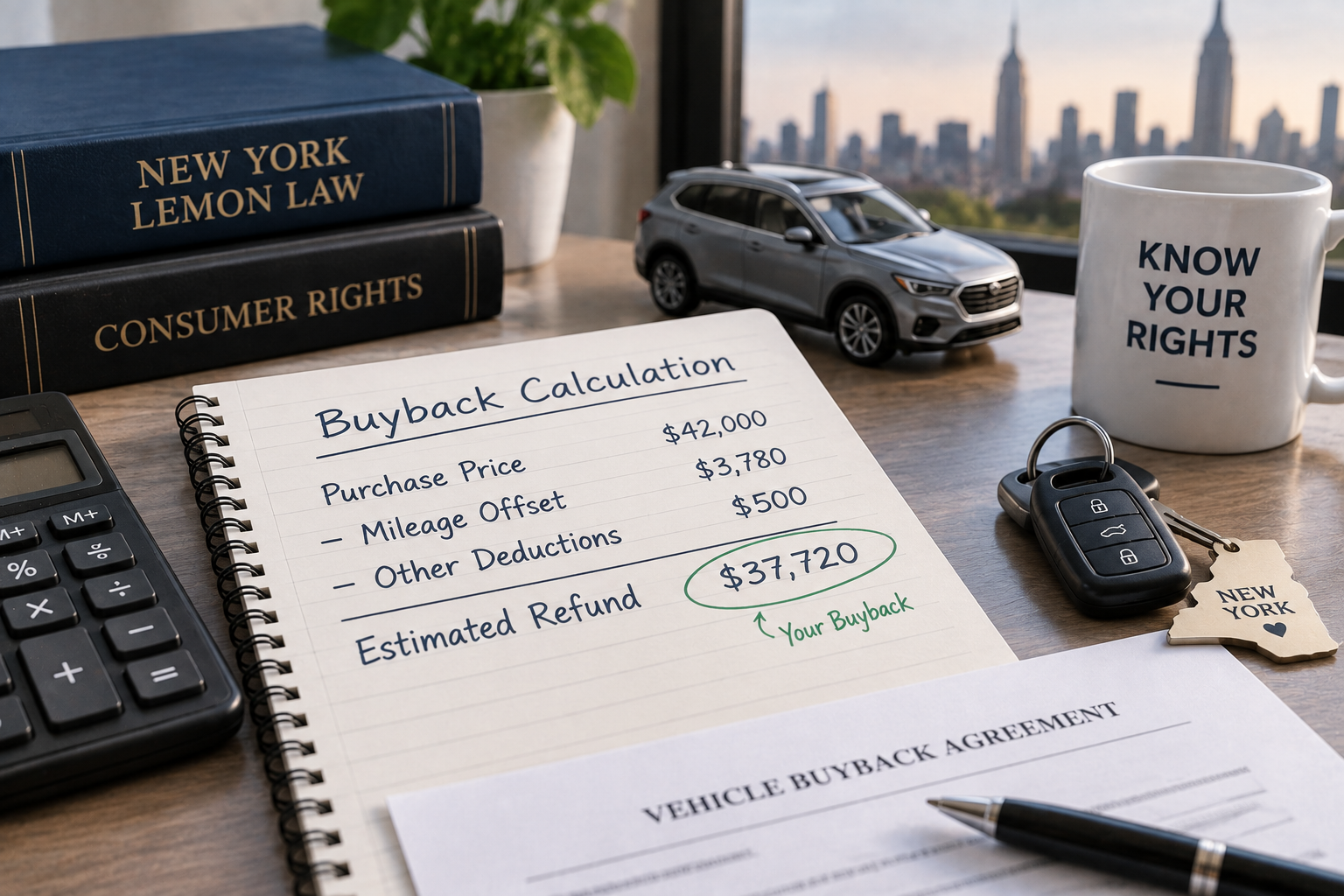
NY Lemon Law Refund Calculation: How the Buyback Math Works
Your new car has been back at the dealer four times for the same problem. Now you’re wondering what a buyback would actually be worth. The NY lemon law refund calculation follows a formula written into state law, and once you see the pieces, the math is simpler than most people expect.
This guide walks through each piece. That means what gets added in, what gets subtracted, how the mileage offset works, and how the numbers change for leased and used cars. For the basics on who qualifies in the first place, see our complete guide to New York lemon law.
What Goes Into a New York Lemon Law Refund?
New York’s new car lemon law is General Business Law § 198-a. It covers cars with a defect that shows up within the first 18,000 miles or two years after delivery, whichever comes first. When a car qualifies and the owner picks a refund instead of a replacement, the manufacturer has to take the car back and pay an amount set by the statute.
What gets added
- The full purchase price of the car (or the lease price for a leased car)
- Any trade-in allowance applied to the deal
- License fees, registration fees, and similar government charges
What gets subtracted
- An allowance for miles driven beyond the first 12,000
- A reasonable allowance for damage beyond normal wear, or for improvements
Notice what isn’t named. The statute says fees and charges “include but not be limited to” government charges, but it doesn’t specifically list towing bills, rental cars, or other incidental damages. Florida’s law does. A pending New York bill would add them, which we cover further down.
The NY Lemon Law Mileage Offset Formula
The biggest deduction in most buybacks is the mileage offset. New York calls it the “mileage deduction formula,” and it’s defined in § 198-a(a)(4). The key feature is simple. The first 12,000 miles are free, and you only pay for miles beyond that.
Mileage offset = (miles over 12,000 × purchase price) ÷ 100,000
Put another way, each mile past 12,000 costs one hundred-thousandth of the price. On a $40,000 car, that works out to 40 cents per mile.
If the car has fewer than 12,000 miles, the offset is zero. Say Derek in Albany buys a new pickup for $52,000 and the transmission starts slipping in month three. If his claim is resolved at 9,800 miles, there’s no mileage deduction at all.
Which odometer reading counts?
The statute refers to mileage in excess of 12,000 but doesn’t pin down the exact date the odometer is read. It’s commonly tied to the mileage when the car goes back. That detail can matter a lot when a dispute drags on for months and the car keeps getting driven.
Key takeaway: New York only charges for miles driven past 12,000. Many other states charge for every mile from day one.
Worked Example: A Lemon Law Buyback Calculation in Yonkers
Maria buys a new Subaru Forester from a dealer on Central Park Avenue in Yonkers. The price is $36,000. She trades in her old sedan for a $5,000 credit and finances the rest. Registration, title, and plate fees come to $310.
The engine keeps stalling on the Saw Mill River Parkway, and repeat repairs don’t fix it. By the time the manufacturer agrees to a buyback, the Forester has 19,400 miles on it and no damage beyond normal wear. Here’s how the math would generally run.
- Start with the full purchase price: $36,000. The $5,000 trade-in credit is already part of that number, so its value comes back to her in the refund.
- Add government fees: $36,000 plus $310 equals $36,310.
- Find the miles over 12,000: 19,400 minus 12,000 equals 7,400.
- Apply the formula: 7,400 × $36,000 ÷ 100,000 equals $2,664.
- Subtract the offset: $36,310 minus $2,664 equals $33,646.
So the manufacturer’s refund would be about $33,646. If Maria still owes money on her loan, part of that check goes to the lender first. The statute says refunds are paid to the consumer and any lienholder as their interests appear on DMV records. If she owes $22,000, the lender would get $22,000 and Maria would get $11,646.
Where Does the Sales Tax Come From?
This part surprises a lot of people. Under the new car statute, the sales tax isn’t part of the manufacturer’s refund formula. Instead, the manufacturer has to include an application form and a notice explaining that the sales tax on the refunded amount can be refunded by the New York State Department of Taxation and Finance.
That process comes from Tax Law § 1139(f). A request is timely if it’s made within three years of the date the consumer receives the refund from the manufacturer.
Watch the clock: The sales tax refund is a separate application with its own three-year window. It doesn’t happen automatically just because the manufacturer paid.
Leased Cars: How the Refund Gets Split
Leased cars are covered too, but the money is divided between the driver and the leasing company. The driver gets back what § 198-a calls the “capitalized cost.” In this statute, that means the deposit plus the lease payments already made, minus “service fees.” It’s not the same thing as the cap cost printed on a lease worksheet.
Service fees are mostly an interest charge figured at two points above the prime rate, plus any insurance or other costs the leasing company paid for the driver’s benefit. The leasing company receives the balance it’s owed. The lease ends on the date of the arbitrator’s decision, and no early termination penalty can be charged.
Say Kevin in Buffalo leases a new Chevy Equinox. He paid $2,500 at signing and has made 14 payments of $420, for $8,380 total. In a buyback, his share would be that $8,380 minus the service fees, which might run a few hundred dollars depending on the prime rate when he signed.
Used Car Refunds Under New York’s Used Car Lemon Law
Used cars bought from a dealer fall under a separate statute, General Business Law § 198-b. The refund math works differently in a few important ways.
- The dealer pays the refund, not the manufacturer.
- The refund includes the sales tax the buyer paid.
- There’s no mileage deduction formula. The refund can be reduced for damage beyond normal wear and adjusted for modifications that raise or lower the car’s value.
- If the dealer keeps a trade-in, it’s valued at NADA Used Car Guide wholesale value, adjusted for mileage and condition, instead of the number on the sales contract.
Say Tanya buys a used Toyota Camry with 45,000 miles from a lot in Rochester for $21,000. At that mileage, the law requires a dealer warranty of at least 60 days or 3,000 miles, whichever comes first. The dealer gives her $4,000 for her trade-in, so her cash difference is $17,000. The trade-in’s NADA wholesale value is only $3,200.
If Tanya qualifies for a refund and the dealer keeps the trade-in, her refund base would be $17,000 plus $3,200, or $20,200, plus the sales tax she paid. Her trade-in credit shrinks by $800 because of the wholesale valuation rule.
There’s one more wrinkle. If the refund isn’t enough to pay off the car loan, the dealer has to send written notice by registered or certified mail. The buyer then has 30 days to pay the lender the difference, or the dealer’s refund obligation ends.
How New York’s Math Compares to Florida and Federal Law
New York’s formula is friendlier to drivers than many states. Florida’s definition of a “reasonable offset for use” in Fla. Stat. § 681.102 counts every mile the consumer drove up to the settlement or arbitration hearing. It uses the base price of the car without taxes and fees, and it divides by 120,000.
Run Maria’s Forester through Florida’s formula: 19,400 × $36,000 ÷ 120,000 equals $5,820. That’s more than double New York’s $2,664 deduction for the same car and the same miles. Florida does add back collateral charges like sales tax and earned finance charges, plus incidental charges caused by the defect, so the final totals aren’t an apples-to-apples comparison.
Federal law is different again. The Magnuson-Moss Warranty Act sets refund-or-replace duties for products sold with a “full” warranty under 15 U.S.C. § 2304, but it has no mileage formula like New York’s. Most new car warranties are labeled “limited,” which is a big reason state lemon laws do most of the work.
A Pending Bill Could Change the NY Lemon Law Refund Formula
As of September 2026, the New York Legislature is considering Assembly Bill A8594A. It hasn’t passed either house or been signed, so it isn’t law. If it’s enacted as written, it would take effect one year after it becomes law.
- Free miles would rise from 12,000 to 24,000.
- The divisor would go from 100,000 to 200,000, which cuts the per-mile charge in half.
- Title fees, document fees, and incidental damages such as reasonable repair, towing, and rental car costs would be added to the refund.
- New car coverage would expand to 36,000 miles or three years.
Under that version, Maria’s 19,400 miles would fall under the free threshold, and her mileage offset would drop from $2,664 to zero. We’ll update this article if the bill moves.
What Happens When the Refund Amount Is Disputed?
Disagreements over the numbers often end up in arbitration. The Attorney General’s Lemon Law Arbitration Program lets consumers take a claim to an independent arbitrator for a filing fee. Manufacturers can also run their own informal programs. Under § 198-a(g), an arbitrator in a manufacturer’s program can’t reduce a refund award below the full purchase price plus fees, except for the deductions the statute allows.
After a consumer accepts an arbitrator’s decision, the manufacturer has up to 30 days to comply. Missing that deadline can add $25 per business day, up to $500. A court may also award reasonable attorney’s fees to a consumer who wins.
Any lawsuit under § 198-a has to be filed within four years of the car’s original delivery. These cases are commonly heard in New York State Supreme Court, which is the state’s main trial court despite its name. Court proceedings to challenge or confirm an AG program award go through Article 75 of the Civil Practice Law and Rules and must be brought in the county where the consumer lives or where the arbitration was held.
Common Questions About NY Lemon Law Refunds
Does a New York lemon law refund include my down payment?
The refund is based on the full purchase price, and a down payment is part of that price. So the down payment and trade-in value come back through the calculation, minus the allowed deductions. Any loan balance is paid to the lender first.
Do I pay anything for the first 12,000 miles?
Not under current New York law. The mileage offset only applies to miles driven past 12,000 on a new car.
Is loan interest refunded under New York lemon law?
Section 198-a doesn’t specifically list finance charges the way Florida’s law lists earned finance charges. Whether interest gets recovered is something that can come up in settlement talks or litigation, and it depends on the facts.
Is a lemon law buyback the same as a settlement?
Not always. A buyback, or repurchase, means the car goes back and the formula above sets the payment. A settlement can take other forms, like a cash payment where the owner keeps the car. Nothing stops a manufacturer from offering less than the formula, but the statute says any agreement that waives new car lemon law rights at purchase is void.
Does the refund formula change for a car bought outside New York?
The new car statute can cover a car that’s registered in New York even if it wasn’t bought here. The AG’s program also screens for cars purchased or registered in the state. Which state’s formula applies in a cross-border case can get complicated.
The Bottom Line
A New York lemon law refund starts with the full purchase price and government fees, then subtracts a mileage offset only for miles past 12,000. Sales tax comes back through a separate Tax Department application, leases split the money with the leasing company, and used cars follow their own rules under § 198-b. A pending bill could make the math even more favorable to drivers, so the formula is worth watching.
This article is for educational purposes only and is not legal advice. Reading it does not create an attorney-client relationship. For advice on your specific situation, consult a licensed attorney in your state.