Florida Lemon Law: Your Plain-English Guide to Rights, Deadlines, and Refunds
You bought a new car in Florida. Maybe it’s a Ford F-150 from a dealer on US-1, or a Honda Accord you picked up in Doral. Either way, you expected reliable transportation, not a vehicle that lives at the service center.
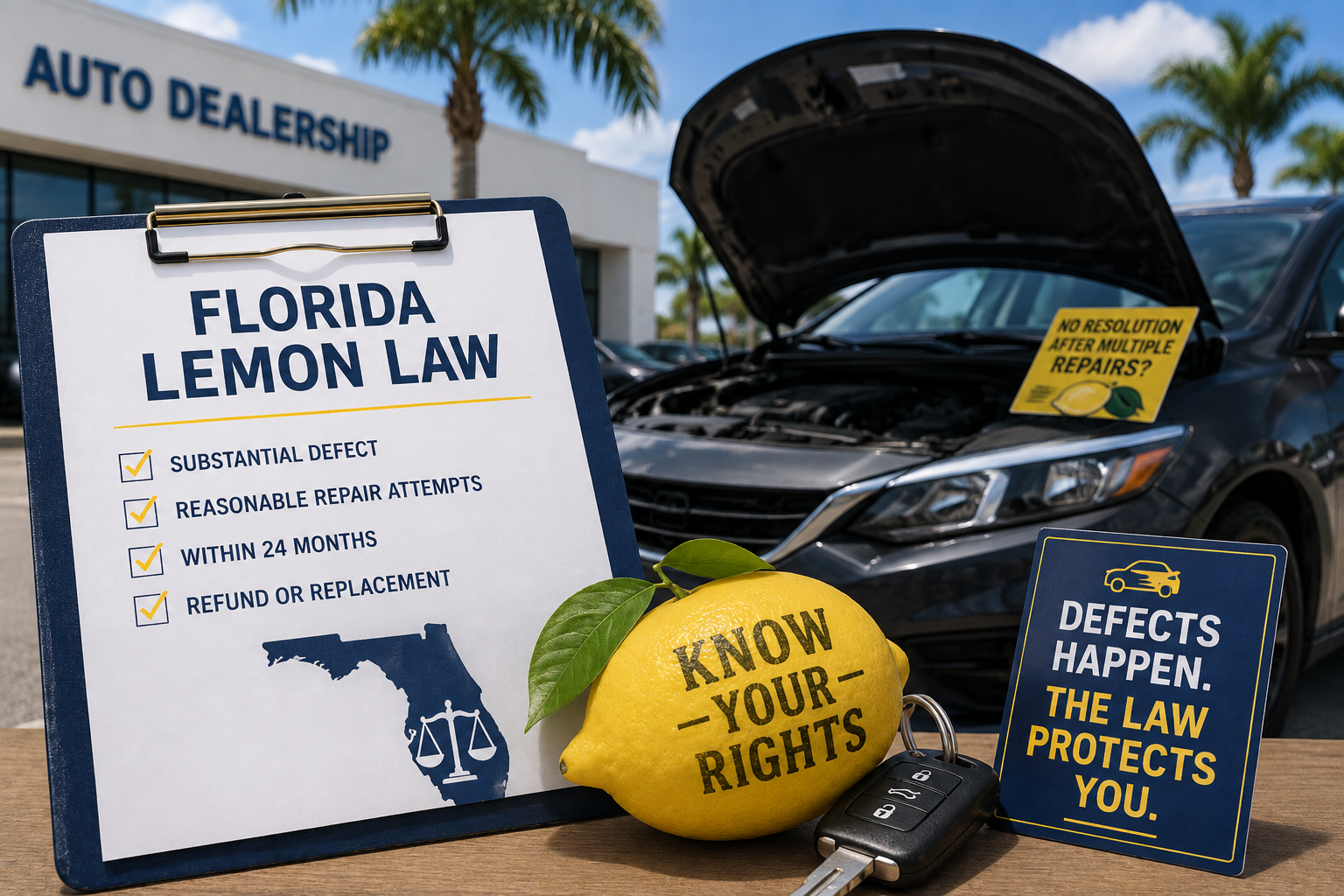
That’s where the Florida Lemon Law comes in. It’s a state statute designed to put pressure on manufacturers when a defect can’t be fixed after a fair shot. If your car qualifies, the law gives you a path to a refund or a replacement vehicle, not just another repair attempt.
This guide breaks down how the Florida Lemon Law actually works. We’ll cover what qualifies as a lemon, the 24-month “rights period,” what counts as a reasonable repair attempt, how state arbitration works, the rules on used cars, and the deadlines that can quietly kill a claim. No legalese. Just clear explanations with examples you can actually picture.
What Is the Florida Lemon Law?
The Florida Lemon Law isn’t just a nickname. The official statute is called the Motor Vehicle Warranty Enforcement Act, found at Chapter 681 of the Florida Statutes (sections 681.10 through 681.118). The Florida Legislature passed it in 1983 because car defects were creating real financial hardship for buyers, and existing remedies under the Uniform Commercial Code weren’t doing enough.
The law’s basic idea is simple. If you buy or lease a new vehicle and it has a substantial defect the manufacturer can’t fix after a reasonable number of tries, you shouldn’t be stuck with it. The statute gives you two main remedies. Either the manufacturer takes the car back and refunds your money, or they give you a comparable replacement vehicle.
The law uses the word “nonconformity” instead of “defect.” Under Fla. Stat. § 681.102, a nonconformity is a defect or condition that substantially impairs the use, value, or safety of the motor vehicle. A loose cup holder isn’t a nonconformity. A transmission that jerks unpredictably at highway speed almost certainly is.
One thing to understand from the start. The Florida Lemon Law puts the obligation on the manufacturer, not the dealer. The dealer is treated as the manufacturer’s authorized service agent. So when you read about notice requirements and refund obligations, the entity on the hook is usually Ford, Toyota, or General Motors, not the dealership where you signed the paperwork.
What Vehicles Does the Florida Lemon Law Cover?
This is where a lot of people get tripped up. The Florida Lemon Law has a specific definition of “motor vehicle” and it leaves some categories out.
The law covers new vehicles that are sold, transferred, or leased in Florida and used primarily for personal, family, or household purposes. That includes:
- New cars
- New trucks (with a weight limit, more on that below)
- Leased new vehicles, as long as they came with a manufacturer’s warranty
- Demonstrator vehicles (the “demo” cars dealers let people test drive)
- The chassis and self-propelled components of recreational vehicles
What the law specifically excludes under Fla. Stat. § 681.102:
- Motorcycles
- Mopeds
- Off-road vehicles
- Trucks with a gross vehicle weight over 10,000 pounds
- The living facilities portion of recreational vehicles
So if you bought a heavy-duty work truck for your construction business in Tampa, and it weighs over 10,000 pounds, the Florida Lemon Law won’t help. If you bought a motorhome, the engine and chassis might be covered but the living quarters aren’t. These distinctions matter, and they’re the kind of detail that often surprises consumers.
Here’s a quick example. Say Maria buys a new Toyota RAV4 from a dealer in Orlando and uses it to commute to work. Six weeks in, the transmission starts slipping. That vehicle is squarely covered. Now imagine her neighbor, Dave, buys a used Ducati motorcycle from the same dealer. Even if the bike has a serious defect, the Florida Lemon Law doesn’t apply to motorcycles at all. Dave would need to look at the federal Magnuson-Moss Warranty Act and his motorcycle’s written warranty, which we’ll get into later.
The 24-Month Florida Lemon Law Rights Period
The Florida Lemon Law has a window. It’s called the Lemon Law rights period, and it lasts 24 months from the date the vehicle was delivered to you. That’s the most important date in your file.
Within those 24 months, you need to do two things to set up a potential claim. First, you have to actually report the defect to the manufacturer or its authorized service agent. Second, the manufacturer needs to fail to fix it after a reasonable number of attempts.
There’s no mileage cap built into the statute the way some states have. So in theory, a high-mileage commuter who drives 30,000 miles in a year could still be within the rights period at month 23. What matters is the calendar, not the odometer. Mileage still matters as evidence of how the vehicle has been used and when problems started, but it isn’t the disqualifying factor.
A common point of confusion. The 24-month rights period is not the deadline to file a lawsuit. It’s the window during which the defect has to surface and be reported. The actual statute of limitations is separate, and we’ll cover that next.
What Counts as a “Reasonable Number of Repair Attempts”
The Florida Lemon Law doesn’t say a manufacturer has to fix every problem on the first try. The law gives them a reasonable number of attempts. The statute, at Fla. Stat. § 681.104, creates a legal presumption that the manufacturer has had a reasonable number of attempts when one of two things happens.
Path One: Three Repair Attempts for the Same Defect
You bring the vehicle in three separate times for the same nonconformity. The manufacturer or its authorized service agent has had a fair shot. Some sources also reference a fourth-attempt rule for serious defects after written notice, but the core trigger is the three-strikes pattern for the same recurring issue.
Path Two: 30 Cumulative Days Out of Service
If the vehicle has been out of service for repair for a cumulative total of 30 or more days during the Lemon Law rights period, the statute creates a presumption that the manufacturer has had a reasonable number of attempts to conform the vehicle to the warranty. Important detail. After 15 cumulative days out of service, you generally need to send the manufacturer written notice. That notice is what triggers the manufacturer’s last chance to perform a final repair.
Let’s make this concrete. Picture Jamal, who buys a new Chevy Silverado from a dealer in Jacksonville. The check engine light keeps coming on. He brings it in to the dealership in March, again in May, and again in August. Three repair attempts for the same problem, all during the 24-month rights period. Under the Florida Lemon Law, that pattern creates a presumption that Chevrolet has had a reasonable number of attempts to fix the issue.
Or picture Linda from Cape Coral. Her new SUV has been sitting at the service center off and on for transmission work. By month nine, she totals it up and realizes the vehicle has been at the shop for 32 cumulative days. After she sent the 15-day written notice and the manufacturer didn’t fix it, the 30-day total triggers the presumption.
Whether the actual claim succeeds depends on documentation, the nature of the defect, and other factors. But the statutory presumption is the legal lever that moves the case forward.
What Defects Qualify as a “Nonconformity”
Not every quirk in a new car is a lemon. The statute requires the defect to substantially impair the vehicle’s use, value, or safety.
Defects that typically do qualify include:
- Transmission failures or persistent slipping
- Engine stalling or sudden power loss
- Brake system failures
- Steering defects
- Persistent electrical failures that affect operation
- Recurring safety system malfunctions, like airbags or anti-lock brakes
Defects that typically don’t qualify on their own include:
- Cosmetic issues like paint imperfections or interior trim
- Squeaks or minor rattles that don’t affect operation
- Aftermarket parts the manufacturer didn’t install
- Damage from accidents, abuse, neglect, or unauthorized modifications
The statute specifically excludes defects caused by accident, abuse, neglect, or modifications not authorized by the manufacturer. If you lifted your truck on enormous tires and the suspension fails, that’s not the manufacturer’s problem. If your engine fails and you skipped every recommended oil change, you have a hard road ahead.
How the Final Repair Attempt and Manufacturer Notice Work
The Florida Lemon Law doesn’t let you spring a claim on the manufacturer by surprise. The statute requires written notice to the manufacturer (not just the dealer) so the manufacturer has a final chance to fix the problem.
The state provides a form called the Motor Vehicle Defect Notification, sometimes referred to as the MVDN. You send it by registered or express mail to the manufacturer’s address listed in your owner’s manual or warranty booklet. Once the manufacturer receives that notice, it generally has a window (typically 10 days) to direct the vehicle to an authorized service agent for a final repair attempt. The service agent then has a reasonable amount of time, usually around 10 more days, to conform the vehicle to the warranty.
If the final repair attempt fails, you’ve now built the foundation for the next step. State arbitration.
The Florida New Motor Vehicle Arbitration Board
Unlike some states, Florida funnels most lemon law disputes through a state-administered arbitration process before they get to court. The body that handles this is the Florida New Motor Vehicle Arbitration Board, administered by the Florida Department of Legal Affairs (part of the Attorney General’s office).
There’s a wrinkle worth understanding. If the manufacturer has a “certified” informal dispute settlement procedure (think of it as the manufacturer’s own complaint process), you may be required to use that first before the state board will hear your case. The catch is that you only have 60 days after the Lemon Law rights period expires to file with the certified procedure. Miss that, and you can lose the right to state arbitration entirely.
If the manufacturer doesn’t have a certified procedure, or if you’ve gone through it and aren’t satisfied, you can file a request for state arbitration with the Department of Legal Affairs. The board reviews your case, holds a hearing, and issues a decision. The manufacturer has 40 days to comply with a decision in your favor (whether refund or replacement). If they don’t, the statute allows for fines up to $1,000 per day, capped at twice the purchase price of the vehicle.
Arbitration decisions can be appealed to the circuit court by either side, and the appeal is heard as a trial de novo. That means the circuit court doesn’t just review what the board did, it hears the whole case fresh.
Florida Lemon Law Refund and Buyback Calculation
If you win a buyback under the Florida Lemon Law, the manufacturer doesn’t just hand you the original sticker price. The statute spells out what’s included and what gets deducted.
What you generally get back:
- The full purchase price of the vehicle, including any trade-in allowance
- Collateral charges (sales tax, registration fees, title fees, financing charges, and similar costs)
- Incidental damages tied to the defect, like rental car expenses or tow charges
What gets deducted:
- A reasonable allowance for the consumer’s use of the vehicle
That “use offset” is calculated under the statute based on the mileage on the vehicle at the time of the first repair attempt for the nonconformity. The formula uses 120,000 miles as the assumed useful life. So if your car had 12,000 miles when you first reported the defect, the offset would be roughly 12,000 divided by 120,000, or 10 percent of the purchase price. The exact math gets technical, but that’s the rough shape of it.
If you choose a replacement vehicle instead of a refund, the manufacturer must provide a comparable new vehicle acceptable to you, with the same mileage offset applied. You don’t have to take the replacement. The choice is yours.
Here’s an example. Suppose Tom bought a 2025 Hyundai Tucson in Miami for $32,000 plus tax. The transmission first showed signs of trouble at 8,000 miles. After three failed repair attempts and a successful arbitration, Hyundai owes him a refund. The reasonable use offset would be roughly 8,000 divided by 120,000 times the purchase price, which is around $2,133. Add back collateral charges like sales tax and registration, subtract the offset, and Tom is looking at something close to a full refund of his out-of-pocket loss. Real numbers will vary based on the specific facts.
Does the Florida Lemon Law Apply to Used Cars?
Short answer. Usually no, with one important exception.
Florida’s main lemon law (Chapter 681) is built for new vehicles, leased new vehicles, and demonstrator vehicles. Used cars sitting on a lot at a buy-here-pay-here in Lakeland generally don’t qualify under the statute.
The exception that matters. If you buy a used car that is still under the original manufacturer’s warranty, and a substantial defect appears within the 24-month Lemon Law rights period (measured from the original delivery date, not your purchase date), you may have rights under the statute. The clock doesn’t reset when the vehicle changes hands. So a one-year-old, low-mileage car bought from a private seller could still be within its rights period if the timing works.
For used car defects outside the statute, Florida buyers usually have two other tools.
The Federal Magnuson-Moss Warranty Act
This is the federal warranty law, and it applies to any consumer product covered by a written warranty. That includes used cars sold with any kind of written warranty, including certified pre-owned vehicles. The Magnuson-Moss Act has a longer window for filing suit, typically up to four or five years depending on the warranty type. It’s a separate body of law from the Florida Lemon Law, but it often runs alongside lemon claims, especially for used vehicles.
Florida’s Used Motor Vehicle Warranty Law
Florida has a separate statute requiring dealers to provide certain disclosures and minimum warranty terms on used vehicles, though the protections are narrower than Chapter 681. There are also rules about “as is” sales and required buyer’s guides under federal regulations.
So if you’re in a used-car situation, the Florida Lemon Law isn’t your only option. It’s just the strongest one when it applies.
How the Florida Lemon Law Differs From Federal Law
A lot of people think there’s a “federal lemon law” that overrides state law. There isn’t, exactly. What exists at the federal level is the Magnuson-Moss Warranty Act, which deals with warranties on consumer products generally.
The two laws work side-by-side. Chapter 681 is faster, has clearer presumptions, and forces arbitration through a state-run process. Magnuson-Moss is broader, covers used cars more readily, and has a longer statute of limitations. Many cases involve both. Lawyers who handle these matters routinely plead claims under both statutes when the facts support it.
The other important difference. The Florida Lemon Law allows you to recover attorney’s fees from the manufacturer if you prevail under the statute. Magnuson-Moss also has a fee-shifting provision. This is a significant reason why these cases are economically viable for consumers who couldn’t otherwise afford to fight a major automaker.
Statute of Limitations: The Deadline That Quietly Kills Claims
Under Fla. Stat. § 681.112, an action under the Florida Lemon Law must be commenced within one year after the expiration of the Lemon Law rights period. So if your rights period runs out 24 months after delivery, you have one more year, roughly through month 36, to file suit. The clock can be tolled (paused) if you’ve gone through arbitration, but you can’t simply sit on the claim forever.
This is one of the most common ways legitimate claims get lost. The vehicle has problems in months 18 through 24, the owner tries to work it out with the dealer for another year, and by the time they think about a lawyer, the deadline is closing in or already passed.
If your vehicle is having serious problems and you’re approaching the end of the rights period, that calendar should be on your mind every week.
How Florida Lemon Law Cases Are Handled in Court
If state arbitration isn’t an option, or if either side appeals an arbitration decision, the case ends up in Florida’s circuit court system. Florida courts are organized into 20 judicial circuits, each covering one or more counties. For example, the 11th Judicial Circuit covers Miami-Dade County, the 17th covers Broward, the 13th covers Hillsborough (Tampa), and the 9th covers Orange and Osceola (Orlando).
Most lemon law cases that reach court are filed in the circuit court of the county where the consumer lives or where the vehicle was purchased. If the case is appealed from arbitration, it’s heard as a trial de novo, meaning the circuit court hears the evidence as if for the first time.
You don’t typically see lemon law cases in Florida county court, even though county court has jurisdiction over smaller civil claims, because the typical refund amount in a new car case exceeds the county court limit, and because the statute contemplates the circuit court as the appeal venue from arbitration.
Common Misconceptions About the Florida Lemon Law
“Florida has a 30-day return policy on new cars.”
No. There’s no general 30-day window where you can simply bring a new car back. The 30-day reference in the statute is about cumulative days out of service for repair, which creates a presumption under § 681.104. That’s a very different thing.
“If the dealer can’t fix it, I get to keep the car for free.”
No. The remedy is a refund or replacement, not free vehicle ownership. The manufacturer takes the car back (less the use offset) or gives you a comparable replacement.
“Used cars are never covered.”
Mostly true, but not always. If a used vehicle is still inside the original 24-month Lemon Law rights period and still under the manufacturer’s warranty, the statute may apply. And federal Magnuson-Moss protections often cover used vehicles separately.
“I can skip arbitration and go straight to court.”
Sometimes, but not always. If the manufacturer has a certified informal dispute settlement procedure, you generally have to use it first. And state arbitration through the Florida New Motor Vehicle Arbitration Board is built into the process. Lawyers can advise on the best route, but skipping required steps can sink a claim.
“Attorney’s fees will eat up my recovery.”
The Florida Lemon Law has a fee-shifting provision. If you prevail, the manufacturer is responsible for reasonable attorney’s fees. The same is generally true under Magnuson-Moss. This is one of the rare areas of consumer law where the playing field is structured so consumers can actually afford to fight.
Frequently Asked Questions About Florida Lemon Law
What qualifies as a lemon in Florida?
A new motor vehicle qualifies under Chapter 681 if it has a nonconformity (a defect that substantially impairs use, value, or safety) and the manufacturer fails to fix it after a reasonable number of attempts within the 24-month Lemon Law rights period.
How long do I have to file a Florida Lemon Law claim?
The defect has to be reported within the 24-month rights period from delivery. A lawsuit under the statute must be filed within one year after that rights period expires. Arbitration deadlines are shorter, especially the 60-day window for certified manufacturer procedures.
Does the Florida Lemon Law cover leased cars?
Yes, as long as the vehicle is leased new and came with a manufacturer’s warranty. The same 24-month rights period applies.
Can I get my money back under the Florida Lemon Law?
Yes. The remedies are a refund (purchase price plus collateral charges minus a reasonable use offset) or a comparable replacement vehicle. The consumer typically gets to choose which.
Do I need an attorney to file a Florida Lemon Law claim?
The statute doesn’t require one. Many people start with the manufacturer’s informal procedure or state arbitration on their own. That said, the law has a fee-shifting provision that makes hiring an attorney economically realistic, since the manufacturer pays the consumer’s fees if the consumer prevails.
Does Florida’s Lemon Law apply to trucks?
It applies to trucks under 10,000 pounds gross vehicle weight used primarily for personal, family, or household purposes. Heavy-duty trucks over that limit, and trucks used primarily for commercial purposes, fall outside the statute.
Wrapping Up
The Florida Lemon Law is one of the stronger consumer protection statutes on the books. It puts real pressure on manufacturers, gives consumers two clear remedies, and shifts attorney’s fees so the math works for ordinary buyers. But the law also has hard deadlines, narrow definitions, and procedural steps that can easily be missed by someone trying to handle a defective vehicle on their own.
The most important takeaway is to act inside the 24-month window. Keep every repair order. Note every day the vehicle is in the shop. Send written notice to the manufacturer when the pattern is clear. Whether your situation involves a brand-new SUV in Orlando, a leased truck in Jacksonville, or a used car still under the original warranty in Miami, the timeline drives almost everything.
This article is for educational purposes only and is not legal advice. Reading it does not create an attorney-client relationship. For advice on your specific situation, consult a licensed attorney in your state.