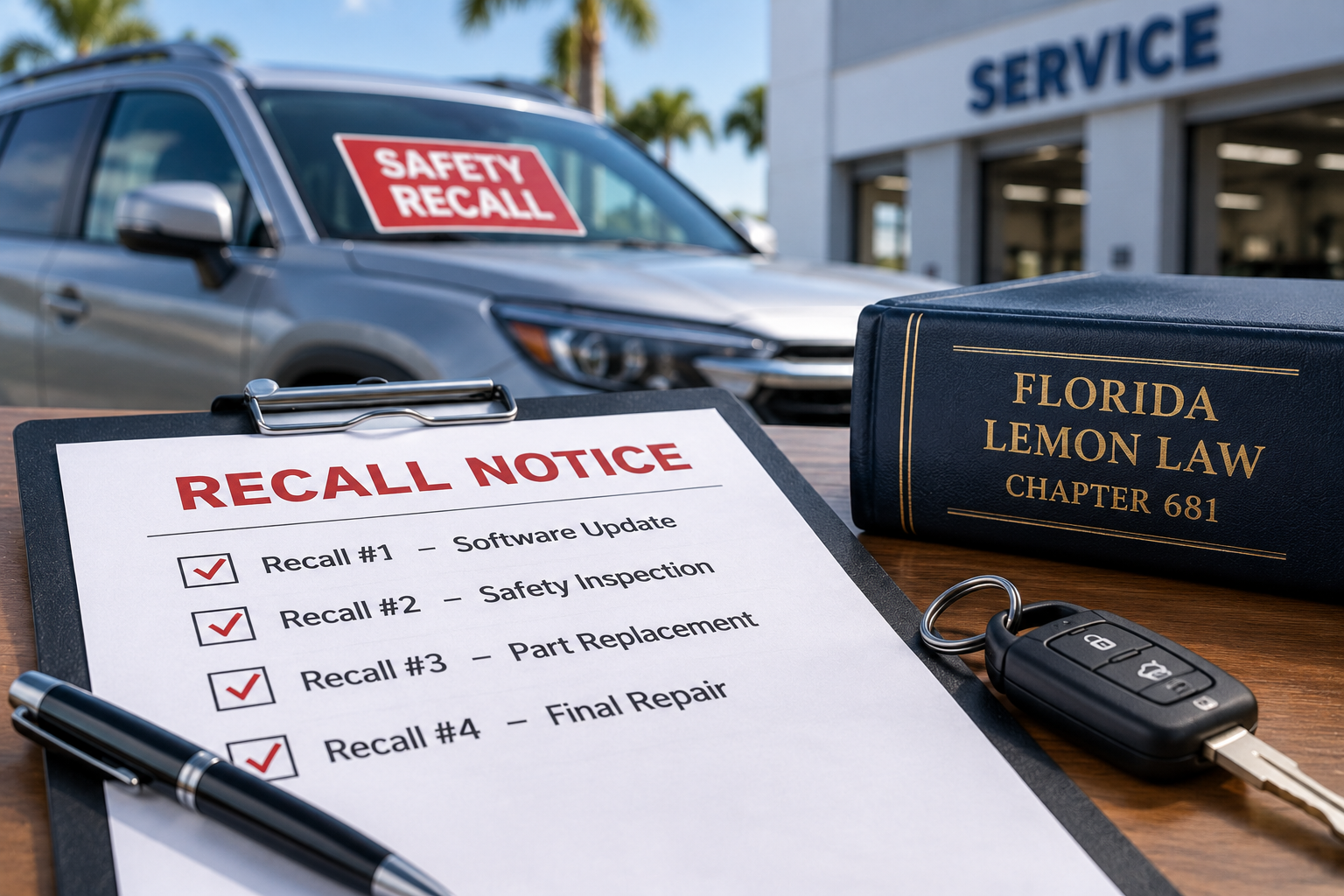
How Many Recalls Before Lemon Law Applies in Florida?
You open the mailbox and find another recall notice for your new car. It’s the second one this year. Maybe the third. At some point you start wondering how many recalls before lemon law protection kicks in.
The short answer surprises most people. In Florida, there is no magic number of recalls. A recall on its own doesn’t make a car a lemon, and it doesn’t restart the 24-month clock. But a recall repair can still matter a lot, depending on what the defect is and whether the dealer actually fixes it.
This guide walks through how recalls fit into Florida’s lemon law, in plain English. For the full picture of how the law works from start to finish, see our plain-English guide to the Florida Lemon Law.
How Many Recalls Before Lemon Law Protection Applies?
Florida’s lemon law is officially called the Motor Vehicle Warranty Enforcement Act. It lives in Chapter 681 of the Florida Statutes. If you read the whole chapter, you won’t find the word “recall” anywhere.
That’s the key point. The law doesn’t count recalls. It counts repair attempts and days out of service for a defect that seriously affects the car. A recall is simply the manufacturer’s announcement that a defect exists. What the law cares about is what happens to your specific car after that.
Key takeaway: Five recalls for five different minor issues, each fixed on the first try, generally won’t make a car a lemon. One recall defect that the dealer fails to fix again and again might.
What Florida’s Lemon Law Actually Counts
To see where a recall fits, it helps to know the three building blocks the law uses. Each one comes straight from the statute.
The “Nonconformity” Test
The law only covers a “nonconformity.” Under Fla. Stat. § 681.102, that means a defect or condition that substantially impairs the use, value, or safety of the vehicle. Damage from an accident, abuse, neglect, or aftermarket changes doesn’t count.
Many safety recalls involve problems like stalling, brake issues, or airbags. Those can easily touch “safety.” But some recalls are for things like a mislabeled sticker or a warning chime that doesn’t sound. A defect that small may not meet the “substantially impairs” standard, and the manufacturer can raise that as a defense under section 681.104(4).
Three Repair Attempts Plus a Final Chance
Under Fla. Stat. § 681.104(3)(a), the law presumes the manufacturer had a reasonable number of repair attempts when the same nonconformity has been repaired at least three times, the manufacturer got a final repair attempt, and the problem still exists. All of this has to happen during the Lemon Law rights period.
The final attempt has its own rules. After the third try, section 681.104(1)(a) calls for written notice to the manufacturer by registered or express mail. The manufacturer then has 10 days to respond, and 10 days after the car is delivered to its chosen repair shop to fix it. If it doesn’t respond or repair in time, the final-attempt requirement drops away.
30 Days Out of Service
The second path is time. Under section 681.104(3)(b), the presumption also applies when the car has been out of service for repair of one or more nonconformities for a total of 30 or more days. The days don’t have to be in a row, and the problems don’t have to be the same. Routine maintenance doesn’t count.
There’s a notice step here too. Once the car hits 15 days out of service, section 681.104(1)(b) calls for written notice to the manufacturer by registered or express mail. The manufacturer must then get at least one chance to inspect or repair the car.
When a Recall Repair Counts Toward Florida’s Repair Attempts
Here’s where recalls come back in. A trip to the dealer for recall work is still a trip to the manufacturer’s authorized service agent to fix a defect. If that defect is a nonconformity, and it’s the same problem you’ve already brought the car in for, the visit can generally be argued as a repair attempt.
Say Tyrone buys a new Nissan Rogue in Jacksonville. Twice in his first six months, the engine stalls at red lights on Beach Boulevard, and twice the dealer can’t find the cause. Then the manufacturer issues a recall for a fuel pump that can cause stalling. Tyrone brings the car in for the recall repair, and a week later it stalls again. That recall visit looks a lot like a third attempt at the same stalling problem.
Now compare Brianna in Orlando. Her new Honda Accord gets three recall notices in a year: one for a software update to the backup camera, one for a trunk latch bolt, and one for a seat belt warning label. Each is fixed on the first visit. That’s three recalls, but three different issues that were each resolved. On those facts, the three-attempt path generally wouldn’t be met.
Heads up: Chapter 681 doesn’t directly address recall visits. Whether a particular recall repair counts as an attempt is decided case by case, often by the state arbitration board. What the repair orders say can make a big difference.
What About a Recall With No Fix Available Yet?
Sometimes a manufacturer announces a recall before parts are ready. If the dealer keeps the car because it’s unsafe to drive, those days may count toward the 30-day total, since the car is out of service because of the defect. If the car stays in your driveway waiting for parts, the answer is less clear. The statute counts days out of service “by reason of repair,” and a car that was never dropped off is harder to fit into that language.
Picture Ana in Hialeah. Her new SUV gets a do-not-drive recall for a fuel leak in month 11. The dealer tows it in and holds it for 34 days waiting on parts. Those 34 days in the shop are the kind of time section 681.104(3)(b) is built to capture, as long as the notice steps are followed.
Does a Recall Restart the 24-Month Lemon Law Period?
No. Under section 681.102, the Lemon Law rights period ends 24 months after the car was first delivered to a consumer. It’s a fixed window tied to the delivery date. Nothing in the chapter pauses or restarts it when a recall is announced.
There is one related rule worth knowing. Under Fla. Stat. § 681.103(1), if you first report a problem during the 24 months, the manufacturer still has to fix it even if the repair happens after the period ends. But that same section says it doesn’t extend the rights period or the time to file a claim.
24 months + 60 days: Under Fla. Stat. § 681.109(4), a request for arbitration before the state board generally has to be made no later than 60 days after the rights period ends, or 30 days after a manufacturer’s certified program finishes, whichever is later.
So think about Kevin in Fort Myers. A recall comes out in month 26 for a transmission defect. If Kevin never reported a transmission problem during his first 24 months, the recall alone doesn’t open a new lemon law window for him. The recall repair itself is still free under federal law, which we’ll cover next.
Federal Recall Remedy vs. Florida Lemon Law Remedy
Recalls are a federal system run through the National Highway Traffic Safety Administration. Under 49 U.S.C. § 30120, the manufacturer has to remedy a recalled defect free of charge. But the manufacturer picks the remedy. It can repair the car, replace it, or refund the price minus a reasonable allowance for depreciation. In practice, most recalls end in a repair.
Florida’s lemon law works differently. When a car can’t be fixed after a reasonable number of attempts, section 681.104(2)(a) requires the manufacturer to repurchase or replace it within 40 days. And the consumer, not the manufacturer, has an unconditional right to choose a refund over a replacement. A refund is reduced by a “reasonable offset for use,” which is a mileage-based formula spelled out in section 681.102.
The two systems also cover different cars. A federal recall applies to every affected vehicle, new or used. Florida’s lemon law covers new vehicles, demonstrators, and certain leases sold in Florida, plus people who acquire the car during the original 24-month window. The statute also says it doesn’t limit rights you may have under other laws, so a recall and a lemon law claim can exist side by side.
Some states give a shorter path when a defect could cause death or serious injury, counting fewer repair attempts. Florida’s statute has no special shortcut for safety defects. A serious safety recall still runs through the same three-attempt and 30-day rules.
A Hypothetical Walkthrough: Denise’s SUV in Tampa
Denise buys a new Toyota Highlander from a dealer on Dale Mabry Highway in Tampa. The price is $44,000. Here’s how a recall could play into her situation, step by step.
In month 4, her brakes feel soft and the warning light flickers. The dealer bleeds the lines. In month 7, it happens again, and the dealer replaces a sensor. In month 9, the manufacturer recalls her model for a brake booster defect that causes the same symptoms. The dealer does the recall repair, and the repair order notes “customer reports soft brake pedal.”
Two weeks later, the soft pedal is back. On these facts, Denise’s car has arguably had three repair attempts for the same nonconformity, and one of them was the recall. The next step under the statute would be written notice to the manufacturer by registered or express mail, giving it a final chance to fix the brakes.
If the final repair fails, the presumption kicks in. If Denise had driven 12,000 miles by the time of settlement or hearing, the offset formula would work out to roughly 12,000 times $44,000, divided by 120,000. That’s about $4,400 off her refund, before collateral and incidental charges are added back in. (The formula uses the base price on the purchase invoice, not taxes or dealer fees, so the real figure depends on her paperwork.)
How the Florida Process Generally Works
Florida routes most lemon law disputes through a state arbitration program before any lawsuit. Here’s the general order of events under Chapter 681.
- The defect is reported to the manufacturer or dealer during the 24-month rights period.
- The repair attempts or days out of service add up, with the written notices the statute describes.
- If the manufacturer has a state-certified dispute program, the claim generally goes there first.
- The dispute goes to the Florida Attorney General’s Lemon Law Arbitration Division, which screens it for the Florida New Motor Vehicle Arbitration Board.
- The board hears the case within 40 days and decides within 60 days of approval, under Fla. Stat. § 681.1095(6).
- Either side can appeal to circuit court within 30 days of receiving the decision.
Under section 681.1095(4), a consumer generally must go through the Attorney General’s office before filing a lawsuit on these claims. Section 681.112 then sets a one-year window for filing suit, measured from the end of the rights period or from the final action of the arbitration process.
Paperwork matters throughout. Section 681.103(4) requires the dealer to hand over an itemized repair order every time the car comes back, showing the reported problem, the work done, the dates, and the mileage. For recall visits, those orders are often what shows whether the recall fixed the same problem you’d already complained about.
Common Questions About Recalls and Florida Lemon Law
Does a recall automatically make my car a lemon?
No. Millions of cars are recalled every year, and most are fixed on the first try. Florida’s law looks at whether a substantial defect survived a reasonable number of repair attempts, not at how many recall notices went out.
How many repair attempts before lemon law applies in Florida?
The statute presumes a reasonable number of attempts after three repairs of the same nonconformity plus a final attempt by the manufacturer, or after 30 total days out of service. Both have to happen within the first 24 months.
Can I get a refund just because my car was recalled?
Under federal recall law, the manufacturer decides whether to repair, replace, or refund, and it usually repairs. A refund you get to choose comes from the lemon law, which has its own requirements.
Does Florida lemon law cover recalls on used cars?
Florida’s lemon law is built for new vehicles. A used car can still be covered if it changed hands during the original owner’s 24-month window. Recall repairs, though, are free on used cars too, and you can look up open recalls by VIN or plate at NHTSA’s recall lookup tool.
Do recall repairs count toward the 30 days out of service?
They can, if the recall defect is a nonconformity and the car was actually in the shop for that repair. Time the car spends parked at home waiting for parts is a harder argument.
The Bottom Line
There’s no set number of recalls that turns a car into a lemon in Florida. What counts is whether a substantial defect keeps coming back after repeated repairs, or keeps the car in the shop for 30 days, all within the fixed 24-month window. A recall repair can be one of those attempts when it targets the same problem.
This article is for educational purposes only and is not legal advice. Reading it does not create an attorney-client relationship. For advice on your specific situation, consult a licensed attorney in your state.