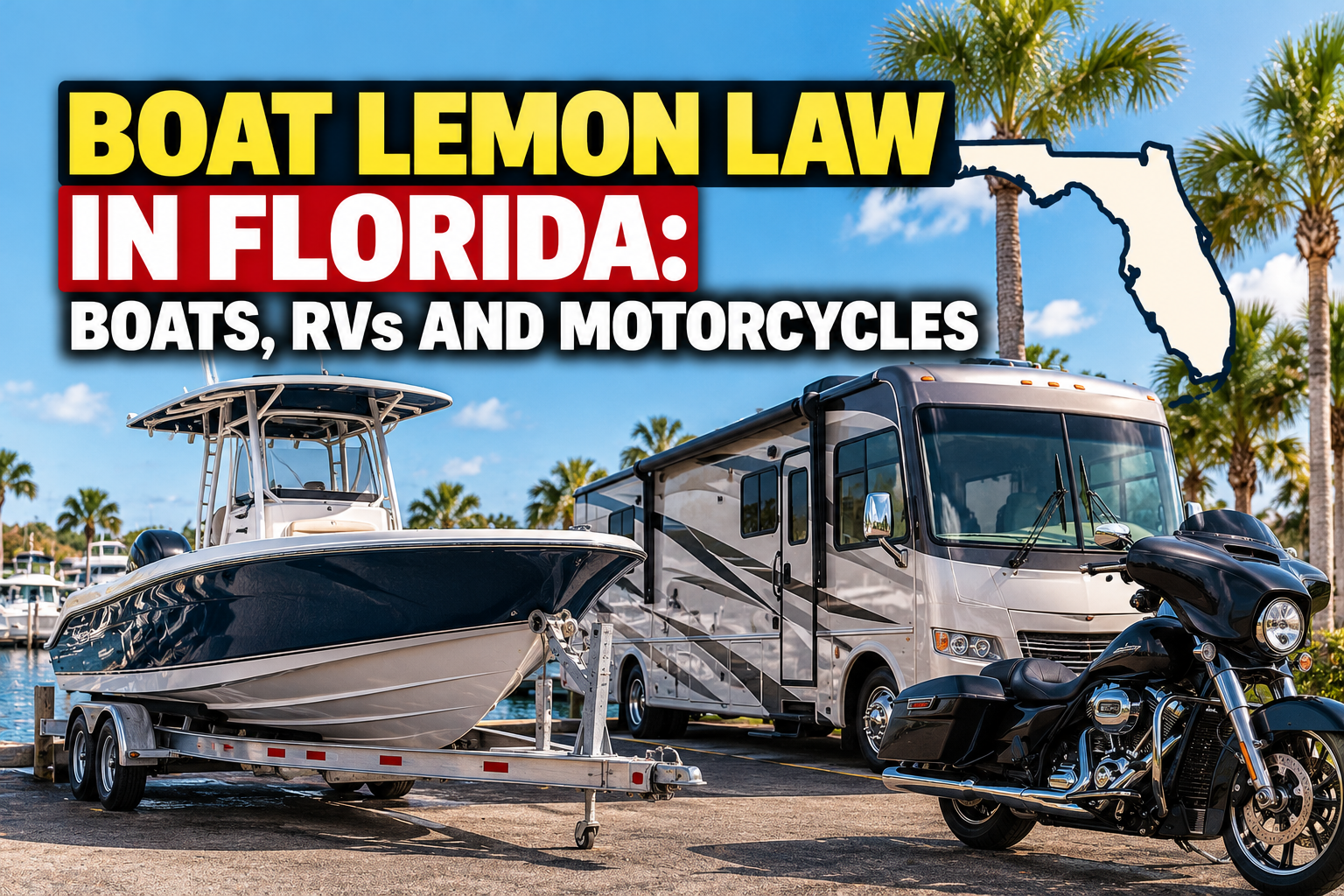
Boat Lemon Law in Florida: Boats, RVs and Motorcycles
Florida has more registered recreational boats than any other state, and RVs fill campgrounds from the Keys to the Panhandle. So it surprises a lot of people to learn there’s no boat lemon law in Florida at all. The state’s lemon law was written for cars and trucks, and it leaves several popular vehicles out on purpose.
This guide covers what Florida’s lemon law excludes, why RVs are only partly covered, how the separate RV program works, and what other laws step in when a boat, motorcycle, or camper turns out to be a lemon. For how the law works on regular passenger cars, start with our plain-English guide to Florida’s lemon law.
Is There a Boat Lemon Law in Florida?
No. Florida’s lemon law only applies to a “motor vehicle,” and the statute defines that as a vehicle sold in the state to transport persons or property. Boats aren’t part of that definition, and no separate Florida boat lemon law exists.
That doesn’t mean a defective boat leaves the buyer with nothing. It means the rules come from somewhere else, mainly federal warranty law and Florida’s general sales law. We’ll walk through those below.
Key takeaway: Florida’s lemon law doesn’t cover boats, motorcycles, mopeds, e-bikes, off-road vehicles, or the living quarters of an RV. Other warranty laws may still apply to those purchases.
Which Vehicles Does Florida’s Lemon Law Exclude?
The definition of “motor vehicle” in Fla. Stat. § 681.102 covers new vehicles, demonstrators, and certain leased vehicles sold in Florida. It also includes recreational vehicles. Then it carves out a specific list of exceptions.
Under the statute, these aren’t covered:
- Vehicles that run only on tracks
- Off-road vehicles
- Trucks over 10,000 pounds gross vehicle weight
- Motorcycles and mopeds
- Electric bicycles
- The living facilities of recreational vehicles
Boats never make the list because they were never in the definition to begin with. The Florida Attorney General’s “Is My Vehicle Covered?” page lays out the same exclusions, along with the rule that vehicles bought for resale don’t qualify.
The Florida RV Lemon Law: Covered, but Only Partly
RVs sit in a strange middle ground. Florida’s lemon law does cover a motorhome, but it splits the vehicle in two. The part that drives is covered. The part you live in isn’t.
The Driving Parts vs. the Living Facilities
The statute defines “living facilities” as the portions designed or used mainly as living quarters. Its list of examples isn’t meant to be complete:
- Flooring
- Plumbing system and fixtures
- Roof air conditioner and furnace
- Generator
- Electrical systems other than automotive circuits
- The side entrance door and exterior compartments
- Windows, except the windshield and the driver and front passenger windows
So a chassis problem that makes the motorhome unsafe to drive is a lemon law problem. A roof AC that won’t cool the bedroom isn’t, at least not under Chapter 681.
RVs Run on Different Numbers
The 24-month Lemon Law rights period is the same for RVs and cars. Some of the other timelines are longer for RVs under Fla. Stat. § 681.104.
After a final repair notice, a manufacturer generally gets 10 days to fix a car. For an RV, it gets 45 days from the time the RV is delivered to the repair facility. The out-of-service presumption is doubled too. A car is presumed to have had a reasonable number of repair attempts after 30 cumulative days in the shop, as long as the other conditions are met. An RV needs 60. The mileage offset on an RV refund is also figured over 60,000 miles instead of 120,000.
60 days out of service for repairs is the RV threshold under Florida’s lemon law presumption. For a regular car, it’s 30.
RVs also tend to have more than one manufacturer. The chassis might come from one company and the coach body from another, each with its own warranty. The Attorney General’s recreation vehicle page explains that written notice generally goes to each manufacturer that might be responsible, not to the dealer.
How Florida’s RV Mediation and Arbitration Program Works
Car disputes in Florida usually go to the state’s New Motor Vehicle Arbitration Board, the process covered in our walkthrough of how Florida lemon law arbitration works. RVs take a different road. Under Fla. Stat. § 681.1096, every manufacturer involved in an eligible RV dispute, including separate chassis and component makers, must take part in a mediation and arbitration program the state has approved. The program applies to RVs acquired on or after October 1, 1997.
Here’s how the program generally runs under Fla. Stat. § 681.1097:
- Application. An eligible RV dispute has to go to the program before a lawsuit. The application is due no later than 60 days after the 24-month rights period ends, and it counts as filed on the date the program stamps it received.
- No certified-program detour. Unlike car buyers, RV owners don’t have to go through a manufacturer’s own certified dispute program first, even if one of the RV’s manufacturers has one.
- Mandatory mediation. Both sides have to mediate unless the dispute settles first. The manufacturer must send someone with settlement authority.
- Arbitration if mediation fails. A deadlocked case moves to a single arbitrator, who can’t be the same person who mediated. The decision comes within 10 days of the hearing.
- Compliance or appeal. The manufacturer has 40 days to comply. The decision is binding unless either side appeals to circuit court.
The whole process, mediation and arbitration together, is supposed to wrap up within 70 days of the program receiving the claim. Program fees are paid by the manufacturer, not the consumer. And if a manufacturer appeals an RV award and loses, the same consumer protections that apply to state board appeals kick in, including attorney’s fees and possible double or triple damages for a bad-faith appeal.
If the program isn’t qualified or loses its approval, RV disputes fall back to the state arbitration board instead. Our guide to the Florida lemon law statute of limitations lines up the RV deadline with the other clocks.
Towable Campers and Van Conversions
Florida defines an RV as a motor vehicle designed mainly for temporary living, camping, or travel. Because a “motor vehicle” under the statute is one propelled by its own power, travel trailers and fifth wheels that get towed