What Does a TCPA Lawyer Do in Florida? How These Cases Get Paid For
Your phone buzzes at 7 a.m. It’s another text about a car warranty you never asked about, from a number you’ve never seen. You delete it and move on. But somewhere in the back of your mind you wonder whether a TCPA lawyer would even look twice at one spam text.
The Telephone Consumer Protection Act is one of a small handful of federal laws that lets a regular person walk into court and sue on their own behalf. That single feature shapes everything about how these cases get built and funded. Florida then stacks its own rules on top, and Florida’s rules are some of the most heavily litigated telemarketing laws in the country.
Here’s a general look at what this work involves, why so many robocall cases become class actions, and how Florida law and Florida courts change the picture. If you want the ground-level basics first, start with our plain English guide to the TCPA.
What a TCPA Lawyer Actually Does All Day
Most of the work has nothing to do with courtrooms. It’s records, spreadsheets, and tracking down who is actually behind the phone number.
In a typical robocall or spam text matter, the work tends to break down like this:
- Collecting the raw proof: screenshots, voicemails, carrier logs, and call detail records
- Identifying the real defendant, since the company that dialed is usually a vendor hired by the company that wanted the sale
- Testing the consent story, meaning whether anyone can produce a signed agreement showing the consumer agreed to the calls
- Drafting demand letters and complaints, then pushing discovery into dialing equipment and consent databases
The Consent Fight Is Usually the Whole Case
Companies almost never argue that the calls didn’t happen. They argue the consumer agreed to them. That agreement often traces back to a checkbox on a website the consumer doesn’t remember, or a lead form sold through three different marketing companies.
Unwinding that chain is where the hours go. Someone handling these cases spends far more time on consent records than on anything a person would recognize as courtroom work.
Why You Can Sue at All: The TCPA Private Right of Action
Most federal regulations are enforced only by the government. The TCPA is different. 47 U.S.C. section 227 gives private individuals their own path into court.
Under subsection (b)(3), a person can sue to stop the calls, or recover actual money lost or $500 per violation, whichever is greater. If a court finds the violation was willful or knowing, it has discretion to triple that number. That’s where the familiar $1,500 figure comes from.
Do-not-call claims work a little differently. Subsection (c)(5) requires more than one call within a twelve month period from the same company, and it gives the caller an affirmative defense if it can show it had real written procedures in place to honor do-not-call requests.
$500 per violating call or text under federal law, up to $1,500 if a court finds the violation was willful or knowing. Damages are counted per message, not per campaign.
How TCPA Cases Get Paid For
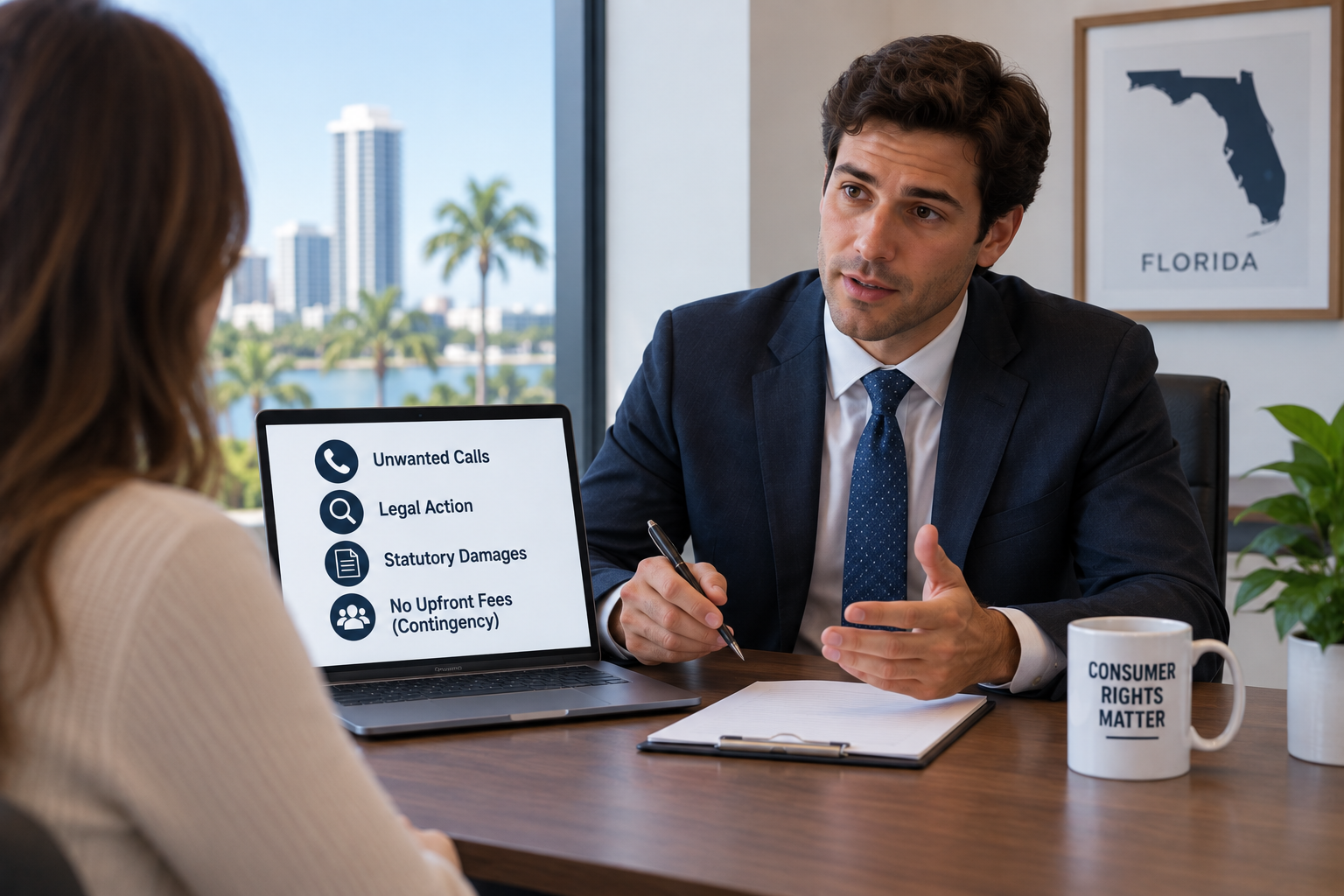
Consumer-side TCPA work is almost always handled on contingency. The lawyer takes a percentage of whatever comes back and gets nothing if the case loses. Filing fees, service costs, expert analysis of dialing systems, and deposition transcripts are typically advanced by the firm and repaid out of any recovery.
The Federal Statute Has No Attorney Fee Provision
This is the detail most people miss, and it explains a lot about how these cases get staffed. Plenty of consumer statutes tell a losing defendant to pay the winning consumer’s legal fees. The federal Fair Debt Collection Practices Act works that way. The TCPA does not. Read section 227 from top to bottom and there’s no fee-shifting language anywhere in it.
So on a pure federal claim, the fee has to come out of the recovery itself. A single consumer with nine illegal calls is looking at $4,500 in statutory damages before any trebling. After a year of litigation, a contingency share of $4,500 doesn’t cover a deposition transcript, let alone the case.
Florida changes that math, and not only in the consumer’s favor. More on that below.
Why Class Actions Dominate TCPA Litigation
Robocalling is a volume business. A company that sends one illegal text usually sent two hundred thousand of them, off the same list, using the same consent paperwork. That makes the legal question identical for everyone who got the message, which is exactly the setup class actions are built for.
In a class case, the fee comes out of a common settlement fund rather than any one person’s pocket, and the judge reviewing the settlement has to approve what the lawyers receive. That structure is what makes it economically possible to litigate a claim worth $500 to any individual member.
These cases shifted hard in 2021. In Facebook, Inc. v. Duguid, the Supreme Court read the statute’s definition of an autodialer narrowly, holding that the equipment has to use a random or sequential number generator. That wiped out a whole category of cases built on the equipment theory and pushed TCPA litigation toward consent failures, prerecorded voice calls, and do-not-call violations instead.
Where a Florida TCPA Case Gets Filed
For two decades, courts disagreed about whether private TCPA suits could go to federal court at all. The statute says a person may bring the claim in state court, and some judges read that as state court only.
The Supreme Court settled it in Mims v. Arrow Financial Services, LLC, decided in 2012. Fittingly, Mims was a Florida case that came up through the Eleventh Circuit. A unanimous Court held that letting state courts hear these claims doesn’t strip federal district courts of their ordinary federal question jurisdiction. Both systems can hear them.
On the state side, Florida sorts cases by dollar amount under Fla. Stat. section 34.01. The small claims division of county court handles money claims up to $8,000 and is built for people without lawyers. County court takes cases above that up to $50,000, and circuit court takes anything larger. On the federal side, Florida is split into the Southern, Middle, and Northern Districts.
The Standing Question That Used to Sink Florida Text Cases
Getting into federal court requires showing a real injury, not just a technical violation. For several years the Eleventh Circuit, which covers Florida, was the outlier on this. Under a 2019 decision called Salcedo v. Hanna, receiving a single unwanted text message wasn’t a concrete enough harm to get into federal court here, even though most other circuits said it was.
That changed in 2023. Sitting en banc in Drazen v. Pinto, the Eleventh Circuit held that a single unwanted, illegal telemarketing text is a concrete injury, comparing it to the old common law tort of intrusion upon seclusion. Florida is now in line with the rest of the country on that question, and single-text class definitions no longer get knocked out at the door.
Florida Telemarketing Laws, and What They Actually Add
Florida has two separate telemarketing statutes plus its own do-not-call list. They do different jobs, and mixing them up is the most common mistake people make about Florida robocall law.
The Florida Telephone Solicitation Act
The FTSA lives at Fla. Stat. section 501.059. Subsection (8)(a) bars unsolicited sales calls made with an automated system for the selection and dialing of numbers, or with a recorded message, without the called party’s prior express written consent. That consent has to be a written agreement with the person’s signature, the specific number, and a clear disclosure that they aren’t required to agree in order to buy anything.
Subsection (10) lets an aggrieved person sue for an injunction plus actual damages or $500, whichever is greater, with discretionary trebling for willful or knowing violations. A rebuttable presumption in the statute treats a call to a Florida area code as a call to someone in Florida, which makes these cases easier to plead than most.
The FTSA got a private right of action in 2021 and set off a wave of litigation. The Legislature narrowed it in 2023, tightening what counts as an automated system and adding the text message step described next. Those changes also reached pending class cases, which reshaped a lot of what was on file at the time.
For text message solicitations, subsection (10)(c) requires the recipient to reply STOP first. The sender then gets 15 days to cut it off. A damages claim only opens up if texts keep coming after that window. Skipping the STOP step is how Florida text claims most often get dismissed.
The Fee Provision That Cuts Both Ways
Subsection (11) says that in civil litigation resulting from a transaction involving a violation, the prevailing party recovers reasonable attorney fees and costs from the nonprevailing party. Read the words carefully. It runs in both directions, unlike the one-way fee provisions in most consumer statutes, and courts have not all agreed on how far that phrase about a transaction reaches.
That two-way exposure is a real part of how Florida robocall cases get evaluated. A weak claim in Florida carries a downside that the same weak claim wouldn’t carry under the federal statute alone.
The Florida Telemarketing Act: Licensing, Hours, and a Call Cap
Separate from the FTSA, the Florida Telemarketing Act requires non-exempt commercial telephone sellers and their salespeople to be licensed. The Florida Department of Agriculture and Consumer Services handles that licensing and requires security of at least $50,000, in the form of a bond, letter of credit, or certificate of deposit.
Two rules in Fla. Stat. section 501.616 are worth knowing, because they apply even to telemarketers who are otherwise exempt from the licensing requirements.
First, sales calls can’t be made before 8 a.m. or after 8 p.m. local time in the called person’s time zone. That’s tighter than the federal window, which runs to 9 p.m. A call at 8:30 p.m. in Orlando can be fine under federal rules and still violate Florida’s.
Second, a seller can’t make more than three sales calls to the same person over a 24-hour period on the same subject, no matter how many different numbers they dial from. Deliberately spoofing caller ID to hide who’s calling is a second degree misdemeanor under the same section.
The Florida Do Not Call List
Florida runs a state registry separate from the national one. The Florida Do Not Call list is maintained by FDACS, is free to join for residential and mobile numbers, and a number stays on it indefinitely. Telemarketers have to screen against the current state list before calling.
Registering on either list doesn’t stop scammers, who ignore both. What it does is turn a call from a real company into a documented violation.
A Hypothetical: How a Tampa Robocall Case Gets Evaluated
Say Dev lives in Seminole Heights, up in Tampa. Over three weeks he gets eleven prerecorded calls from a company calling itself Gulfshore Auto Shield, pitching extended vehicle warranties. His cell number has been on both do-not-call lists for years, and he’s never owned a car.
On paper, eleven violating calls at $500 each is $5,500 under federal law, and up to $16,500 if a court found the conduct willful. The FTSA claim stacks its own $500 per call on top, with its own trebling and its own fee provision. If four of those calls came in at 8:20 p.m., that’s a Florida Telemarketing Act problem too.
But a lawyer evaluating this isn’t focused on Dev’s $5,500. The real questions are whether Gulfshore called forty thousand other people off the same list, whether the company is a real business with assets, and whether it dissolves the week a complaint gets served.
Now change one fact. Say it was texts instead of calls, and Dev never replied STOP. The federal claim survives. The FTSA claim mostly doesn’t, because the statute makes that reply a precondition. Same annoying phone, very different case.
Common Questions About TCPA Lawyers in Florida
What is the fine for a violation of the TCPA?
For a private lawsuit it isn’t really a fine. It’s statutory damages paid to the person who got the call, set at $500 per violation with discretionary trebling to $1,500. Separately, the FCC can impose forfeiture penalties on callers, and FDACS and the Florida Attorney General can pursue civil penalties, but that money goes to the government rather than to consumers.
Do TCPA lawyers charge money upfront?
Consumer-side TCPA work is generally contingency based, meaning the fee comes out of a recovery rather than the client’s pocket. Arrangements vary by firm and are governed by the Florida Bar’s rules on fees and contingency agreements, and they get spelled out in writing before work starts.
What is the statute of limitations for a TCPA claim in Florida?
The TCPA doesn’t contain its own deadline, so courts apply the federal catch-all in 28 U.S.C. section 1658, which sets four years from when the claim accrues. Because each call is its own violation, the clock generally runs separately for each one. A Florida state law claim under the FTSA runs on its own limitations period, which is a separate analysis.
Do text messages count the same as phone calls?
Under the federal statute, courts have long treated texts as calls, and the national do-not-call protections extend to them. Florida’s statute is explicit, defining a telephonic sales call to include text messages and voicemail transmissions. The difference is the STOP step, which applies to Florida text claims and not to federal ones.
What changed recently?
On the federal side, FCC rules now make clear that a consumer can revoke consent to robocalls and robotexts in any reasonable way, and callers have to honor it. On the Florida side, the 2023 FTSA amendments narrowed what counts as an automated system and added the text message notice requirement, which together cut down the volume of Florida filings considerably.
Can you handle a robocall case without a lawyer?
Florida’s small claims division is built for people appearing without counsel, and a handful of $500 claims can fit under the $8,000 ceiling. Keep the two-way fee provision in mind before filing an FTSA claim there. Reporting is a separate track from suing, and the FCC’s consumer guide on robocalls and robotexts explains how federal complaints work.
The Short Version
TCPA work is funded almost entirely through contingency arrangements, because the federal statute gives consumers a private right of action but no attorney fee award. That gap is why class actions carry most of this litigation. Florida adds a second statutory damages claim, a fee provision that runs in both directions, and a text message step that has to be cleared before a state claim exists at all.
The federal rule is the floor, not the whole picture. In Florida, which statute you’re under changes the damages, the procedure, and sometimes who pays whose legal bills at the end.
This article is for educational purposes only and is not legal advice. Reading it does not create an attorney-client relationship. For advice on your specific situation, consult a licensed attorney in your state.