TCPA Exemptions and the Established Business Relationship: Where the Exceptions Start and Stop
You bought a car or a gym membership last year. Now the same company keeps calling to sell you something new, even though your number is on the National Do Not Call Registry. Is that allowed? The answer usually turns on TCPA exemptions, and one in particular: the established business relationship.
The Telephone Consumer Protection Act, found at 47 U.S.C. § 227, limits telemarketing calls, robocalls, and texts. But it isn’t a total ban, and its exceptions are narrower than most people think. Our plain-English guide to the TCPA covers each exemption briefly. This article goes deeper on the established business relationship and the line between informational messages and sales calls.
What Counts as a TCPA Exemption?
The TCPA isn’t one rule. It’s a set of separate restrictions, and the FCC’s regulations at 47 C.F.R. § 64.1200 give each one its own exceptions:
- Do Not Call rules. Sales calls to numbers on the Registry, or to anyone who asked a company to stop, are restricted.
- Robocall rules. Calls and texts made with an autodialer or a prerecorded voice need consent. Marketing robocalls need prior express written consent.
- Calling hours. Sales calls to homes are limited to 8 a.m. to 9 p.m., local time.
- Junk fax rules. Unsolicited fax ads are banned unless specific conditions are met.
Key takeaway: An exemption from one rule is not an exemption from all of them. The established business relationship is a strong exception to the Do Not Call rules. It does very little for robocalls.
What Is an Established Business Relationship Under the TCPA?
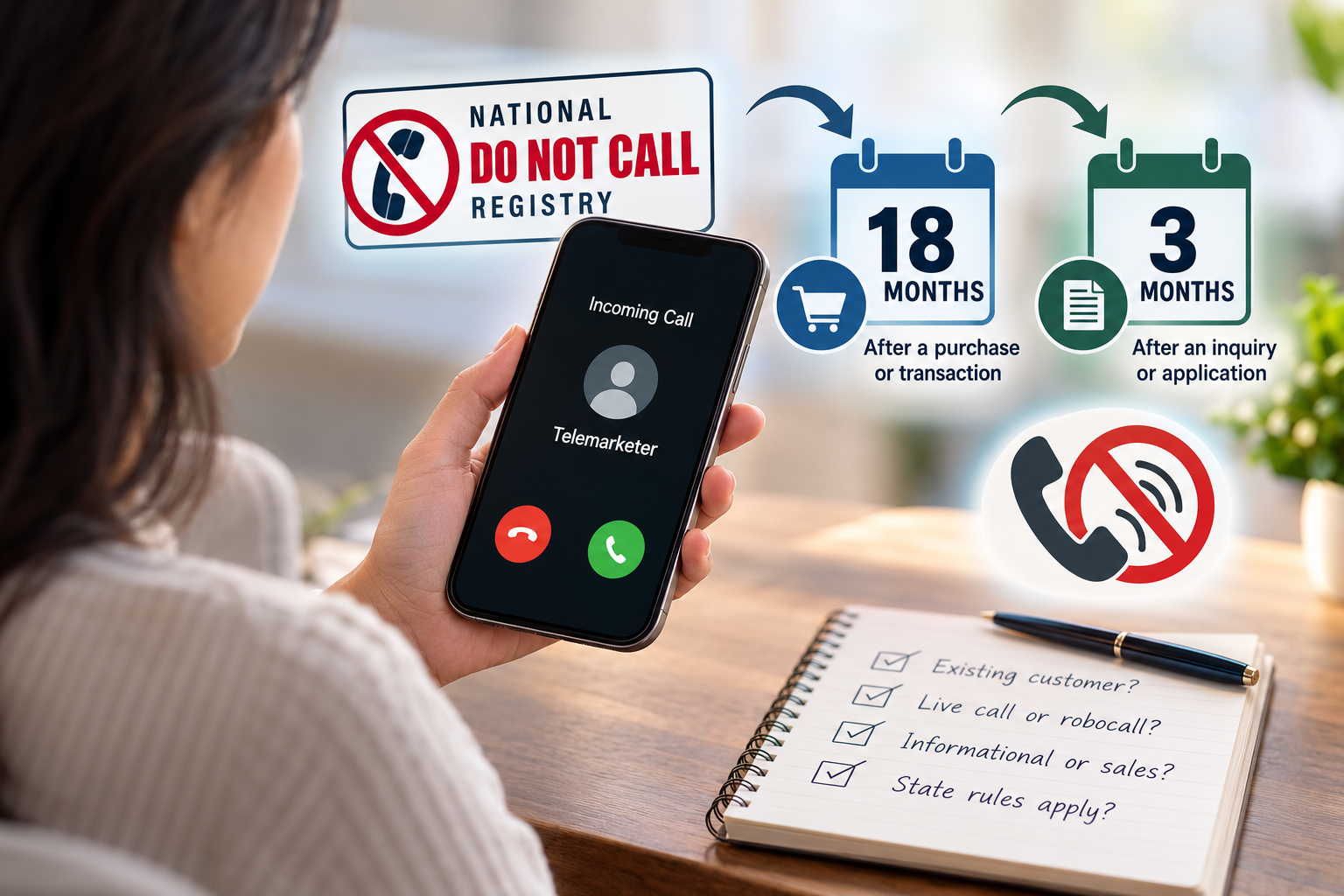
The FCC defines an established business relationship, or EBR, as a relationship formed by a voluntary two-way communication between a business and a consumer. No money has to change hands, but the consumer has to have started it. There are two ways to form one, and each has its own clock.
The 18-Month Window for Purchases
A purchase or transaction creates an EBR that lasts 18 months, measured backward from the date of the call. Say Priya buys tires from a fictional shop called Harbor Point Tire & Auto on January 10, 2026. A live salesperson could generally call her about an alignment special through early July 2027, even if her number is on the Registry. After that, the window closes unless she buys something else and restarts the clock.
The 3-Month Window for Inquiries
An inquiry or application creates a much shorter EBR of 3 months. If Dante fills out a quote request on a fictional solar company’s website on June 1, 2026 and never signs up, the company’s EBR with him runs out around September 1, 2026.
The Relationship Belongs to One Company
Under § 64.1200(f)(5)(ii), an EBR doesn’t automatically extend to a company’s affiliates. It reaches an affiliate only if a consumer would reasonably expect it to, based on what the affiliate sells and who it is. A call from your phone carrier about an upgrade likely fits. A call from its sister company selling home warranties probably doesn’t.
18 months after a purchase. 3 months after an inquiry. Those are the FCC’s two EBR windows.
How an Established Business Relationship Ends Early
The windows are maximums. An EBR ends sooner if either side terminates the relationship or if the consumer asks the company to stop calling. Under § 64.1200(f)(5)(i), a stop request ends the EBR for telemarketing even if the person stays a customer. The company has up to 10 business days to honor it, and the request lasts 5 years.
So if Marisol tells her internet provider, “Please stop calling me with offers,” the sales calls have to stop, even though she still pays her bill every month. The provider can still contact her about a billing problem, because that isn’t telemarketing.
Where the EBR Stops Helping a Caller
The EBR is mainly an exception to the Do Not Call rules. The FCC’s definition of “telephone solicitation” leaves out calls to people the caller has an EBR with, which is why existing customers on the Registry can still get live sales calls. It doesn’t unlock much else.
- Prerecorded sales calls to home phones. The FCC eliminated the EBR shortcut for these in rules adopted in 2012. Today, § 64.1200(a)(3) requires prior express written consent.
- Robocalls and robotexts to cell phones. These never had an EBR exception. Under § 64.1200(a)(2), marketing calls or texts using an autodialer or prerecorded voice need prior express written consent.
- Stop requests. An EBR never overrides a request to be put on the company’s internal do-not-call list.
“Prior express written consent” means a signed agreement, which can be electronic, that clearly authorizes marketing robocalls or texts to a specific number. It also has to say that signing isn’t a condition of buying anything.
Common misconception: “I already buy from them, so they can robocall me.” Under federal rules, an EBR covers live sales calls to numbers on the Registry. Marketing robocalls and robotexts generally still need prior express written consent.
Informational Messages vs. Telemarketing
The second big group of TCPA exemptions turns on what a message says. The FCC defines telemarketing as a call or message meant to encourage the purchase or rental of, or investment in, property, goods, or services. Messages that don’t do that are often called “informational” or “transactional.”
Fraud alerts, shipping notices, flight delays, and reminders about appointments you already booked are usually informational. They still fall under the robocall rules, but for a cell phone they need only prior express consent, a lower bar than the signed agreement marketing requires. The FCC has also carved out narrow exemptions for free, marketing-free cell phone messages like package delivery notices, bank fraud alerts, and certain health care reminders.
Call Limits on Exempt Prerecorded Calls to Home Phones
For residential lines, § 64.1200(a)(3) lets some prerecorded calls go out without consent, but only up to a cap. Each must also offer a way to opt out.
- Non-commercial calls: 3 in any 30-day period.
- Commercial calls that don’t advertise or telemarket: 3 in any 30-day period.
- Calls by or for tax-exempt nonprofits: 3 in any 30-day period.
- Health care messages from HIPAA-covered providers: 1 per day and 3 per week.
Dual-Purpose Messages: When a Reminder Becomes a Sales Pitch
A “dual-purpose” message delivers real information and also tries to sell something. The FCC has long treated these as telemarketing. Adding useful information doesn’t clean up the sales pitch.
The leading case is Chesbro v. Best Buy Stores, L.P., 705 F.3d 913 (9th Cir. 2012). Best Buy sent automated calls reminding a customer that his rewards certificates were about to expire. Because the rewards could only be used by buying more from Best Buy, the Ninth Circuit found the calls encouraged future purchases and counted as telemarketing, even though they never named a product.
Here’s how that line can shift. A fictional dental office, Maple Hollow Dental, texts Kevin in Tampa: “Reminder: your cleaning is Tuesday at 10 a.m. Reply C to confirm.” That’s informational. Add one line, “Ask about our whitening package, 20% off this month!”, and the text arguably becomes telemarketing. Without Kevin’s prior express written consent, it could support a TCPA claim.
One recent change matters here. In McLaughlin Chiropractic Associates, Inc. v. McKesson Corp. (2025), the Supreme Court held that federal district courts aren’t bound by the FCC’s interpretations of the TCPA. The FCC’s view on dual-purpose messages still carries weight, but judges now decide the question for themselves and may draw the line a bit differently.
The more a message nudges someone toward buying, renewing, upgrading, or redeeming, the more likely a court is to treat it as telemarketing, whatever the sender calls it.
How the FTC and Fax Rules Measure the EBR Differently
The FTC’s Telemarketing Sales Rule at 16 C.F.R. Part 310 has its own EBR exception, and it now counts in days: 540 days after a purchase and 90 days after an inquiry. Eighteen calendar months usually runs a few days longer than 540 days, so a call near the end of the window could fit the FCC’s version and miss the FTC’s.
Fax ads have a separate EBR definition in § 64.1200(f)(6) with no 18-month or 3-month limit. A fax EBR generally lasts until the relationship ends or the recipient opts out, and every fax ad still needs a clear opt-out notice on its first page.
How New York and Florida Treat Existing Customers
Federal law sets a floor, not a ceiling. A call has to satisfy every law that applies to it, and New York and Florida each handle existing customers a little differently from the FCC.
New York General Business Law § 399-z
New York’s General Business Law § 399-z bars unsolicited telemarketing calls and texts to New York customers on the National Do Not Call Registry. Like federal law, it exempts calls tied to an established business relationship. Unlike the FCC rule, the statute’s text sets no 18-month or 3-month window. The relationship counts until either side ends it or the customer says stop.
New York adds a rule federal law doesn’t have. Within the first 30 seconds of every telemarketing call, the caller must give its name and offer to put the customer on the seller’s do-not-call list. Say Tasha in Queens gets a call from her fictional gym, Ironbridge Fitness. Her membership gives the gym an EBR, but if the rep skips the opt-out offer and launches into a training package pitch, that’s a New York disclosure problem. New York also requires a signed written agreement for any prerecorded telemarketing call, and the Department of State can fine violators up to $20,000 per violation.
The Florida Telephone Solicitation Act
Florida’s version, Fla. Stat. § 501.059, covers calls, texts, and voicemails. It leaves calls to a person with a “prior or existing business relationship” out of its definition of an unsolicited sales call, again with no time window in the text. On paper, that keeps existing customers outside the FTSA’s own autodialer consent rule. But federal law still applies on top, so marketing robocalls and robotexts generally still need prior express written consent.
The FTSA’s stop rule has no existing customer exception. And before suing over text solicitations, the recipient generally has to reply “STOP” and give the company 15 days to quit. If Luis in Orlando texts STOP to his fictional pool company and the promos keep coming after 15 days, that can support a claim for $500 or actual damages, whichever is greater, and up to triple that if the violation was willful or knowing.
A Hypothetical: One Customer, Four Calls
Marcus lives in Columbus, Ohio, and his cell number is on the Registry. On March 3, 2025, he buys a used Honda Civic from a fictional dealer, Tollgate Ridge Motors. He gives his number on the paperwork but never agrees in writing to marketing robocalls or texts.
- July 2025, live sales call. The EBR generally takes this call outside the Do Not Call rules.
- August 2025, prerecorded promo to his cell. The EBR doesn’t help. This generally needs prior express written consent, which Marcus never gave.
- October 2025, after he said “stop.” His July stop request ended the EBR for sales calls, even though he still brings his Civic in for oil changes.
- September 20, 2026, with no stop request and no new purchase. The 18-month window closed on September 3, 2026, so the EBR no longer covers a live sales call.
Why does the label matter? Under § 227(c)(5), more than one Do Not Call violation from the same company within 12 months can support up to $500 per violation. Robocall violations under § 227(b)(3) carry a $500 minimum. A court can triple either award for willful or knowing violations. Whether a real call qualifies depends on facts a licensed attorney would need to review.
TCPA Exemptions FAQ
Does an existing business relationship let a company robocall me?
Generally, no. An EBR mostly affects live sales calls to numbers on the Registry. Marketing robocalls and robotexts generally need prior express written consent no matter how recently someone bought from the company.
How long does an established business relationship last under the TCPA?
Under the FCC rule, 18 months after the last purchase or 3 months after an inquiry. It ends sooner if the consumer says stop or either side ends the relationship.
Are transactional messages exempt from the TCPA?
Not completely. They face lower consent requirements than telemarketing, but automated texts and calls to cell phones still generally need some consent. Adding sales content can turn them into telemarketing.
Does the EBR exemption for faxes expire?
Not on a fixed timer. It generally continues until the relationship ends or the recipient opts out using the method listed on the fax.
The Bottom Line on TCPA Exemptions
The established business relationship is real but narrow. It lets a company make live sales calls to recent customers and inquirers on the Registry until the window closes or the consumer says stop. It doesn’t cover marketing robocalls or robotexts, and states like New York and Florida add their own rules on top.
This article is for educational purposes only and is not legal advice. Reading it does not create an attorney-client relationship. For advice on your specific situation, consult a licensed attorney in your state.