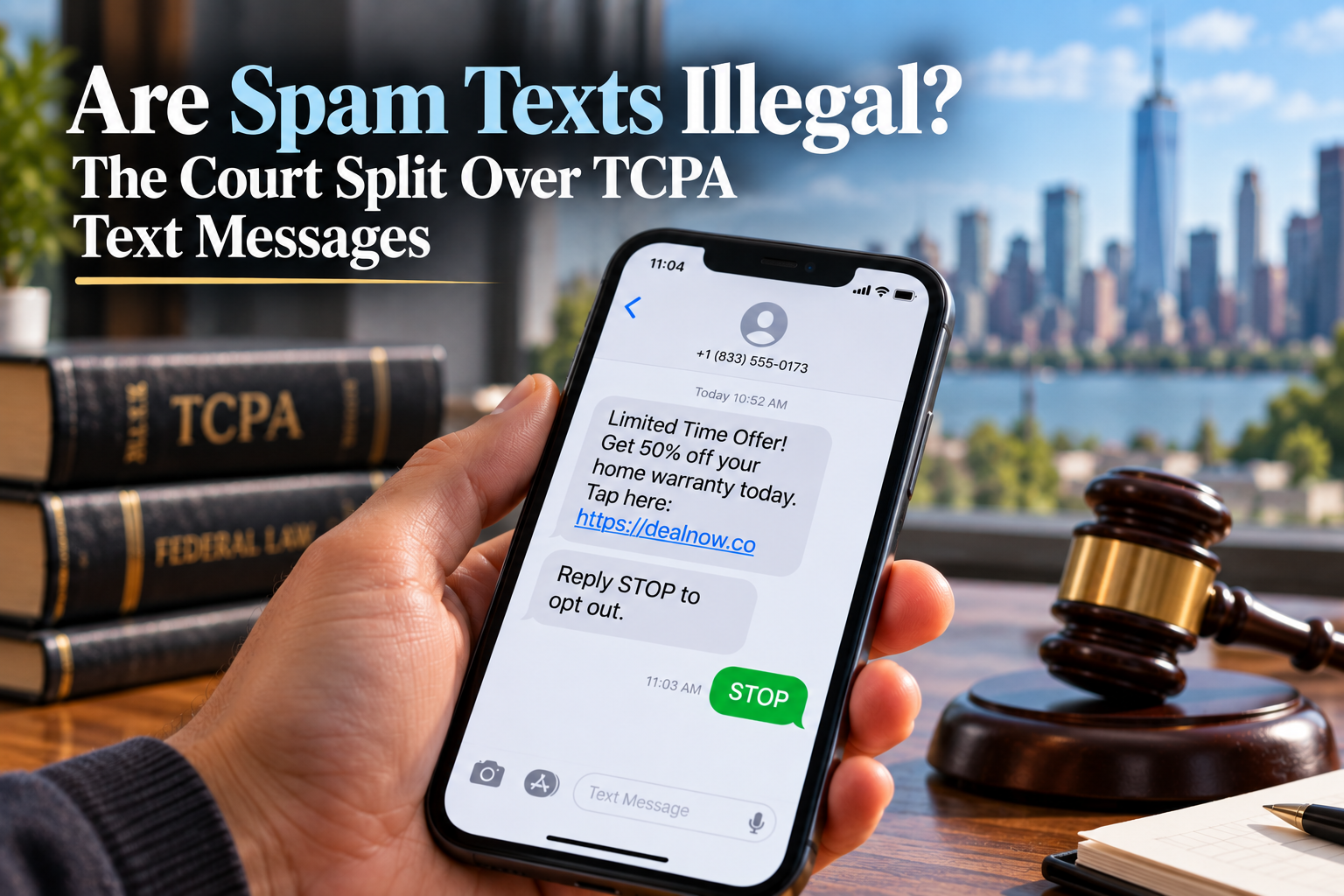
Are Spam Texts Illegal? The Court Split Over TCPA Text Messages
Your phone buzzes. It’s another “exclusive offer” from a company you’ve never heard of. You replied STOP last week, and the texts keep coming anyway. So are spam texts illegal, or just annoying?
For years, the answer under the federal Telephone Consumer Protection Act seemed simple. Courts treated a TCPA text the same way they treated a phone call. That changed in 2026. Federal appeals courts now disagree about whether a text message counts as a “call” at all, and the answer can depend on where you live.
This guide explains the split in plain English, with a close look at what it means for people in Florida and New York.
What the TCPA Says About Calls and Texts
The TCPA is found at 47 U.S.C. § 227. Congress passed it in 1991, years before most people had ever sent a text. That timing is at the center of today’s fight.
Two parts of the law matter most for texting rules. They’re worded differently, and courts are now treating them differently.
Section 227(b): Autodialers and Prerecorded Voices
This section bars calls made with an automatic telephone dialing system or an artificial or prerecorded voice, unless the caller has the recipient’s prior express consent. The statute says “any call,” and many courts have long read that to include texts. A private lawsuit under this section allows $500 per violation, and up to $1,500 if a court finds the violation willful or knowing.
Section 227(c)(5): The Do Not Call Lawsuit
This section lets a person sue after receiving “more than one telephone call within any 12-month period” that breaks the FCC’s Do Not Call rules. Notice the wording. It says “telephone call,” not “any call.” That small difference is where the whole split lives.
Most spam text lawsuits in recent years were filed under 227(c)(5). Think of marketing texts sent to a number on the National Do Not Call Registry, or texts that kept coming after someone asked them to stop.
How the Supreme Court Opened the Door
Starting in 2003, the FCC took the position that text messages count as calls under the TCPA. Federal courts mostly went along because they believed FCC interpretations bound them.
In June 2025, the Supreme Court changed that in McLaughlin Chiropractic Associates, Inc. v. McKesson Corp. The Court held that federal district courts aren’t bound by the FCC’s reading of the TCPA. Judges now interpret the statute themselves and give the agency’s view only “appropriate respect.”
Defendants quickly started arguing that a 1991 law about “telephone calls” doesn’t reach a text. Some judges agreed. Others didn’t.
The Seventh Circuit Says Texts Aren’t “Telephone Calls”
On July 14, 2026, the Seventh Circuit decided Steidinger v. Blackstone Medical Services. The plaintiffs said they kept getting marketing texts about home sleep tests even after replying STOP and registering on the National Do Not Call Registry.
The court ruled against them. It held that “telephone call” in 227(c)(5) doesn’t include text messages, based on what the phrase meant when Congress passed the law. The court also noted that nearby parts of the statute use the broader phrase “telephone call or message.” To the judges, that showed Congress chose the narrower wording on purpose.
Steidinger binds federal courts only in Illinois, Indiana, and Wisconsin. Everywhere else, judges can find it persuasive, but they don’t have to follow it.
A Florida twist: The Steidinger plaintiffs also sued under the Florida Telephone Solicitation Act. The trial court threw out the federal claims and then declined to decide the Florida claim at all. So the Seventh Circuit’s ruling says nothing about whether those texts broke Florida law.
The Ninth Circuit Went the Other Way
Six months earlier, the Ninth Circuit decided Howard v. Republican National Committee. An Arizona man received a political text with a video file that downloaded automatically. He argued it was a prerecorded voice call sent without his consent.
The Ninth Circuit treated the text as a “call” under the TCPA. He still lost. The video didn’t play until he pressed play, so the court said the message wasn’t made using a prerecorded voice.
Here’s the catch. Howard was a 227(b) case, and Steidinger was a 227(c)(5) case. The courts read different sections, so the split isn’t a perfect mirror image. But they reached opposite answers to the same basic question: is a text a call? Many legal commentators expect the Supreme Court will eventually have to decide.
2 federal appeals courts. 2 opposite answers on whether a text is a call. 0 Supreme Court rulings that squarely settle the question.
TCPA Text Messages in Florida: Where the Fight Started
Florida’s federal courts reached the “texts aren’t calls” result before the Seventh Circuit did. In August 2025, a federal judge in the Northern District of Florida dismissed a Do Not Call lawsuit over promotional pharmacy texts, reasoning that no ordinary person thinks of a text as a telephone call. In October 2025, a judge in the Middle District of Florida adopted the same reasoning. Other courts in the Eleventh Circuit, including federal courts in Georgia, followed in early 2026.
Not every Florida judge agrees. Some judges in the Southern District of Florida, which covers Miami, Fort Lauderdale, and West Palm Beach, have ruled that texts still count. For now, whether a federal Do Not Call text claim survives in Florida can depend on which federal courthouse hears it.
The Eleventh Circuit, which covers Florida, Georgia, and Alabama, will eventually decide the question for Florida. Appeals raising the issue have been filed there, including an appeal of the Northern District decision. As of this writing, the court hasn’t ruled.
Florida’s Own Law Names Texts Directly
Florida residents have another layer of protection that doesn’t depend on how federal judges read a 1991 phrase. The Florida Telephone Solicitation Act, Fla. Stat. § 501.059, defines a “telephonic sales call” as a telephone call, text message, or voicemail transmission. The statute says texts count, so no court has to guess.
The FTSA generally bars unsolicited sales texts to numbers on the Florida Do Not Call List. It also bars texts to people who have already said they don’t want them. Sales texts sent through an automated dialing system require prior express written consent. A person harmed by a violation can recover actual damages or $500, whichever is greater, and a court can triple that amount if the violation was willful or knowing.
Florida’s STOP Rule
Florida adds a step the federal TCPA doesn’t have. Before a damages lawsuit over sales texts, the person must reply “STOP” to the number the texts came from. The sender then has 15 days to stop. A lawsuit is allowed only if the texts continue after that 15-day window. This rule came from a 2023 amendment.
The exact word matters. The statute specifically names a “STOP” reply. Other wording, like “quit texting me,” isn’t what the text of the law describes, and that difference could become an issue in a later dispute.
FTSA cases can be filed in Florida state court. Depending on how much money is at stake, that means county court or circuit court.
Unsolicited Text Messages in New York
New York is part of the Second Circuit, along with Connecticut and Vermont. Before McLaughlin, the Second Circuit treated texts as calls in 227(b) cases, relying partly on FCC guidance. As of this writing, it hasn’t decided whether texts count under the 227(c)(5) Do Not Call provision.
That leaves the question to federal judges in New York’s four districts: the Southern, Eastern, Northern, and Western Districts. They can weigh Steidinger’s reasoning, but they aren’t bound by it.
New York General Business Law § 399-z
New York’s main telemarketing statute is General Business Law § 399-z. It bars unsolicited telemarketing sales calls to numbers on the National Do Not Call Registry, which New York relies on instead of keeping a separate list. A 2021 amendment extended the law’s reach to telemarketing by text.
Here’s the big difference from Florida. Section 399-z doesn’t give consumers their own damages lawsuit. Enforcement runs through the New York Department of State’s Division of Consumer Protection, which can fine violators up to $11,000 per violation. Consumers can file complaints, but the state brings the case, not the individual.
So a New Yorker’s private claim over spam marketing texts generally depends on federal law. That’s exactly where the split creates the most uncertainty.
What the Court Split Doesn’t Change
Headlines about Steidinger can make it sound like texting is now a free-for-all. It isn’t. Several things stay the same.
- Section 227(b) claims. Steidinger addressed only 227(c)(5). Texts sent with an autodialer or prerecorded voice without consent remain a separate issue. The Supreme Court narrowed the definition of “autodialer” in 2021, though, which already limits these claims.
- Actual phone calls. Nobody disputes that repeated voice telemarketing calls to a number on the Do Not Call Registry fall under 227(c)(5).
- State laws that name texts. Florida’s FTSA and similar state statutes don’t depend on how federal courts read “telephone call.”
- Government enforcement. The split is mainly about whether individuals can sue. FCC and FTC rules are still on the books.
That’s why TCPA compliance for texting hasn’t gone away for businesses. Steidinger closed off one type of lawsuit in three states. It didn’t repeal the rest of the law.
A Hypothetical: Same Texts, Three Different States
Say a made-up company called Nexavo Home Warranty sends the same marketing texts to three people. None of them ever gave consent, and all three are on the National Do Not Call Registry. Each one replies STOP, and the texts keep coming for another month.
Maria lives in Tampa and is also on the Florida Do Not Call List. Federal judges in the Middle District of Florida have dismissed text-only Do Not Call claims like hers. But the FTSA names texts directly, and Maria’s STOP reply started the 15-day clock. Say six more texts arrive after that window and each counts as a separate violation. The statutory minimum would be $3,000, and up to $9,000 if a court found the conduct willful.
Derek lives in Astoria, Queens. A federal Do Not Call claim would go to the Eastern District of New York, where no appeals court has settled the text question. It could go either way. Section 399-z covers the texts, but it gives Derek a complaint to file with the Department of State, not a lawsuit of his own.
Tyler lives in Chicago. Steidinger binds federal courts in Illinois, so a 227(c)(5) claim based only on texts would face dismissal. If Nexavo had used a prerecorded voice message, a 227(b) theory would be a separate question.
Key takeaway: The same texts from the same company can lead to three very different legal outcomes. It depends on the state, the federal court, and which section of the law applies.
Common Questions About TCPA Text Messages
Are spam texts illegal under federal law?
It depends on the text and where you live. Texts sent with an autodialer or prerecorded voice without consent are still addressed by 227(b). Whether plain marketing texts to a Do Not Call number support a private lawsuit under 227(c)(5) is now disputed. In Illinois, Indiana, and Wisconsin, federal courts must answer no.
Does the Do Not Call Registry apply to text messages?
The FCC says yes, and in 2024 it expressly extended Do Not Call protections to texts. But after McLaughlin, courts deciding private lawsuits don’t have to follow the FCC’s reading. That’s the heart of the split. Florida’s state list covers texts by statute.
Does consent still matter for texts?
Yes. Prior express consent is still central under 227(b). Florida’s FTSA requires prior express written consent for automated sales texts. Under Florida law, a “signature” for consent can include checking a consent box or replying yes to a text campaign.
Is Florida’s texting law stricter than the TCPA?
In one way, yes, because it names texts directly. In another way, no, because of the STOP reply and the 15-day waiting period, which the federal TCPA doesn’t require.
Does the Steidinger ruling apply in New York or Florida?
No. It binds only federal courts in Illinois, Indiana, and Wisconsin. Judges in New York and Florida can find its reasoning convincing, but they aren’t required to follow it.
The Bottom Line on Unsolicited Text Messages
Whether a spam text supports a federal lawsuit now depends on the section of the TCPA involved and the part of the country you’re in. Florida’s FTSA covers texts by name but adds a STOP requirement. New York’s § 399-z covers texts but leaves enforcement to the state. For a broader overview of the federal law, see our plain-English guide to the TCPA.
This article is for educational purposes only and is not legal advice. Reading it does not create an attorney-client relationship. For advice on your specific situation, consult a licensed attorney in your state.