TCPA Calling Hours: The 8 a.m. to 9 p.m. Rule for Calls and Texts
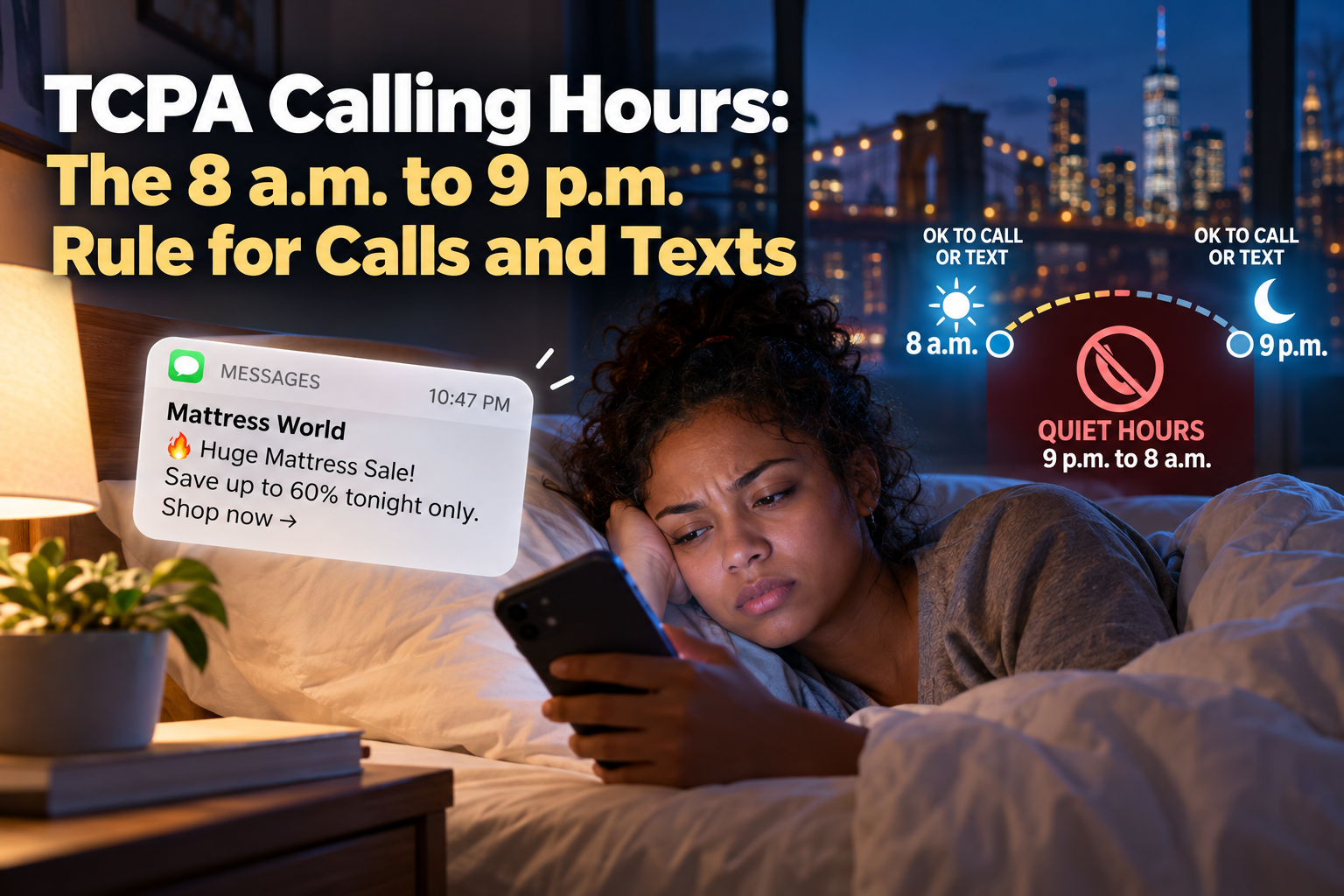
It’s 10:47 p.m. in Brooklyn. Jasmine is half asleep when her phone buzzes with a text about a mattress sale. She doesn’t remember signing up. Was that text even allowed at that hour?
That question sits at the center of TCPA calling hours, one of the simplest rules in federal telemarketing law and one of the most fought over. Federal rules say sales calls and texts can’t reach you before 8 a.m. or after 9 p.m. your time. Since late 2024, that short rule has fueled a wave of class action lawsuits over late-night marketing texts.
This guide explains how the time-of-day restrictions work, what the “quiet hours” lawsuits are really arguing about, what one federal court decided, and how New York and Florida set their own clocks. If you want the full picture of the TCPA first, start with our plain-English guide to the Telephone Consumer Protection Act.
What Are the TCPA Calling Hours?
The Telephone Consumer Protection Act, found at 47 U.S.C. § 227, lets the Federal Communications Commission write rules that protect people’s privacy at home. One of those rules is 47 C.F.R. § 64.1200(c)(1). It bars any person or company from starting a “telephone solicitation” to a residential subscriber before 8 a.m. or after 9 p.m., measured by the local time where the person being called is located.
People in the industry call the blocked window, 9 p.m. to 8 a.m., “quiet hours.” Courts treat text messages as calls under the TCPA, so the rule reaches marketing texts too. Several courts have also accepted that a cell phone used as someone’s main household line can count as a residential line.
8 a.m. to 9 p.m. The federal window for telephone solicitations, measured by the clock where you are, not where the caller sits.
What Counts as a “Telephone Solicitation”
This definition is where most of the fighting happens. Under the statute, a telephone solicitation is a call or message meant to encourage you to buy, rent, or invest in something. The definition then carves out three kinds of calls.
- Calls to someone who gave the caller “prior express invitation or permission”
- Calls to someone who has an established business relationship with the caller
- Calls made by a tax-exempt nonprofit organization
If a call falls into one of those buckets, it isn’t a telephone solicitation at all. And if it isn’t a telephone solicitation, the federal quiet hours rule doesn’t apply to it. Keep that in mind, because it drives the whole lawsuit wave discussed below.
Debt Collection Calls Follow a Different Law
A call about a past-due bill usually isn’t a sales call, so the TCPA quiet hours rule generally doesn’t cover it. Debt collectors have their own call times under the Fair Debt Collection Practices Act. 15 U.S.C. § 1692c(a)(1) tells collectors to assume the convenient time to reach you is after 8 a.m. and before 9 p.m. your local time, unless they know something different about your schedule.
So the hours look the same, but the laws, the defenses, and the damages are different. Say Tony works overnight shifts at a warehouse in Yonkers and a collector calls him at 11 a.m. while he’s asleep. That call sits inside the usual window, but if the collector already knew about his schedule, the analysis under the FDCPA can change.
How “Local Time” Works When Your Area Code Moves With You
The rule looks at your location, not your area code. That used to be easy when every phone was a landline bolted to a kitchen wall. Today, people keep their numbers for decades and across several moves.
Say Derek grew up in Queens, moved to Phoenix, and kept his 347 number. In July, a company sends him a promo text at 8:30 a.m. Eastern time because its system assumes a New York number means a New Yorker. Arizona doesn’t observe daylight saving time, so that text lands at 5:30 a.m. where Derek actually is. On the face of the rule, that is outside the federal window.
Businesses have complained that they can’t always know where a cell phone user is. An industry group raised exactly this problem with the FCC in 2025 and asked the agency to let callers rely on the area code. As of this writing, the FCC has not issued a ruling resolving it.
The Quiet Hours Lawsuit Wave, Explained
Starting around late 2024, plaintiffs’ firms began filing large numbers of nearly identical class actions. The typical complaint says a shopper got marketing texts from an online brand before 8 a.m. or after 9 p.m. The twist is that many of these shoppers had signed up for the texts.
The Plaintiffs’ Argument
The plaintiffs argue that saying yes to marketing texts isn’t the same as saying yes to marketing texts at 2 a.m. In their view, consent covers what a company may send, but the quiet hours rule still controls when it may send it. They point out that the rule is meant to protect people’s sleep and privacy, and that a signup form rarely mentions the time of day.
The Defendants’ Argument
The companies respond with the definition. The quiet hours rule only covers “telephone solicitations.” A message sent with the person’s prior express invitation or permission is not a telephone solicitation. So once you asked for the texts, they argue, the time rule never applies, and your remedy for an annoying text is to reply STOP.
What the Court Decided in King v. Bon Charge
The most talked-about ruling on this question so far came out of federal court in Delaware in King v. Bon Charge, in an opinion dated December 30, 2025, that drew national attention in spring 2026. The judge was Stephanos Bibas, a federal appeals judge who was sitting by designation as a trial judge in that case.
According to the opinion, the plaintiff texted a keyword to an online wellness company to subscribe to its marketing messages and get a discount code. She later received dozens of promotional texts, some in the middle of the night or early morning. She eventually texted STOP, the messages ended, and she sued.
The court threw out her quiet hours claim. It reasoned that by knowingly giving her number to subscribe, she gave prior express invitation or permission, so the texts weren’t telephone solicitations. The court also noted that the quiet hours rule, unlike the Do Not Call rule, doesn’t require that permission to be in a signed, written agreement.
That contrast mattered. The same court let her separate Do Not Call Registry claim move forward, because that rule does require a signed written agreement to prove consent, and her complaint didn’t show one.
Key takeaway: In King, the court held that when a person knowingly shares a number to get marketing texts, those texts fall outside the federal quiet hours rule. Consent for Do Not Call purposes, by contrast, has to meet a stricter written standard.
One ruling is not the final word. King is a single trial court decision. It doesn’t bind federal courts in New York, Florida, or anywhere else, and other judges may read the rule differently. It also says nothing about state calling-hour laws, which have their own wording.
Why One Late-Night Call Usually Isn’t Enough
The private right to sue over the quiet hours rule comes from 47 U.S.C. § 227(c)(5). That section only covers someone who received more than one violating call within any 12-month period from the same company or someone acting for it. A single 9:45 p.m. sales call, standing alone, generally doesn’t meet that threshold.
When the threshold is met, the statute allows actual damages or up to $500 for each violation, whichever is greater. If a court finds the violation was willful or knowing, it can raise the award to as much as $1,500 per violation. The King court also noted that “willful” isn’t a separate claim. It’s an enhancement of the damages on the underlying violation.
A Worked Example: Two Phones, Two Very Different Stories
These are made-up people and made-up companies, used only to show how the rules fit together.
Priya in Astoria
Priya texts the word JOIN to Kickline Supply, a fictional online sneaker shop, to get 15 percent off. Over the next three months, Kickline sends her promo texts at 11:10 p.m., 11:40 p.m., and 6:50 a.m. She never agreed to any specific time of day.
Under the reasoning in King, Priya’s signup likely counts as prior express permission, so a federal quiet hours claim would face a serious consent defense. New York law is worded differently, as explained in the next section. That difference is why the same late-night texts can raise separate questions under state law.
Marcus in Orlando
Marcus never gave his number to Gatorline Solar Co., another fictional business. In one month, a Gatorline sales rep calls him at 7:40 a.m., 8:15 p.m., and 9:30 p.m. There’s no consent and no prior business relationship.
Two of those calls, at 7:40 a.m. and 9:30 p.m., fall outside the federal window. That’s more than one violating call within 12 months, so the federal statute could allow up to $500 for each of those two calls, or up to $1,500 each if a court found the conduct willful. The 8:15 p.m. call is fine under federal law. Florida’s own cutoff, though, is 8 p.m., so that call could matter under state law if Gatorline is covered by it.
New York and Florida Calling Hours: How State Law Differs
The federal rule is a floor, not a ceiling. Many states have their own outbound calling laws with their own time-of-day or day-of-week limits. Here’s how New York and Florida compare, plus one well-known outlier.
New York: Same Hours, Different Consent Language
New York General Business Law § 399-z(2) bars telemarketing outside 8 a.m. to 9 p.m. at the customer’s location, the same window as federal law. The statute expressly covers “electronic messaging texts,” not just voice calls. The key difference is the exception. New York allows calls outside the window only if the customer “has given their express consent to the call at a different time.”
That wording ties consent to the time itself, which is closer to the plaintiffs’ theory than to the reasoning in King. It isn’t yet clear how courts will apply that language to people who signed up for marketing texts. Enforcement under § 399-z runs through the New York Department of State, which can fine violators up to $20,000 per violation after a hearing.
Florida: An Earlier 8 p.m. Cutoff and a Three-Call Cap
Florida’s calling-hours rule lives in the Florida Telemarketing Act, at Fla. Stat. § 501.616(6). It bars commercial telephone solicitation calls before 8 a.m. or after 8 p.m. in the called person’s time zone. That’s a full hour earlier than the federal cutoff.
The same subsection also caps these calls at three per 24 hours to the same person on the same subject, no matter which phone number the caller uses. The Act has its own definitions and exemptions, and at least one Florida federal court has read “commercial telephone solicitation” narrowly when it comes to texts. It’s also a separate law from the better-known Florida Telephone Solicitation Act, so the two shouldn’t be confused.
Texas: A Day-of-Week Rule
Federal law doesn’t treat weekends differently. Texas does. Under Tex. Bus. & Com. Code § 301.051, covered telephone solicitors may call from 9 a.m. to 9 p.m. on weekdays and Saturdays, but only from noon to 9 p.m. on Sundays.
Side by side: Federal, 8 a.m. to 9 p.m. New York, 8 a.m. to 9 p.m. with a time-specific consent exception. Florida, 8 a.m. to 8 p.m. with a three-call daily cap. Texas, 9 a.m. to 9 p.m., and noon to 9 p.m. on Sundays.
Common Questions About TCPA Call Times
Can telemarketers call after 9 p.m.?
Under federal law, a telephone solicitation can’t be started after 9 p.m. or before 8 a.m. in your local time. Calls that fall outside the definition, like those made with your prior permission or by a nonprofit, aren’t covered by that federal rule. State laws may still apply.
Do TCPA calling hours apply to text messages?
Yes, in general. Courts treat texts as calls under the TCPA. The open question is whether marketing texts you signed up for count as telephone solicitations in the first place, which is exactly what King addressed.
Are there federal rules about calling on Sundays or holidays?
The federal quiet hours rule is the same every day of the week. Day-of-week limits come from state law, like the Sunday rule in Texas.
Is one late-night sales call enough for a TCPA claim?
Usually not. The federal private right of action for this rule requires more than one violating call from the same company within a 12-month period.
Does the 8 a.m. to 9 p.m. rule apply to debt collectors?
Debt collection calls are generally handled by the FDCPA, not the TCPA quiet hours rule. The FDCPA uses the same 8 a.m. to 9 p.m. presumption, but it works differently and has its own remedies.
The Bottom Line on TCPA Hours
Federal TCPA calling hours bar telephone solicitations before 8 a.m. and after 9 p.m. at your location, and the real fight is over whether consent takes a message outside that rule. One Delaware federal court said it does, but that ruling binds no one else. New York and Florida each set their own terms, and those terms don’t always match the federal ones.
This article is for educational purposes only and is not legal advice. Reading it does not create an attorney-client relationship. For advice on your specific situation, consult a licensed attorney in your state.