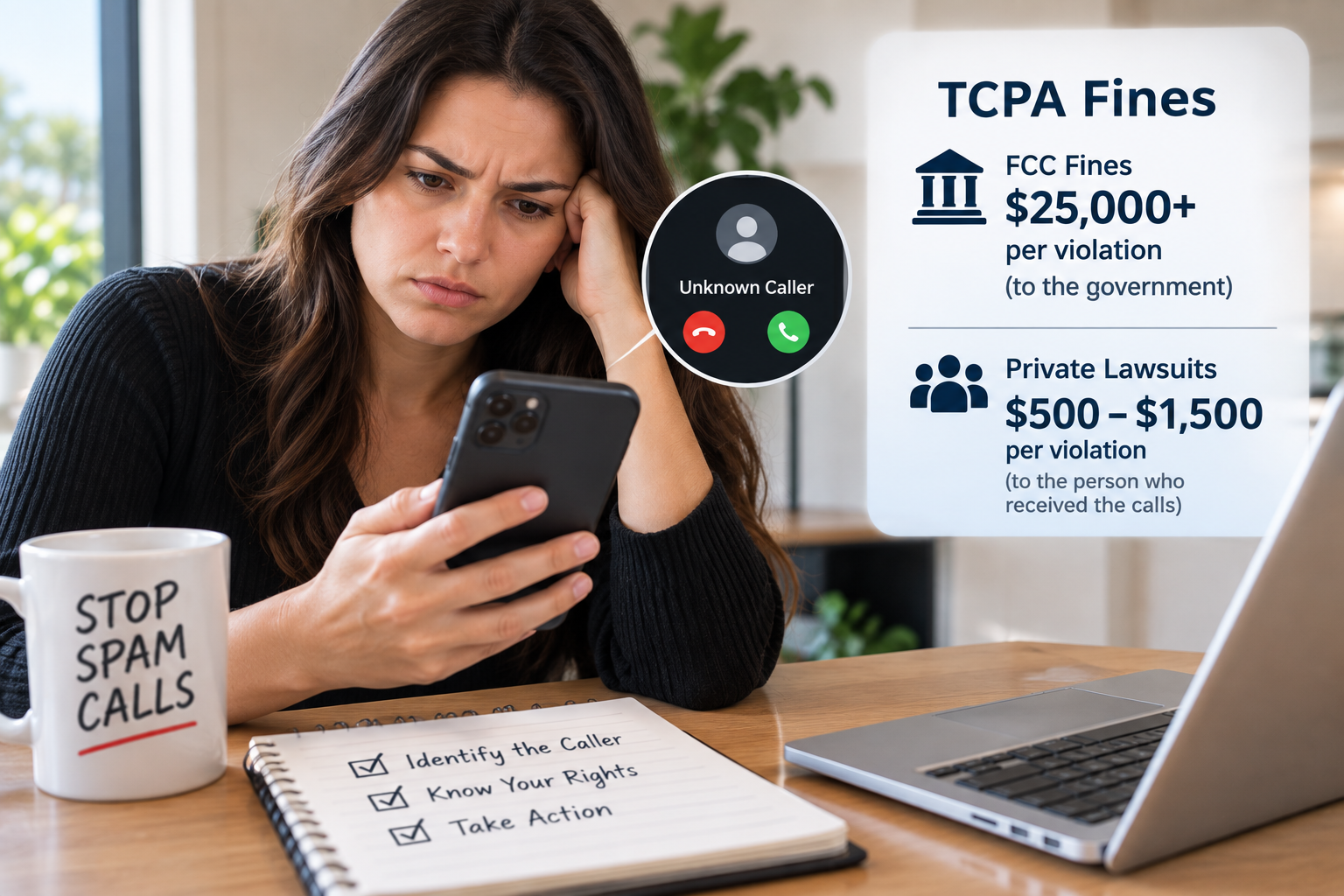
TCPA Fines Per Call: How Violations Get Counted
You’ve probably seen headlines about a robocall company hit with a nine-figure penalty. You’ve also heard about regular people suing over a handful of calls and recovering a few thousand dollars. Both get called “TCPA fines,” but they come from two very different systems.
Our plain-English guide to the Telephone Consumer Protection Act covers the basics, including the $500 per violation starting point that can rise to $1,500 for willful or knowing violations. This article goes a level deeper into how violations get counted, who collects the money, and when courts shrink awards that grow too large.
TCPA Fines vs. TCPA Damages
Under the TCPA, a fine is money a company pays to the government. Damages are money a company pays to the person who got the calls. The same calling campaign can trigger both.
How FCC Fines Work
The Federal Communications Commission issues fines, called forfeitures, under 47 U.S.C. section 503(b). The TCPA ties robocall violations to that process in 47 U.S.C. section 227(b)(4). For callers without an FCC license, the base cap is $10,000 per violation. Annual inflation adjustments under 47 C.F.R. section 1.80 have pushed that figure well above $25,000.
Intentional robocall violations can draw up to $10,000 more per violation. The Pallone-Thune TRACED Act added that extra penalty in 2019 and gave the FCC four years to pursue intentional violations. Either way, FCC fine money goes to the federal government, not to the people who got the calls.
By the numbers: A $500 private damages claim and a federal forfeiture of $25,000 or more can both grow out of the same call. Multiply either by thousands of calls and penalties climb into eight and nine figures.
How Statutory Damages Work
Statutory damages come from a private lawsuit, and the consumer collects whatever the court awards. State attorneys general can also sue for $500 per violation on behalf of residents under section 227(g), and many states have their own telemarketing laws with separate penalties.
How TCPA Violations Get Counted Per Call
The TCPA has two main private lawsuit provisions, and they count violations differently.
Section 227(b): Robocalls and Autodialed Calls
Section 227(b)(3) covers autodialed or prerecorded calls made without the required consent. It allows $500 “for each such violation,” and that $500 is a floor. In Lary v. Trinity Physician Financial & Insurance Services, the Eleventh Circuit held these damages are counted per violation, not per call. One fax that broke two rules counted twice.
Section 227(c): Do Not Call Violations
Section 227(c)(5) covers telemarketing calls that break the Do Not Call rules in 47 C.F.R. section 64.1200. A person must receive more than one call from the same company within 12 months to sue. In Charvat v. GVN Michigan, Inc., the Sixth Circuit held that the first call still counts once that threshold is met, but damages are limited to one award per call.
This section also says “up to” $500, so a court can award less. And a company can avoid liability by proving it followed reasonable procedures, with due care, to prevent these calls.
Can One Call Violate Both Section 227(b) and Section 227(c)?
Yes, according to Charvat v. NMP, LLC. The Sixth Circuit held that a person can recover under both sections for the same call, because Congress wrote two damages provisions aimed at two different harms. A prerecorded sales call to a number on the Do Not Call Registry could support up to $1,000, or up to $3,000 if a court raises both awards. Not every appeals court has ruled on this, so the answer can depend on where a case is filed.
What “Willful or Knowing” Means for TCPA Penalties
Both sections let a court raise the award up to three times the base amount for willful or knowing conduct. The increase is always “in its discretion,” so it’s never automatic.
Courts don’t all use the same test. In Lary, the Eleventh Circuit said the company must know it was doing the specific thing that breaks the law, like calling an emergency line. Just knowing it placed a call wasn’t enough. Other courts use a looser standard focused on whether the calls were intentional. Ignored stop requests and known Do Not Call listings often come up in this analysis.
Keep in mind: Simply labeling conduct “willful” isn’t enough. In Lary, the court called that a legal conclusion and refused to triple the award without supporting facts.
Can Courts Cut Down Huge Class-Wide TCPA Awards?
Sometimes. The TCPA has no cap on total class action damages, so millions of calls can produce an enormous verdict. Two federal appeals courts have said due process can limit those totals in extreme cases.
In Golan v. FreeEats.com, Inc., the Eighth Circuit upheld cutting a roughly $1.6 billion award to about $32 million, or $10 per call. In Wakefield v. ViSalus, Inc., the Ninth Circuit sent back a $925 million verdict so the trial court could decide whether the total was so severe and oppressive that it violated due process.
Key takeaway: The Ninth Circuit stressed that these reductions should be rare. The $500 per-violation amount itself is constitutional. Courts step in only when the combined total becomes wildly out of proportion to the conduct.
A Hypothetical: Priya and the Warranty Calls
Say Priya is a nurse in Phoenix whose cell number has been on the National Do Not Call Registry for years. A fictional company called Lakeshore Auto Shield sends her nine prerecorded warranty calls over ten weeks, without her consent. On the third call, she reaches a live person and says, “Stop calling me.” The calls keep coming.
Under the Sixth Circuit’s approach, a court might count it this way:
- Section 227(b): Nine calls at $500 each, a $4,500 floor.
- Section 227(c): Nine calls at up to $500 each, up to another $4,500.
- Willfulness: If calls four through nine were willful, a court could raise those six to $1,500 each under both sections. The maximum would then be $21,000.
That’s a ceiling, not a guarantee. Lakeshore could raise defenses, and the court could decline any increase. If the FCC also fined Lakeshore, that money would go to the government, not to Priya.
Common Questions About TCPA Fines and Penalties
What is the fine for a violation of the TCPA?
In a private lawsuit, usually $500 to $1,500 per violation. In an FCC action against a non-licensee, the inflation-adjusted cap is more than $25,000 per violation, plus up to $10,000 for intentional robocall violations.
Are TCPA fines per call or per violation?
It depends on the section. Courts have counted section 227(b) damages per violation, so one call can count more than once. Section 227(c) damages have been limited to one award per call.
Does the person who got the calls receive FCC fine money?
No. Consumers can report calls through the FCC’s robocall consumer guide, but FCC forfeitures go to the federal government. Any money a consumer recovers comes from their own lawsuit.
The Bottom Line on TCPA Fines Per Call
FCC fines and private TCPA damages run on separate tracks, and one call can trigger both. What a call is worth depends on which sections it violates, how courts count those violations, and whether a judge finds the conduct willful. In the biggest class cases, due process can also cap the final number.
This article is for educational purposes only and is not legal advice. Reading it does not create an attorney-client relationship. For advice on your specific situation, consult a licensed attorney in your state.