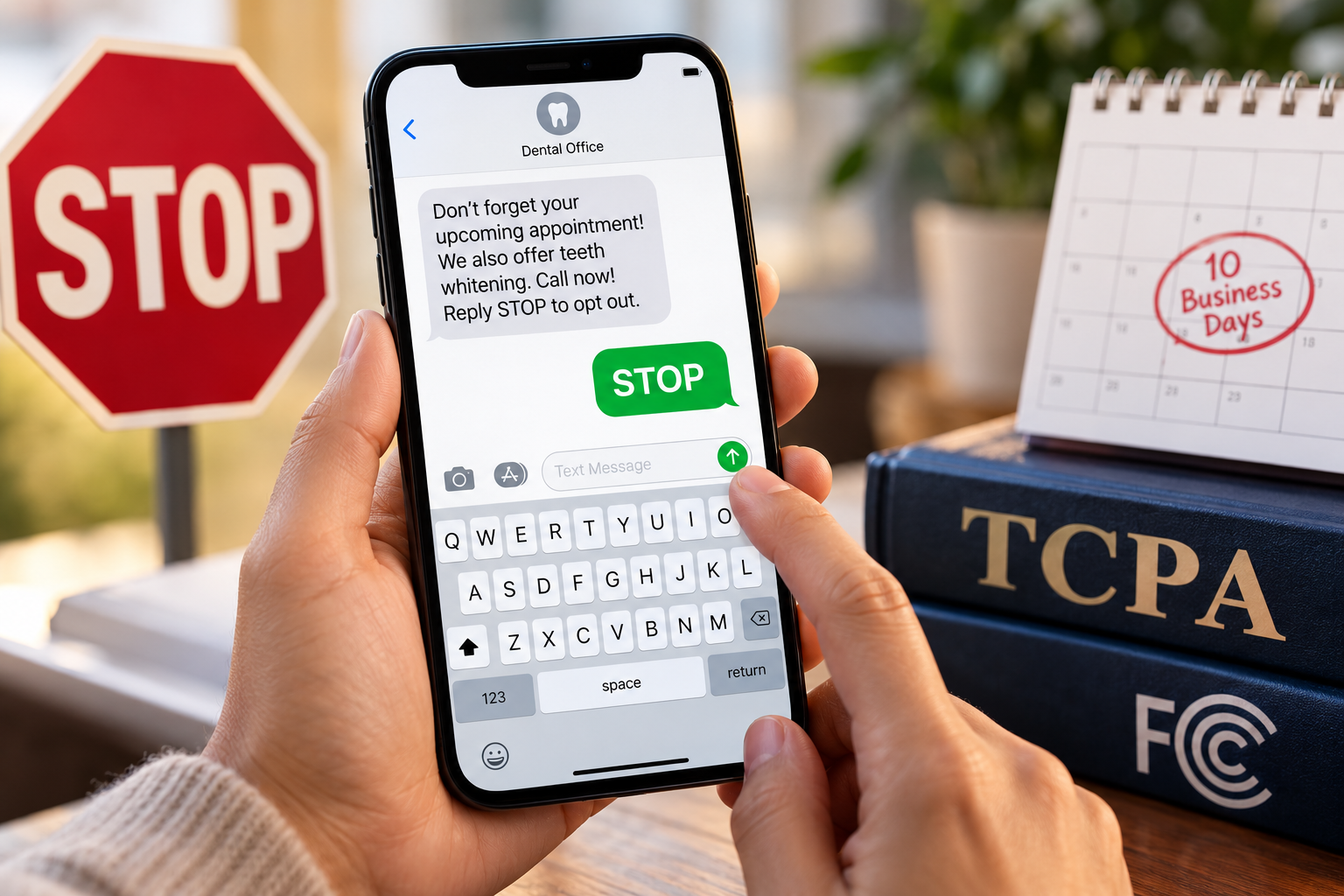
Revoking TCPA Consent: How Opting Out Works
Say Tasha in Atlanta signed up for appointment texts from her dentist a few years ago. Now the office also sends payment reminders, a teeth whitening promo, and a survey link. She replies “please stop” and the texts keep coming. Can she take back the permission she gave?
That question is the heart of revoking TCPA consent. Under the Telephone Consumer Protection Act, permission to get robocalls and automated texts isn’t permanent. The law generally lets people withdraw it. But the rules on how to withdraw it, and how far that withdrawal reaches, have changed more than once in the past two years.
The biggest shift came on September 30, 2026, when the Federal Communications Commission voted to rework its revocation rules. This guide explains how revocation works right now, what the new order changes, and a separate rule most people never hear about: the company-specific do-not-call list. For the basics of the law itself, see our plain-English guide to the Telephone Consumer Protection Act.
What Counts as TCPA Consent in the First Place
The TCPA, codified at 47 U.S.C. § 227, generally bars calls made with an autodialer or a prerecorded voice to cell phones unless the caller has the called party’s “prior express consent.” Text messages count as calls for this purpose. Calls made for emergency purposes are the main exception written into the statute.
The FCC’s rules at 47 C.F.R. § 64.1200 add a second, stricter tier. Marketing robocalls and robotexts generally need “prior express written consent.” That means a signed agreement, and an electronic signature counts, that clearly authorizes the seller to send telemarketing messages using automated technology. Informational messages, like a pharmacy refill alert or a flight delay notice, usually need only plain prior express consent.
That split between marketing and informational messages matters a lot for revocation. As you’ll see below, the FCC’s new order treats an opt-out from a sales text very differently from an opt-out from a payment reminder.
Can You Take Back Consent Under the TCPA?
Surprisingly, the statute doesn’t say. Congress wrote the consent requirement but never explained how someone takes consent back. The FCC filled that gap in 2015, ruling that consumers can revoke consent in any reasonable way that clearly expresses a wish not to get more calls.
Several federal appeals courts reached a similar result by borrowing from the common law of consent. Under that body of law, a person who gives permission freely can generally withdraw it.
The Contract Exception in New York, Connecticut and Vermont
The Second Circuit, which covers federal courts in New York, Connecticut and Vermont, carved out an important exception. In Reyes v. Lincoln Automotive Financial Services, the court held that a consumer can’t revoke consent on their own when that consent was part of a bargained-for contract, like a car lease.
Say Kevin in Yonkers finances a Toyota RAV4, and his signed loan agreement lets the lender call his cell phone using an autodialer. If he falls behind and tells the lender to stop calling, a court applying Reyes may find he couldn’t withdraw that consent without the lender’s agreement. Courts outside the Second Circuit don’t all follow this reasoning, so where a case is filed can change the outcome.
The “Any Reasonable Method” Standard Explained
The FCC’s 2024 TCPA Consent Order wrote the reasonable method standard directly into its rules, and most of those revocation rules took effect April 11, 2025. Under the current version of section 64.1200(a)(10), a person can revoke consent using any reasonable method that clearly tells the caller they don’t want more calls or texts.
The rule also names methods that automatically count as reasonable. Those include using a key-press or voice opt-out during an automated call, using a website or phone number the caller set up to handle opt-outs, and replying to a text with certain keywords.
The STOP Keywords
Under the current rule, a reply text using any of these seven words is a valid revocation on its own:
- stop
- quit
- end
- revoke
- opt out
- cancel
- unsubscribe
Those seven words aren’t the only ones that work. If someone replies with different words, the rule says the sender has to treat the reply as a revocation when a reasonable person would read it that way. Say Ray in Houston gets a home warranty text and writes back, “I’m done with these, take me off your list.” He didn’t use a keyword, but a reasonable reader would understand exactly what he meant.
Voicemails, Emails and Other Methods
What about a voicemail left on a company’s customer service line, or an email to its support address? Under the current rule, a method like that creates a rebuttable presumption that consent was revoked once the consumer shows the request was made. The company can try to prove otherwise, and the question is decided by looking at the totality of the circumstances.
The current rule also bars callers from forcing consumers to use one exclusive opt-out channel. That ban is one of the biggest things the September 2026 order changes.
How Fast Companies Have to Stop
10 business daysThe longest a caller can take to honor a revocation request under the current federal rule.
Companies must honor a revocation within a reasonable time, and no later than 10 business days after receiving it. A company may also send a confirmation text, as long as it only confirms the opt-out and includes no marketing. If that confirmation goes out within five minutes, it’s presumed to fall within the consumer’s earlier consent.
What the FCC Changed on September 30, 2026
The 2024 order included a “revoke all” rule. Under it, opting out of any one type of message would cut off every robocall and robotext from that caller that needs consent. Banks, utilities and health care groups pushed back, arguing that a customer who stops payment reminders probably doesn’t mean to stop fraud alerts too. The FCC delayed that piece twice, most recently pushing it to January 31, 2027, in a January 2026 waiver order.
On September 30, 2026, the Commission voted to adopt a Report and Order that reworks the whole framework, and it released the final text on October 1. The final order follows the draft order and fact sheet the FCC released on September 9 on the key points below, with one added clarification about how companies disclose a text opt-out. Here’s what the order does.
Informational Opt-Outs Can Be Limited to One Category
Under the new approach, a company may treat an opt-out from an informational call or text as covering only that category of message. The FCC pointed to categories like payment reminders, fraud alerts, multi-factor authentication codes, appointment reminders and utility outage notices. This is optional. A company that prefers to stop everything after one opt-out can still do that.
Say Dana in Columbus gets automated payment reminder texts from her credit union and replies STOP. Under the new rule, the credit union may treat that as ending the payment reminders only. It could keep sending fraud alert texts unless Dana opts out of those separately.
Marketing is different. An opt-out in response to a call or text that contains an advertisement or telemarketing still revokes consent to all future marketing robocalls and robotexts from that caller. One “unsubscribe” covers every sales pitch.
Companies Can Pick an Exclusive Opt-Out Method
The order also lets callers designate one or more exclusive ways to revoke consent. The options are limited to three: an automated key-press or voice opt-out on a call, a reply text using the standardized keywords, or a website or phone number the caller sets up for opt-outs.
There’s a condition. The caller has to clearly and conspicuously disclose the designated method on the call or in the text itself. A company that doesn’t designate an exclusive method stays under the “any reasonable means” standard.
The final order adds a practical detail for texts. A company that makes reply texts its exclusive method can meet the disclosure requirement by naming just one keyword, like “Reply STOP to opt out.” It still has to honor a reply that uses any of the seven standardized words.
Say Priya in Denver gets automated class reminders from her gym, and every text ends with “Reply STOP to opt out. This is the only way to opt out of these messages.” If she emails the front desk instead, the gym generally wouldn’t have to process that email under the new rule. If she replies “cancel,” the gym would still have to honor it, because “cancel” is one of the seven keywords. And if the gym’s texts never disclosed an exclusive method, her email would still be judged under the reasonable means standard.
Not in effect yet. The new rules take effect 30 days after the order is published in the Federal Register, and the FCC has said it will announce the exact date in a public notice. When this article was published in October 2026, that publication had not happened. Until it does, the rules that took effect in April 2025, including the ban on exclusive opt-out methods, remain the operative federal rules.
What the FCC Is Still Considering
The same order opened a further rulemaking. The FCC asked whether to shorten the 10-business-day deadline, noting a joint letter from banking, debt collection and consumer advocacy groups that suggested seven business days. It also asked whether to require two-way texting so people can always reply STOP, whether to require a one-step “revoke all” option, and how opt-outs should apply across a company’s affiliates.
Will Courts Follow the New Rules?
In 2025, the Supreme Court held in McLaughlin Chiropractic Associates v. McKesson Corp. that federal district courts aren’t bound by the FCC’s reading of the TCPA in private lawsuits. Courts still give the agency’s views weight, but they decide for themselves what the statute means. That leaves room for future cases to test whether an exclusive opt-out method fits with the consent the statute requires.
Company-Specific Do-Not-Call Lists Under 47 C.F.R. § 64.1200(d)
Revoking consent isn’t the only way to stop a company from calling. A separate rule, section 64.1200(d), requires companies that make telemarketing calls to residential subscribers to keep their own internal do-not-call list. This rule covers live sales calls from real people, not just robocalls. That’s a major difference from the consent rules above.
Under section 64.1200(d), a company making these calls must have procedures that meet these minimum standards:
- A written do-not-call policy that’s available on demand.
- Training for everyone involved in telemarketing on how the list works.
- Recording a consumer’s do-not-call request when it’s made and honoring it within a reasonable time, no more than 10 business days.
- Giving the person called the caller’s name, the company’s name, and a phone number or address where the company can be reached.
- Keeping the request on file and honoring it for five years.
A do-not-call request also ends any “established business relationship” exemption the company had for telemarketing, even if the person keeps doing business with that company. The request generally covers the company that called, plus affiliates the consumer would reasonably expect to be included.
Say Greg in Charlotte gets a live sales call from a fictional company called Sunbright Solar. He tells the rep, “Put me on your do-not-call list.” Sunbright has up to 10 business days to process that request, and then the request lasts five years. If Greg gets another Sunbright sales call a month later, that call may violate the internal list rule.
How the Internal List Differs From the National Registry
The National Do Not Call Registry is a single federal list that covers most telemarketers at once. The internal list works company by company. Someone can be on the national registry and still need to tell a particular company to stop, for example when that company has an established business relationship that lets it call registered numbers.
The FCC’s rules apply the internal list requirements to wireless numbers, and many courts treat a personal cell phone as a residential line. Courts haven’t all agreed on whether internal list violations can support a private lawsuit under the TCPA’s do-not-call provision, though many have allowed those claims to proceed.
How Florida’s STOP Rule Differs From Federal Law
States can add their own rules on top of the TCPA, and Florida is a clear example. The Florida Telephone Solicitation Act, Fla. Stat. § 501.059, was amended in 2023 to add a step that comes before any lawsuit over marketing texts.
Under the Florida law, a person who wants to sue over unwanted sales texts must first reply “STOP” to the number that sent them. The sender then gets 15 days to stop texting, and a damages claim can move forward only if the texts continue after that window. The sender is allowed one text confirming it got the request.
Compare that with federal law, where many reasonable methods can count and the outside deadline is 10 business days. Say Marco in Orlando replies “no more texts please” to a car dealership’s promotions. Under the federal rule, that reasonable request could count as a revocation. Under the Florida statute’s text message provision, only a STOP reply starts the 15-day clock.
A Hypothetical Walkthrough
Here’s how the federal pieces fit together in one fictional case. Alyssa in Philadelphia gave a furniture store her cell number and signed an online form agreeing to get marketing texts. On Monday, March 2, she replies “unsubscribe” to a sale text.
- March 2: “Unsubscribe” is one of the standardized keywords, so her reply is a valid revocation of consent to marketing texts.
- March 2, one minute later: The store texts “You’ve been unsubscribed.” That’s allowed because it only confirms the opt-out.
- March 5: Another promo text arrives. The store’s 10-business-day window runs through March 16, so this text likely falls inside the processing period.
- March 20 and March 27: Two more promo texts arrive, both after the deadline.
Under the TCPA, each covered text sent without consent can support statutory damages of $500. A court may raise that to as much as $1,500 per text if it finds the violation was willful or knowing. For the two late texts, that’s a potential range of $1,000 to $3,000. One big “if” remains: whether the store’s texting platform counts as an autodialer, which is a separate and heavily litigated question.
Key takeaway: Most revocation questions come down to three things. What kind of message was it, marketing or informational? How was the opt-out made? And when did the company receive it?
Common Questions About Revoking TCPA Consent
Does replying STOP to a text revoke TCPA consent?
Under the current federal rule, yes. “Stop” is one of seven standardized keywords that count as a valid revocation on their own. Once the new order takes effect, a STOP reply to an informational text may end only that category of messages, while a STOP reply to a marketing text still ends all marketing from that caller.
Can a company make you opt out only one way?
Not under the rules in effect when this article was published in October 2026. Once the September 2026 order takes effect, a company can designate an exclusive method from the FCC’s approved list. It has to clearly disclose that method on the call or in the text for the designation to work.
Can you revoke TCPA consent over the phone?
Generally yes, as long as it’s a reasonable way to get the message across and the caller hasn’t validly designated an exclusive method. Telling a live agent “stop calling me” is the kind of request the FCC has long treated as reasonable. The Second Circuit’s contract exception in Reyes is a notable limit.
How long does a company have to stop calling after you opt out?
Up to 10 business days under the current federal rule. That deadline applies to consent revocations and to internal do-not-call requests. The FCC is now considering whether to shorten it.
Does joining the Do Not Call Registry revoke consent?
Not exactly. The registry restricts telemarketing calls to registered numbers, but it doesn’t erase consent a person already gave a specific company. A signed written agreement to be contacted by a particular seller can still allow sales calls to a registered number.
The Bottom Line
Revoking TCPA consent has long been possible, but the rules on how it works and how far it reaches are shifting. Right now, almost any reasonable method counts, and companies get up to 10 business days to comply. Once the September 2026 order takes effect, companies may limit informational opt-outs to one category and require a single disclosed opt-out method, while a marketing opt-out still stops all marketing.
This article is for educational purposes only and is not legal advice. Reading it does not create an attorney-client relationship. For advice on your specific situation, consult a licensed attorney in your state.