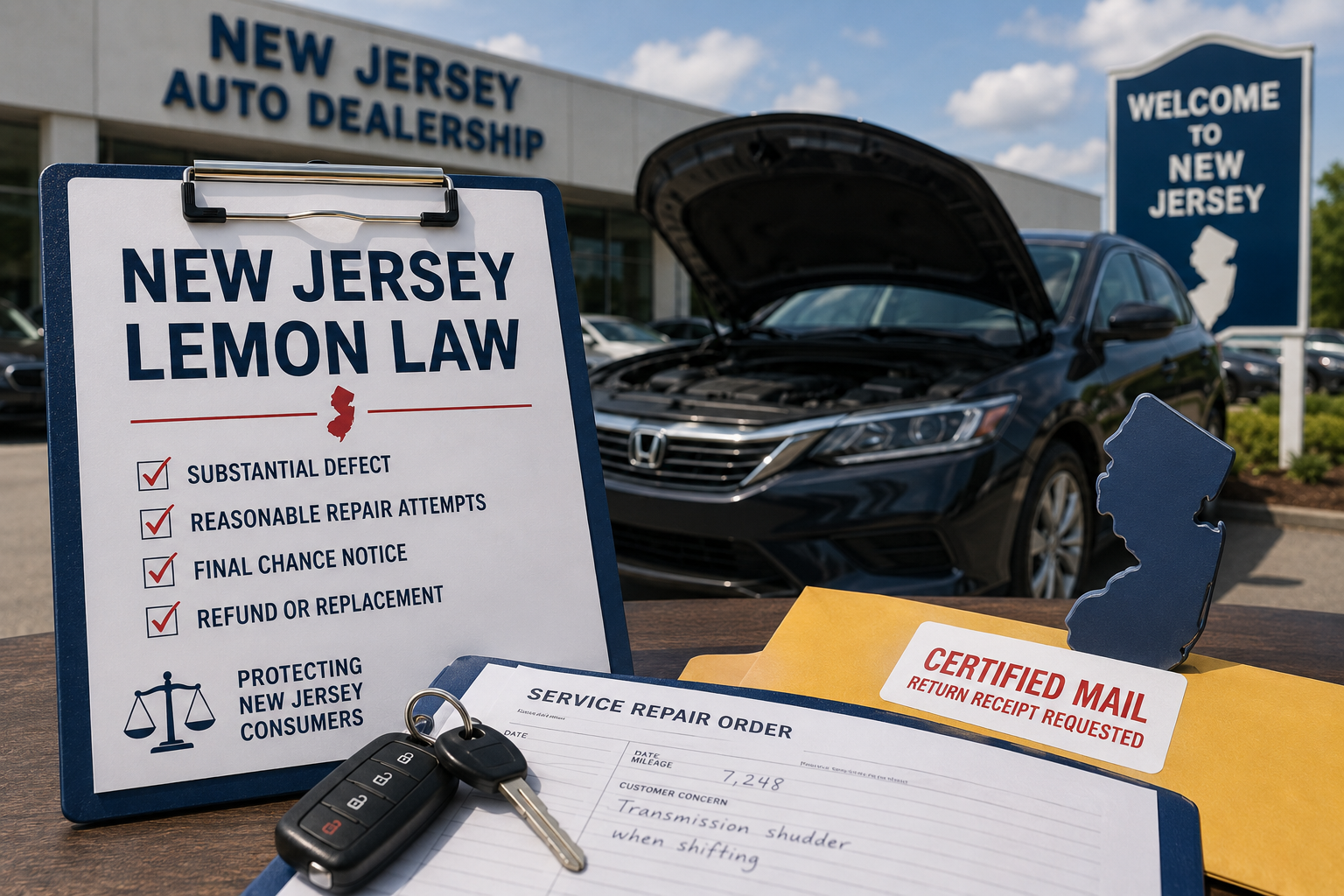
If you bought or leased a car in New Jersey and the same problem keeps coming back no matter how many times the dealer says it’s fixed, you may be wondering whether the New Jersey Lemon Law actually applies to you. That’s the right question to ask, and this guide is built to answer it.
What follows is a plain English walkthrough of how the NJ Lemon Law works. Who it covers. How repair attempts get counted. What the certified mail final chance letter is and why so many claims fall apart on that one step. How new car protections differ from used car protections. What the Lemon Law Unit process looks like from application to hearing.
The same rules apply whether you bought your car in Jersey City, Cherry Hill, Paterson, or Toms River. Only the hearing location changes.
This is general educational information about how New Jersey law works. It is not legal advice, and reading it does not create an attorney-client relationship. Lemon law outcomes depend heavily on the specific facts, documents, vehicle, and timing involved.
What Is a Lemon Law?
A “lemon” is a vehicle with a serious, repeating defect that the manufacturer or dealer can’t fix in a reasonable number of tries. The term goes back decades in the auto industry. It basically means a car you got stuck with that should have worked.
Every state has some version of a lemon law. The general purpose is the same everywhere. If you bought a defective car, the manufacturer or dealer should fix it, replace it, or buy it back, instead of leaving you making payments on something that doesn’t run right.
The specifics vary a lot from state to state. Some states only cover new cars. A small handful, including New Jersey, also cover certain used cars. A claim generally requires three things. A substantial defect. A reasonable opportunity for the manufacturer or dealer to fix it. And the right procedural steps by the consumer, which usually includes written notice.
What Is the New Jersey Lemon Law?
The New Jersey Lemon Law is a state consumer protection statute that may entitle qualifying consumers to a refund, replacement, or buyback when a vehicle has a substantial defect the manufacturer or dealer cannot fix after a reasonable number of attempts.
New Jersey actually has two separate lemon laws that tend to get talked about as one.
The New Car Lemon Law
The first is the New Car Lemon Law, found at N.J.S.A. 56:12-29 and following. It covers new cars, motorcycles, authorized emergency vehicles, farm tractors, and the vehicle portion of motor homes that are purchased, leased, or registered in New Jersey. The term of protection runs for two years or 24,000 miles from delivery, whichever comes first.
The Used Car Lemon Law
The second is the Used Car Lemon Law, found at N.J.S.A. 56:8-67 and following. It covers used passenger vehicles bought from a licensed New Jersey dealer that meet certain price, age, and mileage thresholds. Instead of a flat two year window, it requires a tiered dealer warranty of 90, 60, or 30 days depending on the mileage at the time of sale.
Both laws are administered by the New Jersey Division of Consumer Affairs through its Lemon Law Unit, located at P.O. Box 45026, Newark, NJ 07101, and reachable at (973) 504-6226. When a hearing is scheduled, it takes place at the Office of Administrative Law in Newark, Trenton, or Atlantic City.
How the NJ Lemon Law Process Works, Step by Step
At a high level, a New Jersey Lemon Law claim moves through the same stages every time.
- A defect shows up and the consumer takes the vehicle to an authorized dealer for repair.
- The dealer either fixes the problem or doesn’t. The consumer keeps every repair order.
- The same defect keeps happening, and the repair attempts start adding up.
- The consumer sends the manufacturer a certified mail final chance letter, and the manufacturer gets 10 days to make one last repair attempt.
- If the defect is still there, the consumer files an application with the Lemon Law Unit.
- If the application is accepted, the case is scheduled for a hearing at the Office of Administrative Law, where an administrative law judge issues an initial decision.
That’s the structure. The details matter, because most consumers who never get relief make a procedural mistake somewhere in the first four steps. The rest of this guide breaks each one down.
What Qualifies as a Lemon in New Jersey?
To qualify under the New Jersey Lemon Law, the defect has to substantially impair the vehicle’s use, value, or safety. It can also qualify if it’s a serious safety defect likely to cause death or serious bodily injury if the vehicle is driven.
That phrase, “use, value, or safety,” shows up over and over in NJ lemon law materials. It’s the legal heart of the standard. A scratch on the bumper doesn’t impair use, value, or safety in a substantial way. A transmission that randomly drops into neutral on the Turnpike does.
Defects that have historically raised lemon law questions in New Jersey include engine stalling, no start conditions, and sudden power loss. Transmission failures and repeated shifting problems come up often. Brake and steering defects are frequently treated as serious safety defects. Electrical malfunctions that affect drivability, airbag and safety system defects, and persistent water intrusion that damages wiring all show up regularly.
Minor cosmetic issues, problems fixed on a single visit, and rattles that don’t affect use or safety usually don’t meet the standard on their own. Buyer’s remorse doesn’t qualify either. You can’t return a car under the lemon law just because you don’t like how it drives or because gas prices went up.
The New Car Lemon Law does not cover vehicles registered for commercial use, the living quarters of motor homes, defects caused by accident, vandalism, abuse, or neglect, or defects caused by someone other than the manufacturer, its agent, or an authorized dealer.
How Many Repair Attempts Are Needed Under NJ Lemon Law?
This is where a lot of confusion lives, because New Jersey uses two different counts for two different purposes.
The Count That Lets You Send the Letter
Under the Division’s New Car Lemon Law guidance, the final chance letter can go out to the manufacturer once any one of these has happened inside the protection period:
- Two repair attempts for the same defect have failed to fix the problem
- The vehicle has been out of service for a total of 20 days, or 45 days for a motor home
- A single repair attempt has failed on a serious safety defect
The Count That Gets You a Hearing
To qualify for a hearing at the Office of Administrative Law, the Division looks for a fuller record. Three repair attempts. Certified mail notice to the manufacturer within 24,000 miles and two years from delivery. Proof from the return receipt that the manufacturer got that notice. A real final chance to repair. And a defect that still exists after that final attempt.
Two failed attempts opens the door to the letter. Three attempts is generally what gets the case in front of an administrative law judge. Twenty cumulative days out of service is its own separate trigger, and it counts even if the days came from a series of different problems.
People often search “what if my car is out of service for 20 days in NJ” or “what if my car is out of service for 30 days in NJ.” Twenty cumulative calendar days is the number built into the process. Thirty exceeds it. Once you cross 20 days while the dealer is trying to fix something, that prong is satisfied.
The Certified Mail Final Chance Letter
This is the step where the most New Jersey lemon law claims fall apart, so it deserves its own section.
Inside the protection period, the consumer sends the manufacturer, not the dealer, a written notice by certified mail with return receipt requested. The letter says the consumer may have a lemon law claim and is giving the manufacturer one last chance to repair the defect. The manufacturer then has 10 days from the date on the return receipt to make that repair.
A phone call to customer service doesn’t count. An email doesn’t count. A complaint posted on social media tagging the manufacturer doesn’t count. The process uses certified mail with a return receipt because that’s how the consumer proves the manufacturer actually received notice and had its 10 day window.
One detail that trips people up: the letter has to go to the manufacturer’s regional office, and the Lemon Law Unit is the source for that address. Sending it to the dealership, or to a corporate address pulled off a website, can undercut the whole step.
Three pieces of paper come out of this step and all three matter. A copy of the letter itself. The certified mail return receipt showing the date the manufacturer received it. And the final repair attempt invoice showing what the dealer did during those 10 days.
Without that return receipt, an application can stall before it ever reaches a hearing. Plenty of otherwise strong cases have been weakened by a consumer skipping or fumbling this single step. The Division’s New Car Lemon Law consumer brief includes a sample version of the letter, which shows the kind of information the notice is expected to contain.
People search for this step under a lot of names. “NJ lemon law certified letter.” “New Jersey lemon law demand letter.” “NJ lemon law final chance letter.” They’re all the same thing.
How the NJ New Car Lemon Law Works
Who Is Covered
The New Car Lemon Law applies to anyone who buys, leases, or registers a new car or motorcycle in New Jersey. The term of protection is two years or 24,000 miles from delivery, whichever comes first.
Does it apply to leased cars? Yes. Leased new vehicles registered in New Jersey are covered, and a manufacturer can be ordered to release the lease without an early termination penalty if the consumer wins.
Motorcycles are explicitly covered. SUVs and trucks are covered as passenger vehicles, as long as they aren’t registered for commercial use. As of January 2010 the law also reaches authorized emergency vehicles, and a 2016 amendment added farm tractors.
Motor homes are partly covered. The vehicle portion counts. The living quarters don’t. So if the engine, transmission, or steering has a substantial defect, the New Car Lemon Law may apply. If the problem is the refrigerator, the bed, or the bathroom, it probably won’t.
What the Protection Period Looks Like in Practice
The two year and 24,000 mile clock starts at delivery. Buy a new car on March 1, 2026 with 12 miles on the odometer, and the protection period runs until March 1, 2028 or until the odometer hits 24,012, whichever happens first.
That second condition catches New Jersey commuters off guard all the time. If you drive from Newark to Princeton every weekday, you can put 20,000 miles a year on a car without trying. In that case your protection period might really run out around month 14, not month 24, because you’d hit the mileage cap first.
The defect has to appear and be reported inside that window. A problem that surfaces at 26,000 miles or in month 25 typically won’t qualify, even if you’d only just noticed it.
Filing a New Car Lemon Law Claim
If the manufacturer doesn’t resolve the issue after the final chance letter, the next step is a Lemon Law application to the Division of Consumer Affairs. The Unit reviews it and either approves it, rejects it, or sends it back for edits. Once approved, a $50 filing fee is requested, and that fee is refunded if the consumer wins.
After the fee is paid, a copy of the application goes to the manufacturer and a hearing date is set, usually within about 20 days of acceptance, subject to the OAL’s calendar. The administrative law judge issues an initial decision within 20 days of the hearing. The Director of Consumer Affairs then issues a final decision within 15 days, adopting, modifying, or rejecting that initial decision.
Some manufacturers also run their own informal arbitration programs. The state process through the Lemon Law Unit is the one with the built in deadlines described above.
If a consumer prevails, the manufacturer may be ordered to:
- Refund the purchase price, or the lease payments and remaining lease obligation
- Release the lease without an early termination penalty
- Reimburse collateral charges such as registration fees, taxes, towing, and rental car costs
- Pay reasonable attorney’s fees
The refund is reduced by a deduction for personal use, based on how many miles the consumer drove between delivery and the buyback.
How the NJ Used Car Lemon Law Works
New Jersey is one of a small group of states with a dedicated used car lemon law. It applies only to used vehicles bought from a licensed New Jersey dealer, which means private party sales aren’t covered at all.
NJ Used Car Lemon Law Eligibility Thresholds
To fall under the Used Car Lemon Law, the vehicle has to meet all of the following at the time of sale:
- Purchase price of more than $3,000
- Seven model years old or less
- Odometer reading of 100,000 miles or less
- Not declared a total loss by an insurance company
Miss even one of those and the Used Car Lemon Law doesn’t apply, though other consumer protection laws like the New Jersey Consumer Fraud Act may still be in play.
This is why so many people search “does NJ lemon law apply to used cars.” The answer is yes, with real limits. A $2,500 used hatchback from a dealer isn’t covered. A nine year old used pickup isn’t covered. A used car with 110,000 miles isn’t covered. And a used car sold privately isn’t covered, no matter how new or expensive it is.
Required Dealer Warranty, Tiered by Mileage
For qualifying used vehicles, the dealer has to provide a written warranty. How long that warranty runs depends on the odometer reading at the time of sale.
| Mileage at Sale | Minimum Dealer Warranty |
|---|---|
| 0 to 24,000 miles | 90 days or 3,000 miles, whichever comes first |
| 24,001 to 60,000 miles | 60 days or 2,000 miles, whichever comes first |
| 60,001 to 100,000 miles | 30 days or 1,000 miles, whichever comes first |
A waiver of this warranty is only valid for vehicles between 60,001 and 100,000 miles, and only if it’s in a signed writing. For vehicles under 60,000 miles, a dealer can’t sidestep the warranty by selling the car “as is.”
NJ Used Car Lemon Law Repair Attempt Rule
The used car standard mirrors the new car standard. A consumer may be entitled to a refund of the full purchase price if, during the dealer warranty period, the dealer has been unsuccessful at fixing the same material defect after at least three attempts, or the vehicle has been out of service for 20 cumulative days while the dealer is trying to fix it.
Consumers may be charged a deductible of up to $50 per repair of each covered item. The regulations that govern this process are set out in N.J.A.C. 13:45A-26F.
Filing a NJ Used Car Lemon Law Claim
Unlike the New Car Lemon Law, filing a Used Car Lemon Law application with the Lemon Law Unit is free. There’s no $50 fee. The Division publishes the Used Car Lemon Law dispute resolution application on its site in several languages.
If the consumer wins, the dealer may be ordered to repurchase the vehicle and refund the purchase price, reduced by a deduction for the miles the consumer drove.
NJ New Car vs. Used Car Lemon Law: Quick Comparison
| Factor | New Car Lemon Law | Used Car Lemon Law |
|---|---|---|
| Statute | N.J.S.A. 56:12-29 et seq. | N.J.S.A. 56:8-67 et seq. |
| Protection period | 2 years or 24,000 miles | 30, 60, or 90 days, tiered by mileage |
| Hearing threshold | 3 attempts or 20 days out of service | 3 attempts or 20 days out of service |
| Final chance certified letter | Required, sent to the manufacturer | Dealer warranty procedure applies |
| Filing fee | $50, refunded if you win | $0 |
| Private sales covered | Not applicable | No, licensed NJ dealers only |
| Per repair deductible | None | Up to $50 per repair |
| Attorney’s fees if you win | Manufacturer pays | Dealer pays |
Refunds Under the NJ Lemon Law
A refund is one of the available remedies under both New Jersey lemon laws. It isn’t automatic, and the amount follows a formula rather than a round number.
A typical New Car Lemon Law refund includes the full purchase price, or the total of lease payments plus the residual obligation, minus a deduction for personal use based on miles driven. It also typically includes collateral charges like registration fees and sales tax, plus documented expenses tied to the defect such as towing and rental cars.
A “manufacturer buyback” is essentially the same thing as a refund. People search both phrases interchangeably. Under New Jersey procedure, a buyback can arrive in a few ways. Through a settlement with the manufacturer before a hearing. Through an order from the administrative law judge after a hearing. Or through a manufacturer’s own arbitration program.
Replacement Vehicles Under the NJ Lemon Law
A replacement vehicle is another possible outcome, but in practice refunds are far more common in New Jersey than replacements. The math on a replacement is messier. The manufacturer has to provide a vehicle of comparable value, and both sides have to agree on what “comparable” means.
Refunds are cleaner administratively, so they tend to be the default in NJ buybacks. Where a consumer specifically wants a replacement instead of money back, that generally becomes a negotiation point raised early rather than something the process produces on its own.
Records That Matter in a NJ Lemon Law Case
Lemon law cases are built on documentation. Whether or not a claim ever gets filed, these are the records that carry weight.
- Repair orders for every visit, showing the date, the mileage at drop off, the complaint in the consumer’s own words, and the technician’s notes
- The purchase or lease agreement, including any addenda
- The finance contract or lease payment history
- The warranty booklet
- The certified mail return receipt from the final chance letter
- Photos or video of the defect actually happening, which matters most for intermittent problems like a stall that shows up once a week
- Tow and rental car receipts
- Every email, text, and letter exchanged with the dealer and the manufacturer
One practical habit is worth more than the rest combined. Read each repair order before leaving the service department. If it says “no problem found” or just “customer states issue,” but you described stalling at 60 miles per hour on the Garden State Parkway, that gap can matter a lot at a hearing months later. The repair order is the official record of what happened.
Example: Maria’s New Car in Bergen County
Say Maria lives in Hackensack. She picks up a brand new sedan from a dealership in Paramus on a Saturday in April. The car has 8 miles on the odometer when she drives it home.
At about 3,800 miles she notices a transmission shudder when the car shifts from second to third. It’s mild at first. Over a couple of weeks it gets worse, so she brings the car in.
Visit one, at 4,400 miles. The dealer keeps the car two days and replaces the transmission valve body. Maria picks it up and the shudder seems gone.
Visit two, at 6,100 miles, about three weeks later. The shudder is back. The dealer keeps the car four days and reflashes the transmission control module software. The repair order documents the same complaint.
At this point Maria has two failed repair attempts for the same defect, well inside her two year and 24,000 mile window. Under the Division’s guidance, that’s already enough to send the manufacturer a certified mail final chance letter.
Visit three, at 7,200 miles, about a month after that. The shudder is still there, and now there’s a delayed engagement shifting from reverse to drive. The dealer keeps the car 11 days waiting on a part. Total time out of service across the three visits is 17 days, and Maria now has three documented attempts at substantially the same defect.
If the manufacturer’s final repair attempt fails after the certified letter, the next procedural step would be a Lemon Law application to the Division of Consumer Affairs, the $50 filing fee, and a hearing date at the OAL.
This is a made up scenario. Every real case turns on its own facts, documents, and timing. The point is just to show how the procedural pieces stack up.
Example: David’s Used SUV in Union County
Now say David lives in Elizabeth. He buys a five year old SUV from a licensed dealer for $11,500. The odometer reads 48,000 miles at the time of sale.
Because the SUV falls between 24,001 and 60,000 miles, the Used Car Lemon Law puts him in the 60 day or 2,000 mile warranty tier. He drives off the lot on a Tuesday.
Two weeks later the check engine light comes on and the SUV starts running rough. He brings it back. The dealer replaces a coil pack and says it’s fixed. That’s visit one.
A week after that the same misfire returns. Visit two, and the dealer replaces all the spark plugs. Three days later the misfire is still happening. Visit three, and the dealer keeps the SUV three days running diagnostics before admitting they can’t find the root cause.
David now has three documented repair attempts for substantially the same material defect, all inside the 60 day warranty window. Under the Used Car Lemon Law, that’s the point at which a consumer may be entitled to a refund from the dealer, not the manufacturer, and may file a free application with the Lemon Law Unit if the dealer refuses.
Hypothetical again. Every real used car situation depends on its own paperwork, timing, and vehicle history.
Common Mistakes New Jersey Consumers Make
The first is skipping or botching the certified mail final chance letter. Plenty of people call the manufacturer’s customer service line or send an email and assume it counts. The process contemplates certified mail with a return receipt, sent to the regional address the Lemon Law Unit provides.
The second is letting the dealer write vague repair orders. “Customer concern” is not the same thing as a document that describes a stalling defect, and that difference can decide a case months later.
The third is assuming a private used car sale is covered. The Used Car Lemon Law reaches licensed New Jersey dealers only. A car bought from someone on Facebook Marketplace falls outside it, though the Consumer Fraud Act may still apply if the seller misrepresented the vehicle.
The fourth is waiting past the protection period. New cars get two years or 24,000 miles, whichever comes first. Used cars can be down to a 30 day dealer warranty. The window can close before a serious problem even fully reveals itself.
The fifth is signing a buyback or settlement without reading it closely. Releases, confidentiality clauses, and “as is” language in settlement papers can have effects that outlast the car itself.
The sixth is trading in or selling the vehicle before the claim is resolved. Once the car is gone, the remedies often go with it.
The seventh is taking the car to an independent shop for warranty work. Repairs generally have to be done by the manufacturer, its agent, or an authorized dealer to count toward the lemon law thresholds.
When People Consider Talking to a New Jersey Lemon Law Attorney
The Lemon Law Unit notes that an attorney isn’t required at an OAL hearing, and that a consumer who wins is entitled to reasonable attorney’s fees paid by the manufacturer. That fee shifting rule is why many New Jersey lemon law attorneys handle qualifying cases on contingency.
Consumers commonly start looking for representation when:
- The same defect keeps returning after multiple repairs
- The manufacturer has denied a claim or made a low buyback offer
- The defect involves a safety system such as brakes, airbags, steering, or stalling
- It isn’t clear whether a used car meets the eligibility thresholds
- A hearing has been scheduled at the OAL
- Settlement paperwork has arrived and needs a careful read
How the NJ Lemon Law Applies Across the State
The Lemon Law Unit handles applications from every county in New Jersey. Hearings are held at the Office of Administrative Law in Newark, Trenton, and Atlantic City, so consumers statewide move through the same process.
The same rules apply whether the vehicle was bought or registered in Bergen County towns like Hackensack, Paramus, and Fort Lee, or in Hudson County cities like Jersey City, Hoboken, and Bayonne. Essex County residents in Newark, East Orange, and Montclair follow the same steps as Passaic County residents in Paterson, Clifton, and Wayne.
It works the same way in Union County, Middlesex County, Monmouth County, Ocean County, Mercer County, Camden County, Burlington County, and Atlantic County, and in the rest of the state’s counties as well. Whether you bought in Elizabeth, Edison, Toms River, Cherry Hill, or Trenton, the standards don’t change. Only the hearing location does.
Frequently Asked Questions About the NJ Lemon Law
What is the New Jersey Lemon Law in simple terms?
It’s a state consumer protection statute that may require a manufacturer or dealer to refund or replace a vehicle when a substantial defect can’t be repaired after a reasonable number of attempts during the protection period.
How long is the lemon law period in New Jersey?
For new cars, two years or 24,000 miles from delivery, whichever comes first. For used cars, a tiered dealer warranty of 30, 60, or 90 days depending on mileage at sale.
How many repair attempts are required under NJ lemon law?
Two failed attempts at the same defect generally allow the final chance letter to go out. Three attempts is what the Division looks for to qualify a case for a hearing. Twenty cumulative days out of service is a separate trigger on its own.
What qualifies as a lemon in New Jersey?
A vehicle with a substantial defect that impairs its use, value, or safety, or a serious safety defect likely to cause death or serious bodily injury, where the manufacturer or dealer has had a reasonable opportunity to repair it.
Does the NJ Lemon Law cover used cars?
Yes, but only used cars sold by a licensed New Jersey dealer for more than $3,000, with 100,000 miles or less, seven model years old or less, and not declared a total loss.
Does the NJ Lemon Law cover private used car sales?
No. Private party sales fall outside the Used Car Lemon Law. Other laws such as the Consumer Fraud Act may still apply.
Does the NJ Lemon Law cover leased vehicles?
Yes. Purchased and leased new vehicles registered in New Jersey both fall under the New Car Lemon Law, and a manufacturer can be ordered to release the lease without an early termination penalty.
Does the NJ Lemon Law cover motorcycles, SUVs, and trucks?
Motorcycles are explicitly covered. SUVs and trucks are covered as passenger vehicles, as long as they aren’t registered for commercial use.
Does the NJ Lemon Law cover motor homes and RVs?
The vehicle portion is covered, including the engine, transmission, and steering. The living quarters are not. Motor homes also get a 45 day out of service trigger instead of the usual 20.
What if my car is out of service for 20 days in NJ?
Twenty cumulative calendar days out of service for repairs is one of the qualifying thresholds under both New Jersey lemon laws.
What if the dealer cannot fix my car in NJ?
Under the New Car Lemon Law, the next procedural step is a certified mail final chance letter to the manufacturer. Under the Used Car Lemon Law, it depends on whether the problem happened during the dealer warranty period.
How much does it cost to file a NJ Lemon Law claim?
Fifty dollars under the New Car Lemon Law, refunded if the consumer wins. The Used Car Lemon Law has no filing fee.
How do I file a lemon law claim in NJ?
An application goes to the Division of Consumer Affairs Lemon Law Unit with supporting documentation, including the purchase or lease agreement, repair orders, the certified mail receipt, and manufacturer correspondence. If accepted, the case is scheduled at the OAL.
Where are NJ Lemon Law hearings held?
At the Office of Administrative Law in Newark, Trenton, or Atlantic City. Consumers can choose from the available hearing dates.
How do I contact the NJ Lemon Law Unit?
New Jersey Division of Consumer Affairs, Lemon Law Unit, P.O. Box 45026, Newark, NJ 07101, (973) 504-6226. The Unit’s page is on the Division of Consumer Affairs website.
Official New Jersey Lemon Law Resources
- Division of Consumer Affairs Lemon Law Unit, the main state hub for both laws
- Used Car Lemon Law consumer brief, which lists the covered parts in detail
- N.J.A.C. 13:45A-26, the automotive dispute resolution regulations
- Statutes, regulations, and forms index from the Division of Consumer Affairs
The New Jersey Lemon Law gives consumers a real path to a refund when a vehicle can’t be fixed, but that path runs on deadlines and paperwork. The protection period is short. The certified mail step is easy to get wrong. And the repair orders written at the service desk end up being the record everything else is judged against.
Understanding how the process is built is the first step to recognizing where a case stands.
This article is for educational purposes only and is not legal advice. Reading it does not create an attorney-client relationship. For advice on your specific situation, consult a licensed attorney in your state.