Florida Lemon Law and the Stellantis Backup Camera Recall
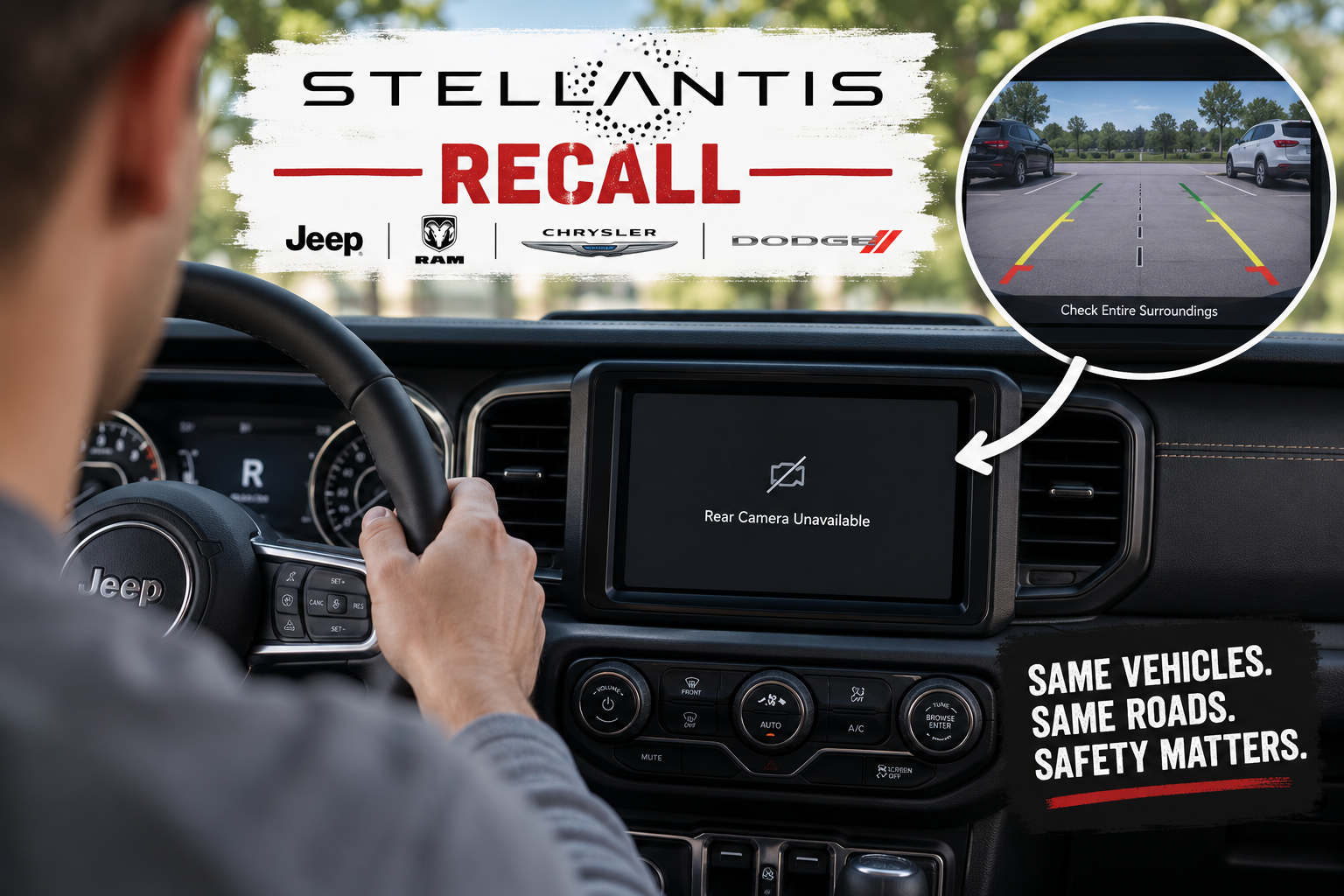
You shift your brand new Jeep into reverse and the screen stays black. No camera image, no warning, nothing. That is the problem behind one of the largest vehicle recalls of the year, and it is why a lot of Florida drivers are suddenly reading up on Florida lemon law.
In August 2026, Stellantis recalled roughly 955,000 vehicles worldwide because of a radio software problem that can stop the rearview camera image from appearing when you back up. The camera itself is fine. The software that puts the picture on your center screen is the part that fails.
For most owners this will end with a free software update and nothing more. For a smaller group, the fix will not stick. This article explains what the recall actually covers and how Florida’s lemon law generally treats a defect that keeps coming back after repairs.
What Went Wrong With the Camera
The recall is filed with federal regulators as NHTSA campaign number 26V531000. Stellantis calls it recall 78D internally. It covers vehicles built with a specific Uconnect 5 radio unit, and the bug lives in that radio’s software.
When it happens, you get no alert. You put the car in reverse and the image that should appear on the media screen simply does not load. There is no pattern the driver can predict and no way to tell in advance whether this trip will be the one where the screen goes dark.
Federal safety records list 844,027 affected vehicles in the United States. Stellantis originally told reporters the number was closer to 848,511. The gap is normal. Manufacturer press estimates and the final federal count often differ slightly once the vehicle list is nailed down.
Which Vehicles Are Covered
The list runs across all four Stellantis brands and covers mostly 2026 model year vehicles, with the Chrysler Pacifica and Dodge Charger stretching into 2027.
- Jeep Wrangler, Gladiator, Compass, Cherokee, Grand Cherokee, Grand Cherokee L, Grand Wagoneer and Grand Wagoneer L
- Ram 1500, Ram 2500, ProMaster and ProMaster EV
- Chrysler Pacifica, Pacifica Plug-In Hybrid and Voyager
- Dodge Charger
Owner notification letters started going out around September 1, 2026. Vehicle identification numbers became searchable on the federal database on August 20, so owners can check a specific vehicle through NHTSA’s VIN lookup tool without waiting for mail. The repair is free either way, whether it arrives as an over the air update or gets loaded at a dealership.
Why a Dark Screen Counts as a Safety Problem
It would be easy to write this off as an infotainment annoyance. Federal regulators do not see it that way. Backup cameras have been required equipment on new light duty vehicles since the 2018 model year under Federal Motor Vehicle Safety Standard 111, 49 C.F.R. section 571.111, which says the rear image has to appear by default at the start of every backing event.
Because the image can fail to show up, these vehicles are recorded as failing to meet that standard. That makes this a noncompliance recall, not just a defect recall. The distinction matters. It means a federal agency has already written down that the vehicle does not meet a safety requirement, which is a useful fact for anyone later arguing the defect affects safety.
Stellantis says it is not aware of any crashes or injuries connected to this defect. The company’s interim guidance is to stay alert and use the rearview and side mirrors when reversing until the update is installed.
How Florida Lemon Law Handles a Defect Like This
Florida’s lemon law is officially the Motor Vehicle Warranty Enforcement Act, found at Chapter 681, Florida Statutes. It applies to new and demonstrator vehicles bought or leased in Florida for personal, family or household use.
The law does not cover every flaw. Fla. Stat. section 681.102 defines a nonconformity as a defect or condition that substantially impairs the use, value or safety of the vehicle. A camera that will not display when you back up is a reasonable candidate for the safety half of that test, especially given how federal regulators classified it.
That same section sets the clock. The Lemon Law rights period runs 24 months from the day the vehicle was originally delivered, and the defect has to be reported to the manufacturer or an authorized dealer inside that window.
Does a Recall Count as a Repair Attempt?
This is the question people ask most often, and the answer surprises them. A recall notice by itself is not a lemon law claim. It is a notice that a fix exists. What the statute counts is documented repair attempts for the same nonconformity.
Under Fla. Stat. section 681.104, the law presumes a manufacturer has had a reasonable number of chances in one of two situations. The first is when the same problem has gone in for repair at least three times, the consumer then sends the manufacturer written notice by registered or express mail, the manufacturer gets a final attempt, and the problem still exists. The second is when the vehicle has been out of service for repairs for 30 or more cumulative days.
Florida spells out what those terms mean in its regulations, not just its statutes. Rule 2-30.001, Florida Administrative Code defines a repair attempt as replacing a component or making an adjustment to correct a nonconformity, and it counts an out of service day as any day, weekends and holidays included, that the vehicle sits at an authorized service agent for examination or repair.
There is a separate written notice step that catches people off guard. Section 681.104 also says that once a vehicle has been out of service for 15 or more cumulative days, the consumer notifies the manufacturer in writing by registered or express mail so it gets a chance to inspect or repair. Skipping that step can undercut the 30 day path later.
For a software glitch with an over the air fix, most owners will never get near those numbers. One update, one backup camera that works again, done. The owners who end up with a real claim are the ones where the screen keeps failing after the update and the dealer keeps writing repair orders for it.
A Hypothetical: Danielle in Hillsborough County
Say Danielle buys a new 2026 Jeep Grand Cherokee from a dealership off Dale Mabry Highway in Tampa. Base price on the invoice is $52,000 before taxes and fees. She takes delivery in March.
In September the recall notice arrives and the over the air update installs itself. Two weeks later the camera goes black again while she is backing out of a spot at her kid’s school. She brings it in. The dealer reloads the software and hands the Jeep back.
It fails again in October. Third visit in November, and the service department keeps the vehicle for eleven days waiting on a replacement radio module. The camera works for a month and then quits a fourth time.
By this point Danielle has three documented repair attempts for the same problem, all inside her 24 month rights period, all written up on repair orders that describe the same symptom. That is the fact pattern the statute is built around. Written notice to the manufacturer by registered or express mail would give it a final attempt, and if the camera still failed after that, the presumption in section 681.104 would generally be available to her.
What a Florida Buyback Would Look Like
If a Florida claim succeeds, the manufacturer has to repurchase the vehicle and refund the purchase price less a mileage offset, or provide a replacement vehicle the consumer accepts. The consumer has an unconditional right to pick the refund instead of the replacement, and the manufacturer has 40 days to comply.
Florida’s mileage offset formula is written into section 681.102 as the reasonable offset for use. It is the miles you drove, multiplied by the base selling price before taxes and dealer fees, divided by 120,000.
Running Danielle’s numbers: 9,000 miles multiplied by her $52,000 base price, divided by 120,000, comes to $3,900. That is the offset subtracted from her refund. Recreational vehicles use 60,000 as the divisor instead of 120,000, which makes the offset twice as large per mile.
The refund also has to include reasonably incurred collateral and incidental charges. Collateral charges include things like sales tax, title charges and earned finance charges.
Where These Disputes Get Decided in Florida
Florida does something most states do not. It runs its own arbitration board through the Attorney General’s office. Fla. Stat. section 681.1095 creates the Florida New Motor Vehicle Arbitration Board, which hears cases in three member panels at locations around the state. The Attorney General’s office publishes its own walkthrough of how the Florida lemon law works.
There is a wrinkle. Fla. Stat. section 681.108 says that if the manufacturer runs its own dispute program that Florida has certified, the consumer generally has to go through that program first. If that program does not decide within 40 days, or the consumer is unhappy with the outcome, the dispute can move to the state board.
Deadlines are strict. Under Fla. Stat. section 681.109, a request for arbitration has to be filed no later than 60 days after the Lemon Law rights period expires, or 30 days after a certified program’s final action, whichever is later. Once approved, the board is supposed to hear the case within 40 days and decide within 60. The Attorney General also publishes guidance on hearings before the arbitration board.
Court is a separate track with its own clock. Fla. Stat. section 681.112 requires an action under the chapter to be filed within one year after the rights period expires, or within one year after the final action of a certified program, the department or the board.
Questions Florida Owners Are Asking
How many recalls before lemon law applies?
There is no recall count in the statute. Florida measures repair attempts for the same nonconformity and days out of service, not how many recall notices arrived in the mail. A vehicle with five unrelated recalls that were all fixed on the first try generally does not fit the presumption. A vehicle with one defect that came back four times might.
Does an over the air update count as a repair attempt?
This is genuinely unsettled territory, and Florida’s regulation is the place to start. Rule 2-30.001 says examination or repair performed by anyone other than the manufacturer or its authorized service agent is not considered a repair attempt. A wireless update pushed by the manufacturer is not a third party fix, but it also does not produce the paperwork the law expects.
That paperwork matters. Fla. Stat. section 681.103 requires the manufacturer, through its service agent, to hand the consumer an itemized repair order every time the vehicle comes back from warranty work, listing the reported problem, the diagnosis, the work performed, the date and the odometer reading. An update that installs in your driveway does not generate one of those. Owners who bring the vehicle in and collect the paperwork end up with a much clearer record.
Does Florida lemon law cover used cars?
Chapter 681 applies to new and demonstrator vehicles. It is not a used car statute. That said, Fla. Stat. section 681.115 extends these rights to a later transferee of the vehicle, and it voids any agreement that tries to waive or limit them. A 2026 Jeep sold secondhand nine months into its life is a different situation than a ten year old trade in.
Can the dealership be held responsible?
Generally not under this chapter. Fla. Stat. section 681.113 is unusually direct and says the lemon law does not create a cause of action against a dealer, with narrow exceptions such as written express warranties the dealer made on its own. The obligation to buy back or replace sits with the manufacturer.
Is there a federal option too?
Yes. The Magnuson-Moss Warranty Act is a federal warranty law that runs alongside state lemon laws. Section 681.112 says explicitly that Chapter 681 does not prohibit a consumer from pursuing other rights or remedies under other law.
The Short Version
For the overwhelming majority of the 844,027 affected owners, this recall ends with a free software update and a working camera. Florida’s lemon law is not built for problems that get fixed on the first try.
Where it becomes relevant is the smaller set of vehicles where the same defect keeps returning after multiple documented repair attempts, or where the vehicle piles up 30 or more cumulative days in the shop. Repair orders, dates and written notice sent by registered or express mail are what the statute runs on.
This article is for educational purposes only and is not legal advice. Reading it does not create an attorney-client relationship. For advice on your specific situation, consult a licensed attorney in your state.