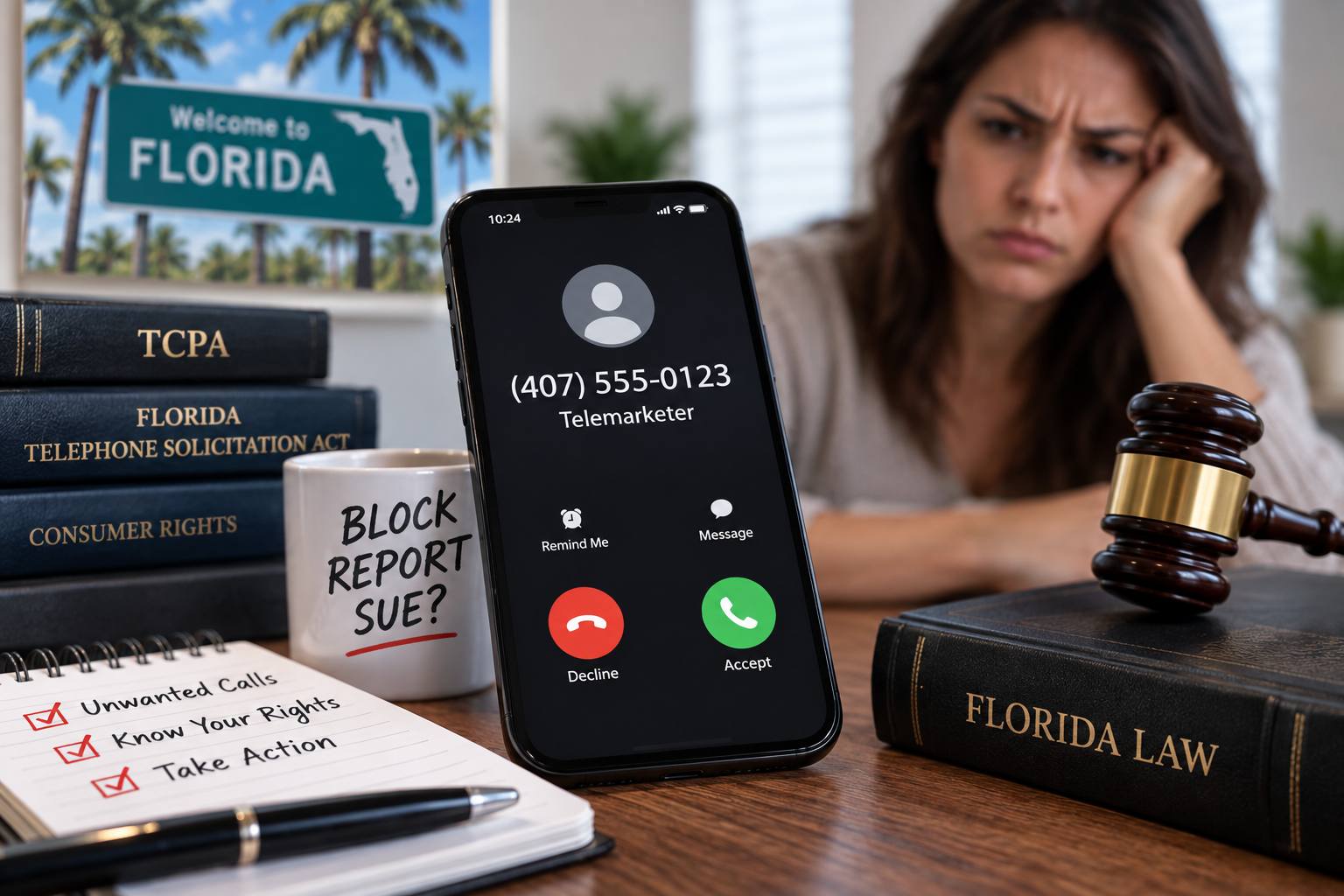
Can You Sue a Telemarketer in Florida? How the Law Actually Works
Your phone rings four times before lunch. Two are about your car warranty. One is a recorded voice asking about solar panels. By the third week you start wondering whether any of this is legal, and whether there’s anything to be done about it.
The short answer is that yes, people do sue telemarketers, and Florida residents have two separate laws to work with instead of one. The longer answer is that suing spam callers is harder in practice than the ads on social media make it look, and the reasons why are worth understanding before you form an opinion about your own situation.
Here’s how both laws operate, what they pay when they work, and where these cases tend to fall apart.
Two laws, two separate claims
Most states have one telemarketing law that matters. Florida has two, and they don’t cover the same ground.
The federal law is the Telephone Consumer Protection Act at 47 U.S.C. § 227, with the details filled in by the Federal Communications Commission at 47 C.F.R. § 64.1200. It applies everywhere in the country.
The state law is the Florida Telephone Solicitation Act at Fla. Stat. § 501.059. People sometimes call it the Florida mini TCPA. It only covers calls and texts to people in Florida, and in some ways it reaches further than the federal law does.
These are separate claims, not alternatives. The same phone call can violate both statutes at once, and each one carries its own damages. That stacking is the main reason Florida became a center of telemarketing litigation.
What the federal TCPA pays, and the rule people miss
The federal statute has two different private claims tucked inside it, and they work differently.
Autodialer and prerecorded voice claims
Section 227(b)(3) covers calls made with an autodialer or an artificial or prerecorded voice to a cell phone without consent. It lets a person recover actual monetary loss or $500 per violation, whichever is greater.
If a court finds the violation was willful or knowing, it can raise that figure to as much as $1,500 per call.
$500 per call. Up to $1,500 if willful. Those numbers are per violation, not per lawsuit, which is why a campaign of forty texts draws attention that a single call never would.
Do not call claims, and the more-than-one-call requirement
Section 227(c)(5) is the do not call side. It covers violations of the FCC rules on registry scrubbing, calling hours, and internal opt-out lists.
This is where a lot of people get tripped up. The statute lets a person bring an action only after receiving more than one call within a 12-month period from the same company. One stray call, however annoying, generally isn’t enough to start a do not call claim.
How the Florida Telephone Solicitation Act adds to it
Florida’s own statute runs on a parallel track. Section 501.059(10) lets a called party who was hit by a violation recover actual damages or $500, whichever is greater, and a court has discretion to increase that award up to three times for a willful or knowing violation.
The FTSA covers telephone calls, text messages, and voicemail drops. It requires written consent before a company uses an automated system to place sales calls, it bars caller ID spoofing, and it backs the state’s own do not call list.
The STOP requirement for text messages
In 2023 the Legislature added a gate in front of text message claims. Under section 501.059(10)(c), before anyone can sue over text solicitations, the called party has to reply STOP to the number that sent them.
The sender then gets 15 days to stop. It’s allowed to send one confirmation text. Only if the marketing texts keep coming after those 15 days does the statute open the door to a claim.
The attorney fee rule cuts both ways. Section 501.059(11) says the prevailing party in FTSA litigation recovers reasonable attorney fees and costs from the losing party, after judgment and after appeals are exhausted. That’s an advantage when a claim succeeds. It’s a real exposure when one doesn’t, because the consumer who loses can end up owing the company’s legal bill.
Does the Florida do not call list actually do anything?
Florida runs its own registry alongside the national one. Section 501.059(3) directs the Department of Agriculture and Consumer Services to keep a “no sales solicitation calls” list, and registration is free.
Section 501.059(4) then bars telephone solicitors from making unsolicited sales calls to any number on the department’s current quarterly listing, and requires them to screen their calling lists against it.
Here’s the part that frustrates people. Registering doesn’t stop calls from outfits that were never going to follow the law in the first place. Overseas boiler rooms and outright scam operations ignore the registry entirely. What registration does is convert a call from a legitimate business into a documented violation, which is a different kind of useful.
A separate Florida statute, Fla. Stat. § 501.616, sets the state’s calling curfew. Sales calls can’t be made before 8 a.m. or after 8 p.m. in the called person’s time zone, and no more than three calls can go to the same person in a 24-hour period on the same subject. That section is enforced by state regulators rather than through the private damages route in section 501.059.
Which Florida court hears these cases
Florida claims are filed in county court, which is organized by dollar amount. Under Fla. Stat. § 34.01, disputes of $8,000 or less go to the small claims division. Anything above that up to $50,000 goes to county civil, and larger cases go to circuit court.
Small claims in Florida has a feature most states don’t have. The rules require the parties to attend a pretrial mediation conference before a judge hears the case, and a good number of disputes resolve there.
Federal TCPA claims can be brought in state court as well, though larger cases and class actions usually land in federal district court. Florida has three of them, covering the Northern, Middle, and Southern Districts.
A Clearwater example, worked through
Say Ray lives near Gulf to Bay Boulevard in Clearwater. He put his cell number on both the national and Florida do not call lists two years ago.
Starting in April, a solar installation company begins calling. Ray counts eleven calls over six weeks. Four of them open with a recorded voice before a live person picks up. He never asked for any of it and has no account with the company.
Under the federal statute, those recorded-voice calls to his cell without consent point toward the section 227(b)(3) claim at $500 each. Because he got far more than one call in a 12-month period from the same company, the do not call route under section 227(c)(5) is also on the table. Under the FTSA, the automated calls without written consent point toward a separate state claim.
Now change one fact. Suppose Ray had entered his number on the company’s website eight months earlier while pricing out a roof. That single detail brings consent into the case, and consent is the defense that resolves most of these disputes before damages ever get calculated.
Change another fact. Suppose the calls came from a spoofed number belonging to a shell company that dissolved in March. The law is the same. The practical picture is not, because there’s nobody left to sue.
Where these cases usually fall apart
Three things account for most of it.
- Consent. A checkbox on a form, a number typed at online checkout, or an entry on a lead generation site can all be raised as consent. People routinely forget giving it.
- Identifying the caller. Caller ID spoofing is widespread. A number on a screen frequently has nothing to do with who actually dialed, and a claim needs a real defendant.
- Collectability. Many of the worst offenders are offshore or judgment proof. A judgment against a company with no assets in the United States is a piece of paper.
This is the gap between the law on the page and what happens in practice. The statutes are real and the damages figures are real. The cases that go somewhere tend to involve identifiable American companies running documented campaigns, not the anonymous scam calls that make up the bulk of what most people receive.
Common questions about suing telemarketers in Florida
Is it illegal to spam call someone?
It depends on the kind of call. Sales calls to a number on a do not call registry, automated or prerecorded sales calls placed without consent, and calls made outside the legal hours are all restricted. A call from a business you already deal with about an existing account is treated differently.
Do I need a lawyer to bring one of these claims?
Florida small claims court is built to be usable without one, and attorneys are permitted but not required. The fee shifting provision in section 501.059(11) is worth understanding either way, since it can run against a losing plaintiff.
How long is the deadline to file?
Federal TCPA claims are generally subject to the four-year catch-all limitations period in 28 U.S.C. § 1658. Florida claims run under chapter 95 of the Florida Statutes, where the applicable period depends on how the claim is characterized. Deadlines are one of the few things in this area that can’t be fixed after the fact.
What about harassing phone calls that aren’t sales calls?
Different laws cover that ground. Debt collection calls fall largely under federal and state collection statutes rather than telemarketing law. Threatening or obscene calls are handled under Florida’s criminal statutes and are a matter for law enforcement.
Does registering on the do not call list start a case?
No. Registration is a preventive step and a complaint mechanism. It’s separate from a private lawsuit, though being on the list at the time of a call is often what makes a call a violation in the first place.
The short version
Florida consumers have two overlapping laws covering unwanted sales calls and texts, and both carry statutory damages starting at $500 per violation. The federal TCPA applies nationwide. The FTSA applies to calls reaching Florida and adds a written consent standard and a text message opt-out step.
What determines whether any of it matters in a given situation is usually consent, whether the caller can be identified, and whether that caller has anything to collect from. Those three questions do more work than the damages figures do.
This article is for educational purposes only and is not legal advice. Reading it does not create an attorney-client relationship. For advice on your specific situation, consult a licensed attorney in your state.