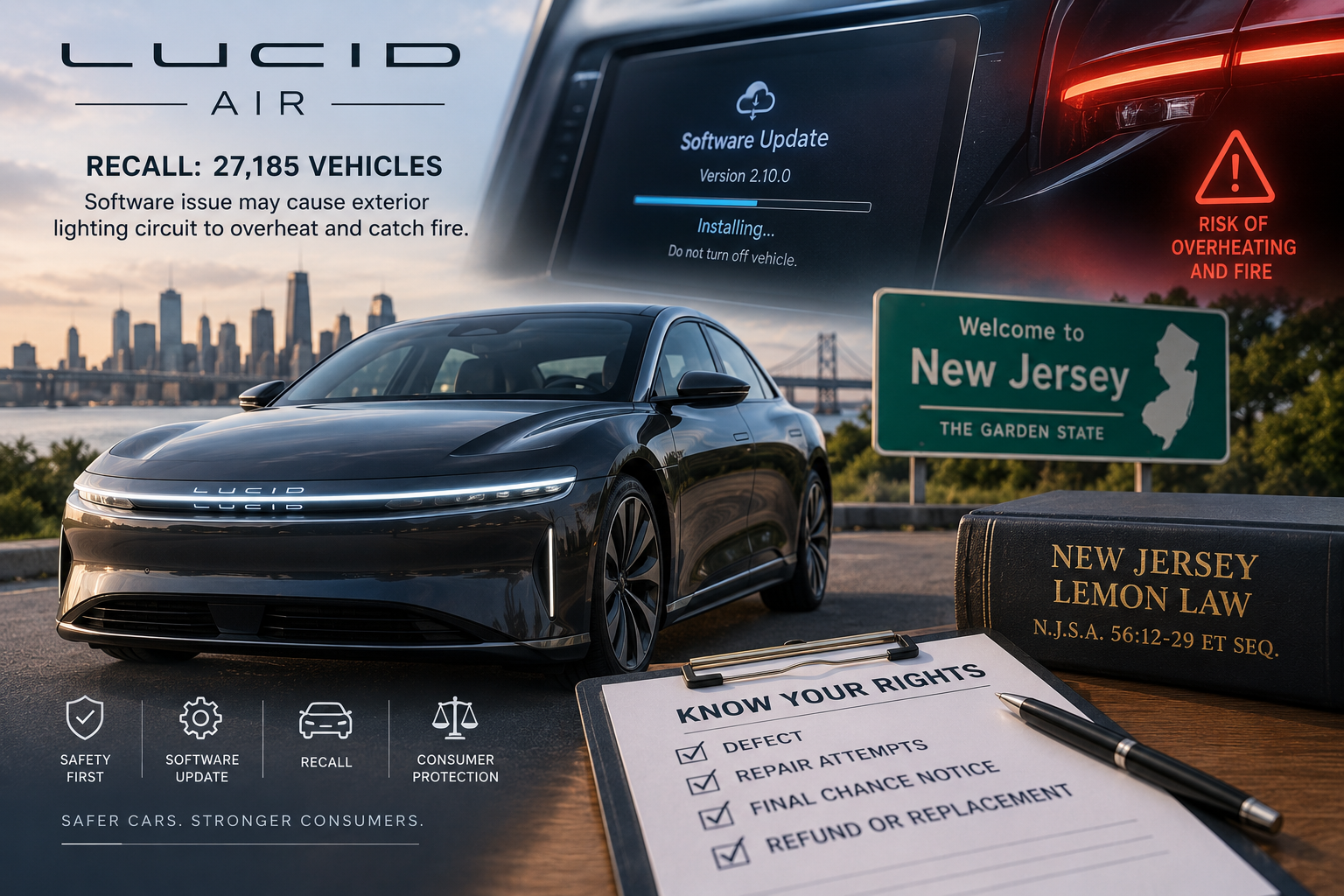
Lucid Air Fire Recall and the New Jersey Lemon Law
Lucid is recalling 27,185 Air sedans because a software problem can let an exterior lighting circuit overheat and catch fire. If you drive one in New Jersey, the first question is usually about safety. The second question is almost always whether the New Jersey lemon law gives you a way out of the car.
Those are two different questions with two different answers. A recall is a federal safety process. The lemon law is a state warranty statute with its own deadlines, its own counting rules, and its own paperwork.
This article walks through both, and through a wrinkle that comes up more and more with electric cars. What happens when the fix arrives over the air while your car sits in your driveway?
This is general educational information about how New Jersey law works. It is not legal advice, and reading it does not create an attorney-client relationship. Outcomes depend on the specific vehicle, dates, mileage, and repair records involved.
What the Lucid Air Recall Actually Says
Lucid filed the recall with the National Highway Traffic Safety Administration in August 2026 under campaign number 26V540000. It covers roughly 27,185 Air sedans from the 2022 through 2026 model years, built between October 2021 and July 2026.
The problem is software, not a broken part. In an older car, a fuse is a strip of metal that melts when too much current runs through a circuit. The Air uses an eFuse instead, where code watches the current and shuts the circuit down, and the recall filing says that threshold was set too high on the low voltage circuits that run the exterior lights.
So a circuit could keep drawing more amperage than the wiring was built for. Wire that runs hot enough melts its insulation, which is how you get smoke and, in rare cases, fire. The same fault can kill the center brake light or the front lights, and Lucid reported 33 warranty claims involving damaged wiring near that third brake light.
Three fires tied to front lighting over roughly three years. Thirty-three warranty reports of damaged wiring near the center brake light. One free software update, version 2.10.0, pushed over the air starting in July 2026. Owner notification letters were set to go out beginning October 16, 2026.
Until the update is installed, the recall notice tells owners to park outside and away from buildings. That guidance matters no matter what you decide about the legal side.
A Recall Is Not a Lemon Law Claim
A federal safety recall gets you one thing. A free fix. It does not get you a refund, a replacement car, or money for the hassle.
The New Jersey Lemon Law is separate. It lives at N.J.S.A. 56:12-29 and following, and the rules that put it into practice are in N.J.A.C. 13:45A-26. It asks a narrower question. Did the manufacturer get a fair number of chances to fix a serious defect inside a set window, and does the defect still exist?
So a recall can be evidence in a lemon law claim. It is not the claim itself.
What Qualifies as a Lemon in New Jersey
New Jersey calls the covered window the term of protection. It runs for the first 24,000 miles of operation or two years from the original delivery date, whichever comes first. Everything else has to happen inside that window.
The defect also has to be a nonconformity, meaning something that substantially impairs the use, value, or safety of the vehicle. A rattle in the door trim will not get there. A circuit that can catch fire is a different conversation.
The Three Triggers
Under the regulations, a consumer can send the manufacturer written notice of a potential claim once one of these happens inside the term of protection:
- Substantially the same problem has been examined or repaired two or more times and it still exists
- The car has been out of service for repairs for 20 or more days total, or 45 days for a motor home
- The problem is one that is likely to cause death or serious bodily injury if the vehicle is driven, and one attempt has already been made
That third trigger is why a fire risk gets attention. New Jersey treats defects that could kill or seriously injure a driver differently from ordinary defects, and the number of chances the manufacturer gets shrinks accordingly.
The Certified Mail Step Most People Skip
New Jersey requires written notice to the manufacturer by certified mail, return receipt requested. The manufacturer then gets one final opportunity to fix the problem within 10 calendar days of receiving it.
The notice has to be received inside the term of protection, not just mailed inside it. Claims fall apart on that detail more than on anything else.
Do Over the Air Updates Count as Repair Attempts?
Here is where the Lucid recall gets interesting. The fix is wireless. No appointment, no service advisor, no repair order.
New Jersey’s regulations were written around dealer visits. An examination means an inspection by a service technician for or on behalf of the manufacturer. Out of service means days the vehicle sits on the premises of a repair facility. A software patch installed overnight in your own driveway does not obviously produce either one.
Say Dev in Edison wakes up to a notification that his car installed version 2.10.0 while he slept. Nothing was fixed at a shop. No days were lost. If the update works, there is no continuing defect and no claim. If it does not work, he has zero countable repair attempts on paper, because nothing was ever documented by a technician.
Software recalls create a records problem that mechanical recalls do not. Written repair orders showing dates in and dates out are the backbone of a New Jersey claim, and a wireless update generates none of them.
How a New Jersey Buyback Gets Calculated
If a claim succeeds, the refund is broader than the sticker price. Under the regulations it can include the total purchase or lease price with finance charges, sales tax, license and registration fees, and any trade-in credit. It can also include options installed within 30 days of delivery, towing, rental car costs while the vehicle was out of service, the filing fee, and reasonable attorney and expert fees.
From that total comes one deduction, called the allowance for vehicle use. The formula is fixed. Take the mileage at the moment the car was first brought in for the defect, multiply by the purchase price, and divide by 100,000.
A Hypothetical Cherry Hill Example
Say Renata buys a new electric sedan in Cherry Hill for $74,000. At 3,100 miles the headlights cut out on Route 70 at night, and she brings it in. Over the next four months the car goes back twice more for the same fault and sits at the shop for 22 days total.
Her use allowance would be 3,100 times $74,000, divided by 100,000, which comes to $2,294. That figure is locked to the mileage at her first visit, not the mileage today. Every mile she drives after that first appointment costs her nothing under the formula.
The offset is anchored to the odometer reading at the first repair visit for the defect. That is one reason the date of that first appointment is worth documenting carefully.
What About a 2022 or 2023 Air?
Most of the recalled Airs are years past two years and 24,000 miles. For those cars the New Car Lemon Law window has closed, and a recall does not reopen it.
New Jersey has a second statute, the Used Car Lemon Law at N.J.S.A. 56:8-67 and following, with rules at N.J.A.C. 13:45A-26F. It applies to used vehicles bought from a New Jersey dealer for more than $3,000, seven model years old or newer, under 100,000 miles, and not a prior total loss. It runs on a dealer warranty scaled to mileage, and it covers a specific list of parts rather than the whole car, so whether a given electrical component falls inside that list is its own question.
Two other bodies of law come up in these situations. The federal Magnuson-Moss Warranty Act allows breach of warranty claims that are not bound by state lemon law deadlines. And the New Jersey Consumer Fraud Act, N.J.S.A. 56:8-1 and following, carries treble damages plus fees when a dealer or manufacturer engages in unconscionable practices, which is a different theory with a different proof burden.
New Jersey Compared to New York and Pennsylvania
If you commute across state lines, the numbers change with the plates. New York’s new car law runs to two years or 18,000 miles and generally looks for four repair attempts or 30 days out of service. Pennsylvania runs one year or 12,000 miles and generally looks for three attempts or 30 days.
New Jersey’s 24,000 mile ceiling and 20 day out of service trigger are friendlier than both. Coverage follows where the vehicle was purchased, leased, or registered, not where you happen to be driving when the dash lights up.
Where New Jersey Lemon Law Cases Get Decided
New Jersey routes these through the Division of Consumer Affairs Lemon Law Unit in Newark. An accepted application carries a $50 filing fee, which is recoverable as a cost if the consumer prevails.
The Lemon Law Unit refers accepted applications to the Office of Administrative Law for a summary hearing, generally set within 20 days of acceptance. The Director of the Division issues the final decision, and either side can appeal to the Appellate Division of the Superior Court within 45 days. Filing in Superior Court instead of using the administrative track is also an option.
Common Questions About Recalls and the NJ Lemon Law
Does a recall automatically make my car a lemon in NJ?
No. A recall shows the manufacturer identified a safety defect across a model line. New Jersey’s statute asks about your specific vehicle, your repair history, and whether the defect still exists after the manufacturer’s chances ran out.
How many recalls before the lemon law applies?
There is no recall count in the statute. New Jersey counts repair attempts for substantially the same problem and days out of service. Ten recalls for ten unrelated issues fixed on the first try would not satisfy the presumption.
Is a fire risk a serious safety defect?
The statute uses the phrase likely to cause death or serious bodily injury if the vehicle is driven. Defects with fire risk are the kind of thing that provision is aimed at, though whether a particular defect clears that bar is decided case by case on the evidence.
Does the NJ lemon law cover leased cars?
Yes. Lessees are covered, and the refund is built from lease payments and related charges rather than a purchase price. The same use allowance formula applies.
What if the vehicle was bought out of state?
New Jersey’s law reaches vehicles purchased, leased, or registered in New Jersey, and it applies whether the repairs happened inside the state or outside it. A car registered in Bergen County but serviced in Manhattan is still a New Jersey vehicle for these purposes.
The Short Version
The Lucid Air recall is a real safety issue with a free fix, and the parking guidance is worth following until the update lands. Whether it becomes a New Jersey lemon law matter depends on the term of protection, documented repair attempts, and whether the defect survives the manufacturer’s final chance.
For most of the 27,185 recalled cars, that window closed long ago. For the newest ones, the calendar and the odometer are doing the deciding.
This article is for educational purposes only and is not legal advice. Reading it does not create an attorney-client relationship. For advice on your specific situation, consult a licensed attorney in your state.