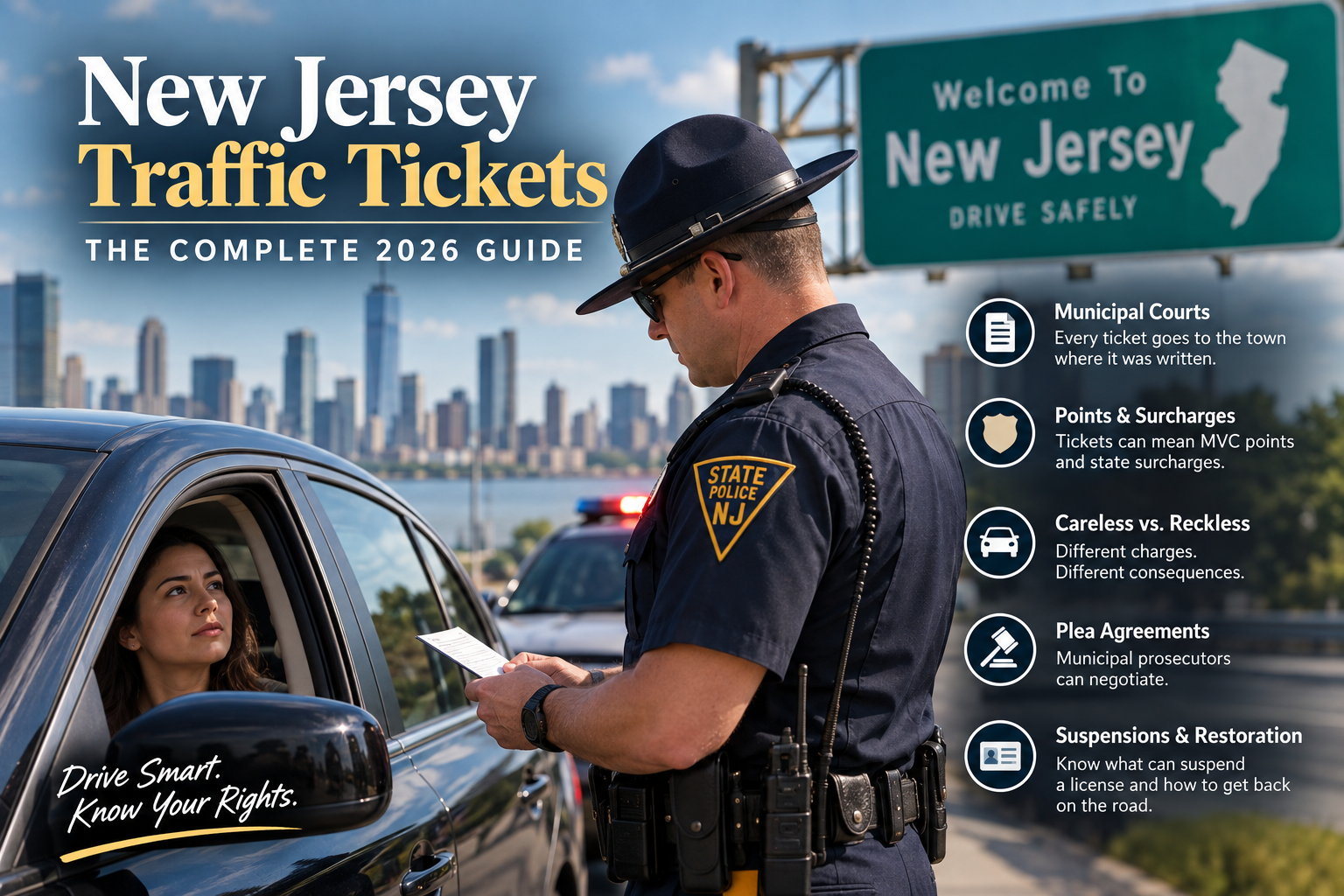
How a New Jersey Traffic Ticket Works, From the Stop to the Surcharge Bill
Most people think a New Jersey traffic ticket ends when the fine is paid. It usually doesn’t. One ticket passes through three different offices: the municipal court that hears it, the Motor Vehicle Commission that records the points, and the state program that bills surcharges. Each one can cost money, and some of those costs show up a year later.
The easiest way to see how it all fits together is to follow one ticket from start to finish. So that’s what this guide does.
Meet Carla. She lives in Hoboken, drives a Jeep Grand Cherokee, and just got stopped in Secaucus doing 72 in a 50 mph zone. We’ll follow her ticket through every stage.
Carla is fictional, and nothing here is advice about any real ticket. This is general education about how New Jersey law works.
Stage 1: Reading a New Jersey Traffic Ticket
Carla’s ticket tells her three important things. The charge, which cites N.J.S.A. 39:4-98, New Jersey’s speeding statute. The court, which is Secaucus Municipal Court, because New Jersey tickets go to the municipal court in the town where the stop happened. And whether a court appearance is required.
Her ticket doesn’t require an appearance, so she could pay it online through NJMCdirect, the Judiciary’s municipal court system. According to the New Jersey Courts, NJMCdirect lets people plead guilty and pay, set up installment payments, enter a not guilty plea, and request a plea agreement from the municipal prosecutor for certain charges.
What Carla Might Not Realize About NJMCdirect
Paying online is a guilty plea. The conviction goes to the MVC, the points attach, and any chance to negotiate the charge is over.
There’s also a practical trap. Several lookalike websites use “njmcdirect” in their web addresses, and some show up in search ads. The New Jersey Courts link to the real system from their municipal court self-help page, which also explains how to find a lost ticket. Drivers who don’t know which town wrote a ticket can call the Judiciary at 609-421-6100 and have it looked up by license number.
Stage 2: Municipal Court and the Plea Offer
Say Carla doesn’t pay. She enters a not guilty plea and gets a court date. This is where New Jersey looks very different from New York City, where traffic tickets go to a DMV bureau with no prosecutor at all. New Jersey municipal courts have municipal prosecutors, and plea agreements are a routine part of resolving traffic cases.
A plea agreement usually means pleading guilty to a different charge. The prosecutor decides whether to offer one, and the judge has to approve it. If there’s no deal, the case goes to trial, and the State has to prove the charge.
The “No-Point” Charge: Unsafe Driving
The charge that comes up most often in New Jersey plea talks is unsafe driving under N.J.S.A. 39:4-97.2. It’s a catch-all offense for driving in an unsafe manner likely to endanger a person or property. What makes it popular is how it handles points:
- First conviction: $50 to $150 fine, no points
- Second conviction: $100 to $250 fine, no points
- Third conviction: $200 to $500 fine, plus 4 points if it falls within five years of the second
The catch is a $250 surcharge the court adds to every unsafe driving conviction. A no-point plea trades points for a bigger bill up front.
Carla’s Two Paths
Carla was 22 over. Convicted as charged, that’s 4 points. And because she was 20 mph or more over the limit, N.J.S.A. 39:4-98.7 doubles the fine.
If the prosecutor offers unsafe driving instead, and it’s her first, she’d pay the unsafe driving fine, the $250 surcharge, and court costs, with no points. Nothing requires the prosecutor to make that offer. Whether it’s offered, and whether it’s worth taking, depends on the facts and the driver’s record.
Heads up: Under New Jersey’s cell phone statute, when a handheld phone violation is used as the substitute charge in a plea, it carries the same penalty as unsafe driving, including the $250 surcharge, and counts toward the unsafe driving tally.
Stage 3: What the NJ MVC Does With a Conviction
Once the court enters a conviction, it reports it to the Motor Vehicle Commission. The MVC adds points using the official NJ points schedule. Say Carla’s case ends with a speeding conviction as charged. Her record picks up 4 points.
Here’s how some of the most common charges score in New Jersey:
- Speeding: 2 points (1 to 14 over), 4 points (15 to 29 over), 5 points (30 or more over)
- Careless driving: 2 points
- Reckless driving, tailgating, or improperly passing a school bus: 5 points
- Improper passing on the right or in a no passing zone: 4 points
- Improper turn or U-turn: 3 points
- Running a red light, stop sign, or yield sign: 2 points
- Leaving the scene of an accident with personal injury: 8 points
- Any moving violation committed in another state: 2 points
12 points is where New Jersey suspends driving privileges, according to the MVC. Carla, at 4, is well under it, for now.
The Out-of-State Rule That Surprises New York Commuters
That last line on the list matters for anyone who drives into New York for work. New Jersey adds 2 points for a moving violation committed in another state. New York generally does the opposite and doesn’t add points for out-of-state convictions.
So if Carla later gets a speeding ticket on the West Side Highway and is convicted in New York, her New Jersey record picks up 2 more points. She’d be at 6.
How Points Come Down in NJ
New Jersey points don’t simply expire on a date. The violation stays on the driving record, and the point total shrinks over time. According to the MVC’s FAQ, a driver who goes one year from the most recent violation without new points or violations gets 3 points deducted. There are two other routes:
- Time. Three points come off for each violation-free year.
- A defensive driving course. The MVC’s driver programs page says a state-approved New Jersey course may remove 2 points, once every five years, and only if there are points on the record when the course is finished.
- An MVC-ordered program. The MVC can direct drivers into a Driver Improvement Program or, for newer drivers, a Probationary Driver Program. These are based on the driving record, not something a driver just signs up for.
Here’s the part most drivers miss. None of those reductions touch the surcharge. That’s the next stage.
Stage 4: The NJ MVC Surcharge Bill
Surcharges are a separate state charge, billed through the New Jersey Surcharge Violation System. They have nothing to do with the court fine, and the MVC says it has no authority to waive them.
According to the MVC’s surcharge page, a driver with six or more points within three years gets a $150 surcharge plus $25 for each point over six, and it can be billed every year for three years. The clock runs from the date each violation is posted to the driving record, not the date of the ticket.
Back to Carla. Her 4-point speeding conviction alone doesn’t trigger anything. But add that 2-point New York ticket, and she’s at 6 points within three years. That’s a $150 surcharge, and it can come back each year for three years. A defensive driving course might bring her point total down, but the MVC says the course and the safe driving credit don’t reduce surcharge points.
Surcharges That Don’t Depend on Points
Some convictions carry their own surcharge, billed every year for three years:
- Unlicensed driver or expired license: $100 a year ($300 total)
- Driving with a suspended license: $250 a year ($750 total)
- Operating an uninsured vehicle: $250 a year ($750 total)
- First or second DWI: $1,000 a year ($3,000 total)
Unpaid surcharges can lead to collection action, including a judgment filed with the Superior Court. The MVC notes that judgments can lead to wage garnishment and can be paid from state tax refunds.
Stage 5: A Suspended License in NJ
Suppose Carla had ignored her court date instead. The municipal court could suspend her driving privileges for failure to appear. Reaching 12 points is another path to suspension, and some offenses carry their own suspensions regardless of points.
How to Check If a License Is Suspended in NJ
The MVC mails suspension notices to the address on file, so an outdated address can mean a driver never sees one. A driver history abstract, requested through the MVC’s online services, shows violations, points, and suspensions on the record.
Driving While Suspended
Driving during a suspension is a separate offense under N.J.S.A. 39:3-40. A first conviction carries a $500 fine, and repeat convictions bring higher fines and jail. It also triggers that $250-a-year surcharge.
How License Restoration Works in NJ
A New Jersey license doesn’t switch back on by itself. Based on the MVC’s suspensions and restorations page and its surcharge guidance, restoration generally runs in this order:
- Resolve whatever caused the suspension, such as the open ticket or unpaid fine.
- Send the MVC proof that outstanding fines or tickets are paid. The MVC says this is the driver’s responsibility.
- If surcharges are owed, pay at least 5 percent of the outstanding surcharge balance.
- Pay the $100 driver license restoration fee.
- Wait for written notice of restoration from the MVC before driving.
That last step is the one people skip. The MVC is explicit that a suspended driver can’t drive until the written restoration notice arrives. Driving in the gap risks a brand new 39:3-40 charge.
Quick Reference: New Jersey’s Most Common Traffic Charges
Carla’s ticket was for speeding. Here’s how the other charges New Jersey drivers ask about most often compare.
Careless Driving (N.J.S.A. 39:4-97): 2 Points
N.J.S.A. 39:4-97 covers driving without due caution in a way that endangers, or is likely to endanger, people or property. It’s often written after a fender bender the officer didn’t witness. Say Dana rear-ends a pickup in stop-and-go traffic on Route 17 in Paramus. No one’s hurt, but the responding officer writes careless driving, which would add 2 points if Dana is convicted.
Reckless Driving (N.J.S.A. 39:4-96): 5 Points
N.J.S.A. 39:4-96 covers driving heedlessly, in willful or wanton disregard of others’ safety. A first conviction can bring up to 60 days in jail, a $50 to $200 fine, or both. A second can bring up to three months and a $100 to $500 fine. It isn’t a felony. It’s a Title 39 motor vehicle offense heard in municipal court.
Handheld Cell Phone Use (N.J.S.A. 39:4-97.3): 0 to 3 Points
Under N.J.S.A. 39:4-97.3, fines run $200 to $400 for a first offense, $400 to $600 for a second, and $600 to $800 for a third or later. Points only start at the third offense, which carries 3 points and a possible 90-day suspension at the judge’s discretion. Offenses more than 10 years apart are treated as a lower-level offense for sentencing.
Red Lights: Officers Only
New Jersey’s red light camera pilot program ended in December 2014, and the state doesn’t run red light cameras today. A red light ticket in New Jersey comes from an officer and carries 2 points.
Default Speed Limits
When no other limit is posted, N.J.S.A. 39:4-98 sets 25 mph in business and residential districts, 35 mph in suburban business and residential districts, and 50 mph elsewhere. Some highways are posted at 65 mph under a separate law.
Five Myths About New Jersey Traffic Tickets
Myth: “Points stay on your NJ license for exactly three years.”
Not quite. The violation stays on the record, and the point total drops by 3 for each violation-free year. The three-year number people remember comes from the surcharge lookback, which is a different system.
Myth: “A defensive driving course lowers my surcharge.”
It doesn’t. The MVC says the 2-point course reduction and the 3-point safe driving credit don’t reduce surcharge points.
Myth: “A ticket in New York won’t affect my New Jersey license.”
It can. New Jersey assigns 2 points for moving violations committed out of state.
Myth: “Paying online just makes the ticket go away.”
Paying is a guilty plea. The conviction and points go to the MVC, and the option to negotiate is gone.
Myth: “Once my suspension ends, I can drive again.”
Restoration isn’t automatic. The MVC requires the restoration fee and any other conditions first, and says not to drive until written notice of restoration arrives.
Where Carla Ends Up
One stop in Secaucus put Carla in front of a municipal court, onto the MVC point system, and potentially into the surcharge program years later. Which of those she feels depends on what happens at each stage, starting with whether that first online payment ever gets made.
That’s the core of how New Jersey traffic tickets work. The court, the MVC, and the surcharge system each keep their own rules, and understanding all three is the only way to see what a single ticket really costs.
This article is for educational purposes only and is not legal advice. Reading it does not create an attorney-client relationship. For advice on your specific situation, consult a licensed attorney in your state.