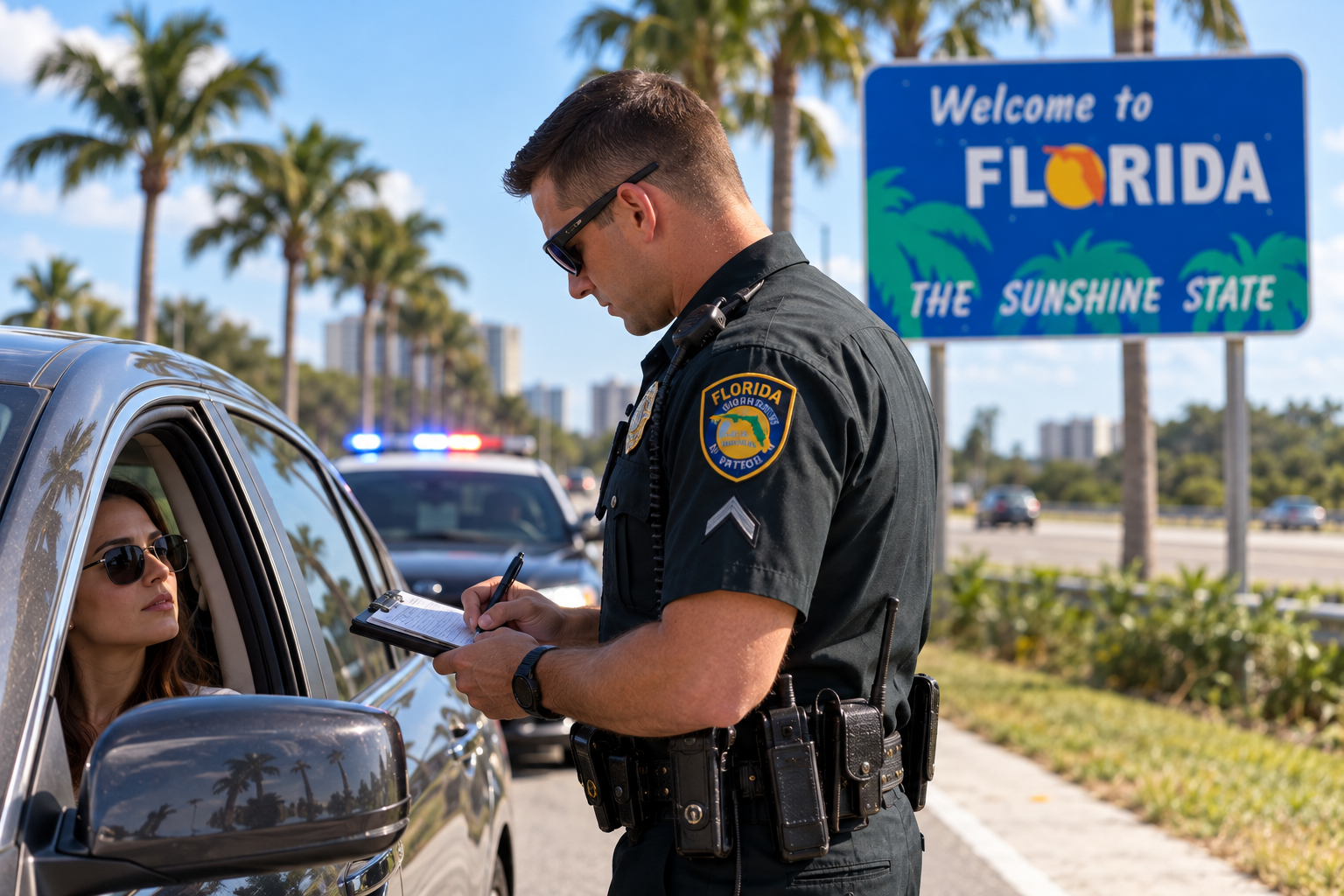
Got a Florida Traffic Ticket? Your 30-Day Decision, Explained
Florida handles traffic tickets differently than most states. For the typical Florida traffic ticket, there’s no automatic court date. Instead, the law hands you a deadline and a short menu of choices, and the choice you make in the next 30 days usually decides whether points ever hit your license.
This guide is built around that decision. It walks through the three paths Florida gives drivers, what each one costs, how the state’s point system counts, and which tickets aren’t really “tickets” at all because they’re criminal charges.
30 days is the window Florida law gives most drivers to pay, elect traffic school, or request a hearing on a civil traffic ticket.
This article is general education about Florida law. It isn’t advice about any particular ticket.
Step Zero: Is It a Civil Infraction or a Criminal Traffic Charge?
Before anything else, it matters which kind of ticket you’re holding. Most Florida tickets, like ordinary speeding, running a stop sign, or careless driving, are noncriminal traffic infractions. Those are the tickets that come with the 30-day menu under section 318.14, Florida Statutes.
A smaller group of charges are criminal. Those tickets say the driver must appear in court, and there’s no pay-and-go option. Common examples include:
- Reckless driving under section 316.192, which can bring up to 90 days in jail and a $25 to $500 fine on a first conviction.
- Dangerous excessive speeding under section 316.1922, a crime created in 2025 for driving 50 mph or more over the limit, or 100 mph or more in a way that threatens others. A first conviction can bring up to 30 days in jail, a $500 fine, or both.
- Knowingly driving with a suspended license under section 322.34, which is a misdemeanor on a first conviction.
Everything in the next few sections applies to civil infractions. Criminal traffic charges run through county court like any other misdemeanor case.
The Three Paths for a Civil Traffic Ticket in Florida
Florida tickets are handled through the clerk of court in the county where the ticket was written. Within 30 days, drivers generally pick one of three paths.
Path A: Pay the Civil Penalty
Paying the ticket, or setting up a payment plan with the clerk, counts as admitting the infraction and waiving the right to a hearing. The clerk reports it to the Department of Highway Safety and Motor Vehicles (FLHSMV), and the points go on the driving record.
Path B: Elect a Basic Driver Improvement Course (Traffic School)
This is the option most Florida drivers mean when they say “traffic school.” Under section 318.14, an eligible driver can elect a state-approved Basic Driver Improvement (BDI) course instead of a court appearance. When that happens:
- Adjudication is withheld, which the statute says is not a conviction.
- The civil penalty is reduced by 18 percent.
- No points are assessed.
There are real limits. The election has to be made within the 30-day window, and FLHSMV says the driver must tell the clerk and pay an election fee before taking the course. A driver can’t elect it if they did so in the previous 12 months. Commercial license holders can’t use it, and neither can drivers cited for going 30 mph or more over the limit.
Heads up: Plenty of websites still say drivers get five traffic school elections in a lifetime. The current version of section 318.14 allows eight. The once-every-12-months limit still applies.
Path C: Request a Hearing
A driver can instead contest the ticket in front of a county court judge or civil traffic hearing officer. The State has to prove the infraction beyond a reasonable doubt, which is the same standard used in criminal cases. If the official finds no infraction, no penalty is imposed.
Choosing a hearing gives up the fixed civil penalty. If the infraction is proven, the official can impose a penalty of up to $500, or up to $1,000 for speeding in a school or construction zone, and can order driver improvement school.
Same Ticket, Three Outcomes
Say Andre is driving his Toyota Tacoma on I-4 near downtown Orlando and gets cited for 17 over. Here’s how his three paths compare:
- He pays. The base civil penalty for 15 to 19 over is $150, plus court costs and county fees. Four points go on his record.
- He elects traffic school. His civil penalty drops by 18 percent, he pays the clerk’s election fee and the course provider, adjudication is withheld, and no points are assessed. He uses one of his eight lifetime elections.
- He requests a hearing. If the State can’t prove the violation beyond a reasonable doubt, he owes nothing. If it can, the official sets the penalty, which could be higher than $150.
None of those is automatically the right answer. It depends on his record, whether he’s used traffic school recently, and the facts of the stop.
What Happens If the 30 Days Pass
Missing the deadline adds a $16 late penalty under section 318.18. It can also lead to a license suspension for failure to pay or appear, which Florida drivers often call a “D6” suspension. Under section 322.245, the clerk reports the failure and FLHSMV suspends the license until the ticket is resolved.
How Much Is a Speeding Ticket in Florida?
Florida sets the base civil penalty for speeding in section 318.18, tiered by how far over the limit the driver was:
- 1 to 5 mph over: warning
- 6 to 9 mph over: $25
- 10 to 14 mph over: $100
- 15 to 19 mph over: $150
- 20 to 29 mph over: $175
- 30 mph or more over: $250
Those numbers are only the starting point. Speeding fines double in a school zone and in a posted construction zone when workers are present. On top of the penalty, state law adds court costs and fees, and counties can add their own surcharges. That’s why the total on two identical speeding tickets can look different in Miami-Dade and in Hillsborough.
At 50 mph or more over, the situation changes completely. That’s the dangerous excessive speeding threshold, and it’s a criminal charge with a mandatory court appearance rather than a payable ticket.
How Much Is a Red Light Ticket in Florida?
The statute sets the red light penalty at $158 whether an officer writes it or a camera catches it. The difference is points. An officer-issued red light ticket carries 4 points. A red light camera violation under section 316.0083 carries no points, and state law says it can’t be used to set insurance rates.
School zone speed cameras, authorized under section 316.1896, work the same way. The fine is $100, and no points are assessed.
Florida’s Point System, in Plain Numbers
Points are assigned under section 322.27. Florida’s scale is compact:
- Speeding up to 15 mph over: 3 points
- Speeding more than 15 mph over: 4 points
- Reckless driving: 4 points
- Running a red light (officer-issued): 4 points
- Passing a stopped school bus: 4 points
- Any other moving violation causing a crash: 4 points
- Speeding that causes a crash: 6 points
- Leaving the scene of a crash with property damage over $50: 6 points
- Most other moving violations, including careless driving: 3 points
Careless driving under section 316.1925 is one of the most common Florida tickets after a crash. It requires driving in a careful and prudent manner, and a violation is a noncriminal moving violation.
The Three Suspension Windows
Florida doesn’t use a single point cap. It uses three windows, each with its own suspension:
- 12 points within 12 months: up to 30 days
- 18 points within 18 months: up to 3 months
- 24 points within 36 months: up to 1 year
FLHSMV counts from the offense date of each conviction, not the date the case closed. And after a driver’s first and only points suspension is reinstated, the statute deducts 3 points from the record.
How Long Do Points Stay on Your License in Florida?
There’s no single expiration date written into section 322.27. What matters for suspension is how many points fall inside the 12-, 18-, and 36-month windows. The violations themselves stay on the driving record longer, and insurers review that record when setting rates. That’s a big reason traffic school is popular. A withheld adjudication through BDI keeps the points from landing at all.
Out-of-State Tickets
Section 322.27 lets FLHSMV record an out-of-state conviction against a Florida driver at the same point value it would carry in Florida. That’s a different approach from New York, which generally doesn’t add points for out-of-state tickets.
Say Gail lives on Long Island, keeps her New York license, and spends winters in Naples. If she gets a speeding ticket on I-75 in Collier County, it’s handled by the Collier County clerk, and she has the same 30-day menu as anyone else. How her home state treats the conviction is a New York question.
Suspended License in Florida: The Four Common Routes
Florida suspensions tend to come from one of four places. FLHSMV’s page on suspensions and revocations covers each one, and it links to the state’s online Driver License Check for verifying status.
- Unpaid or ignored tickets. The D6 suspension described above. It usually lifts once the clerk’s side is resolved and any reinstatement fee is paid.
- Points. The 12, 18, and 24-point windows.
- Habitual Traffic Offender status. According to FLHSMV, 15 moving violations with points within five years, or three major offenses within five years, brings a five-year revocation.
- Offense-based suspensions. Certain convictions, including DUI and a second dangerous excessive speeding conviction within five years, carry their own suspension or revocation.
Unknowingly Driving With a Suspended License in Florida
Florida draws a sharp line based on knowledge. Under section 322.34, driving on a suspended license without knowing about the suspension is a moving violation handled under the civil traffic rules. Driving with knowledge is a crime: a second-degree misdemeanor for a first conviction and a first-degree misdemeanor for a second, with a possible felony in some later cases.
Say Sofia moved from Fort Lauderdale to Tampa and never updated her address. A notice about an unpaid ticket went to her old apartment, and her license was suspended without her knowing. If she’s stopped on Dale Mabry Highway, that first stop is typically the civil version. But once she’s been cited, the law treats her as knowing. A second stop before she fixes it can become the criminal version.
Repeated suspended-license convictions also count toward Habitual Traffic Offender status, which is why these tickets can snowball in Florida.
Hardship Licenses
For some suspensions, Florida allows a restricted “hardship” license while the suspension runs. These are handled by FLHSMV’s Bureau of Administrative Reviews, not by the court that heard the ticket. Eligibility depends on why the license was suspended. For several non-DUI suspensions, FLHSMV lists an Advanced Driver Improvement course and a reinstatement fee among the requirements, and some suspensions aren’t eligible at all.
Florida’s Move Over Law
Florida’s Move Over law, section 316.126, is one of the most-searched traffic rules in the state, and it grew in 2024. Drivers have long had to move over for stopped emergency vehicles, tow trucks, and sanitation and utility vehicles. Since January 1, 2024, the law also covers any disabled vehicle stopped with its hazard lights on, flares out, emergency signs posted, or people visibly present.
When moving over isn’t safe or possible, drivers must slow to 20 mph below the posted limit, or to 5 mph when the limit is 20 mph or less. FLHSMV says a violation brings a fine, fees, and points.
Say Marisol is driving her Honda Odyssey on the Turnpike near Port St. Lucie and passes a sedan on the shoulder with a flat tire and its hazards flashing. Before 2024, that car wasn’t covered. Now, if she stays in the adjacent lane at full speed, she can be cited.
A Florida Traffic Ticket Glossary
Florida tickets, court notices, and FLHSMV letters use terms that don’t show up much in other states. Here’s what the most common ones mean.
- Civil infraction: A noncriminal traffic violation resolved by penalty, traffic school, or hearing.
- Adjudication withheld: The court doesn’t formally convict. Under section 318.14, it isn’t a conviction.
- BDI: Basic Driver Improvement, the course drivers can elect to avoid points on an eligible ticket.
- ADI: Advanced Driver Improvement, a longer course often required for points suspensions or hardship licenses.
- D6 suspension: The common name for a suspension caused by failing to pay or appear on a ticket.
- HTO: Habitual Traffic Offender, a status that brings a five-year revocation.
- BAR: FLHSMV’s Bureau of Administrative Reviews, which handles hardship license requests.
How many points is a speeding ticket in Florida?
Three points for up to 15 mph over, four points for more than 15 over, and six if the speeding caused a crash. Camera-issued school zone speeding tickets carry no points.
Can you take traffic school for any ticket in Florida?
No. It’s limited to eligible civil infractions, it has to be elected within 30 days, and it isn’t available for commercial license holders, for speeding 30 mph or more over, or for a driver who elected it within the past 12 months.
Is reckless driving a crime in Florida?
Yes. It’s a criminal traffic offense with possible jail time, a mandatory court appearance, and 4 points on conviction. Careless driving, by contrast, is a civil moving violation.
The Short Version
Most Florida traffic tickets come down to a 30-day choice: pay, elect traffic school, or request a hearing. That choice decides whether points land, and the points feed into three separate suspension windows.
Key takeaway: In Florida, the ticket itself is rarely the whole story. The deadline, the traffic school rules, and the difference between civil and criminal charges shape what one ticket really costs.
This article is for educational purposes only and is not legal advice. Reading it does not create an attorney-client relationship. For advice on your specific situation, consult a licensed attorney in your state.