Florida Hardship License: Who Qualifies and How It Works
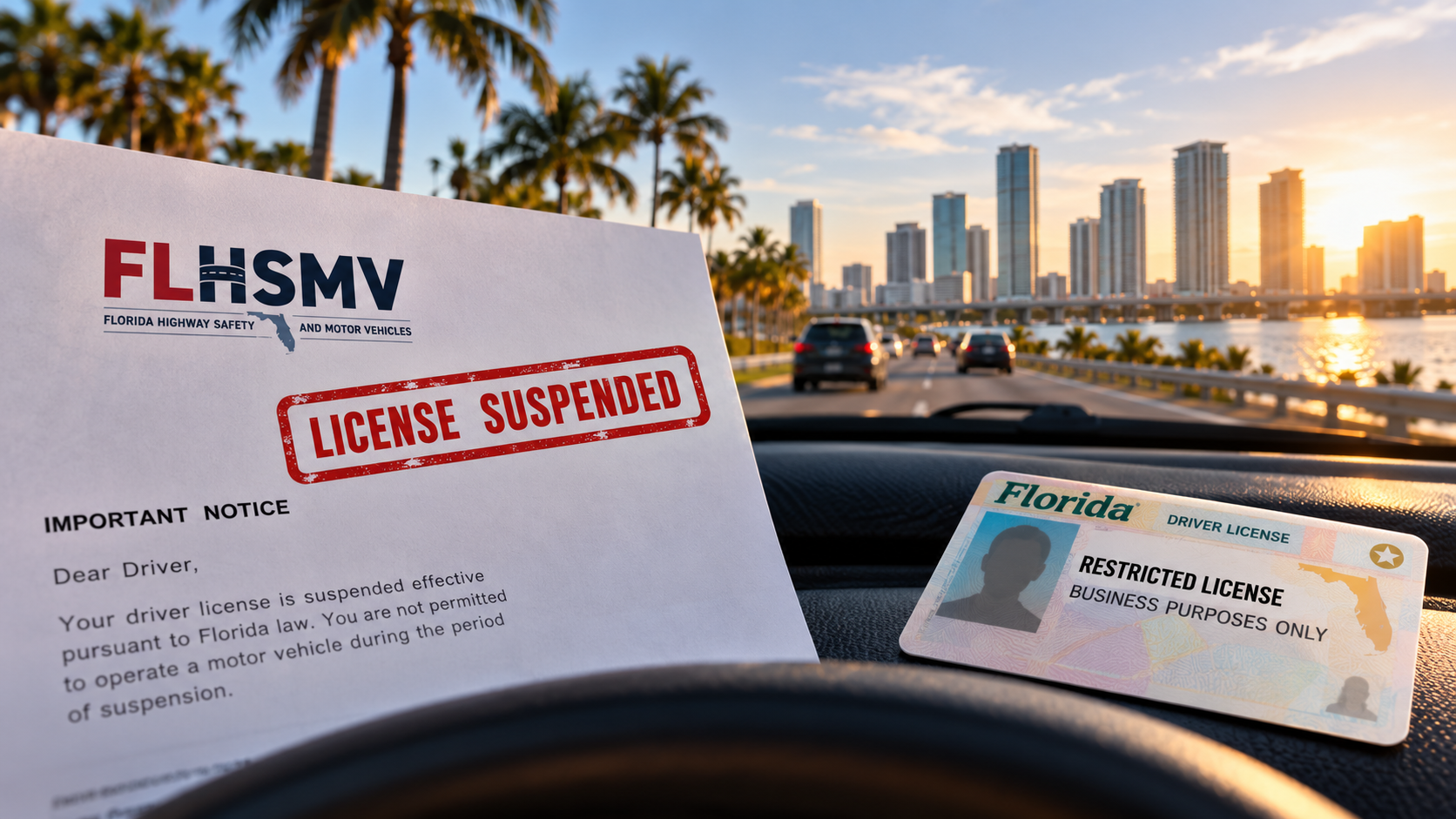
A letter from the Florida Department of Highway Safety and Motor Vehicles (FLHSMV) says your license is suspended. You still have a shift on Monday, a kid who needs a ride to school, and no bus line anywhere near your house. That’s the exact situation a hardship license in Florida was built for.
A Florida hardship license is a restricted license. It lets some drivers keep driving for work and life necessities while a suspension or revocation runs its course. It is not automatic, and plenty of people don’t qualify. The rules change a lot depending on why you lost your license in the first place.
This guide walks through how the law works: who is eligible, who isn’t, what the Bureau of Administrative Reviews hearing looks like, and how DUI and habitual traffic offender cases are treated differently. If your situation started with a single ticket, our guide to the 30-day decision after a Florida traffic ticket covers that earlier stage.
What Is a Hardship License in Florida?
“Hardship license” is the everyday name. The law itself talks about a driving privilege “restricted to business or employment purposes.” The main statute is Fla. Stat. § 322.271, which gives FLHSMV the power to modify a suspension or revocation and restore limited driving.
Under that statute, the driver has to show that losing the license causes a serious hardship. Specifically, the driver shows it keeps them from carrying out their normal job or trade, and that driving is necessary to support themselves or their family. The decision is made by FLHSMV’s Bureau of Administrative Reviews (often called the BAR), not by a judge.
There’s no federal hardship license. Driver licensing is state law, so everything in this article comes from Florida’s statutes and FLHSMV’s own procedures.
Business Purposes vs. Employment Purposes Only
Florida has two kinds of hardship restrictions, and the difference matters every single time you get behind the wheel. Both are defined in section 322.271(1)(c).
Business Purposes Only (BPO)
This is the broader one. It covers any driving necessary to maintain your livelihood, including driving to and from work, on-the-job driving, school, church, and medical purposes. The statute doesn’t give a detailed list of every allowed errand, so the core test is whether the trip is truly necessary.
Employment Purposes Only (EPO)
This one is narrow. It covers driving to and from work and any on-the-job driving your employer or occupation requires. That’s it. No church, no doctor’s office, no school drop-off.
Say Rosa is a dental hygienist in Fort Myers with a BPO license. She can drive to her office on Colonial Boulevard, take her son to his pediatrician, and get to her Tuesday night community college class. If her license were restricted to employment purposes only, the pediatrician visit and the class would both be off limits. Neither one would cover a Saturday drive to the beach.
Watch out: The statute says driving for any purpose outside the restriction “is not permitted.” A hardship driver who is stopped on a trip that doesn’t fit the restriction can face new charges, and in some cases loses the hardship privilege entirely.
One more detail people miss. A hardship license keeps any restrictions that applied to the license you held before. If your old license required corrective lenses, your hardship license does too.
Who Is Not Eligible for a Hardship License in Florida?
This is where a lot of people get surprised. Florida law shuts the door completely in some situations and delays it in others. Here are the main categories where the statutes block or limit a hardship license:
- Multiple DUI convictions or refusals. Under section 322.271(2)(a), a person with two or more DUI convictions, or two or more suspensions for refusing a breath, blood, or urine test, generally can’t get a hardship license. The exception is the longer waiting-period track for second and third DUI revocations, covered below.
- Permanent revocations. Four or more DUI convictions, or a DUI manslaughter conviction, leads to permanent revocation under Fla. Stat. § 322.28. A narrow petition process opens only after at least 5 years, and for DUI manslaughter only if there are no prior DUI-related convictions.
- Felony drug possession while driving. Under Fla. Stat. § 322.27(6), someone whose license was revoked for a felony drug possession conviction while driving can’t get a business or employment license during that revocation.
- Habitual traffic offenders in their first year. A habitual traffic offender revocation has a mandatory 12-month wait before a petition is even allowed.
- Commercial driving while disqualified. Section 322.271(6) bars issuing a commercial driver license while a person is disqualified from operating commercial vehicles. A hardship restriction doesn’t put a CDL holder back in a commercial truck.
Other suspensions, such as ones tied to unpaid tickets or a lapse in required insurance, are usually cleared by fixing the underlying problem rather than through a hardship hearing. And even when someone is technically eligible, the BAR still has discretion. Eligibility only means you get to make your case.
How to Get a Hardship License in Florida
The exact path depends on the reason for the suspension, but the general process for most applicants looks like this:
- Confirm the reason and length of the suspension. The notice from FLHSMV, or a driving record, shows which statute the suspension falls under. That decides everything else.
- Enroll in or complete the required course. Depending on the case, this is a state-approved driver improvement course or a DUI program’s education course and evaluation.
- File the application. FLHSMV’s hardship application is form HSMV 78306, sent with a $12 filing fee to the BAR office assigned to the county where you live.
- Attend the hearing, unless it’s waived. The BAR reviews the application and either holds a hearing or decides on the paperwork.
- Pay reinstatement and license fees. If approved, the restricted license is issued once the fees are paid.
Which office handles your case depends on where you live. FLHSMV’s locations page lists the assigned BAR office, email, and phone number for each county. FLHSMV says hardship applications can be sent to that office without visiting in person.
What Happens at the Bureau of Administrative Reviews Hearing
Section 322.271(1)(a) says the hearing should be held as early as practicable, within 30 days after the department receives the request, in the county where the driver lives (unless both sides agree to another county). The hearing officer looks at the driver’s record, the reason for the suspension, and the need to drive.
The BAR may also ask for letters of recommendation from respected business people, law enforcement officers, or judicial officers. The point is to show the driver can be trusted to stick to the restriction. Afterward, the department either affirms its order or modifies it to allow restricted driving.
Sometimes there’s no hearing at all. Under section 322.271(2)(b), the department may waive the hearing if the driver has enrolled in or completed the required course. That waiver isn’t available for suspensions involving death or serious bodily injury, multiple DUI convictions, or a second suspension under the same provision.
The Course Requirement: Driver Improvement and DUI School
Florida ties almost every hardship license to education. Section 322.271(2)(a) requires proof of the applicable driver training course approved under Fla. Stat. § 318.1451, or a DUI program’s substance abuse education course and evaluation.
For points suspensions and habitual traffic offender revocations, the course is generally the 12-hour Advanced Driver Improvement (ADI) course. For alcohol-related cases, it’s DUI school through a licensed DUI program.
Enrollment vs. completion: For a points suspension or an administrative DUI suspension, proof of enrollment is generally enough to apply. But the course must be finished within 90 days after reinstatement, or FLHSMV cancels the license until it’s done. Someone convicted of DUI can’t get a hardship license until the DUI education course and evaluation are complete.
Hardship License in Florida After a DUI
DUI cases are the most complicated part of the hardship rules, because a DUI arrest can trigger two separate actions. One is an administrative suspension that FLHSMV imposes right away. The other is a court-ordered revocation if there’s a conviction under Fla. Stat. § 316.193.
After a DUI Arrest: The Administrative Suspension
Under Fla. Stat. § 322.2615, the officer takes the license and issues a 10-day temporary permit. A first breath or blood result of 0.08 or higher brings a 6-month suspension. A first refusal brings a 1-year suspension. Within those 10 days, the driver can request a formal or informal review, or ask for a review of eligibility for a restricted license.
Here’s the key choice. Section 322.271(7) lets a true first-timer (no prior 322.2615 suspension, no prior DUI conviction, and no prior commercial disqualification under Fla. Stat. § 322.64) get a business-purposes-only license for the length of the suspension. But accepting it counts as a waiver of the right to formal and informal review.
If the driver instead challenges the suspension and loses, there’s a waiting period before any hardship license. It’s 30 days after the last temporary permit expires for a breath or blood result of 0.08 or higher, and 90 days for a refusal.
Picture Kayla, a pharmacy tech in Tampa, pulled over on Dale Mabry Highway at 1 a.m. She blows a 0.11, and it’s her first arrest. One path: she enrolls in DUI school, waives review, and can apply for a business-purposes-only license right away. The other path: she requests a formal review to fight the suspension. If the suspension is upheld, she waits 30 days past her permit’s expiration before she can get a hardship license.
After a DUI Conviction: The Court Revocation
Section 322.28(2)(a) sets the revocation periods. A first conviction means 180 days to 1 year. A second conviction within 5 years of a prior one means at least 5 years. A third within 10 years means at least 10 years.
For second and third DUI revocations, section 322.271(2)(c) creates a delayed path to a restricted license:
- Revocation of 5 years or less: petition allowed after 12 months.
- Revocation of more than 5 years: petition allowed after 24 months.
- Either way, the driver must not have driven and must have been drug free for at least 12 months before reinstatement.
- The driver is supervised by a licensed DUI program and reports at least three times a year for the rest of the revocation.
The department may also require an ignition interlock device under section 322.271(2)(e). Say Marcus in Daytona Beach gets a second DUI conviction four years after his first. His license is revoked for 5 years. The earliest he could petition for a restricted license is 12 months in, and only if he hasn’t driven at all during that year.
Habitual Traffic Offender Hardship License in Florida
Fla. Stat. § 322.264 defines a habitual traffic offender (HTO) as someone with, within a 5-year period, either three or more convictions for serious offenses from separate incidents, or 15 convictions for moving violations that carry points. The serious offenses include DUI, driving while your license is suspended or revoked, vehicular manslaughter, felonies involving a vehicle, and leaving the scene of a crash with injury or death. The 2026 version of the statute also lists driving without a valid license.
An HTO designation means a 5-year revocation under section 322.27(5). After 12 months, the driver can petition for a restricted license limited to business or employment purposes. The department looks at the person’s qualification, fitness, and need to drive before deciding.
No second chances: Under section 322.271(1)(b), an HTO who gets a restricted license and then violates its conditions loses it, and isn’t eligible for any driving privilege for the rest of the 5-year period.
Take Andre, a warehouse supervisor in Jacksonville. Over four years, he picks up three convictions for driving on a license suspended over unpaid tickets. That makes him an HTO with a 5-year revocation. Once 12 months have passed, he could complete the ADI course and petition the BAR for a restricted license. Any new driving offense during that year would badly hurt his case.
Andre’s situation has one more wrinkle. Section 322.27(5)(b) provides that when the HTO revocation came from a third suspended-license conviction, and the driver shows proof of compliance for certain underlying offenses, the clerk of court submits an amended disposition removing the HTO designation. That’s a separate route from a hardship license, and it only applies to specific underlying offenses.
How Much Does a Hardship License Cost in Florida?
The state fees are set by Fla. Stat. § 322.21, but course costs and license fees add up on top.
- Hardship hearing filing fee: $12.
- Reinstatement service fee: $45 after a suspension or $75 after a revocation.
- DUI or refusal add-on: an extra $130 when the suspension or revocation was for DUI or a test refusal.
- License fee: the regular fee for issuing the license itself.
- Course costs: ADI or DUI school fees, which vary by provider, plus any DUI program supervision costs.
$12 + $75 + $130 = $217
State fees alone for a hardship license after a DUI revocation, before the license fee, DUI school, and any interlock device.
A Hypothetical: Points Suspension in Lakeland
Let’s put the pieces together. Devon is a 29-year-old roofer in Lakeland who drives his own truck to job sites around Polk County. Over 18 months he collects a red-light ticket (4 points), two tickets for going more than 15 mph over the limit (4 points each), and two other moving violations (3 points each). That’s 18 points within 18 months.
Under section 322.27(3), 18 points in 18 months means a suspension of up to 3 months. Devon can’t miss three months of work. So he enrolls in the 12-hour ADI course, mails form HSMV 78306 with the $12 fee to his assigned BAR office, and includes his enrollment certificate.
Because he enrolled in the course and this is his first points suspension, the BAR has the option to waive the hearing. Say it grants him a business-purposes-only license. He pays the $45 reinstatement fee plus the license fee. He can now drive to job sites, to the supply house, and to his doctor, but not to his buddy’s fantasy draft party on a Sunday.
Then the clock matters. Devon has 90 days after reinstatement to finish the ADI course. If he doesn’t, FLHSMV cancels his license until he does.
Key takeaway: In Florida, the reason for the suspension controls everything. Points suspensions are usually the most straightforward path. Administrative DUI suspensions turn on a 10-day window. DUI convictions and HTO revocations come with mandatory waiting periods and tighter conditions.
How Florida Compares to Other States
Florida runs hardship licenses through an administrative agency, the BAR, instead of through the criminal court that handled the ticket or DUI. Other states use different systems. New York, for example, uses a “conditional license” tied to enrollment in its Drinking Driver Program for many alcohol-related suspensions.
Florida also splits restricted driving into two tiers, business and employment. That means two Florida drivers with the same suspension can end up with very different freedom behind the wheel.
Common Questions About Florida Hardship Licenses
Can I apply for a Florida hardship license online?
FLHSMV’s posted process is to download the hardship form and submit it to the assigned BAR office. FLHSMV says that can be done without visiting the office in person.
How long does it take to get a hardship license in Florida?
The statute calls for a hearing within 30 days after the department receives the request. When the hearing is waived, things can move faster. Mandatory waiting periods for DUI and HTO cases come on top of that.
What happens if a hardship license is denied?
Under section 322.27(7), review of a suspension or revocation order is by writ of certiorari in the circuit court, as set out in Fla. Stat. § 322.31. That review looks at whether the department followed the law, not a brand-new hearing.
How long does a hardship license last?
Generally, until the underlying suspension or revocation ends and the driver qualifies for full reinstatement. For first-time administrative DUI suspensions under section 322.271(7), the business-purposes-only restriction lasts for the length of the suspension.
Does a hardship license let me drive a commercial vehicle?
No, not while you’re disqualified from commercial driving. Section 322.271(6) bars issuing a CDL during a disqualification, suspension, revocation, or cancellation.
The Bottom Line
A hardship license in Florida can keep a suspended driver working, but only within strict limits set by section 322.271 and the BAR. Who qualifies, how long they wait, and which course they need all depend on why the license was suspended in the first place.
This article is for educational purposes only and is not legal advice. Reading it does not create an attorney-client relationship. For advice on your specific situation, consult a licensed attorney in your state.