Florida Lemon Law Refund Calculation: How Payouts Work
Most people who look up the Florida lemon law refund calculation want one number. What is the car actually worth back to me? The honest answer is that Florida does not pay a settlement in the way a car accident case does. It runs a formula.
Florida’s lemon law lives in Chapter 681, Florida Statutes, also called the Motor Vehicle Warranty Enforcement Act. It does not award pain and suffering. It does not award punitive damages. What it does is unwind the purchase, hand the vehicle back to the manufacturer, and put money back in the buyer’s pocket according to a calculation the Legislature wrote down.
Below is how that calculation works, what gets added, what gets subtracted, and how a Chapter 681 matter actually moves from a repair order to a check.
What Florida’s Lemon Law Pays: Refund or Replacement
Under Fla. Stat. § 681.104, once a manufacturer cannot fix a defect after a reasonable number of attempts, it has 40 days to do one of two things. It either repurchases the vehicle and refunds the full purchase price minus a reasonable offset for use, or it swaps the vehicle for a replacement the consumer accepts.
There is an important asymmetry buried in that section. The consumer has an unconditional right to choose the refund instead of the replacement. The manufacturer does not get to force a swap. That single sentence is why most Florida lemon law buyback outcomes end in cash rather than a new car.
If a replacement is chosen instead, section 681.104 requires it to be identical or reasonably equivalent, and the statute defines that as a vehicle whose manufacturer’s suggested retail price does not exceed 105 percent of the original. The consumer still pays the offset for use in that scenario, just in the other direction.
Key takeaway: Chapter 681 is a rescission statute, not a damages statute. It is built to undo the transaction, not to compensate for the aggravation of owning a broken car.
How the Florida Lemon Law Repurchase Calculation Works
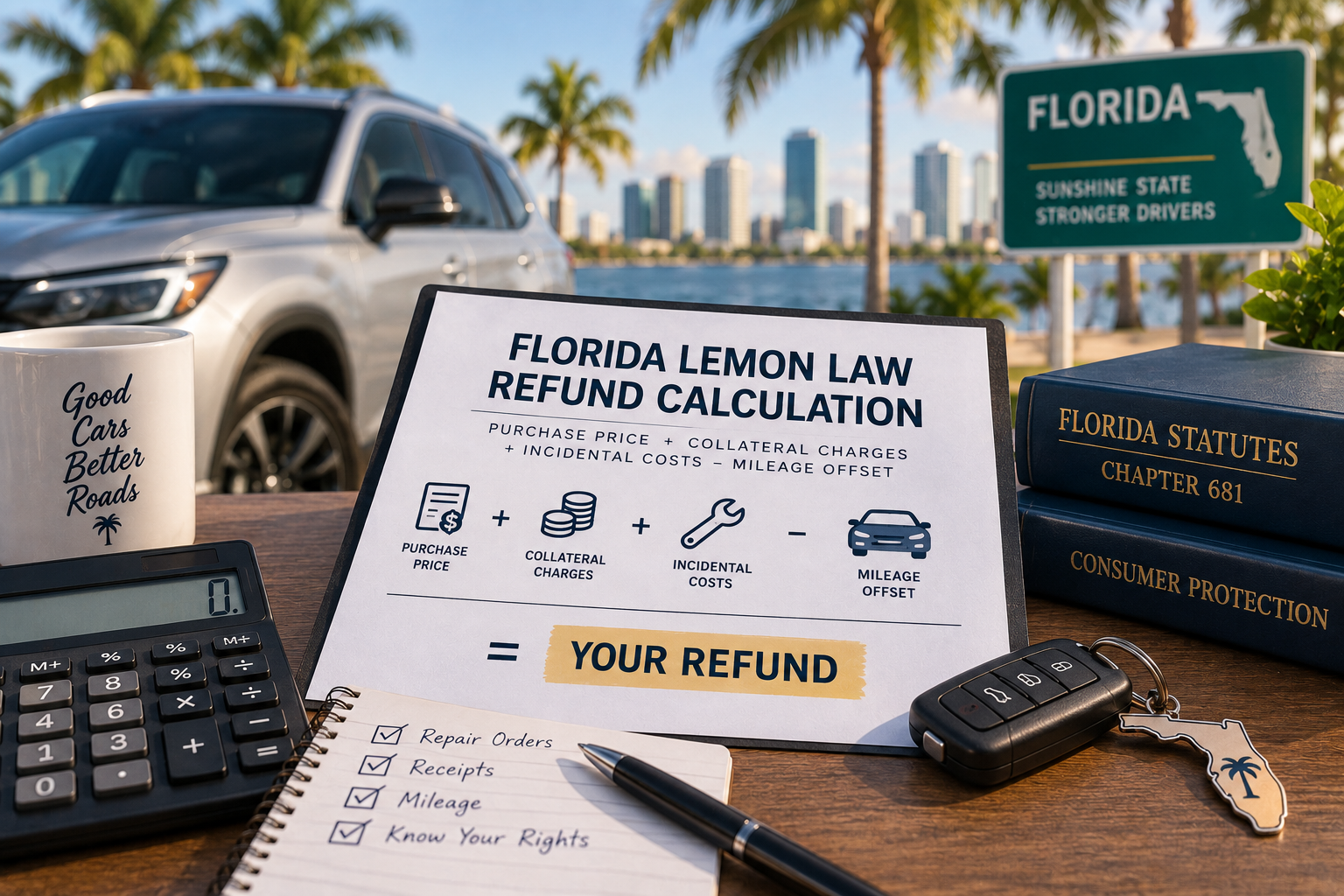
A Florida repurchase award is built from four moving parts. Three of them add to the number. One of them subtracts. Each is defined in Fla. Stat. § 681.102, which is where most of the real math lives.
Purchase Price
Section 681.102 defines purchase price as the cash price from the contract, including any allowance for a trade-in vehicle. It excludes debt rolled in from another transaction, so negative equity carried over from an old loan does not get refunded.
Trade-ins get their own rule. The net trade-in allowance in the contract controls if both sides accept it. If they don’t, the statute sets the allowance at 100 percent of the trade-in’s retail price in the applicable NADA guide in effect at the time of the trade, and it makes the manufacturer supply the book.
Collateral Charges
These are the extra costs incurred purely because the vehicle was acquired. Section 681.102 lists manufacturer-installed or agent-installed items, service charges, earned finance charges, sales taxes, and title charges. Sales tax on a Florida vehicle purchase is often several thousand dollars on its own, so this category matters.
Incidental Charges
Incidental charges are reasonable costs caused directly by the defect. Towing when the vehicle died on the shoulder of I-4. A rental while it sat at the service department. Section 681.104 requires that a refund or replacement include all reasonably incurred collateral and incidental charges, which is why receipts matter as much as repair orders.
The Reasonable Offset for Use
This is the deduction, and it is the part almost everyone gets wrong. Section 681.102 defines it precisely.
The Florida offset formula: Miles attributable to the consumer, multiplied by the base selling price on the purchase invoice, divided by 120,000. For a recreational vehicle, the denominator is 60,000 instead.
Two details inside that formula move the number a lot. First, the multiplier is the base selling price on the invoice, not the out-the-door total. The statute specifically excludes taxes, government fees, and dealer fees from that figure, so the offset is calculated on a smaller number than most people assume.
Second, the mileage runs up to the date of a settlement agreement or the arbitration hearing, whichever comes first. Not the date the defect appeared. Not the date the notice went out. Miles driven while a claim is pending keep increasing the deduction.
Florida spreads that offset across 120,000 miles, which is a longer runway than several other states use. A New York or New Jersey number will not match a Florida number for the same vehicle and the same odometer reading, because the denominators and the starting points differ.
A Worked Example: A Buyback in Tampa
Say Marisol Vega buys a new midsize SUV from a dealership on North Dale Mabry in Tampa. The purchase invoice shows a base selling price of $36,000. With 7 percent sales tax, title and tag, and a dealer fee, her total contract price comes to $39,834.
The transmission shudders and slips starting at 1,800 miles. It goes back four separate times over eleven months. Marisol pays $340 for a tow off the Selmon Expressway and $520 for a rental while the SUV sits at the service department. By the time her arbitration hearing is scheduled, the odometer reads 9,000 miles.
Her offset for use is 9,000 miles times $36,000, divided by 120,000. That comes to $2,700.
- Purchase price and collateral charges: $39,834
- Incidental charges (tow plus rental): $860
- Less reasonable offset for use: $2,700
- Net repurchase figure: $37,994
Notice that the offset was calculated off $36,000, not $39,834. Running it off the higher figure would have produced $2,987 and cost Marisol close to $300. That gap is the single most common arithmetic error in Florida repurchase calculations.
Section 681.104 also directs that refunds go to the consumer and to the lienholder of record as their interests appear. If Marisol still owed $22,000 on the loan, that portion goes to the lender and the balance goes to her. She hands over clear title and possession in exchange.
Marisol is a fictional example used to illustrate the statutory formula. Real calculations depend on the actual contract documents and the odometer reading on the hearing date.
How Leased Vehicles Get Paid Out
Leases are split differently. Section 681.104 says the lessee receives the lessee cost and the lessor receives the lease price minus the lessee cost. Lessee cost is defined in section 681.102 as the aggregate deposit and rental payments already paid to the lessor, excluding debt from other transactions.
Say Darnell Whitfield leases a sedan in Orlando with $3,500 down and fourteen monthly payments of $520 before the defect claim resolves. His lessee cost is $10,780. The offset formula still applies, but for a lease it runs off the agreed upon value in the lease agreement rather than a purchase invoice.
The statute also bars any early lease termination penalty against a lessee who receives a refund or replacement under Chapter 681. The leasing company does not get to charge for ending a lease the law is ending.
Florida Lemon Law Attorney Fees and Other Money the Statute Allows
Chapter 681 does not provide for an award of attorney’s fees as part of a decision by the Florida New Motor Vehicle Arbitration Board. Consumers may be represented by counsel at a Board hearing under section 681.1095, but the fee-shifting language sits in other sections.
Section 681.112 governs consumer remedies in court. It directs that a court award a consumer who prevails the amount of any pecuniary loss, litigation costs, reasonable attorney’s fees, and appropriate equitable relief.
Section 681.1095 adds pressure on the back end. If a manufacturer appeals a Board decision that favored the consumer and the court upholds it, recovery includes the value of the award, attorney’s fees incurred confirming it, all costs, and continuing damages of $25 per day for every day past the 40-day compliance window. If the court finds the appeal was brought in bad faith, it must double the total award and may triple it.
There is also a stick pointed the other way. Section 681.106 makes a consumer liable for the manufacturer’s costs and reasonable attorney’s fees if a court finds the claim was filed in bad faith, solely to harass, or with no justiciable issue of law or fact.
How a Florida Lemon Law Claim Actually Moves
Florida runs a sequence, and skipping a step generally ends the claim. Chapter 681 lays it out in order.
- The defect is first reported to the manufacturer or an authorized service agent during the Lemon Law rights period, which section 681.102 defines as the 24 months following original delivery.
- Repair orders accumulate. Section 681.103 requires the service agent to hand over an itemized, legible repair order every time, showing the diagnosis, the work performed, the dates, and the odometer readings.
- Written notice goes to the manufacturer, not the dealer, by registered or express mail. Section 681.104 triggers this after three repair attempts on the same problem, or after the vehicle has been out of service for 15 or more cumulative days.
- The manufacturer gets a final shot. It has 10 days from receipt to respond and direct the vehicle to a reasonably accessible facility, then 10 more days to fix it. For a recreational vehicle, that repair window is 45 days.
- The presumption attaches. Under section 681.104, a reasonable number of attempts is presumed after three repairs plus the final attempt, or after 30 or more cumulative days out of service. For recreational vehicles the threshold is 60 days.
- If the manufacturer runs a state-certified dispute settlement program, section 681.108 requires that program first. If it does not, or the program fails to decide within 40 days, the dispute goes to the Board.
- A request for arbitration is filed with the Department of Legal Affairs, which screens it for eligibility under Fla. Stat. § 681.109.
The Attorney General’s Office publishes a Motor Vehicle Defect Notification form that can be used for that written notice step. Mailing a copy of that form to the Attorney General does not start a claim on its own. It is one step toward becoming eligible to file one.
What Happens at a Board Hearing
The Florida New Motor Vehicle Arbitration Board sits in three-member panels. Section 681.1095 requires it to hear cases in locations around the state so a consumer in Jacksonville is not forced to travel to Tallahassee, and to hear an approved dispute within 40 days and issue a decision within 60 days.
At the hearing, both sides may present testimony and evidence, cross-examine witnesses, and be represented by counsel. The panel grants relief if it finds a reasonable number of repair attempts were undertaken, then applies the statutory formula to set the refund or replacement terms.
Manufacturers are required to participate. A decision in the consumer’s favor obligates the manufacturer to comply within 40 days of receipt. Either side may petition the circuit court within 30 days, and that appeal is a trial de novo in the county where the consumer lives, where the vehicle was acquired, or where the hearing was held. Procedural details are filled in by Chapter 2-30 of the Florida Administrative Code.
Deadlines That Control Everything
Florida’s filing windows are short and they are hard. Section 681.109 requires a request for Board arbitration no later than 60 days after the Lemon Law rights period expires, or within 30 days after final action by a certified program, whichever falls later.
Section 681.112 sets a separate clock for court. A civil action under the chapter must be commenced within one year after the rights period expires, or within one year after final action by the procedure, the department, or the Board.
Timing matters: Because the Lemon Law rights period runs 24 months from delivery, the arbitration window can close roughly 26 months after a vehicle is first driven off the lot. Section 681.1095 also requires that a dispute be submitted to the department, and to the Board if eligible, before a civil action on a section 681.104 matter is filed.
One more provision worth knowing. Section 681.115 voids any agreement in which a consumer waives, limits, or disclaims Chapter 681 rights, including confidentiality clauses attached as a condition. Those rights also extend to a later transferee of the vehicle.
Common Questions About Florida Lemon Law Compensation
Does the Florida lemon law cover used cars?
Generally no. Section 681.102 defines a motor vehicle under the chapter as a new vehicle, and it includes demonstrators and leased vehicles where a manufacturer’s warranty was issued as a condition of sale. It excludes trucks over 10,000 pounds gross vehicle weight, motorcycles, mopeds, off-road vehicles, and the living facilities of recreational vehicles. Used vehicle disputes usually run through other bodies of law entirely.
Can a Florida claim be brought against the dealership?
Chapter 681 aims at the manufacturer. Section 681.113 says the chapter generally imposes no liability on a dealer and creates no cause of action against one, apart from written express warranties the dealer made separately from the manufacturer’s. Dealers usually cannot be named as defendants in a Chapter 681 action.
What happens to a repurchased vehicle afterward?
It gets branded and tracked. Section 681.114 requires the manufacturer to report the vehicle identification number to the department within 10 days. Anyone later selling or leasing that vehicle must clearly and conspicuously disclose the nature of the defect, and the manufacturer must warrant a correction for one year or 12,000 miles, whichever comes first.
Is there federal law that applies alongside Chapter 681?
Yes. The Magnuson-Moss Warranty Act is the federal statute governing written warranties on consumer products, and it carries its own fee-shifting provision. Section 681.112 states that Chapter 681 does not prohibit a consumer from pursuing other rights or remedies available under other law.
What if a manufacturer ignores a Board decision?
Section 681.1095 gives the department authority to ask a circuit court to impose fines of up to $1,000 per day against a manufacturer that neither complies nor appeals, until the total reaches twice the purchase price of the vehicle. Those proceeds go into the Motor Vehicle Warranty Trust Fund rather than to the consumer.
The Short Version
A Florida lemon law payout is the purchase price plus collateral and incidental charges, minus a mileage offset calculated on the base selling price and spread over 120,000 miles. The path there runs through repair orders, written notice by registered or express mail, sometimes a manufacturer’s certified program, and then the Florida New Motor Vehicle Arbitration Board.
The arithmetic is fixed by statute, but the inputs are not. The invoice, the trade-in allowance, the receipts, and the odometer reading on the hearing date all move the final number.
This article is for educational purposes only and is not legal advice. Reading it does not create an attorney-client relationship. For advice on your specific situation, consult a licensed attorney in your state.