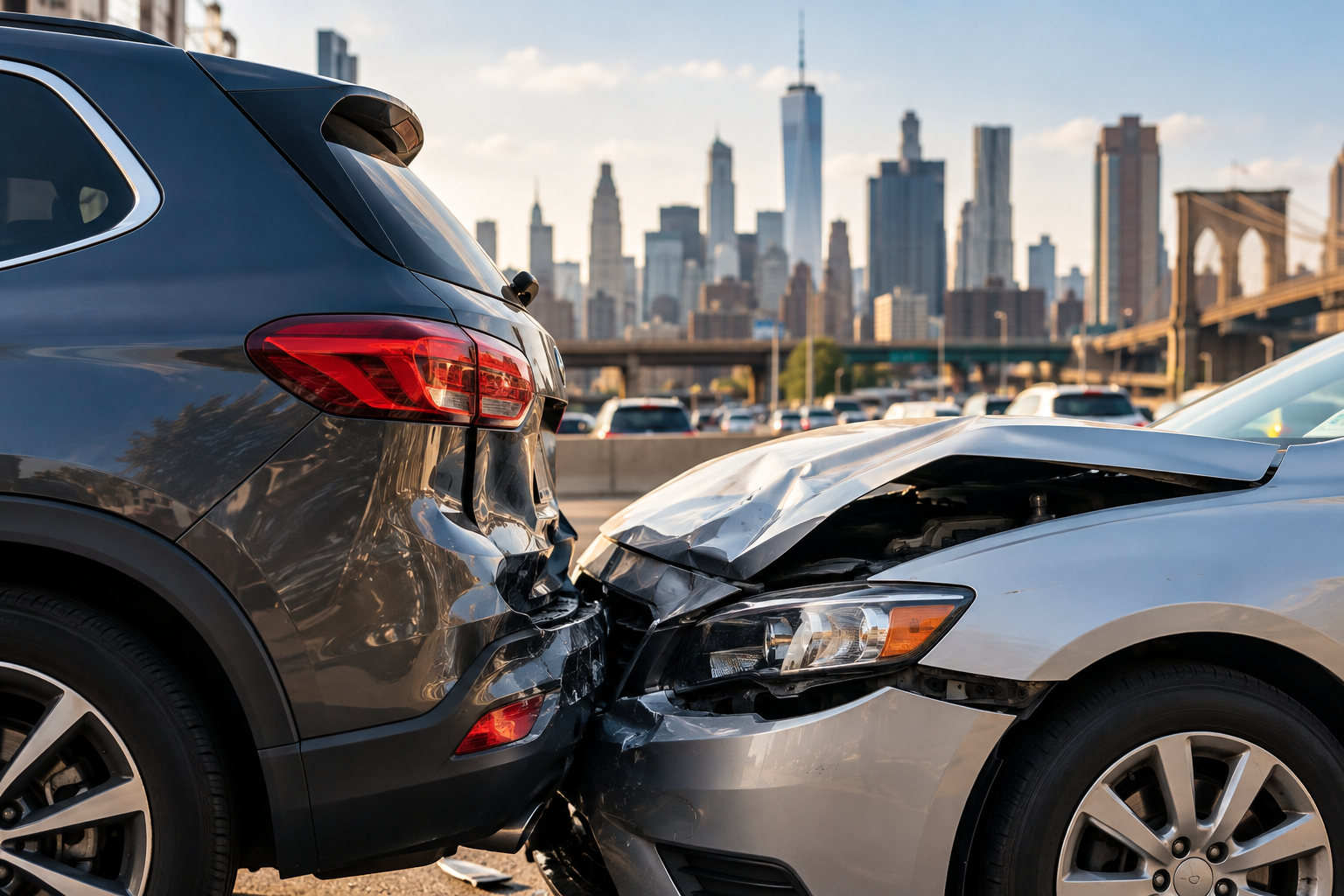
New York Car Accident Lawsuits: The 2026 Guide
If you were hurt in a New York car accident, the rules for who can sue and how much they can recover are not the same as they were a year ago. In May 2026, New York changed its car accident law as part of the state budget. The changes affect fault, injury requirements, and pain and suffering damages.
A lot of what you’ll find online about New York car accident lawsuits was written before those changes. Some of it is now flat wrong. This guide walks through how a New York car accident case works today, from the first no-fault claim to the courtroom, in plain English.
Key takeaway: For lawsuits filed after the May 2026 changes, an injured person who is found more than 50 percent at fault generally can’t recover anything in a New York car accident case. The “90/180 days” injury category is gone. And certain uninsured, impaired, or felony drivers face a $100,000 cap on pain and suffering.
What Changed in New York Car Accident Law in 2026?
Governor Hochul pushed these changes as a way to fight insurance fraud and bring down auto insurance premiums. The legislature passed them inside the 2026 budget, and they took effect right away in late May 2026. There are four big changes.
- A new fault bar. New York used to let injured people recover even if they were mostly at fault. Now, in car accident cases covered by the no-fault system, a person who is more at fault than the people they sue is barred from recovering.
- The 90/180 category is gone. One of the most common ways to meet the “serious injury” threshold was removed.
- Fault comes first. The jury now decides who was at fault before it decides whether the injury is serious enough.
- A $100,000 cap for some drivers. Pain and suffering is capped for at-fault drivers who were uninsured, convicted of impaired driving, or convicted of a felony tied to the crash.
The changes apply to lawsuits started on or after the effective date. That means the date a case is filed matters, not just the date of the crash. A person hurt in 2025 who files suit after late May 2026 may find the new rules apply to them.
Step One Is Still No-Fault Insurance
New York is a no-fault state. That means after most crashes, your own auto insurance pays your basic medical bills and some lost wages, no matter who caused the accident. These are called basic economic loss benefits, and they’re set out in New York Insurance Law § 5102.
No-fault generally covers up to $50,000 per person. That includes necessary medical care, lost earnings up to $2,000 a month for up to three years (with certain offsets), and up to $25 a day for other reasonable expenses for one year. Passengers and pedestrians hit by a car are usually covered too, often through the policy on the car involved.
What no-fault does not pay is pain and suffering. To get that, an injured person has to step outside the no-fault system and sue the at-fault driver. And New York only allows that in certain cases.
No-Fault Deadlines Are Short
According to the New York Department of Financial Services no-fault FAQ, the written no-fault application is generally due within 30 days of the accident. Medical bills are generally due within 45 days of treatment, and lost wage claims within 90 days. Late filings can be excused only with a written reason the insurer accepts.
Watch out: The 30-day no-fault deadline is one of the fastest-moving clocks in New York law. It runs while people are still recovering, still dealing with a damaged car, and often before anyone has thought about a lawsuit.
The Serious Injury Threshold After 2026
To sue for pain and suffering after a New York car accident, the injured person generally has to prove a “serious injury.” The list of qualifying injuries lives in Insurance Law § 5102(d). After the 2026 changes, it includes:
- Death
- Dismemberment or loss of a body part
- Significant disfigurement
- A bone fracture
- Loss of a pregnancy
- Permanent loss of use of a body organ, member, function, or system
- Permanent consequential limitation of use of a body organ or member
- Significant limitation of use of a body function or system
Why Losing the 90/180 Category Matters
Before 2026, there was one more category. It covered an injury that kept a person from doing substantially all of their usual daily activities for at least 90 of the first 180 days after the crash. People with soft tissue injuries, like neck and back strains, often relied on it because their injuries didn’t show up as a fracture or permanent damage.
Say Priya gets rear-ended on Sunrise Highway in her Toyota RAV4. She has severe whiplash and can’t work her warehouse job for four months, but nothing is broken and her doctors expect a full recovery. Under the old law, she might have qualified under 90/180. Under the new law, she would generally need to show something else on the list, like a significant limitation of a body function, which usually takes stronger medical proof.
New York’s New 50 Percent Fault Rule
For decades, New York followed “pure” comparative fault under CPLR § 1411. An injured person’s own fault reduced their damages but never wiped them out. Someone 90 percent at fault could still collect 10 percent of their damages.
The 2026 law added a new subsection (b) to CPLR § 1411. In personal injury cases that fall under the no-fault law, the injured person’s fault now bars recovery if it is greater than the fault of the person being sued, or greater than the combined fault of everyone being sued. A person who is exactly 50 percent at fault isn’t “greater,” so they can still recover half their damages. At 51 percent, the claim generally fails.
The new law also changed Insurance Law § 5104 so the jury decides fault before it looks at whether the injury is serious. If the injured person is more at fault than the defendants, the case can end there.
How It Works in Multi-Car Crashes
The text compares the injured person’s fault to the fault of the people they’re actually suing. That makes the choice of defendants more important than it used to be.
Picture a three-car pileup on the Southern State Parkway near Exit 22. A jury finds Kevin 40 percent at fault, Driver B 35 percent, and Driver C 25 percent. If Kevin sued both B and C, his 40 percent is less than their combined 60 percent, so he can recover 60 percent of his damages. If he only sued Driver C, his 40 percent is greater than C’s 25 percent, and the plain text suggests he’d be barred. Courts are still working out how this plays out in practice.
New Jersey and Connecticut have used a similar “more than 50 percent” bar for years. With the 2026 change, New York moved closer to its neighbors, but only for car accident cases under the no-fault system. Slip and fall, medical malpractice, and most other New York injury cases still follow pure comparative fault.
Example: One Belt Parkway Crash, Old Rules vs. New Rules
Let’s run one fictional crash through both systems. Dana is merging onto the Belt Parkway near Bay Parkway in her Honda Civic. Tom is speeding in the right lane in his Nissan Rogue. They collide, and Dana breaks her collarbone. That’s a fracture, so she meets the serious injury threshold.
At trial, the jury values Dana’s damages beyond what no-fault paid at $150,000. Now the fault split decides everything.
- Dana 55 percent at fault, old rule: She recovers 45 percent, or $67,500.
- Dana 55 percent at fault, new rule: Her fault is greater than Tom’s, so she recovers $0.
- Dana 45 percent at fault, either rule: She recovers 55 percent, or $82,500.
- Dana 50 percent at fault, new rule: Her fault isn’t greater than Tom’s, so she recovers $75,000.
A ten-point swing in fault, from 45 to 55 percent, now separates $82,500 from nothing at all. That’s why fault evidence like dashcam video, witness statements, and the police report carries more weight in New York car accident cases than it did before 2026.
51% At this share of fault or higher, an injured person in a New York no-fault car accident case is generally barred from recovery after the 2026 changes.
The $100,000 Pain and Suffering Cap
The 2026 law added a cap on non-economic damages, meaning pain and suffering, to Insurance Law § 5104. It doesn’t apply to everyone. It applies to an injured person who shares some of the fault, isn’t barred by the new 50 percent rule, and falls into one of three groups:
- They were driving an uninsured vehicle they were required to insure, unless the coverage lapse was under 30 days.
- They were driving while impaired and were convicted of it.
- They were driving while committing a felony, or fleeing one, and were convicted of that felony.
The cap does not apply to cases where the injuries resulted in death. It also only limits pain and suffering. Economic losses like medical bills and lost wages beyond no-fault aren’t capped by this provision.
Say Luis lets his insurance on his Toyota Corolla lapse for two months. While driving on Hylan Boulevard in Staten Island, he gets T-boned by a driver who ran a red light. The jury finds Luis 20 percent at fault for speeding and values his pain and suffering at $300,000. Because Luis was uninsured past the 30-day grace window, his pain and suffering award is capped at $100,000. If his lapse had only been three weeks long, the cap wouldn’t apply. Courts haven’t yet spelled out exactly how the cap and the fault reduction interact.
What the 2026 Law Did Not Change
A few important New York rules stayed the same. Knowing them helps explain who ends up paying after a crash.
Joint Liability for Drivers and Owners
New York generally limits how much a defendant with a small share of fault pays for non-economic damages. But CPLR § 1602 carves out people held liable for using, operating, or owning a motor vehicle. In car cases, that means a driver found only partly at fault can still be on the hook for the full judgment, and then seek a share back from the others.
Owner Liability and the Rental Car Exception
Under Vehicle and Traffic Law § 388, a vehicle owner can be held responsible when someone drives their car with permission and causes a crash. This is a big deal in truck and delivery van cases, where the company that owns the vehicle often has more insurance than the driver.
Federal law creates an exception. The Graves Amendment, 49 U.S.C. § 30106, generally shields rental and leasing companies from being liable just because they own the car, as long as they weren’t negligent themselves. This is one spot where federal law overrides New York’s owner liability rule.
Wrongful Death Claims
The $100,000 cap expressly excludes death cases, and the new fault bar’s text speaks to personal injury actions. Wrongful death claims in New York are governed by EPTL § 5-4.1, which generally gives the estate two years from the date of death to sue.
Key Deadlines After a New York Car Accident
Car accident cases in New York run on several clocks at once. Here’s how the main ones generally work, in the order they usually come up.
- 10 days: Under VTL § 605, drivers must file a written report with the DMV within 10 days when anyone is hurt or killed, or when property damage to any one person tops $1,000. This is done on the MV-104 Report of Motor Vehicle Crash.
- 30 days: The no-fault application to the insurer.
- 45 and 90 days: No-fault medical bills and lost wage claims.
- 90 days: A notice of claim against a city, county, or other public body, like a crash with a city bus or sanitation truck, under General Municipal Law § 50-e.
- 2 years: Wrongful death claims, counted from the date of death.
- 3 years: Most personal injury lawsuits against private drivers, under CPLR § 214(5).
Some crashes also come with a traffic ticket. That’s a separate case in a separate court, and the outcome can show up later in the injury case. You can read more in our guide to New York traffic tickets.
Where New York Car Accident Cases Are Heard
In New York, the “Supreme Court” is not the highest court. It’s the main trial court, and it’s where most serious car accident lawsuits are filed, in counties like Kings, Queens, Nassau, and Suffolk. It can hear cases of any dollar amount.
In the five boroughs, smaller cases may go to the Civil Court of the City of New York, which hears claims up to $50,000. A fender bender with modest injuries in the Bronx might land there, while a Long Island Expressway crash with a broken leg would more likely be filed in Supreme Court.
Uninsured and Hit-and-Run Drivers in New York
Sometimes the other driver has no insurance or drives away. New York created the Motor Vehicle Accident Indemnification Corporation, known as MVAIC, under Insurance Law § 5201 and the sections that follow. Its job is to fill coverage gaps so innocent victims who have no other source of insurance can still receive no-fault benefits.
Many New York drivers also carry uninsured and underinsured motorist coverage on their own policy. That coverage can come into play when the at-fault driver has no insurance or too little to cover the losses.
Common Questions About New York Car Accident Claims
Can you sue in New York if you were partly at fault for a car accident?
Generally yes, as long as your fault isn’t greater than the combined fault of the people you’re suing. Your recovery is reduced by your share of fault. If your share is greater, the 2026 rule generally bars recovery in no-fault car cases.
Does the new law apply to a crash that happened before May 2026?
It can. The changes apply to lawsuits started on or after the effective date, so the filing date matters more than the crash date. A case filed before the change generally stays under the old rules.
Do the new rules apply to motorcycle accidents?
Maybe not. The no-fault law’s definition of “motor vehicle” excludes motorcycles, and the new fault bar only applies to cases under the no-fault law. Many practitioners read that to mean an injured motorcyclist’s claim still follows pure comparative fault, but courts haven’t settled every edge case.
Is there a cap on pain and suffering in New York car accident cases?
For most people, no. The $100,000 cap only reaches at-fault drivers who were uninsured past a 30-day grace period, convicted of impaired driving, or convicted of a felony tied to the crash. It doesn’t apply to death cases.
How do car accident lawyers in New York usually get paid?
Most New York car accident lawyers work on contingency, meaning the fee comes out of any recovery instead of being billed by the hour. New York court rules limit contingency fees in personal injury cases, and a one-third fee is common.
The Bottom Line
New York car accident cases still start with no-fault insurance and still require a serious injury to sue for pain and suffering. What changed in 2026 is that fault now works like an on-off switch above 50 percent, the 90/180 category is gone, and some drivers face a $100,000 cap. For lawsuits filed today, those three rules shape almost every case.
This article is for educational purposes only and is not legal advice. Reading it does not create an attorney-client relationship. For advice on your specific situation, consult a licensed attorney in your state.