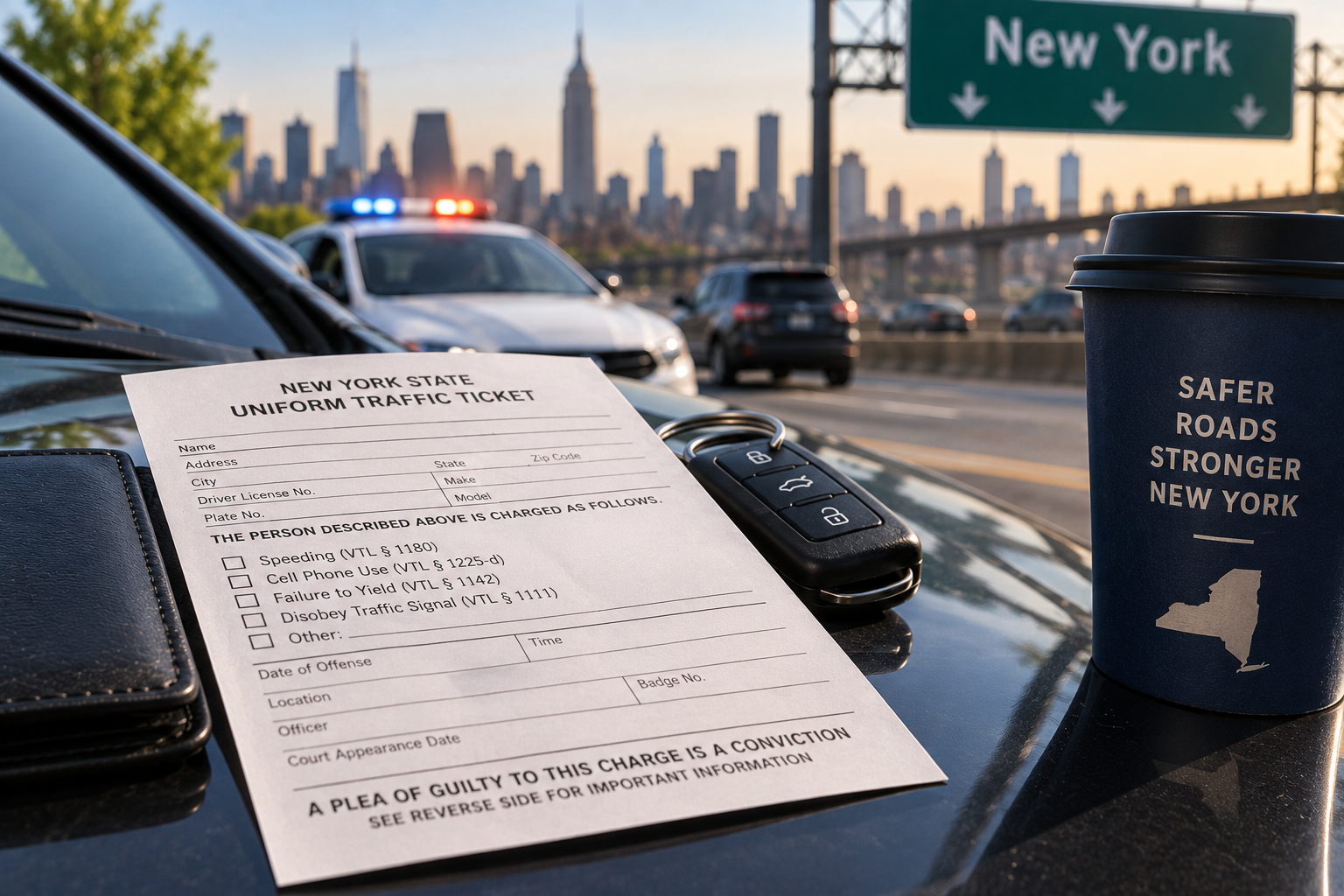
New York Traffic Tickets: The Complete 2026 Guide
A New York traffic ticket looks simple. It’s one piece of paper with a charge, a fine, and a date to respond. But what happens after that paper lands in your hand can follow you for years, through points on your license, a state fee most drivers never see coming, and insurance premiums that climb at renewal.
This guide explains how traffic tickets work across New York State in 2026. It covers the DMV point system (which changed in February 2026), what a speeding ticket in NY can cost, which court or agency hears a ticket depending on where it was written, and where defensive driving courses fit in.
Everything here is general education about how New York law works. It isn’t advice about any one ticket.
Key takeaway: A New York ticket can carry four separate costs: the fine, a mandatory state surcharge, DMV points, and sometimes a Driver Responsibility Assessment. Where the ticket was written (New York City, Nassau, Suffolk, or somewhere else) decides who hears it and what options exist.
What Happens After You Get a Traffic Ticket in New York
A ticket is a charge. It isn’t a conviction. Under the New York State Driver Point System, the DMV only adds points after a driver is convicted of the violation.
Most traffic tickets in New York are handled under the Vehicle and Traffic Law, usually shortened to “VTL.” The section number printed on the ticket tells you the exact charge. For example, a speeding ticket usually cites VTL § 1180.
Paying the Ticket Counts as a Guilty Plea
This is the part that surprises people. In New York, paying the fine is the same as pleading guilty. The conviction goes on the driving record, and any points attached to the charge come with it.
Drivers generally have three paths: plead guilty, plead not guilty and have the case heard, or (in courts that allow it) resolve the ticket through a negotiated plea to a different charge. Which paths exist depends heavily on where the ticket was issued.
Ignoring a Ticket Makes Things Worse
According to the DMV, a license gets suspended when a ticket isn’t answered on time. If the driver keeps ignoring it, the result can be a default conviction, which counts the same as a guilty finding. Driving while suspended is a crime in New York, so an ignored speeding ticket can snowball into something much bigger.
How the New York DMV Point System Works in 2026
The DMV uses points to spot high-risk drivers. Each moving violation conviction carries a set number of points. Pile up too many, and the DMV can move to suspend your license.
Here’s the big 2026 change. The DMV’s updated rules took effect on February 16, 2026. Under the current rules, a license may be suspended for 11 points in 24 months. The old window was 18 months, so points now count against a driver for longer.
11 points in 24 months is the current DMV suspension threshold in New York. Before February 16, 2026, the window was 18 months.
How Long Do Points Stay on Your License in NY?
Points are counted from the date of the violation, not the date of the conviction. Once 24 months pass from the violation date, those points stop counting toward the suspension total.
That doesn’t mean they vanish. The conviction and its points stay visible on the driving record as long as the conviction remains there, and the DMV notes most convictions show for up to four years. Insurance companies run their own point systems and can still raise premiums based on what they see.
How Many Points Is a Speeding Ticket in NY?
Speeding points depend on how far over the limit the conviction says you were. Here’s the DMV’s current point schedule for speeding and other common violations:
- Speeding 1 to 10 mph over (or speed not specified): 3 points
- Speeding 11 to 20 mph over: 4 points
- Speeding 21 to 30 mph over: 6 points
- Speeding 31 to 40 mph over: 8 points
- Speeding more than 40 mph over: 11 points
- Speeding in a work zone: 8 points
- Passing a stopped school bus: 8 points
- Using a cell phone or portable electronic device while driving: 5 points
- Reckless driving or failure to exercise due care: 5 points
- Following too closely (tailgating): 4 points
- Traffic signal, stop sign, or yield sign violation: 3 points
- Unsafe lane change or improper passing: 3 points
- Most other moving violations: 2 points
Some tickets carry no points at all. The DMV lists parking tickets, equipment and inspection violations, and unregistered, unlicensed, or uninsured operation among the violations that don’t add points. No points doesn’t mean no penalty, though. Those charges can still bring fines and other consequences.
What About Tickets From New Jersey or Connecticut?
Plenty of New Yorkers drive through New Jersey and Connecticut every week. Under DMV rules, a conviction from another state doesn’t add points to a New York license. Canada is the exception. New York has a reciprocal agreement that records convictions from Ontario and Quebec as if they happened here.
There’s a catch. The DMV says a New York license will be suspended for failing to answer a moving violation ticket from any state other than Alaska, California, Michigan, Montana, Oregon, or Wisconsin. The DMV’s page on out-of-state tickets explains that the suspension lasts until the ticket is answered.
Say Marcus lives in Hicksville and gets stopped doing 72 in a 55 on the Garden State Parkway while driving his Toyota Camry to the Jersey Shore. That conviction wouldn’t put points on his New York license. But if he tossed the ticket in his glove box and forgot about it, his New York license could end up suspended anyway.
When Tickets Lead to a Suspended License in NY
Points aren’t the only road to a suspension. New York has several separate triggers, and some of them have nothing to do with a point total.
- 11 or more points in 24 months. The DMV may suspend the license after a hearing.
- Three speeding convictions in 18 months. Under VTL § 510, a third speeding violation committed within 18 months leads to a mandatory revocation, no matter how many points are involved.
- Probationary license violations. Newly licensed drivers 18 and older are on a six-month probation. According to the DMV, a conviction for speeding, reckless driving, tailgating, a speed contest, or any two other violations during that period brings a 60-day suspension.
- Failing to answer or pay. An unanswered ticket or unpaid fine can lead to an indefinite suspension until it’s resolved.
A Points Example: Why the 24-Month Window Matters
Say Danny drives a Ford F-150 around Albany for work. In month one, he’s convicted of going 15 over on I-90, which is 4 points. In month ten, he gets a cell phone ticket on Central Avenue, which is 5 more. In month 22, he fails to yield at an intersection in Colonie, adding 3.
All three violations fall inside a 24-month window, so Danny sits at 12 points. That’s over the 11-point line, and the DMV could schedule him for a suspension hearing. Under the old 18-month window, his first ticket would have aged out before the third one, leaving him at 8 points.
Along the way, his first two tickets alone put him at 9 points inside 18 months. That’s enough to trigger a Driver Responsibility Assessment, which is covered next.
How Much Is a Speeding Ticket in NY?
The fine on the ticket is only the first number. A speeding ticket in New York usually involves up to three separate charges: the fine set by VTL § 1180, a state surcharge, and possibly a Driver Responsibility Assessment from the DMV.
Speeding Fines Under VTL § 1180
For a first conviction on a regular posted limit, the statute sets these fine ranges:
- 1 to 10 mph over: $45 to $150
- 11 to 30 mph over: $90 to $300, plus up to 15 days in jail
- More than 30 mph over: $180 to $600, plus up to 30 days in jail
School zones cost more. During school hours, the ranges jump to $90 to $300, then $180 to $600, then $360 to $1,200 for the same speed tiers. Repeat offenses raise the ceiling too. A second speeding violation within 18 months can add $150 to the maximum fine, and a third can add $375.
The Mandatory Surcharge
On top of the fine, VTL § 1809 requires a mandatory surcharge and crime victim assistance fee on most traffic convictions. For a typical traffic infraction, that adds roughly $88 to $93 depending on the court. Unlike the fine, courts generally have no discretion to waive it.
The Driver Responsibility Assessment
The Driver Responsibility Assessment (DRA) is a separate DMV fee paid over three years. It kicks in when a driver gets 6 or more points for violations committed within 18 months. Note that the DRA still uses an 18-month window, even though the suspension threshold now uses 24 months.
At 6 points, the DRA is $100 a year for three years, or $300 total. Each point over 6 adds $25 a year, which is $75 per point over the three years. Missing a DRA payment can lead to a suspension.
Example: A Long Island Expressway Speeding Ticket
Say Jasmine is heading home to Smithtown in her Honda Civic and gets clocked at 79 in a 55 on the Long Island Expressway near Dix Hills. It’s her first speeding ticket in NY. At 24 over, a conviction for that speed carries 6 points and a fine between $90 and $300.
Add the state surcharge, and then the DRA, because 6 points in 18 months hits the threshold. That’s another $300 spread over three years. A ticket that looked like a $150 problem could realistically cost her more than $500 before her insurance company even gets involved.
Heads up: The DRA isn’t printed on your ticket and isn’t paid to the court. The DMV bills it separately, which is why so many New York drivers are caught off guard by it months after the case ends.
Which Court Handles a Traffic Ticket in New York?
New York doesn’t have one traffic court. The ticket itself names where the case goes, and the rules change a lot from one place to the next.
New York City: The Traffic Violations Bureau (TVB)
Non-criminal moving violations written in Manhattan, Brooklyn, Queens, the Bronx, and Staten Island go to the DMV’s Traffic Violations Bureau. A TVB ticket is heard by a DMV administrative law judge, not a criminal court judge.
A few features make the TVB different. There’s no prosecutor, so there’s generally no plea bargaining. The officer testifies, the driver or an attorney can cross-examine, and the judge decides. The DMV says a driver can’t be found guilty unless there’s “clear and convincing evidence” of the violation.
A driver who pleads not guilty gets a TVB hearing. It can happen in person, virtually, or through a written statement called a Statement in Place of Personal Appearance. Convictions can be appealed to the DMV Appeals Board. The TVB doesn’t handle parking tickets, red light or speed camera tickets, or criminal charges like DWI.
Say Priya is driving her Subaru Outback down Queens Boulevard and an officer writes her a ticket for holding her phone. At the TVB, there’s no one to offer her a reduced charge. The case either ends in a guilty plea or goes to a hearing where the judge decides whether the officer’s testimony meets the clear and convincing standard. A conviction would add 5 points.
Nassau County Traffic and Parking Violations Agency
Most moving violations in Nassau County go to the Nassau County Traffic and Parking Violations Agency (TPVA). Unlike the TVB, the Nassau TPVA has prosecutors. According to the county, a prosecutor meets with the driver to discuss options, and that usually (though not always) involves an offer of reduced fines or charges in exchange for a guilty plea.
If the driver and prosecutor agree, a Judicial Hearing Officer approves the deal. If not, the case is set for trial. Nassau also runs a Plea Bargain by Mail program for eligible tickets, though some violations, including a second offense within 18 months, don’t qualify.
Suffolk County Traffic and Parking Violations Agency
The Suffolk County TPVA in Hauppauge handles moving violations, parking tickets, and red light camera tickets from the five western towns of Suffolk County. Tickets written farther east usually go to the local town or village justice court instead. The ticket itself lists the court.
Everywhere Else: Town, Village, and City Courts
Outside New York City and the Long Island agencies, tickets go to the local court of the city, town, or village where the stop happened. That could be a village justice court in Westchester, a town court in the Hudson Valley, or a city court upstate. Prosecutors in these courts often have the authority to negotiate.
These local courts also bring a procedural right that doesn’t exist at the TVB. Under Criminal Procedure Law § 100.25, a driver charged on a standard ticket can request a supporting deposition. That’s a sworn statement from the officer laying out the facts behind the charge.
The request generally has to be made within 30 days of the appearance date on the ticket. Once the court receives it, the officer has 30 days to serve the deposition. When the officer misses that deadline, courts have treated it as grounds to dismiss.
Plea Bargaining a Traffic Ticket in NY
A plea bargain means pleading guilty to a different, usually less serious charge. In traffic cases, that often means a reduction to a charge with fewer points, or none at all. The fine may go up or down as part of the trade.
Whether it’s possible comes back to the court. At the NYC TVB, plea bargaining generally isn’t available. At the Nassau and Suffolk TPVAs and in most town, village, and city courts, prosecutors frequently make offers. Nothing requires them to, and the offer can depend on the charge and the driver’s record.
Say Tom gets a ticket for going 20 over in a Dutchess County town. At the town court, the prosecutor might offer to reduce the speed to a lower tier, or to a non-speeding violation, in exchange for a guilty plea. The same ticket written in the Bronx would go to the TVB, where that conversation doesn’t happen.
Defensive Driving Courses and Point Reduction in NY
New York’s defensive driving course is officially called the Point and Insurance Reduction Program (PIRP). Private companies offer DMV-approved versions in classrooms and online. The classroom version runs 320 minutes.
The name oversells the “point” part a little. A PIRP course doesn’t erase anything from the driving record. Instead, the DMV subtracts up to 4 points only when calculating whether a driver should be suspended. The reduction applies only to violations that happened in the 18 months before finishing the course, and it can only be used once every 18 months.
The insurance side is more concrete. Finishing the course cuts the base rate of auto liability and collision premiums by 10 percent a year for three years for the principal operator on the policy.
What a Defensive Driving Course Can’t Do
- It can’t stop a mandatory suspension or revocation, including the one for three speeding violations in 18 months.
- It can’t reduce or cancel a Driver Responsibility Assessment.
- It can’t be banked as credit against future tickets.
- It won’t affect a suspension or hearing the DMV has already started.
Say Keisha in Rochester has 12 points on the books and hasn’t been scheduled for a hearing yet. If she finishes an approved online defensive driving course and all her tickets fall inside the qualifying window, the DMV would count her at 8 points for suspension purposes. Her record would still show all 12, and her DRA bill wouldn’t change.
Cell Phone, Move Over, and Camera Tickets in New York
Cell Phone Tickets
Under VTL § 1225-d, using a portable electronic device while driving is a traffic infraction. A first conviction carries a fine of $50 to $200. A second within 18 months can reach $250, and a third can reach $450. Each conviction also carries 5 points, which is more than a typical speeding ticket for going 15 over.
The statute also says a driver holding a device in a conspicuous way is presumed to be using it. That presumption can be rebutted with evidence, which is often where these cases turn.
New York’s Move Over Law
VTL § 1144-a requires drivers to use due care around emergency vehicles, hazard vehicles like tow trucks, and certain other vehicles stopped on the roadside. On parkways and controlled-access highways, that includes moving out of the lane next to the shoulder when it’s safe and legal to do so.
NYC Speed Camera and Red Light Camera Tickets
Camera tickets work differently from tickets written by an officer. Under VTL § 1180-b, a speed camera violation is a notice of liability issued to the vehicle’s registered owner, not the driver. These civil penalties aren’t treated as moving violation convictions, so they don’t add points to a driver’s license.
Because the TVB doesn’t handle camera tickets, they follow a separate process through New York City rather than the DMV. An officer-issued speeding ticket for the exact same speed would be a moving violation with points.
How NY Traffic Ticket Lookup Works
Where to look up a ticket depends, again, on where it was issued. The DMV’s traffic tickets page is the starting point for both.
- TVB tickets (NYC): The DMV lets drivers look up and print open TVB tickets online, and multiple tickets can be managed through a MyDMV account.
- Tickets outside NYC: The DMV says these can be viewed in MyDMV, but the ticket itself is answered through the local court.
- Nassau and Suffolk tickets: Each county agency runs its own lookup and payment system.
One detail trips people up. The DMV notes it can take several days for a new ticket to show up in its system. A ticket that doesn’t appear in a lookup yet still has a response deadline.
Frequently Asked Questions About New York Traffic Tickets
How long do points stay on your license in NY?
For suspension purposes, points count for 24 months from the violation date under the DMV’s current rules. They remain visible on the record as long as the conviction does, and insurers can still factor them in after they stop counting.
Can you plea bargain a traffic ticket in NY?
It depends on the court. The NYC TVB generally doesn’t allow it. The Nassau and Suffolk TPVAs and most local town, village, and city courts do allow negotiated pleas, though an offer is never guaranteed.
Does a defensive driving course remove points in NY?
Not from the record. A PIRP course lets the DMV subtract up to 4 points when calculating a suspension, within strict timing limits. The points and convictions themselves stay on the driving record.
Do NYC camera tickets put points on your license?
No. Speed camera and red light camera tickets are owner liability penalties, not moving violation convictions against a driver, so they don’t carry DMV points.
What happens if you ignore a traffic ticket in NY?
The license gets suspended for failure to answer. If the ticket stays unanswered, a default conviction can follow, which works like a guilty plea and brings the points and fines with it. Driving on that suspended license is a separate crime.
The Bottom Line on New York Traffic Tickets
A New York traffic ticket is more than a fine. Points now count for 24 months, the DRA runs on its own 18-month clock, and the court named on the ticket decides whether negotiation is even on the table.
Understanding which system a ticket falls into, and how points, surcharges, and assessments stack together, is the clearest way to understand what a single ticket can really cost in New York.
This article is for educational purposes only and is not legal advice. Reading it does not create an attorney-client relationship. For advice on your specific situation, consult a licensed attorney in your state.