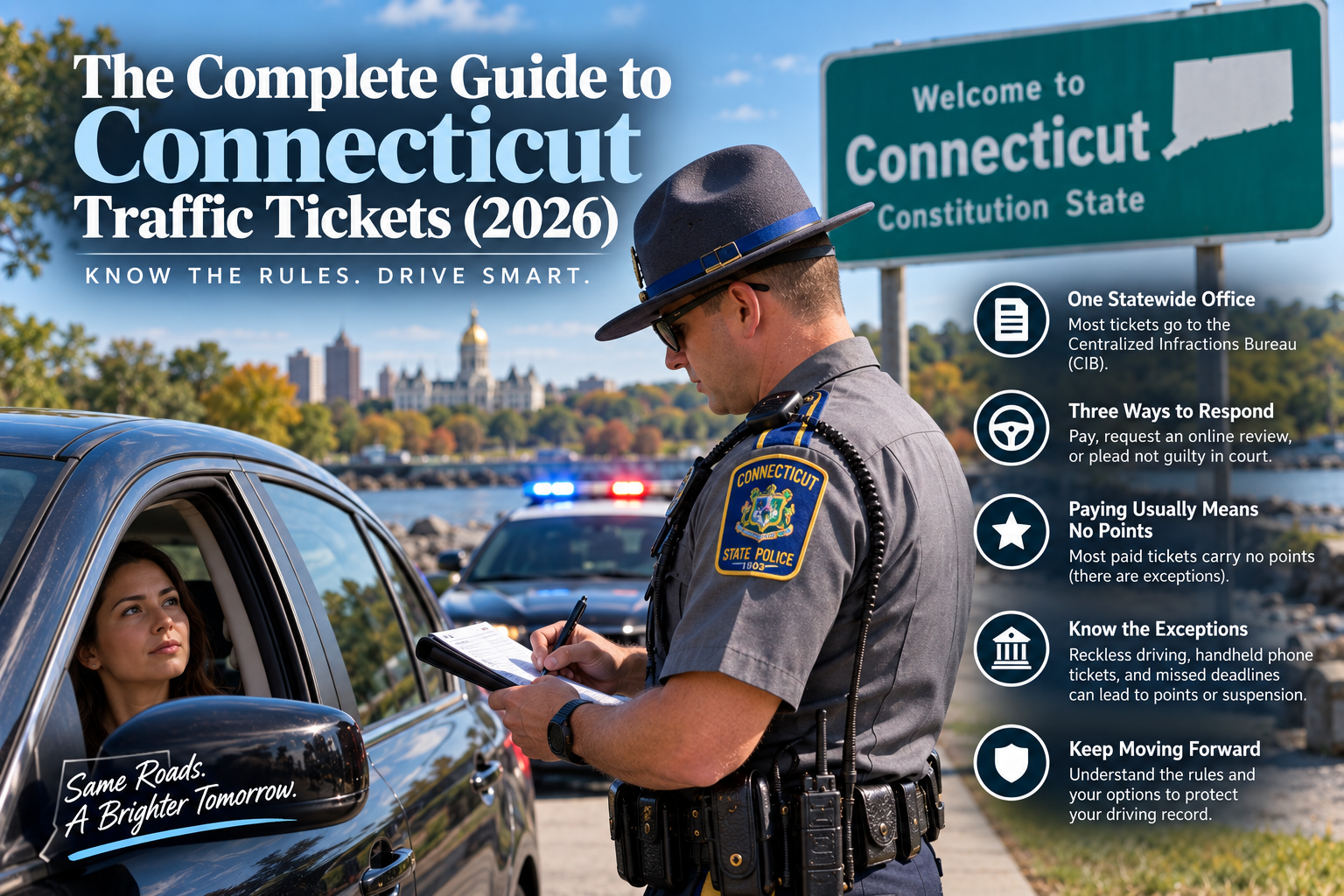
The Complete Guide to Connecticut Traffic Tickets (2026)
Connecticut does traffic tickets its own way. In most states, paying a ticket is the fastest way to get points on your license. In Connecticut, paying a typical traffic ticket by its answer date usually means no points at all. There are exceptions, and plenty of fine print, but that one rule shapes how a Connecticut traffic ticket plays out from start to finish.
This guide covers the whole process in one place: how the Centralized Infractions Bureau works, the three ways to answer a ticket, what happens in court, how points and suspensions work, the most common Connecticut charges, and what to know about driving records, work permits, and ticket scams.
Everything here is general education about Connecticut law. It isn’t advice about any particular ticket.
Key takeaway: Most Connecticut tickets go to one statewide office, most paid tickets carry no points, and most of the real trouble comes from missing the answer date or collecting too many violations on a driving history.
How Connecticut Traffic Tickets Work
Most Connecticut traffic tickets don’t start at a local courthouse. They go to the Judicial Branch’s Centralized Infractions Bureau (CIB), which processes tickets from police departments across the state. The ticket itself is formally called a complaint ticket.
Infractions, Violations, and Misdemeanors
Connecticut sorts motor vehicle charges into three broad groups, and the group decides how the case is handled:
- Infractions. According to the Judicial Branch, an infraction isn’t a crime, and the only penalty is a fine. Most everyday tickets, like speeding under 85 mph or a stop sign violation, fall here. They can be paid or pleaded by mail or online.
- Violations. A violation also carries only a fine. Some violations can be paid through the CIB, and others require a court appearance.
- Misdemeanors. Charges like reckless driving or driving under suspension are criminal. They go to court, can carry jail time, and aren’t handled through the pay-by-mail system.
The Answer Date
There’s no single statewide response window, like Florida’s 30 days. Each Connecticut ticket has an answer date, set by the officer who wrote it, and that date controls everything that follows. Losing the ticket doesn’t change it.
How to Look Up a CT Traffic Ticket
The CIB’s online system finds a ticket using the ticket number and the first three letters of the driver’s last name. For a lost ticket, or to search without a ticket number, the Judicial Branch says to call the CIB at 860-263-2750 with your name and date of birth. A brand-new ticket may not show up right away, because the officer’s copy has to reach the CIB first.
The Three Ways to Answer a Connecticut Traffic Ticket
The Judicial Branch’s traffic ticket FAQ lists three responses. Each one sends the case down a different path.
Option 1: Pay the Ticket
Payment counts as a plea of nolo contendere, or no contest. The driver doesn’t admit or deny the charge, but the Judicial Branch notes it has a similar legal effect to a guilty plea, and the ticket is reported to the DMV. Tickets can be paid online by credit card or mailed to the CIB. The CIB doesn’t offer payment plans on the ticket itself, so full payment is due by the answer date. A driver also can’t pay one charge on a ticket while pleading not guilty to another.
Option 2: The Online Ticket Review Program
For eligible tickets, a driver can plead not guilty and have a prosecutor review the case online. The driver submits a written explanation, along with any documents or photos. The Judicial Branch says a decision usually comes within four to five weeks, and the prosecutor can do one of three things:
- Enter a nolle, meaning the prosecutor chooses not to pursue the ticket. Nothing is owed, and the court notifies the DMV of the nolle.
- Transfer the case to court for a trial.
- Make an offer, which can include reduced fines or fees or a different charge. Accepting and paying enters a no contest plea. Rejecting it, or failing to pay after accepting, sends the ticket to court on the original charges.
Option 3: Plead Not Guilty
A not guilty plea can be entered online, by signing and mailing the ticket, or by phone once the officer’s copy is in the CIB system. The case then transfers to the Superior Court location for the geographical area where the ticket was written. The Judicial Branch warns it can take several months before the case is scheduled.
What Happens in Connecticut Traffic Court
Connecticut doesn’t have separate municipal traffic courts. Contested tickets are heard at a Superior Court location, usually the geographical area (GA) court covering the town where the ticket was issued. The hearing notice lists the courthouse and courtroom.
According to the Judicial Branch, a driver at court typically finds the case on the posted docket, speaks with the state’s attorney (the prosecutor), and then appears before a judge or magistrate when the case is called. In certain parts of the state that have Regional Motor Vehicle courts, a driver may be able to send a written response to a prosecutor first.
If the Driver Is Found Guilty or Not Guilty
A guilty finding in court usually costs more than paying the ticket would have. The Judicial Branch explains that the total includes the fine set by the judge or magistrate plus court costs and fees set by statute. A not guilty finding on an infraction or violation isn’t reported to the DMV at all. A nolle, however, is reported.
Commercial Drivers
For CDL holders, the Judicial Branch’s answer to whether a ticket affects a commercial license is simply “maybe,” and it refers commercial drivers to DMV Driver Services. Federal disqualification rules can apply differently than Connecticut’s point rules.
Connecticut’s Point System, Explained
Why Paying Usually Means No Points
This is the part of Connecticut law that surprises people from other states. Under Conn. Gen. Stat. § 51-164n, paying an infraction or a payable violation to the CIB is a nolo contendere plea that can’t be used in any civil or criminal case to prove what the driver did. And under the point statute, Conn. Gen. Stat. § 14-137a, the DMV assesses no points for those paid tickets.
0 points is the general rule for a Connecticut infraction or payable violation paid to the CIB. The big exception is a handheld phone ticket, which carries at least 1 point even when paid.
Two cautions come with the rule. First, section 14-137a requires at least one point for any handheld phone violation, paid or not. Second, the Judicial Branch notes that paying can still lead to other DMV action, including license suspension for certain charges.
How Many Points Is a Ticket in CT?
When points do apply, such as after a conviction in court, the DMV’s point assessment regulation assigns 1 to 5 points. Common examples include:
- 1 point: speeding, traveling unreasonably fast, improper operation on a multiple-lane highway, improper turn or failure to signal, wrong way on a one-way street, and handheld phone use
- 2 points: running a red light, stop sign, or yield sign, failure to use a seat belt or child restraint, disobeying an officer’s orders, and highway work zone violations
- 3 points: tailgating, improper passing, passing on the right or in a no-passing zone, failure to grant the right of way at an intersection or to a pedestrian, and failure to yield to an ambulance, police car, or fire truck
- 4 points: passing a stopped school bus, racing, and tailgating with intent to harass
- 5 points: operating a school bus at excessive speed, and negligent homicide with a motor vehicle
Warning Letters, Suspensions, and How Long Points Last
Connecticut’s point rules work on a 24-month look-back. Drivers generally receive a DMV warning letter at 6 points, and 10 or more points within 24 months can lead to a suspension of at least 30 days. Points count toward that total for 24 months, then drop off.
An Example: Paying vs. Going to Court
Say Kevin lives in Danbury and gets a speeding ticket on I-84 in his Subaru Forester. If he pays by the answer date, Connecticut law generally keeps points off his license, though the ticket still appears on his driving history.
Now say he pleads not guilty. If a judge or magistrate finds him not guilty, the case isn’t reported to the DMV. If he’s convicted in court, the point schedule applies, and speeding carries 1 point, plus a total cost that’s typically higher than the ticket amount. That trade-off works differently in Connecticut than almost anywhere else.
The Operator Retraining Program
Points aren’t the only thing the DMV tracks. The Operator Retraining Program is based on the number of violations on a driving history, not the point total. According to the DMV, the program is required for:
- Drivers age 24 or younger with two qualifying moving violations or suspension violations
- Drivers age 25 or older with three qualifying moving violations or suspension violations
- Anyone convicted of going more than 75 mph in a highway work zone
The DMV sends a letter with a suspension date. Finishing the program before that date, with the vendor reporting completion electronically, avoids the suspension. Finishing on or after the date means paying a $175 reinstatement fee.
Say Tyler is 22, lives in Norwich, and has two qualifying tickets on his driving history, even though his point total is low. He can still get an Operator Retraining letter. If he finishes the class after the suspension date, the $175 fee applies.
Heads up: The Operator Retraining Program counts violations on a driving history, not points. A low point total doesn’t rule it out.
The Most Common Connecticut Traffic Tickets
Speeding (Conn. Gen. Stat. § 14-219)
Speeding under Conn. Gen. Stat. § 14-219 is usually an infraction. The point statute caps a speeding conviction under that section at 1 point, which is far lower than New York or New Jersey, where speeding points climb with the speed.
The fine itself comes from a statewide schedule. The Judicial Branch says the Superior Court judges set fines for infractions and payable violations, fees and surcharges are set by statute, and the schedule is updated every October 1. Connecticut law also doubles fines in highway construction zones and school zones.
Reckless Driving and the 85 mph Line
Connecticut’s reckless driving statute, section 14-222, says driving faster than 85 mph is a violation of that section. That means a very high-speed stop is charged as reckless driving, a criminal offense, rather than a speeding infraction. A first offense carries a fine of $100 to $300, up to 30 days in jail, or both. A later offense can bring a fine of up to $600, up to a year in jail, or both. A reckless driving conviction also triggers a DMV license suspension.
Say Marcus is driving his Dodge Charger on I-95 near Old Saybrook and is clocked at 88 mph in a 65 zone. That’s not a speeding ticket he can pay online. It’s a reckless driving charge that goes to court.
Failure to Maintain Lane in CT
What people usually call “failure to maintain lane” appears on the point schedule as improper operation on a multiple-lane highway, under section 14-236. It carries 1 point on conviction. It’s often written after a driver drifts across a lane line or changes lanes without enough room.
Failure to Grant the Right of Way
Right-of-way charges are among the higher-point tickets in Connecticut. Failing to grant the right of way at an intersection, at a junction of highways, when pulling out of a driveway, or to a pedestrian each carries 3 points on conviction. These tickets often follow intersection crashes.
Handheld Phone and Texting Tickets
Connecticut’s distracted driving law, section 14-296aa, bans using a handheld phone or mobile electronic device while driving. After a 2021 increase, the fines are $200 for a first violation, $375 for a second, and $625 for a third or later one. It’s also the one common ticket that carries at least 1 point even when it’s paid to the CIB.
Connecticut’s Move Over Law
Connecticut’s Move Over law, section 14-283b, covers more than emergency vehicles. According to the state’s Highway Safety Office, it was expanded in 2017 to include any vehicle stopped along the roadside. Drivers approaching must slow to a reasonable speed and, on multi-lane roads, move over one lane when it’s safe.
A standard violation is an infraction. If the violation injures the operator or an occupant of an emergency vehicle, the fine can reach $5,000, and if it causes a death, up to $20,000, under amounts raised in 2025. The DMV also lists a free online work zone safety course that drivers must take after certain move over or work zone convictions.
Speed and Red Light Camera Tickets
A 2023 state law lets Connecticut municipalities use automated speed and red light cameras once the state approves their plans. The City of New Britain’s automated enforcement page says the fine there is $50 for a first violation and $75 for later ones, plus a processing fee. The citation is mailed to the vehicle’s owner and doesn’t add points to a license.
New Britain’s page also says that as of January 15, 2026, these cameras were in use or approved in 11 Connecticut municipalities, including Middletown, New Haven, and Stamford. Because each town runs its own program, the details on a camera notice come from the town that sent it.
Missing the Answer Date and a Suspended License in CT
Letting the answer date pass sets off several things at once. According to the Judicial Branch:
- The case transfers to court.
- The CIB notifies the DMV, and the DMV suspends the driver’s license.
- Reopening the case costs a $60 fee paid to the court clerk, on top of the original amount.
- The DMV may charge its own fee to reinstate the license.
Ignoring a ticket can also become a separate charge. The Judicial Branch’s infractions guidance says failing to pay or plead to an infraction is a misdemeanor under Conn. Gen. Stat. § 51-164r. For out-of-state drivers, the Judicial Branch says failing to respond leads to a suspension by the driver’s home state.
Who Suspends and Reinstates Licenses
Connecticut courts don’t suspend or reinstate licenses. The DMV does. The DMV’s license suspension page says reinstatement requirements vary, that drivers can’t drive during the suspension, and that drivers who don’t receive a suspension notice can contact Driver Services at 860-263-5720 or dmv.suspension@ct.gov.
Say Elena moves from Hartford to Bridgeport and forgets to update her address. Her ticket’s answer date passes, and the DMV suspends her license. Clearing it means dealing with two offices: the court for the $60 reopening fee and the original ticket, and then the DMV for reinstatement.
Driving Under Suspension
Driving while suspended is a separate criminal charge under section 14-215, with fines and possible jail time. It also makes the situation harder to fix. For example, drivers currently suspended for operating under suspension aren’t eligible for a work permit.
Work Permits for Suspended Drivers
Some suspended drivers can apply for a special use permit, often called a work permit, to drive for limited purposes such as getting to and from work. The DMV lists disqualifiers, including a current suspension for failing to appear or pay a citation, a current suspension for operating under suspension, a prior alcohol-related offense, or three or more prior qualifying moving violations on the driving history. The DMV also says misusing the permit, getting a new ticket, or getting a new suspension while driving under a permit can lead to losing it.
Your Connecticut Driving Record
Most current and past Connecticut license holders can request their own driving history online through the DMV. The DMV says the history is available to download and stays accessible for 30 days. Requests for another person’s driving history go by mail.
A paid ticket still shows up there. The Judicial Branch notes that insurance companies usually check driver histories before issuing a new policy, and the history will show a paid fine or a guilty finding. Whether rates go up is the insurer’s decision, not the DMV’s.
Watch Out for Traffic Ticket Text Scams
Texts claiming a driver owes money on an unpaid Connecticut ticket are a known scam. The DMV has posted a smishing alert warning that some residents are getting fraudulent texts and calls, and it states that the Connecticut DMV does not contact residents about motor vehicle violations. Real tickets are handled through the CIB system, using the ticket number on the complaint ticket itself.
Out-of-State Drivers and How Connecticut Compares
Out-of-state drivers ticketed in Connecticut go through the same CIB process. The Judicial Branch says the court date location is based on the town where the ticket was issued, that Connecticut may report the outcome to the driver’s home state, and that failing to respond leads to a suspension at home.
Plenty of Fairfield County drivers cross into New York and New Jersey every week, so the differences are worth seeing side by side:
- Paying a ticket: In Connecticut, paying most tickets to the CIB means no points. In New York and New Jersey, paying a ticket is a guilty plea that carries the full points.
- Speeding points: Connecticut caps a speeding conviction at 1 point. New York and New Jersey scale speeding points by how far over the limit the driver was.
- Negotiating: Connecticut offers an online prosecutor review for eligible tickets. New Jersey resolves many tickets through municipal prosecutors. New York City’s traffic bureau generally doesn’t allow plea bargaining.
Quick Answers on CT Traffic Tickets
How many points is a speeding ticket in CT? One point if convicted. If the ticket is paid to the CIB, Connecticut law generally assesses no points.
How long do points stay on your license in CT? Points count toward the suspension total for 24 months, then drop off. The violation itself can stay on the driving history longer.
How much is a speeding ticket in CT? It depends on the speed and location. The Superior Court judges set the fine schedule each October 1, fees and surcharges are added by statute, and fines double in construction and school zones.
What happens if you lose a Connecticut traffic ticket? Call the CIB with your name and date of birth. Losing the ticket doesn’t change the answer date.
Does a CT camera ticket go on your license? Based on municipal program guidance, no. Camera citations under the 2023 law don’t add points.
The Bottom Line
A Connecticut traffic ticket runs through the Centralized Infractions Bureau, offers three ways to respond, and often carries zero points when paid. The exceptions matter, though: handheld phone tickets, reckless driving at 85 mph and up, the Operator Retraining rules, and the chain reaction that follows a missed answer date.
This article is for educational purposes only and is not legal advice. Reading it does not create an attorney-client relationship. For advice on your specific situation, consult a licensed attorney in your state.