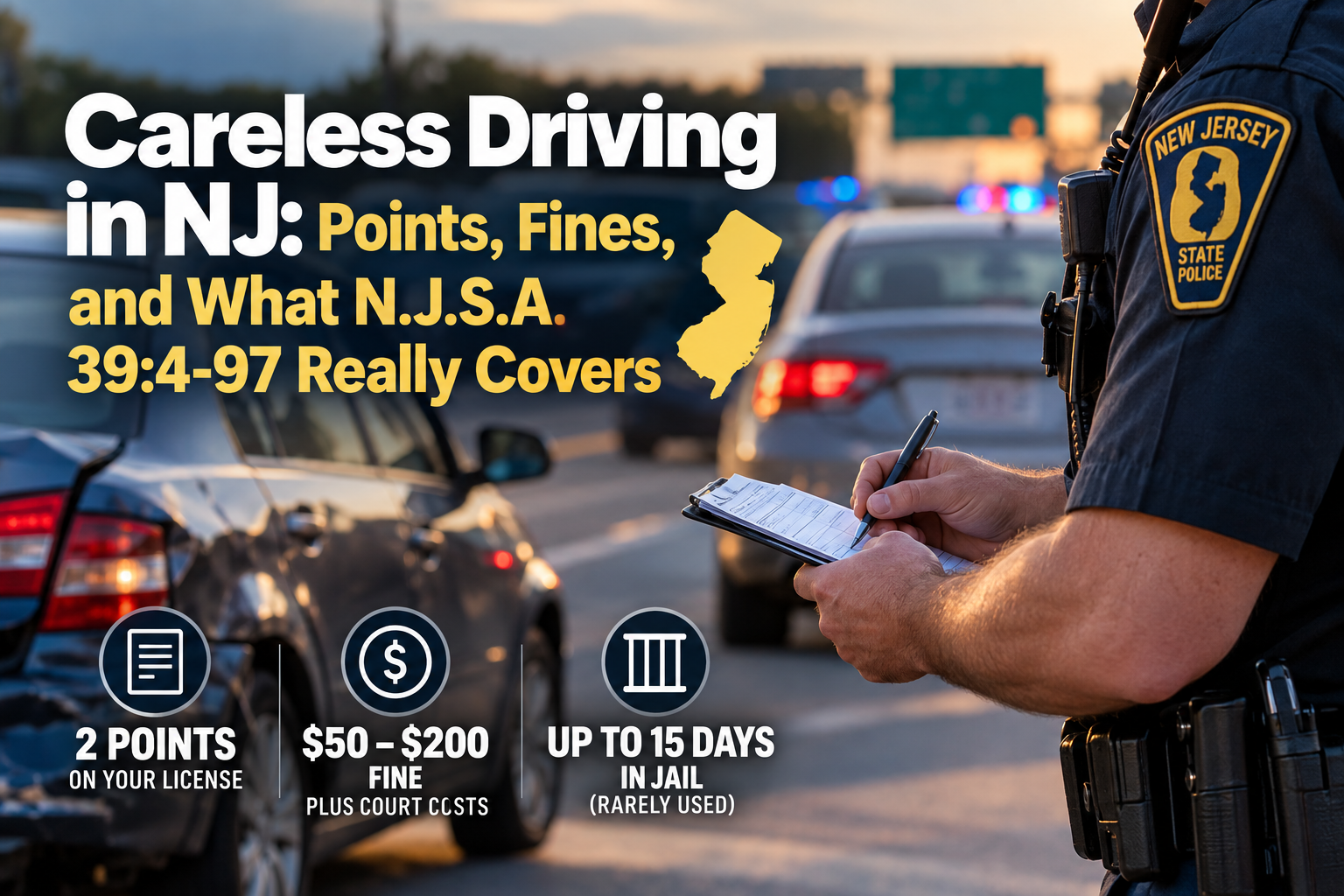
Careless Driving in NJ: Points, Fines, and What N.J.S.A. 39:4-97 Really Covers
Careless driving is one of the most common tickets written in New Jersey. It’s also one of the most confusing. Drivers often get it after a crash the officer never saw, and they walk away wondering how many points it carries, what it costs, and whether it will follow them into an insurance claim.
This guide explains how careless driving in NJ works under state law. It covers the points, the fine range, why the ticket shows up after so many accidents, and how these cases generally end in municipal court. For the bigger picture on tickets, points, and surcharges, see our complete guide to New Jersey traffic tickets.
What Counts as Careless Driving Under N.J.S.A. 39:4-97?
The statute is short. Under N.J.S.A. 39:4-97, a person is guilty of careless driving if they drive “carelessly, or without due caution and circumspection, in a manner so as to endanger, or be likely to endanger, a person or property.”
Two parts matter. First, the driving has to fall below the level of care a reasonable driver would use. Second, it has to put someone or something at risk. Nobody actually has to get hurt. Driving that is merely “likely” to endanger is enough under the wording of the law.
That broad language is why officers use it so often. It works as a catch-all when a driver did something unsafe that doesn’t fit neatly into a more specific rule, like speeding or running a stop sign. Common situations include rear-end collisions, drifting across lanes, backing into another car, and losing control on a wet ramp.
Careless driving at a glance: 2 MVC points, a fine of $50 to $200, plus court costs, and a rarely used maximum of 15 days in jail.
How Many Points Is Careless Driving in NJ?
A careless driving conviction carries 2 points. That number comes from the New Jersey Motor Vehicle Commission’s official point schedule, which lists 39:4-97 alongside every other point-carrying offense.
Two points sounds small. The trouble is that careless driving rarely travels alone. Officers often write it together with a second ticket, such as failure to maintain a lane (2 points) or tailgating (5 points). Two convictions from the same stop can push a driver’s total up fast.
How Points Turn Into Surcharges
New Jersey’s MVC surcharge program kicks in at 6 or more points within three years. The surcharge is $150 plus $25 for each point over six, and it can be billed every year for three years. That’s separate from the court fine.
Point totals do come down over time. The MVC generally reduces a driver’s total by up to 3 points for each 12 months of violation-free driving, and an approved defensive driving course can also bring the number down. But the MVC doesn’t count those reductions when it looks back three years for surcharge purposes. So a driver can have a lower point balance and still get a surcharge bill.
How Much Is a Careless Driving Ticket in New Jersey?
The 39:4-97 section itself doesn’t set a fine. The penalty comes from Title 39’s general penalty provision, which allows a fine of $50 to $200 for this kind of offense. The fine doesn’t automatically go up for a second or third careless driving conviction the way it does for some other tickets.
Court costs are added on top of the fine. The same general provision also allows up to 15 days in jail, although jail for a routine careless driving case is very unusual. The bigger long-term cost for most drivers is insurance. Insurers can look at moving violations when setting rates, and a careless driving conviction after a crash can be part of that picture.
Why a Careless Driving Ticket Follows So Many NJ Accidents
Here’s a pattern New Jersey drivers see all the time. Two cars collide. Police arrive ten minutes later. Nobody in uniform saw the crash, but someone leaves with a careless driving ticket anyway.
That happens because the officer builds the ticket from what’s left at the scene. Vehicle damage, where the cars ended up, skid marks, witness accounts, and what the drivers themselves said all go into the decision. In a rear-end crash, the officer often concludes that the trailing driver wasn’t keeping a safe distance or paying close enough attention.
A Hypothetical: The Route 1 Fender Bender
Say Marcus is driving his 2019 Nissan Altima north on Route 1 in Edison during Friday rush hour. Traffic stops suddenly, and he taps the back of a Honda CR-V. There’s about $2,400 in damage to the Honda and a sore neck for the other driver. When the officer arrives, Marcus says, “I looked down at my GPS for a second.” He gets a careless driving ticket.
Marcus now has two separate things going on. One is the ticket in the Edison Municipal Court, which could mean 2 points and a fine. The other is the possible injury claim from the Honda driver. The ticket and the claim are different cases, but they can overlap in a way many drivers don’t expect.
The Civil Reservation
In New Jersey, a guilty plea to a traffic offense can generally be used as evidence in a later civil lawsuit about the same crash. To deal with that, the municipal court rules allow a “civil reservation.” When a judge grants one, the guilty plea can’t be used as evidence in the civil case.
Timing matters. In Maida v. Kuskin, 221 N.J. 112 (2015), the New Jersey Supreme Court held that the request has to be made in open court at the same time the judge accepts the guilty plea. A request sent afterward by letter didn’t meet that standard. A civil reservation also covers only the plea itself, not other sworn testimony.
Serious crashes are different. When a crash causes serious injury or death, the MVC can open its own administrative case to suspend a license. That process runs separately from the ticket in municipal court.
Careless vs. Reckless vs. Unsafe Driving in New Jersey
New Jersey has three related charges that sound alike but work very differently. The gap between them comes down to the driver’s state of mind and how the points are handled.
Reckless Driving: The More Serious Charge
Reckless driving under N.J.S.A. 39:4-96 requires driving “heedlessly, in willful or wanton disregard” of others’ safety. Careless driving is closer to ordinary negligence. Reckless driving carries 5 points and up to 60 days in jail for a first offense. That’s why a reckless charge is sometimes resolved as careless driving.
Unsafe Driving: The Point-Free Option
Unsafe driving under N.J.S.A. 39:4-97.2 carries no points for a first or second offense. It does carry a $250 surcharge on top of the fine, and a third offense within five years brings 4 points. It comes up constantly in careless driving cases because of how plea agreements work, which the next section explains.
How Careless Driving Tickets Get Dismissed or Amended in NJ
People search for how to get a careless driving ticket dismissed in NJ more than almost any other question on this topic. No one can promise a dismissal. What the law does allow is a look at the general ways these cases tend to end.
The State Has to Prove It
A careless driving ticket isn’t a conviction. If a driver pleads not guilty, the municipal prosecutor has to prove the charge beyond a reasonable doubt at trial. When the officer didn’t see the crash, that proof usually has to come from witnesses, physical evidence, or the driver’s own statements. If the evidence isn’t there, a judge can find the driver not guilty.
Dismissal by the Prosecutor or the Court
Sometimes a prosecutor decides not to go forward. A key witness may not be available, or a problem with the ticket or the evidence may surface. These outcomes depend on the facts and on the prosecutor’s judgment in that specific court.
Plea Agreements and Amendments
Plea agreements are allowed in New Jersey municipal courts, and they’re a common way careless driving cases end. In an amendment, the original charge is changed to a different offense. Careless driving is often amended to unsafe driving, which trades 2 points for a higher up-front cost because of the $250 surcharge.
Say Priya gets a careless driving ticket on Route 70 in Cherry Hill after sliding into a guardrail on a rainy night. She pleads not guilty, and at her court date the prosecutor offers to amend the charge to unsafe driving. The judge still has to approve any agreement. And the prosecutor is never required to offer one.
Paying the Ticket Ends These Options
Paying a careless driving ticket online or by mail counts as a guilty plea. Once it’s paid, the points post, and there’s no longer a chance to challenge the charge or negotiate an amendment. Some tickets, especially those tied to crashes with injuries, have the “court appearance required” box checked and can’t be paid without going to court.
Key takeaway: A careless driving case can end in a not-guilty finding, a dismissal, an amendment to a different charge, or a conviction. Which one happens depends on the evidence, the prosecutor, and the judge. No result is automatic.
Out-of-State Drivers and New Jersey Careless Driving Tickets
New Jersey sits between New York City and Philadelphia, so plenty of careless driving tickets land on drivers who live elsewhere. The consequences depend on the home state. New Jersey itself adds 2 points to a New Jersey license for a moving violation committed in another state.
New York works differently. Its DMV generally doesn’t add points for tickets from other states. Take Kevin, a Staten Island driver who gets a careless driving ticket on the Garden State Parkway near Toms River. A conviction would be reported home, but New York generally wouldn’t put New Jersey’s 2 points on his New York record. His New York insurer could still learn about it, though.
Careless Driving in NJ: Common Questions
Is careless driving a misdemeanor in NJ?
No. New Jersey doesn’t use the word “misdemeanor” at all. Careless driving is a motor vehicle offense under Title 39, heard in municipal court. A conviction goes on the driving record, not a criminal record.
Does careless driving carry points in NJ?
Yes. A conviction under 39:4-97 adds 2 points to a New Jersey driving record. If the charge is amended to unsafe driving, a first or second offense carries no points.
Can a careless driving ticket lead to a license suspension?
A single careless driving conviction doesn’t usually suspend a license on its own. Suspension becomes possible when points pile up to the MVC’s suspension threshold, or when a crash involves serious injury or death and the MVC opens a separate case.
Do I have to go to court for a careless driving ticket?
It depends on the ticket. If the officer checked the “court appearance required” box, a court appearance is required. If not, the ticket can generally be paid, but payment is treated as a guilty plea.
The Bottom Line
Careless driving under N.J.S.A. 39:4-97 carries 2 points, a fine of $50 to $200, and ripple effects that can reach surcharges, insurance, and civil claims after a crash. Many of these cases end through trial, dismissal, or an amendment to unsafe driving, but none of those outcomes is guaranteed. Knowing how the pieces connect makes the ticket much easier to understand.
This article is for educational purposes only and is not legal advice. Reading it does not create an attorney-client relationship. For advice on your specific situation, consult a licensed attorney in your state.