Lemon Title Meaning: What It Is and How Florida Handles It
You are scrolling used car listings and one of them mentions a lemon title. Maybe the price looks too good. A lemon title generally means the manufacturer bought the car back after a dispute involving a defect or warranty nonconformity. The car is not necessarily wrecked and it is not junk, but its title history shows that it was previously repurchased by the manufacturer under a lemon law process.
Florida handles this differently than many buyers expect. Florida does not print the words “lemon title” on the certificate of title. The state uses its own phrase, and Florida law also provides a limited route through which certain owners can later request a corrected title.
Here is what the brand actually means, where it comes from, and what Florida law requires a seller to tell you before the deal closes.
What a Lemon Title Actually Means
“Lemon title” is everyday slang, not a legal term. People generally use it to describe a title showing that a manufacturer previously repurchased the vehicle under a state lemon law process.
In Florida, the relevant category covers a vehicle purchased by a manufacturer pursuant to a settlement, determination, or decision under Chapter 681, Florida’s Lemon Law. The manufacturer then owns a vehicle with a documented history of a warranty nonconformity serious enough to result in a statutory repurchase.
Florida requires that history to be reflected on the certificate of title so a later buyer can identify the vehicle’s prior status. That recorded history is what people commonly mean when they say lemon title, lemon law title, or buyback lemon title.
Key takeaway: A lemon title is a title-history designation, not a description of the car’s current mechanical condition. It tells you something important about the vehicle’s past, not necessarily whether the car runs properly today.
Florida Calls It a “Manufacturer’s Buy Back,” Not a Lemon Title
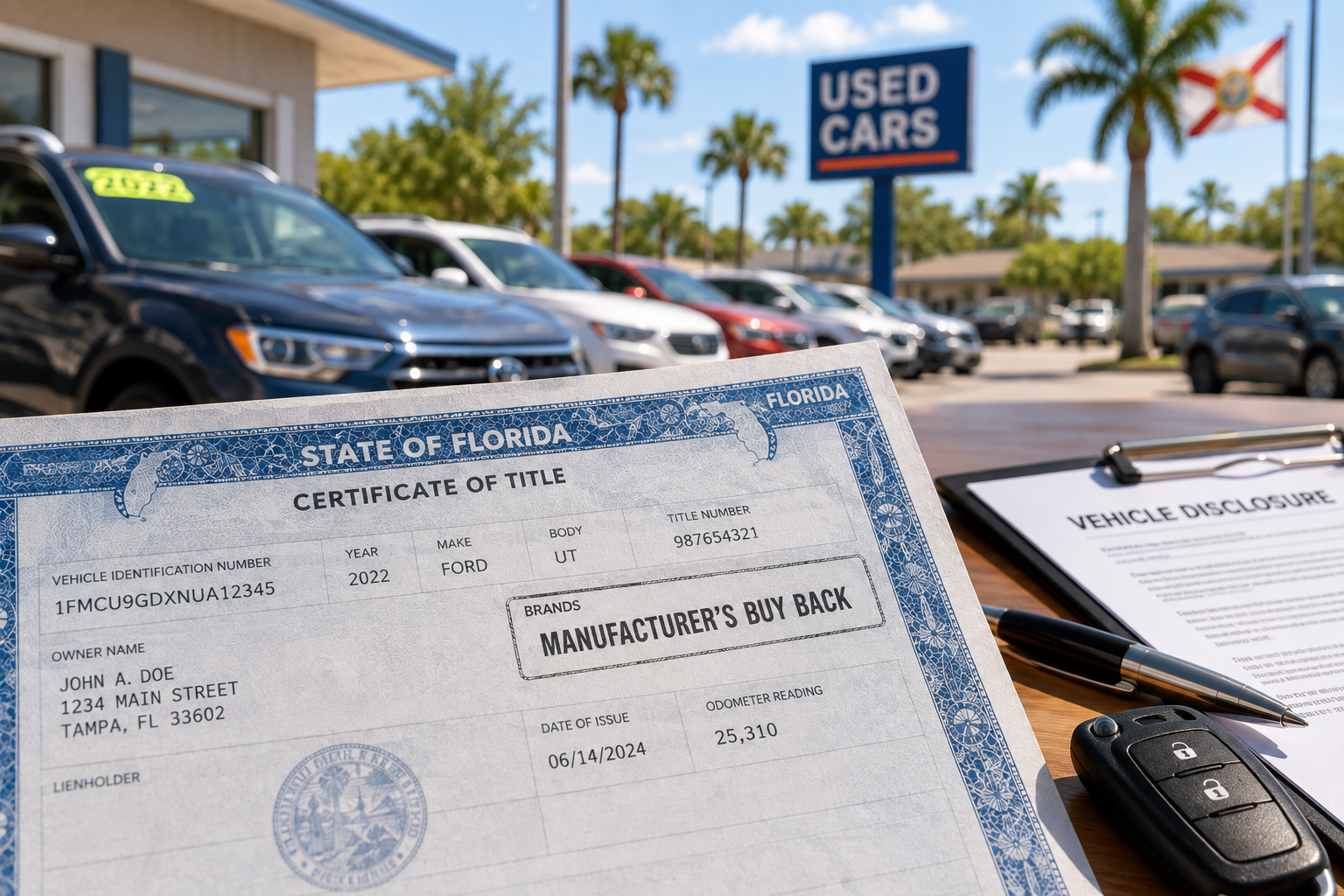
If you are looking at a Florida title and hunting for the word “lemon,” you will not find it. Under Fla. Stat. § 319.14, the Florida Department of Highway Safety and Motor Vehicles stamps the certificate of title with the words “Manufacturer’s Buy Back” when the vehicle has been repurchased by a manufacturer pursuant to a settlement, determination, or decision under Chapter 681.
The statute uses a formal name for these cars. It calls them nonconforming vehicles.
Nonconforming vehicle: Under section 319.14(1)(c)9, a motor vehicle purchased by a manufacturer pursuant to a settlement, determination, or decision under Chapter 681, which is Florida’s lemon law.
So what consumers commonly call a Florida “lemon title” is a Florida certificate of title bearing the “Manufacturer’s Buy Back” notation. The listing might use one phrase while the official Florida paperwork uses the other.
The brand shows up on the registration too
Section 319.14(4) says that when a title, including a foreign certificate of title, is branded to show a condition or prior use, the brand also has to appear on the registration certificate. As a general rule, the brand is then carried forward onto subsequent titles and registrations issued for the vehicle.
That rule applies to out-of-state titles too. A car carrying a qualifying title brand in another state does not ordinarily get a clean slate simply by being titled in Florida.
How a Car Gets a Lemon Title in the First Place
A car does not get Florida’s Manufacturer’s Buy Back notation merely because it had a bad week at the repair shop. For purposes of section 319.14, the vehicle must have been repurchased by the manufacturer pursuant to a settlement, determination, or decision under Chapter 681. If you want the full picture of how Florida’s lemon law process actually works, that is where the repurchase comes from.
One important part of Florida’s Lemon Law is the presumption that a manufacturer has received a reasonable number of opportunities to repair a vehicle. Under Fla. Stat. § 681.104, that presumption can arise in either of two ways during the Lemon Law rights period.
For the repair-attempt route, the same nonconformity must have been subject to repair at least three times. The consumer then gives the manufacturer the required written notice so the manufacturer has a final opportunity to repair the vehicle. If the nonconformity continues to exist after that statutory process, the reasonable-number-of-attempts presumption may apply.
The other route concerns time out of service. The presumption may arise when the vehicle has been out of service because of repair of one or more nonconformities for a cumulative total of 30 or more days, or 60 or more days for a recreational vehicle, provided the other statutory requirements are satisfied.
The Lemon Law rights period is defined in Fla. Stat. § 681.102 as the period ending 24 months after the vehicle was originally delivered to a consumer. That period is important because Florida’s statutory protections and procedures are tied to when the nonconformity arises and when the required steps are taken.
If the process ultimately results in the manufacturer repurchasing the vehicle pursuant to a qualifying settlement, determination, or decision under Chapter 681, section 319.14 requires the title to be stamped “Manufacturer’s Buy Back.”
What a Florida Seller Has to Tell You
Florida stacks two separate disclosure duties on top of each other, and they come from two different chapters of the statutes.
The first is Fla. Stat. § 681.114. It says nobody may knowingly lease, sell at wholesale or retail, or transfer title to a returned vehicle unless the nature of the nonconformity is clearly and conspicuously disclosed to the prospective buyer, lessee, or transferee, and the manufacturer warrants to correct that nonconformity for one year or 12,000 miles, whichever comes first.
That warranty is important because it applies to the disclosed nonconformity. It is not necessarily a new bumper-to-bumper warranty covering everything that could go wrong with the vehicle.
The second disclosure requirement comes from section 319.14 itself. Subsection (2) requires written disclosure of the vehicle’s nonconforming status before the sale, exchange, or transfer is completed. Subsection (3) goes further and requires an advertisement knowingly offering the vehicle for sale or exchange to clearly and precisely state that it is a nonconforming vehicle.
Worth knowing: Under section 319.14(6), knowingly selling, exchanging, or offering to sell or exchange a vehicle contrary to the section is a second degree misdemeanor in Florida. A violation of the advertising requirement in subsection (3) is also expressly classified as a second degree misdemeanor.
There is also a shield built in. Section 319.14(9) says a person is not liable in a civil action arising from a violation of that section when the vehicle’s prior-use or condition designation was not noted on the title and registration certificate received by or delivered to that person, unless that person actively concealed the vehicle’s prior use or condition from the purchaser.
Say You Are Buying a Buyback in Tampa
Say Marcus finds a three-year-old crossover on a small lot off Dale Mabry Highway. Comparable cars are running around $24,000. This one is priced at $17,500. The salesperson says it is a manufacturer buyback and hands him a disclosure form describing a transmission fault that was repeatedly presented for repair.
That form is not merely a courtesy. Section 681.114 requires clear and conspicuous disclosure of the nature of the nonconformity when a returned vehicle is knowingly transferred, and the manufacturer must warrant correction of that nonconformity for one year or 12,000 miles, whichever occurs first.
Marcus examines the Florida title and sees “Manufacturer’s Buy Back” stamped on it, as section 319.14 requires for a qualifying Chapter 681 repurchase.
Now flip the story. Say a different lot in Kissimmee advertises a similarly branded car but the ad says nothing about its nonconforming status and the required disclosure never appears. Florida law separately regulates the title notation, pre-sale written disclosure, and advertising of these vehicles. Failing to disclose the vehicle’s status is where serious legal problems can arise.
Both names and both lots are invented for illustration.
Can a Lemon Title Be Removed in Florida?
This is one of the more unusual parts of Florida’s title law.
Section 319.14 generally requires title brands to carry forward for the life of the vehicle. But subsection (10) creates a specific exception for certain nonconforming vehicles and permits an eligible private-use owner to request a corrected certificate of title.
The statute applies to the transfer of a nonconforming vehicle “with 36,000 or more miles on its odometer, or 34 months whichever is later” once ownership has been transferred to an owner for private use. The owner shown on the certificate of title may then request a corrected certificate that does not contain the nonconforming-vehicle statement.
36,000 miles and 34 months matter under Florida’s corrected-title provision, but the statutory wording is unusual. Section 319.14(10) literally uses the phrase “36,000 or more miles on its odometer, or 34 months whichever is later.” Because the provision compares a mileage threshold with a time threshold using “whichever is later,” it is better to use the statute’s language rather than turn it into a simpler rule the Legislature did not expressly write.
Two other things are worth understanding. First, getting a corrected title is not automatic. The titled private-use owner must request it from the department.
Second, section 319.14(10) expressly lifts the requirements of subsections (1), (2), and (3) under the circumstances it describes. Section 681.114 is a separate statute and independently regulates the knowing transfer of returned vehicles. Nothing in section 319.14(10) expressly eliminates that separate Chapter 681 disclosure requirement.
In other words, obtaining a corrected Florida title should not automatically be treated as erasing every disclosure obligation that may apply to the vehicle’s lemon-law history.
Vehicle history reports are a separate matter entirely. A corrected state title also does not necessarily erase historical information already reported to government or commercial vehicle-history databases.
What a Lemon Title Does to a Car’s Value
A manufacturer-buyback history can make a vehicle less valuable than an otherwise comparable vehicle with a clean title history.
The reason is straightforward. Some buyers will not consider a manufacturer buyback at all. Financing can also be more difficult depending on the lender, and selling the vehicle later may be harder because prospective buyers may place significant weight on its history.
The flip side in Florida is the one-year or 12,000-mile warranty required by section 681.114 on the disclosed nonconformity. That protection is real, but it is tied to correction of the disclosed problem rather than functioning as a blanket warranty against every future mechanical issue.
How to Check for a Lemon Title Before You Buy in Florida
The vehicle’s history may appear in several places. Before buying, check:
- The certificate of title for a “Manufacturer’s Buy Back” notation.
- The registration certificate for the corresponding brand.
- The written disclosures provided by the seller.
- The advertisement for disclosure of the vehicle’s nonconforming status.
- NMVTIS, the federal title-information system that collects vehicle title and brand information reported by participating sources.
- A commercial vehicle history report run against the VIN.
A price far below comparable listings with no explanation attached is worth a second look at the paperwork.
Common Questions About Lemon Titles in Florida
Is a lemon title the same as a salvage title?
No. They come from completely different events.
A salvage or rebuilt title generally concerns a vehicle’s damage or total-loss history. Florida’s Manufacturer’s Buy Back designation concerns a vehicle repurchased by its manufacturer pursuant to a qualifying settlement, determination, or decision under Chapter 681.
Section 319.14 addresses multiple kinds of title brands, but the brands describe different histories and should not be treated as interchangeable.
Should I buy a car with a lemon title?
That is a personal decision and depends heavily on the particular vehicle.
What Florida law gives you is information and some additional protection. When section 681.114 applies, the nature of the nonconformity must be disclosed and the manufacturer must warrant correction of that nonconformity for one year or 12,000 miles, whichever comes first.
A buyer can then weigh the purchase price against the vehicle’s repair history, current condition, remaining warranty protection, financing options, and potential difficulty reselling it later.
Does a lemon title from another state carry over to Florida?
Florida law generally prevents a vehicle from simply losing a title brand by crossing state lines. Section 319.14(4) expressly addresses foreign certificates of title and provides for qualifying brands to be carried forward onto Florida title and registration documents.
Section 681.114 also defines returned vehicles to include certain vehicles returned under a similar statute of another state, meaning Florida’s disclosure protections are not necessarily limited to vehicles originally repurchased under Florida law.
Do lemon law rights pass to the next owner?
Florida law does provide protection for subsequent owners, but there is an important limitation.
Fla. Stat. § 681.115 states that the rights set forth in Chapter 681 extend to a subsequent transferee of the motor vehicle. It also makes agreements that waive, limit, or disclaim those statutory rights void as contrary to public policy.
But transferring the vehicle does not start a brand-new Lemon Law rights period. Florida defines that period by reference to the vehicle’s original delivery to a consumer. A later buyer therefore should not assume that purchasing a manufacturer buyback gives them a fresh 24 months of Florida Lemon Law rights.
What does “lemon title issued” mean on a report?
It generally means that a state motor vehicle agency recorded a lemon-law or manufacturer-buyback designation against that VIN.
The exact terminology varies by state. A national vehicle-history report might use a general phrase such as “lemon title issued,” while the corresponding Florida certificate of title uses the statutory wording “Manufacturer’s Buy Back.”
The Short Version
A lemon title generally means a manufacturer previously repurchased the vehicle through a lemon-law process. Florida uses the title notation “Manufacturer’s Buy Back” for vehicles repurchased pursuant to a qualifying settlement, determination, or decision under Chapter 681.
Florida law also imposes significant disclosure requirements. Section 319.14 regulates the title notation, written disclosure, and advertising of nonconforming vehicles, while section 681.114 separately requires disclosure of the underlying nonconformity and a one-year or 12,000-mile manufacturer warranty to correct that nonconformity.
Florida is particularly unusual because section 319.14(10) provides a limited route through which certain private-use owners can request a corrected certificate of title without the nonconforming-vehicle statement. That does not necessarily mean the vehicle’s history disappears or that every separate disclosure obligation under Chapter 681 disappears with it.
For the broader picture of how repurchases work in the first place, see our Florida lemon law guide in plain English.
This article is for educational purposes only and is not legal advice. Reading it does not create an attorney-client relationship. For advice on your specific situation, consult a licensed attorney in your state.