Does the Lemon Law Apply to Used Cars With No Warranty in Florida?
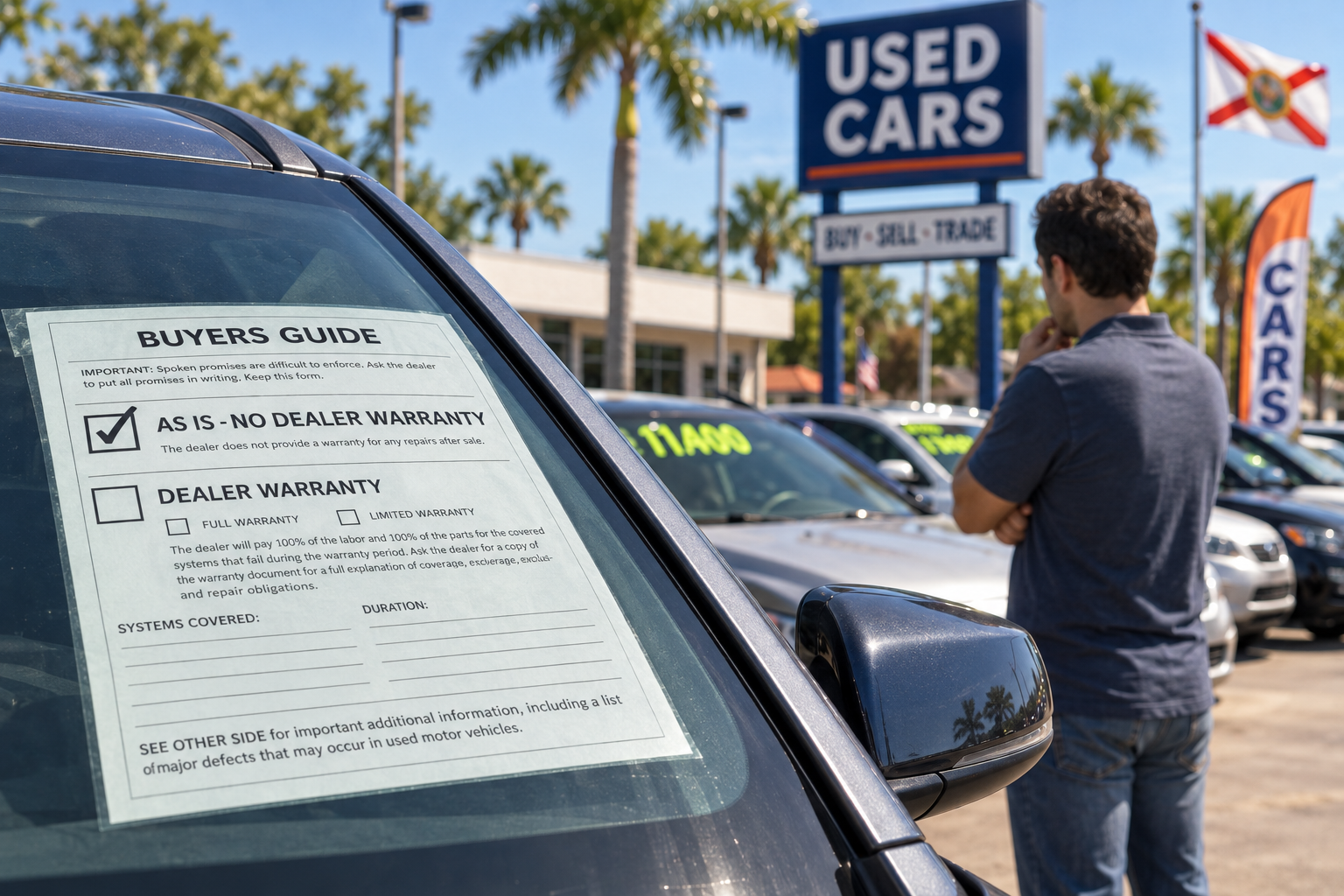
Say Marcus buys a 2019 Nissan Altima for $11,400 from a small used car lot on Semoran Boulevard in Orlando. The Buyers Guide on the window has a check mark next to “As Is.” Nine days later, the transmission starts shuddering every time he pulls away from a red light.
Marcus has the same question thousands of Florida drivers type into a search bar. Does the lemon law apply to used cars with no warranty? In most cases, Florida’s Lemon Law says no. But that isn’t the end of the story, because federal warranty law, Florida’s title disclosure rules, and the state’s dealer practices statute can still come into play.
For how the statute works on new cars, see our plain-English guide to the Florida Lemon Law.
Does Florida’s Lemon Law Cover Used Cars?
Florida’s Lemon Law is officially called the Motor Vehicle Warranty Enforcement Act, and it lives in Chapter 681 of the Florida Statutes. It was written with new vehicles in mind. Under the definitions in Fla. Stat. § 681.102, a “motor vehicle” means a new vehicle sold in Florida, along with certain demonstrator and leased vehicles.
The law also targets the manufacturer, not the dealer. The warranty it enforces is the manufacturer’s written warranty, and statements made by the dealer are specifically left out. For a typical used car that’s several years old, Chapter 681 won’t provide a refund or a replacement.
Key takeaway: “No warranty” on a used car sticker usually means no dealer warranty. It doesn’t automatically mean the manufacturer’s original warranty is gone, and it doesn’t switch off federal warranty law or Florida’s disclosure rules.
When a Used Car Can Still Qualify Under Chapter 681
There’s one big exception. Florida defines a “consumer” to include anyone the car is transferred to for personal, family, or household use during the Lemon Law rights period, which ends 24 months after the car was first delivered to its original owner. Section 681.115 adds that Chapter 681 rights extend to later owners, and any agreement waiving those rights is void. An “As Is” sticker from a used car dealer doesn’t cancel the manufacturer’s obligations.
The clock doesn’t restart when the car is sold. The defect generally has to be reported to the manufacturer or its authorized service agent inside the original 24 months, and the factory warranty has to cover the problem. Because the definition refers to a new vehicle “sold in this state,” a car first sold new in another state can raise extra questions.
Picture Priya, who buys a 2025 Toyota RAV4 “As Is” from a used car lot on Philips Highway in Jacksonville in August 2026. The RAV4 was first sold new in Florida in March 2025, and its factory warranty is still active. When the engine starts stalling on I-95, she’s still inside a rights period that runs until March 2027, so Chapter 681 may still apply.
24 months
Florida’s Lemon Law rights period, measured from the car’s original delivery
90 days
Federal window in which a seller’s service contract can block an “As Is” disclaimer
12,000 miles
Or 1 year, whichever comes first. The manufacturer warranty required on a resold lemon law buyback
What “As Is” Means Under Florida Law
When a business sells goods it regularly deals in, the sale usually comes with an unwritten promise called the implied warranty of merchantability. In plain terms, it’s a promise that the product is fit for its ordinary purpose.
Florida lets sellers get rid of that promise. Under Fla. Stat. § 672.316, words like “as is” or “with all faults” generally exclude all implied warranties, unless the circumstances indicate otherwise. Under Fla. Stat. § 501.976, a dealer’s disclaimer also has to be in writing, conspicuous, and in lay terms.
Florida doesn’t have a separate used car lemon law. So for Marcus, the “As Is” box generally means the dealer made no implied promise about the transmission. Unless another rule applies, the repair bill usually falls on him.
The FTC Buyers Guide on Florida Used Car Lots
That “As Is” box comes from a federal regulation. The FTC Used Car Rule, 16 C.F.R. Part 455, requires dealers to post a Buyers Guide on the used vehicles they offer for sale. It generally covers any seller who has sold or offered five or more used vehicles in the previous 12 months. The guide shows which warranty setup applies:
- As Is (No Dealer Warranty). The dealer offers no warranty and disclaims implied warranties.
- Implied Warranties Only. The dealer makes no written promises, but implied warranties under state law still apply.
- Dealer Warranty (Full or Limited). The dealer gives a written warranty, and the guide lists the covered systems, how long coverage lasts, and what share of repair costs the dealer pays.
The final Buyers Guide becomes part of the sales contract and overrides anything contrary in it. If a sale is conducted in Spanish, as happens every day from Hialeah to Kissimmee, the guide must be in Spanish too.
Private sales work differently. The Used Car Rule applies to dealers, not to a neighbor selling a car through an online classified ad. Florida’s implied warranty of merchantability also generally depends on the seller being a merchant who deals in that kind of goods, so a one-time private seller usually isn’t making that promise.
How the Magnuson-Moss Warranty Act Can Undo an “As Is” Sale
The federal Magnuson-Moss Warranty Act is where a lot of no-warranty situations get interesting. Under 15 U.S.C. § 2308, a seller can’t disclaim implied warranties if it gives the buyer a written warranty, or if it enters into a service contract with the buyer at the time of sale or within 90 days after. A disclaimer that breaks this rule is ineffective under both federal and state law.
Service Contracts and Short Dealer Warranties
Plenty of “As Is” cars leave the lot with an extended service contract folded into the finance paperwork. If the dealer itself is a party to that contract, federal law can bring the implied warranty of merchantability back, even with the “As Is” box checked. Many are issued by third-party companies, though, and courts look closely at whether the dealer entered into the contract or just sold it.
A short dealer warranty counts too. Coverage like “30 days or 1,000 miles” on the engine and transmission is still a written warranty, although the dealer can limit implied warranties to that same length if the limit is conscionable and clearly and prominently stated.
Under 15 U.S.C. § 2310, a consumer can sue over a seller’s failure to honor a written warranty, an implied warranty, or a service contract, and a court may award attorney’s fees to a consumer who wins. These claims can go to Florida county court or circuit court. The Act only opens the door to federal district court when the amount in controversy is at least $50,000.
Florida’s Used Vehicle Disclosure Rules
Even when a car is sold “As Is,” Florida doesn’t let sellers hide certain history. Under Fla. Stat. § 319.14, a person can’t knowingly sell a vehicle with certain past uses or conditions unless the title carries a brand and the buyer gets written disclosure before the sale. The categories include:
- Former taxicabs, police vehicles, and short-term lease vehicles like rental cars
- Rebuilt vehicles built from salvage
- Flood vehicles declared a total loss because of water damage
- Florida lemon law buybacks, which carry a “Manufacturer’s Buy Back” title brand
Ads for these vehicles have to disclose the history too, though the statute carves out some privately owned former lease cars and older buybacks.
Resold Lemons Come With a Required Warranty
Under section 681.114, a vehicle returned under Florida’s Lemon Law, or a similar law in another state, can’t be knowingly resold unless the defect is clearly disclosed and the manufacturer warrants to fix it for 1 year or 12,000 miles, whichever comes first.
Say Ray buys a 2023 Ford Explorer in Tampa that, unknown to him, was bought back under Georgia’s lemon law over a recurring electrical problem. Because section 681.114 reaches buybacks under other states’ laws, that’s where the analysis would start. The Florida Attorney General also publishes a list of vehicles reported as bought back under Florida’s Lemon Law, though the office notes it isn’t complete.
When What the Dealer Said Matters More Than the Sticker
An “As Is” disclaimer covers warranties. It doesn’t give a dealer permission to mislead. Section 501.976 lists dealer practices that are actionable under the Florida Deceptive and Unfair Trade Practices Act, including:
- Misrepresenting a vehicle’s previous use or status
- Describing a car’s condition or service history unless the dealer knows it’s true and can back it up
- Saying a car has no structural damage unless the statement is made in good faith after an inspection
- Misrepresenting warranty coverage
Under Fla. Stat. § 501.211, a person who suffers a loss from a violation can recover actual damages, and attorney’s fees and court costs may be awarded. Under Fla. Stat. § 501.98, if the dealer gave the buyer a specific written notice at the sale, the buyer generally has to send a written demand letter at least 30 days before suing.
Say Carla buys a 2021 Chevrolet Malibu “As Is” from a lot in Fort Myers, and the salesperson promises it has “never been in a flood.” Two months later, a mechanic finds silt and rust under the carpet, and a title check shows a flood brand. The “As Is” box doesn’t answer whether that statement, or the missing written disclosure, broke Florida law.
Hypothetical: One Tampa Used Car, Four Legal Questions
Angela buys a 2020 Jeep Grand Cherokee with 68,000 miles for $19,500 from a used car lot on Dale Mabry Highway in Tampa. The Buyers Guide has “As Is” checked. At signing, the dealer also sells her a $2,400 service contract, and the salesperson tells her the Jeep has “no frame damage, we checked.” Five weeks later, the transmission fails and her mechanic spots a repaired frame rail.
Under general Florida and federal law, each question would typically be analyzed like this:
- Does Chapter 681 apply? Probably not. A 2020 model first delivered years ago is well past the 24-month Lemon Law rights period.
- Did the “As Is” disclaimer hold up? It depends on the service contract. If the dealer is a party to it, the Magnuson-Moss Warranty Act generally blocks the dealer from disclaiming implied warranties.
- What does the paperwork say? The final Buyers Guide is part of the contract, so if the guide and the sales contract conflict, the guide controls.
- Was the frame statement lawful? Florida’s dealer statute bars “no structural damage” claims unless they’re made in good faith after an inspection. A claim under that section would generally begin with a written demand letter if the dealer gave the required notice.
None of this means Angela automatically wins or loses, since each answer turns on facts that would have to be proven. The point is that “no warranty” is where the legal analysis starts, not where it ends.
Common Questions About Used Cars With No Warranty in Florida
Can you return a used car in Florida within 30 days?
Not as a general rule. Florida doesn’t give buyers a cooling-off period to return a car bought at a dealership just because they changed their mind. A return right usually has to come from the contract itself or from one of the laws covered above.
Does the lemon law apply to private sales in Florida?
Only in a narrow situation. Chapter 681 protection follows a car to a new owner who uses it for personal purposes during the original 24-month rights period, and a private sale doesn’t change that. Outside that window, private sales usually fall outside the Used Car Rule and the implied warranty of merchantability.
Does a certified pre-owned car count as having a warranty?
Usually, yes. Certified pre-owned programs typically include a written warranty from the manufacturer or the dealer. A written warranty brings the Magnuson-Moss Warranty Act into play, and if the dealer is the one giving it, the dealer generally can’t also disclaim implied warranties.
The Bottom Line
Florida’s Lemon Law rarely covers a used car sold with no warranty, but a car still inside its original 24-month rights period can be the exception. Beyond Chapter 681, federal warranty law, the Buyers Guide, Florida’s title branding rules, and its dealer practices statute all shape what an “As Is” sale really means.
This article is for educational purposes only and is not legal advice. Reading it does not create an attorney-client relationship. For advice on your specific situation, consult a licensed attorney in your state.