Is There a 30-Day Lemon Law in Florida? The Real Rule
People search “is there a 30-day lemon law in Florida” for one of two reasons. Either they just bought a car they already regret, or their new car has spent most of the last two months sitting at the dealership. Those are very different problems, and Florida law treats them very differently.
Here’s the short version. Florida has no law that lets you return a car within 30 days because you changed your mind. There is no 30-day return window, and there’s no 3-day one either. Both of those are myths that get repeated on car forums and in dealership parking lots all over the state.
What Florida does have is a 30-day number buried inside its lemon law. It has nothing to do with returns. It’s a way of proving that a manufacturer got enough chances to fix a broken new car. This article walks through what that number actually does.
The short answer: Florida’s “30 days” is a cumulative repair-shop count that helps trigger a manufacturer buyback on a new vehicle. It is not a 30-day return policy, and it does not apply to buyer’s remorse.
Where the “30-day lemon law” idea comes from
Florida’s lemon law is officially the Motor Vehicle Warranty Enforcement Act, found at Chapter 681, Florida Statutes. Tucked inside it is a rule that says 30 days in the shop can be enough to prove a car is a lemon.
Somewhere along the way, “30 days in the shop” got shortened to “30-day lemon law.” Then it got twisted again into “you have 30 days to return a car.” That last version isn’t real anywhere in Florida law.
The actual rule lives in Fla. Stat. § 681.104. It’s a presumption, which is a legal shortcut. It doesn’t hand anyone a refund on day 30. It shifts the burden by saying the manufacturer has had a reasonable number of chances to get the car right.
What Florida’s 30-day out-of-service rule actually says
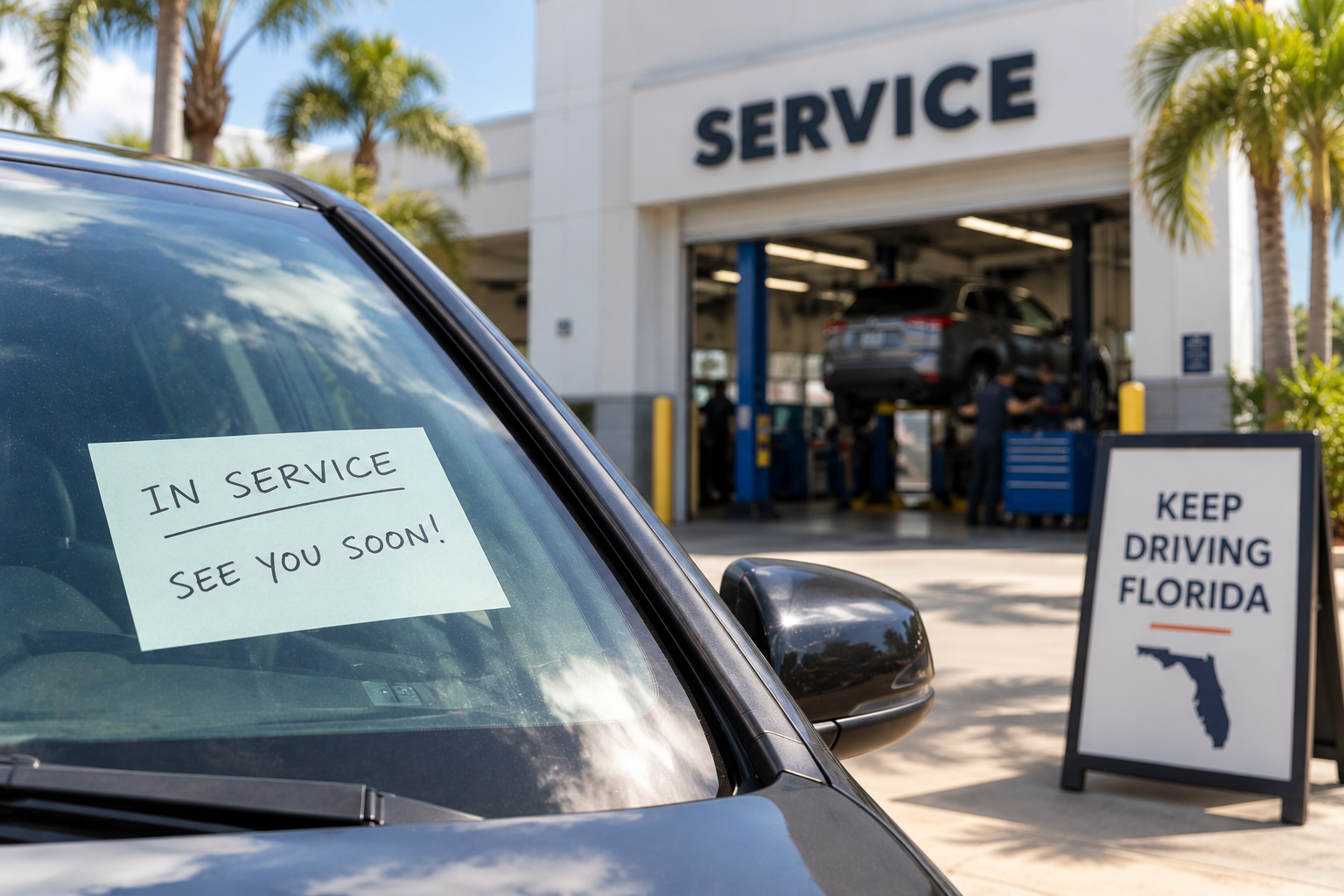
Under section 681.104(3)(b), the presumption applies when a vehicle has been out of service for repair of one or more nonconformities for a cumulative total of 30 or more days. For recreational vehicles the number is 60 days. Downtime for routine maintenance listed in the owner’s manual doesn’t count toward the total.
Two words there do a lot of work. “Cumulative” means the days don’t have to run back to back. Three separate visits of ten days each get you to the same place as one thirty-day stretch.
“Nonconformity” is defined in Fla. Stat. § 681.102 as a defect or condition that substantially impairs the use, value, or safety of the vehicle. A rattling cupholder isn’t going to qualify. A transmission that drops out of gear on I-4 is a different conversation.
The 15-day letter comes first
This is the part most articles skip. The 30-day count doesn’t stand on its own. Section 681.104(1)(b) says that once the vehicle has been out of service for repair for a cumulative total of 15 or more days, the consumer notifies the manufacturer in writing by registered or express mail.
That letter gives the manufacturer or its service agent a chance to inspect or repair the vehicle. The statute requires that the manufacturer have had at least one such opportunity after receiving the notice before the 30-day presumption kicks in.
Common trap: Notice goes to the manufacturer, not the dealership. A service advisor knowing about the problem is not the same thing as the manufacturer receiving written notice under section 681.104.
The other road: three repair attempts
The 30-day count isn’t the only path. The presumption also applies when the same nonconformity has been subject to repair at least three times, plus a final attempt by the manufacturer, and the problem still exists.
After three attempts at the same defect, written notice by registered or express mail goes to the manufacturer. The manufacturer then has 10 days to respond and offer a repair facility, and 10 more days to fix the car once it’s delivered. For recreational vehicles, that final repair window stretches to 45 days.
How the 30 days adds up: a Tampa example
Say Marisol buys a new crossover from a dealership off Dale Mabry in Tampa in January. The base sale price on her purchase invoice is $32,000. By March the transmission shudders every time she merges, and the car goes in for 12 days.
It comes back. It shudders again in May and sits for another 9 days. That puts her at 21 cumulative days, past the 15-day mark, so she sends written notice to the manufacturer by registered mail. The manufacturer arranges another look. The car goes back in during July for 11 more days and still shudders.
Marisol is now at 32 cumulative days inside the 24-month Lemon Law rights period, with the manufacturer having had a post-notice opportunity. Under section 681.104(3)(b), a reasonable number of attempts is presumed. Note what did not happen. Nobody handed her keys back on day 30 and wrote a check. The presumption is a starting position in a dispute, not an automatic refund.
How the offset math works: If a manufacturer repurchases the vehicle, the refund is the full purchase price less a reasonable offset for use. Section 681.102 sets that offset as miles driven up to the settlement or hearing, times the base price, divided by 120,000. On Marisol’s $32,000 crossover at 9,000 miles, that’s 9,000 x $32,000 / 120,000, or $2,400.
Florida’s Lemon Law rights period and the hurricane clause
All of this has to happen inside what Florida calls the Lemon Law rights period. Section 681.102 defines it as the period ending 24 months after the original delivery of the vehicle to the consumer. Not 24 months from the model year, and not from when the problem started.
Florida added something most states didn’t. The statute says the 30-day period can be extended by any time during which repair services aren’t available because of war, invasion, strike, fire, flood, or natural disaster. In a state that loses weeks of dealership service capacity to hurricanes some years, that clause earns its keep.
Other states pick their own numbers for days out of service, which is part of why advice you read online often doesn’t match what Florida actually requires. Federal law doesn’t set a day count at all. There’s no federal lemon law that forces a buyback, so the 30-day figure is purely a creature of Chapter 681.
The 3-day right to cancel a car purchase in Florida
This myth is the 30-day myth’s cousin, and it comes from a real rule that just doesn’t cover cars.
The federal cooling-off rule, 16 C.F.R. Part 429, gives buyers until midnight of the third business day to cancel certain sales. The catch is location. It applies to sales made at a home, a workplace, or a temporary spot like a hotel conference room. A permanent dealership isn’t any of those.
Florida has its own version at Fla. Stat. § 501.025, which gives a buyer the right to cancel a home solicitation sale until midnight of the third business day. Same idea, same limit. It’s aimed at the salesperson who shows up at your door, not the showroom on a Saturday.
So picture Tanya signing for a sedan at a lot in Jacksonville on a Saturday afternoon. By Monday she’s decided the payment is too high. Neither the federal rule nor section 501.025 reaches her purchase. Whether she has any way out depends entirely on what her contract says or what the dealer chooses to offer.
A return policy at a Florida dealership, when one exists at all, is a business decision written into the paperwork. It isn’t a right granted by statute.
Used car problems within 30 days in Florida
This is where a lot of Florida searches land, and the answer is narrower than people hope. Section 681.102 defines a covered motor vehicle as a new vehicle, and the definition reaches demonstrators and certain leased vehicles. The Florida Attorney General’s office puts it plainly on its vehicle coverage page. Florida’s Lemon Law applies to new or demonstrator vehicles sold or leased in the state.
An ordinary used car off an independent lot doesn’t fall under Chapter 681. Neither do motorcycles, mopeds, off-road vehicles, trucks over 10,000 pounds gross vehicle weight, or the living quarters of an RV.
So when Dwayne buys a nine-year-old sedan on Colonial Drive in Orlando and the check engine light comes on during week two, the 30-day out-of-service rule isn’t in play. What may matter instead is the federal Buyers Guide the dealer had to display, which the FTC explains in its guide to buying a used car from a dealer. That sticker says whether the car came with a warranty or was sold “as is,” and it becomes part of the sales contract.
Used car buyers in Florida aren’t without any law at all. Remaining factory warranty coverage, written dealer warranties, federal warranty law, and Florida’s deceptive trade practices statute all exist in the background. They just operate on different rules than the lemon law does.
Where Florida lemon law disputes get decided
Florida routes these cases through arbitration before court. The Attorney General’s Lemon Law Arbitration Division screens disputes and, when eligible, sends them to the Florida New Motor Vehicle Arbitration Board.
The Board is created by section 681.1095. Panels of three members hear cases in locations around the state, from Pensacola to Miami, so consumers don’t have to fly to Tallahassee. A majority vote decides the outcome, and the result is either a refund, a replacement vehicle, or a dismissal.
Timing is unforgiving. Section 681.109 requires a request for arbitration no later than 60 days after the Lemon Law rights period expires. Section 681.112 requires any civil action to be commenced within one year after that period ends, or within a year after final action by the Board. A Board decision can be appealed to circuit court within 30 days, and that appeal is a trial de novo.
Common questions about the 30-day lemon law in Florida
Is there a 30-day lemon law on used cars in Florida?
No. Chapter 681 covers new and demonstrator vehicles. The 30-day out-of-service presumption is part of that chapter, so it doesn’t extend to a standard used car purchase.
Do the 30 days have to be in a row?
No. The statute uses the word cumulative. Separate repair visits add up across the Lemon Law rights period.
Does an oil change count toward the 30 days?
The count covers days out of service by reason of repair of a nonconformity. Downtime for routine maintenance prescribed by the owner’s manual is expressly excluded. How a specific service visit gets characterized is decided case by case.
Can you return a car in Florida within three days?
Not as a general right. The federal cooling-off rule and section 501.025 both target sales made away from a seller’s permanent place of business. A dealership sale sits outside both.
What happens once the 30-day presumption applies?
Section 681.104(2) says that when a manufacturer can’t conform the vehicle after a reasonable number of attempts, it has 40 days to repurchase and refund the purchase price less a reasonable offset for use, or replace the vehicle. The statute gives the consumer an unconditional right to choose the refund over a replacement.
The bottom line on Florida’s 30-day rule
Florida’s 30-day figure is a proof standard for new vehicles that keep breaking, not a return window for cars people regret buying. It works alongside a 15-day notice requirement, a 24-month rights period, and an arbitration system run out of the Attorney General’s office.
If you want the full picture of how the statute fits together, our Florida lemon law guide in plain English covers coverage, notice, remedies, and deadlines in one place.
This article is for educational purposes only and is not legal advice. Reading it does not create an attorney-client relationship. For advice on your specific situation, consult a licensed attorney in your state.