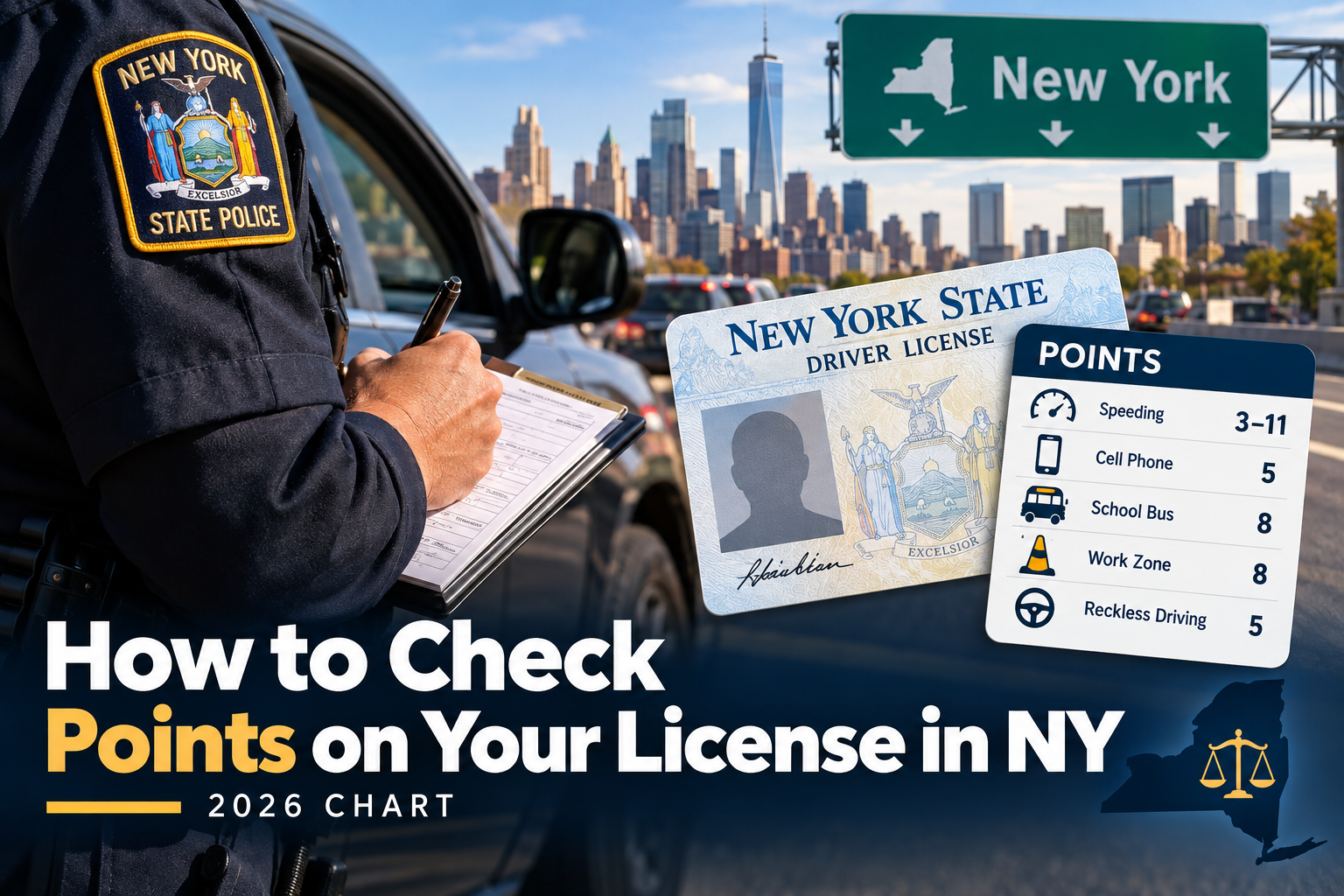
How to Check Points on Your License in NY (2026 Chart)
You got a ticket, and now two questions won’t leave you alone. How many points did it cost you, and how many points are on your license in NY right now? Both have clear answers. The catch is that New York changed its point values in February 2026, so a lot of the charts floating around online are wrong.
This guide walks through the full New York point system as it stands today, including the new 8-point violations. Then it shows how to check points on your license in NY through MyDMV and how to read the driving abstract once you have it. If you want to know how long points last, that’s covered in our separate guide on how long points stay on your New York license.
$7: the fee to download your standard New York driving abstract through MyDMV. According to the DMV, buying the abstract is how you see the points on your record. The free status screen shows whether your license is valid, not your point history.
How the NY Point System Works in 60 Seconds
The New York State DMV assigns points to moving violations. Points only land on your record after a conviction, which means a guilty plea, a guilty finding, or a paid ticket. A ticket you’re still fighting doesn’t carry points yet.
According to the DMV’s Driver Point System page, your total is built from violations that happened within the last 24 months, counted from the date of the violation and not the date you were convicted. At 11 points in that window, your license may be suspended. The point values themselves come from a DMV regulation, 15 NYCRR § 131.3, which sets a default of 2 points for any moving violation that isn’t specifically listed.
New York DMV Point Chart for 2026
These are the point values the DMV lists for violations committed on or after February 16, 2026. Speeding gets its own table because it’s the ticket most New York drivers actually get.
Speeding Points in New York
| Speeding Violation | Points |
|---|---|
| Speed not specified on the ticket | 3 |
| 1 to 10 mph over the limit | 3 |
| 11 to 20 mph over the limit | 4 |
| 21 to 30 mph over the limit | 6 |
| 31 to 40 mph over the limit | 8 |
| More than 40 mph over the limit | 11 |
| Speeding in a work zone | 8 |
Say Tony gets clocked at 72 in a 55 on the Long Island Expressway. That’s 17 over, so a conviction as charged adds 4 points. If he’d been going 76, that’s 21 over, and the same ticket jumps to 6 points. One mile per hour can move you into a new tier.
Points for Other Moving Violations
| Violation | Points |
|---|---|
| Alcohol or drug related driving (DWI, DWAI) | 11 |
| Aggravated unlicensed operation | 11 |
| Passing a stopped school bus | 8 |
| Over-height vehicle or bridge strike | 8 |
| Reckless driving | 5 |
| Cell phone or portable electronic device use, including texting | 5 |
| Railroad crossing violation | 5 |
| Failure to exercise due care | 5 |
| Leaving the scene of a personal injury accident | 5 |
| Facilitating aggravated unlicensed operation | 5 |
| Speed contests and races | 5 |
| Following too closely (tailgating) | 4 |
| Inadequate brakes | 4 |
| Red light, stop sign, or yield sign violation | 3 |
| Failure to yield the right of way | 3 |
| Improper passing, unsafe lane change, driving left of center, or wrong way | 3 |
| Leaving the scene of a property damage accident | 3 |
| Child safety restraint violation (under 16) | 3 |
| Inadequate brakes while driving an employer’s vehicle | 2 |
| Any other moving violation | 2 |
Tickets That Carry Zero Points
Some tickets cost money but add nothing to your point total. The DMV lists these as zero-point violations:
- Parking tickets
- Bicycle and pedestrian violations
- Unregistered, unlicensed, or uninsured operation violations
- Inspection, weight, size, and most equipment violations (inadequate brakes is the exception)
- Improper HOV lane use on the Long Island Expressway in Suffolk County, between exits 49 and 57
Zero points doesn’t mean zero consequences. An uninsured operation ticket carries no points, but it can still lead to fines and license trouble through other parts of the law. Points are only one of the ways the DMV tracks drivers.
The New 8-Point Violations and Other February 2026 Changes
In a January 30, 2026 memo to courts and police, the DMV announced new point values that became enforceable on February 16, 2026. Several violations went up. Some that used to carry zero points now carry a lot of them.
| Violation | Old Points | New Points |
|---|---|---|
| DWI, DWAI, and drug related driving | 0 | 11 |
| Aggravated unlicensed operation | 0 | 11 |
| Passing a stopped school bus | 5 | 8 |
| Speeding in a construction zone | Based on speed | 8 |
| Over-height vehicles and bridge strikes | 0 | 8 |
| Leaving the scene of a personal injury accident | 3 | 5 |
| Failure to exercise due care | 2 | 5 |
| Facilitating aggravated unlicensed operation | 0 | 5 |
| Speed contests and races | 0 | 5 |
The three new 8-point violations are passing a stopped school bus under Vehicle and Traffic Law § 1174, speeding in a work zone, and over-height vehicle or bridge strike violations. The bridge strike rule mostly hits trucks and moving vans that wander onto parkways like the Hutchinson River Parkway or the Southern State, where low overpasses are common.
The Violation Date Decides Which Chart Applies
The DMV memo is clear on timing. Violations committed on or before February 15, 2026 get the old point values. Violations on or after February 16, 2026 get the new ones. The court date doesn’t matter.
Say Dana drives her Ford F-150 past a stopped school bus on a street in Cheektowaga on February 10, 2026, and she’s convicted in April. That’s 5 points under the old chart. If the same thing happened on February 20, 2026, the conviction would carry 8.
How Many Points Before New York Takes Action?
Most people know about the 11-point line. Fewer know the DMV can act well before you reach it. Under 15 NYCRR § 131.4, which rests on the DMV’s suspension power in Vehicle and Traffic Law § 510, the steps look like this, all measured within 24 months:
- 4 to 6 points: the DMV may mail a warning letter about the status of your record.
- 7 to 10 points: the DMV may require you to attend a driver improvement clinic. Skipping a required clinic can lead to suspension.
- 11 or more points: the DMV may schedule a hearing where suspension or revocation is on the table.
- 9 or more points from speeding alone: this can also trigger a hearing, even if your total is under 11.
That speeding rule surprises people. Say Priya gets a ticket for 57 in a 45 on Sunrise Highway in Nassau County in March 2026, which is 4 points. In August she gets stopped doing 72 in a 50 zone in Dutchess County, which is 22 over and 6 points. Her total is 10, one short of 11. But all 10 points came from speeding, so she’s over the 9-point speeding line and the DMV may call her in.
A DMV-approved Point and Insurance Reduction Program (PIRP) course can subtract up to 4 points when the DMV calculates a suspension. The tickets and points don’t physically come off your driving record. The course also generally earns a 10 percent discount on certain insurance premiums.
How to Check Points on Your License in NY
There’s no free, official point counter in New York. The DMV’s license status page says you can see the number of points on your record “by purchasing your driving record.” That record is called an abstract, and there are three ways to get it.
Online Through MyDMV
This is the fastest route. According to the DMV’s driving record page, the process generally works like this:
- Sign in to MyDMV with your NY.gov ID, or create one. You’ll need your Client ID number, the document number from your most recent license or ID, your date of birth, the state and ZIP code on file, and the last four digits of your Social Security number.
- Choose the driving record abstract you want. Most drivers only need the Standard version. There’s also a Lifetime version and a CDL version.
- Pay the $7 fee.
- Save or print the PDF. It stays available in MyDMV for 5 days after purchase and shows your record as of the moment you ordered it.
At a DMV Office
You can also bring a completed Form MV-15C and proof of identity to a DMV office. The in-person fee is $10. If you’re renewing your license anyway, the renewal notice lets you order your record at the same time.
If You Don’t Have Your Current License
MyDMV needs the number from your most recently issued license, permit, or ID. If you don’t have it, the DMV points people to its Records Request Navigator. Those requests take about 5 business days to process.
Watch out for lookalike sites. Plenty of third-party websites promise a quick point check. They aren’t the DMV, and the DMV itself notes that even its own free “My License” screen is not an official copy of your record. The abstract is the document that lists your convictions and their points.
How to Read Your New York Driving Abstract
The part you care about is the section called Convictions and Bail Forfeitures. The DMV’s guide to reading an abstract explains that each entry shows the violation, the violation date, the conviction date, where it happened, the fine, and any points.
Here’s the part that trips people up. The DMV’s description of the abstract doesn’t mention a running 24-month total. You’ll likely need to do the math yourself by adding up the points for violations dated within the last 24 months. Older points still appear on the page even though they no longer count toward a suspension.
Example: Adding Up the Points on an Abstract
Say Marcus lives in Rochester and drives a 2019 Toyota Camry. He downloads his abstract on September 28, 2026, and sees three convictions:
- Red light violation, dated May 2024: 3 points
- Failure to yield, dated November 2025: 3 points
- Cell phone use, dated April 2026: 5 points
The abstract shows 11 points on the page. But the May 2024 violation is more than 24 months old, so it drops out of the count. Marcus’s working total is 8 points, which puts him in the 7 to 10 range where the DMV may require a driver improvement clinic.
There’s a second number to watch. The Driver Responsibility Assessment still uses an 18-month window. Marcus’s two newest tickets add up to 8 points within 18 months, and under the DMV’s formula that works out to $150 a year for three years, or $450 total, on top of his fines.
Where New York Points Come From
Points don’t come from the police officer. They come from the conviction, and New York has several places where that happens. In New York City, most moving violations go to the DMV’s Traffic Violations Bureau. In Nassau and Suffolk counties, many tickets go to county Traffic and Parking Violations Agencies. Across most of the rest of the state, town and village justice courts handle them.
Wherever the conviction happens, it’s reported to the DMV, and the point value comes from the same statewide chart. A 4-point speeding conviction in a village court in Saratoga County counts the same as one at the TVB in Brooklyn.
Tickets From New Jersey, Connecticut, and Canada
New York handles out-of-state tickets differently than many drivers expect. According to the DMV, a conviction in another state doesn’t add points to your New York record. So a speeding conviction on the Garden State Parkway or I-95 in Connecticut won’t raise your New York point total.
Canada is the exception. Because of a reciprocal agreement, convictions in Quebec and Ontario go on your New York record with the same points they’d carry here. Out-of-state tickets can still show up with your insurer, which runs its own system separate from DMV points.
Common Questions About Points on Your License in NY
How many points is a speeding ticket in NY?
It depends on how fast you were going. It’s 3 points for 1 to 10 mph over, 4 for 11 to 20, 6 for 21 to 30, 8 for 31 to 40, and 11 for more than 40 over. Speeding in a work zone is 8 points for violations on or after February 16, 2026.
Can you check points on your license in NY for free?
You can check whether your license is valid, suspended, or revoked for free in MyDMV. For the points themselves, the DMV directs drivers to buy a driving abstract, which costs $7 online or $10 at an office.
How many points does it take to lose your license in NY?
The DMV says 11 points within 24 months can lead to a suspension. You may see articles saying the number dropped to 10. The DMV’s own point system page lists 11. Remember that 9 points from speeding alone can also lead to a hearing.
Does a cell phone ticket put points on your license in NY?
Yes. A conviction for using a mobile phone or portable electronic device while driving, including texting, carries 5 points. Two of those within 24 months would put a driver at 10 points.
Do points show up on my license before I’m convicted?
No. Points are added only after a conviction or a bail forfeiture. A ticket that’s still pending, or one that gets dismissed, doesn’t add points to your record.
The Bottom Line
New York assigns points by violation, with values that jumped for several offenses on February 16, 2026. To see your own points, the DMV route is a $7 abstract through MyDMV, and you’ll add up the points dated within the last 24 months yourself. For the bigger picture on tickets across the state, see our complete guide to New York traffic tickets.
This article is for educational purposes only and is not legal advice. Reading it does not create an attorney-client relationship. For advice on your specific situation, consult a licensed attorney in your state.